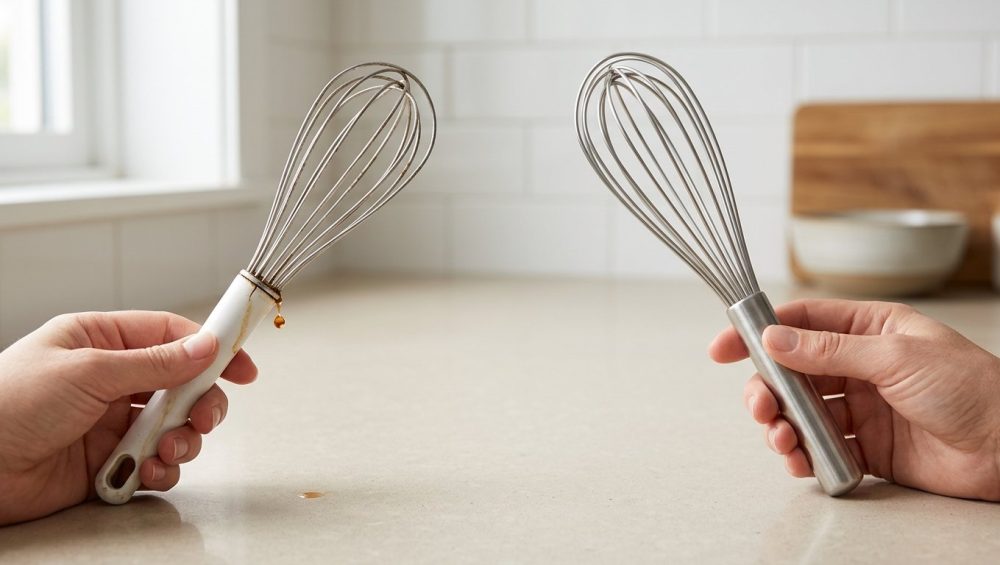
Picture this: It is a beautiful Sunday morning. You have finally carved out some precious weekend time to be a perfectionist in the kitchen. You are whipping up a flawless batch of buttermilk pancakes or perhaps a delicate hollandaise sauce. You give the mixture one final, vigorous stir, and suddenly, a rogue drop of murky, brown liquid cascades down the wire tines of your whisk and plops right into your pristine bowl.
Congratulations. You have just seasoned your gorgeous weekend breakfast with three-day-old, bacteria-laden dishwater.
If you are wondering why your scrambled eggs leak water or suddenly taste a bit metallic, that seemingly innocent kitchen tool might just be the culprit. As a home cook who learned the hard way—by setting off smoke detectors and ruining perfectly good meals—I have zero patience for kitchen gear that actively sabotages my food. We survive the weekday grind by using clever, time-saving cooking hacks, and we certainly do not have the time or the money to throw away a ruined batch of food because a cheap piece of metal decided to leak garbage juice into our mixing bowl.
Today, we are going to talk about the absolute worst offender in your utensil drawer: the unsealed, hollow-handled wire whisk. I despise cheap, toxic kitchenware with a fiery passion, and the standard grocery-store whisk is public enemy number one. We are going to break down the gross science of why your whisk leaks, what is actually brewing inside that handle, and exactly what professional-grade, watertight tools you need to buy instead.
The Hidden Horror in Your Utensil Drawer
Let us get one thing straight: anyone can cook like an absolute expert and make mind-blowing food without a culinary degree. But you cannot do it if your tools are secretly harboring biological warfare.
When you buy a standard, budget-friendly whisk from a big-box store, you are usually buying a hollow metal tube with a bunch of wire tines shoved into the end. To hold those tines in place, the manufacturer squirts in a dollop of cheap industrial glue or epoxy, and then they crimp or roll the metal handle shut. On day one, it looks shiny and perfectly functional. But after a few weeks of heavy use and repeated trips through the dishwasher, that cheap seal begins to degrade.
The moment that seal cracks—even microscopically—your whisk transforms from a helpful baking tool into a Trojan horse for dirty sink water. It is a sneaky flaw, much like why your non-stick pans keep losing their slip without you realizing it. You wash the whisk, put it away in the drawer, and think nothing of it. But the next time you use it, the physical force of your whipping motion combined with the warmth of your hand forces that trapped liquid out.
The Moment of Culinary Betrayal
There is nothing quite as soul-crushing as watching a drop of rusty water fall into a bowl of perfectly whipped egg whites. Because egg whites require absolute purity to hold their structure, even a single drop of grease or impure water will cause them to collapse. When you have to rescue a ruined dinner because your own equipment betrayed you, it is enough to make you want to order takeout for the rest of your life.
But it is not just about ruined meringue. It is about hygiene. The liquid that leaks out of your whisk is not just water; it is a fermented cocktail of old soap, dissolved food particles, and oxidized metal. It is exactly the kind of toxic, mystery-metal nonsense that I actively warn my readers against. If you want to elevate your cooking, the very first step is eliminating the tools that are secretly poisoning your food.
Anatomy of a Cheap Whisk (And Why It Fails)
To understand why this happens, we need to look at the basic anatomy and thermodynamics of cheap kitchenware. Yes, we are doing science today, because understanding the “why” is how you become a smarter, faster cook.
The “Breathing” Handle Phenomenon
When you toss your cheap whisk into the dishwasher, it undergoes a brutal cycle of extreme heat and cooling. During the main wash and heated dry cycles, the air trapped inside the hollow metal handle expands. Because the cheap epoxy seal at the base of the tines has likely cracked from the stress of whisking, that expanded air pushes its way out.
Then comes the cool-down phase. As the metal handle cools, the air inside contracts. This contraction creates a literal vacuum inside the handle. If the base of the whisk is sitting in a puddle of dirty, food-speckled water at the bottom of the dishwasher basket, that vacuum will suck the dirty water straight up into the hollow handle.
It is simple physics, but the result is disgusting. Just like when you wonder why your silicone spatulas taste like soap after a dishwasher run, your whisk is absorbing the worst elements of your wash cycle.
The Mystery Metal Inside
Here is the kicker: while the outside of your cheap whisk might be polished to look like high-quality stainless steel, the inside of that hollow handle is almost never finished or treated. It is raw, exposed, cheap metal.
When the trapped dishwater sits inside that dark, damp, untreated metal cavern for days on end, it immediately begins to rust. The water mixes with the rust, creating that signature brown sludge that eventually leaks into your food. It’s the same infuriating realization you have when your wooden spoons keep cracking after a few cycles in the wash; manufacturers cut corners on the parts you cannot easily see.
The Bacteria Breeding Ground: What Is Actually in That Water?
I have a strict “no-go” rule when it comes to toxic gear in the kitchen. I do not tolerate peeling non-stick coatings, I do not tolerate mystery metals that leach chemicals, and I absolutely do not tolerate tools that harbor bacterial colonies.
When dishwater gets sucked into your whisk handle, it brings along microscopic food particles from everything else in your dishwasher. Raw chicken juice from your cutting board? Yep. Bits of dried egg yolk? You bet.
Inside the handle, these particles sit in a warm, dark, moist environment—the literal definition of an incubator. Bacteria thrive in these conditions. By the time you pull that whisk out of the drawer three days later to whip up some cream, that trapped water is a thriving bacterial soup. You wouldn’t accept it if your plastic containers stay greasy after washing, so why on earth would you accept a whisk that holds onto dirty, contaminated water?
The Smell Test
If you want to know if your current whisk is guilty of this, go to your drawer right now. Pick up your wire whisk and give it a hard shake next to your ear. Do you hear a faint rattling or sloshing sound? Now, smell the base where the wires meet the handle. If it smells like old pennies, mildew, or sour dish soap, throw it in the trash immediately. Do not pass go. Do not try to bleach it. Throw it away.
The NSF Standard: What Professional Kitchens Know That You Don’t
If you have ever worked in a commercial kitchen—or just peeked into the open kitchen of a nice restaurant—you will notice that their tools look a bit different than the ones at the local home goods store. That is because professional kitchens are bound by strict health codes, and their equipment must be certified by the NSF (National Sanitation Foundation).
What Is NSF/ANSI 2 Certification?
The NSF is an independent organization that develops public health standards and certification programs to protect the world’s food, water, and consumer products. Specifically, the NSF/ANSI 2 standard covers the minimum food protection and sanitation requirements for the materials, design, and construction of food handling equipment.
For a kitchen tool to earn an NSF certification mark, it must meet rigorous criteria:
- Smooth Angles and No Crevices: The tool cannot have any cracks, seams, or unsealed hollow areas where bacteria can hide and multiply.
- Material Safety: The materials used must be non-toxic, non-porous, and resistant to corrosion and rust.
- Cleanability: The item must be able to withstand commercial dishwashers and harsh sanitizing chemicals without degrading.
Why Pro Chefs Laugh at Your Rolled-Handle Whisk
If a health inspector walks into a restaurant and sees a chef using a cheap, rolled-metal whisk with a cracked epoxy seal, they will flag it as a critical health violation. Professional kitchens literally cannot use the gear that is heavily marketed to home cooks because it is fundamentally unsanitary.
I firmly believe that professional-level results are achievable in a standard home kitchen, but you have to level the playing field by using professional-grade tools. You do not need to spend a fortune, but you do need to buy smart. Buying an NSF-certified whisk means you are getting a tool that has been scientifically proven to be watertight, rust-proof, and completely sanitary. It is almost as tragic as when your mashed potatoes are gluey because you used the wrong tool; using the wrong whisk is a completely avoidable disaster.
The Ultimate Upgrade: Seamless Stainless Steel and Watertight Wonders
Alright, we have established that your current whisk is probably a biohazard. Now, let us talk about the solution. To ensure you never have a dishwater-leak incident again, you need to invest in a whisk that is either completely seamless or hermetically sealed.
There are three main categories of safe, pro-grade whisks that I actually recommend. They are durable, they offer real value, and they will outlive you.
Fully Seamless 18/8 Stainless Steel Whisks
The gold standard of kitchen hygiene is the fully seamless stainless steel whisk. Instead of a hollow tube with wires glued inside, these whisks are manufactured so that the handle and the wires are completely integrated. Often, the handle is a solid, weighted piece of steel, and the wires are laser-welded directly into it, leaving absolutely zero gaps, cracks, or seams.
Why They Are Brilliant:
Because there is no hollow cavity, there is nowhere for water to hide. You can leave this whisk at the bottom of a running dishwasher for a week, and it will come out perfectly pristine. Furthermore, high-quality versions are made from 18/8 or 18/10 stainless steel. This metallurgy jargon simply means the steel contains 18% chromium and 8% (or 10%) nickel, which makes it highly resistant to rust and corrosion.
The Sassy Sous-Chef Recommendation:
Look for brands that advertise “one-piece construction” or “fully welded seams.” They are slightly heavier than hollow whisks, but that weight actually gives you better balance and control when you are furiously whipping heavy cream. It’s the same chemical betrayal as when your pesto turns brown before your guests arrive; don’t let a cheap tool ruin your hard work.
Hermetically Sealed Professional Handles (Nylon and Exoglass)
If you find solid stainless steel handles to be too heavy or slippery when your hands are covered in butter (no judgment, we’ve all been there), your next best option is a commercial whisk with a hermetically sealed composite handle.
Brands like Vollrath (specifically their Jacob’s Pride line) and Matfer Bourgeat dominate this space. These whisks feature heavy-gauge stainless steel wires that are heat-molded or permanently fused into a solid handle made of high-tech materials like nylon or Exoglass.
Why They Are Brilliant:
The seal on these whisks is virtually indestructible. Because the wires are molded directly into the composite material while it is hot, the material cools and shrinks around the wires, creating a 100% watertight, NSF-certified barrier. The handles are often heat-resistant up to 430°F, meaning you can leave them resting on the edge of a hot saucepan without them melting into your béchamel. Plus, the slightly textured grip is a lifesaver when you are working fast on a busy weeknight.
The Sassy Sous-Chef Recommendation:
The Matfer Bourgeat Exoglass French Whisk or the Vollrath nylon-handled French whip are absolute workhorses. They are the exact tools used in Michelin-starred kitchens, and they cost less than twenty bucks. That is the definition of high value. Instead of turning burnt bits into sauce, you’re just adding a splash of rusty sink water to your pan if you use the wrong whisk. Upgrade to Exoglass and never look back.
Platinum Silicone Overmolded Whisks
For those of you who frequently cook in expensive enameled cast iron or non-stick pans, you know that a metal whisk is a death sentence for your cookware’s finish. You need a silicone whisk. But beware: cheap silicone whisks suffer from the exact same unsealed handle problem as cheap metal ones.
The solution is a platinum silicone overmolded whisk. This is where the core of the whisk (usually stainless steel or fiberglass) is completely encased in one continuous, seamless layer of high-grade silicone.
Why They Are Brilliant:
There are no joints. There are no seams. The handle and the tines are one unified, smooth surface. Water cannot penetrate it because there is literally no entry point. Furthermore, high-quality platinum silicone is heat resistant up to 550°F and will not degrade, crack, or absorb funky odors over time.
The Sassy Sous-Chef Recommendation:
Brands like GIR (Get It Right) make phenomenal seamless silicone whisks. They are sturdy enough to tackle thick batters but gentle enough to protect your expensive Dutch ovens. If you stop eating mushy veggies and demand better cooking techniques, you should demand better gear that protects your investments.
How to Shop for a Whisk That Won’t Poison Your Pancakes
When you are standing in the kitchen supply aisle or browsing online, it can be tricky to tell the difference between a high-quality watertight whisk and a cheap imposter. Here is my rigorous, no-nonsense checklist for buying a whisk that won’t leak dishwater.
The Water Drop Test for Seams
If you are inspecting a whisk in person, look closely at the point where the wire tines enter the handle. If you see a visible gap, a ring of dried glue, or a piece of metal that looks folded or crimped over the wires, put it down. A true watertight whisk will have a transition that looks completely flush and seamless. If you can slide the edge of your fingernail into the gap where the wires meet the handle, water can get in there too.
Hunt for the NSF Logo
This is the ultimate cheat code for buying kitchenware. Look for the little circular NSF logo stamped onto the handle or printed on the packaging. If a whisk has this certification, it means an independent, rigorous public health organization has tested it and verified that it will not harbor bacteria or trap water. It takes all the guesswork out of the equation.
Wire Gauge and Tension
While you are upgrading for hygiene, you might as well upgrade for performance. Cheap whisks use thin, flimsy wires that bend out of shape the moment you try to mix a thick brownie batter. Look for whisks made with heavy-gauge 18/8 stainless steel wires. Press the whisk down against your palm; the wires should offer significant resistance and spring back immediately.
Choose the Right Shape for the Job
Since time is money, especially on a Tuesday evening when you are trying to get dinner on the table, you need the right tool for the job.
- The French Whip: This whisk has a narrower, more elongated profile with thicker wires. It is the ultimate multi-tasker. It is perfect for stirring thick sauces, scraping the corners of a saucepan, and mixing heavy batters. If you only buy one whisk, make it a French whip.
- The Balloon Whisk: This is the classic, bulbous whisk with thinner wires. Its wide shape is designed to incorporate maximum air into liquids. Keep this one reserved for your elaborate weekend baking projects: whipping heavy cream, beating egg whites for meringues, or making a fluffy soufflé.
- The Flat Whisk (Roux Whisk): The wires on this whisk lie flat in a single plane. It is an absolute lifesaver for making gravy or roux in a shallow skillet, as it allows you to scrape the bottom of the pan efficiently without splashing.
Care and Maintenance for Your New Watertight Whisk
Once you have invested in a high-quality, seamless, or NSF-certified whisk, you want to treat it right. Even the best gear in the world will suffer if you abuse it.
The Dishwasher Debate
Can you put your new seamless stainless steel or Exoglass whisk in the dishwasher? Absolutely. That is the entire point of buying a fully sealed, watertight tool. The NSF certification guarantees that it can withstand the extreme temperatures and harsh detergents of a commercial dishwashing cycle.
However, just because it can go in the dishwasher doesn’t mean you should leave it sitting dirty in the sink for three days.
The “Wash It Now” Rule
The wires of a whisk are notorious for trapping sticky, starchy, or protein-rich foods. If you leave pancake batter or egg yolks to dry on the tines of your whisk, they will cement themselves to the metal. By the time you finally run the dishwasher, the machine will likely fail to blast off the hardened debris.
My rule for weeknight efficiency? The moment you are done whisking, take three seconds to rinse the whisk under hot running water. If you rinse it while the food is still wet, it cleans perfectly in seconds. Then, you can toss it in the dishwasher for a final sanitizing cycle without worrying about cemented-on food.
Never Soak Wooden Handles
While we are on the subject of care, a quick public service announcement: if you own a whisk with a beautiful, artisanal wooden handle, keep it far, far away from the dishwasher and the soaking sink. Wood is incredibly porous. If you submerge it in water, the wood will swell, warping the seal where the wires enter the handle. When it dries, the wood shrinks and cracks, leaving massive gaps for bacteria to enter. Wooden-handled whisks are strictly hand-wash only, and they should be dried immediately with a towel.
The Economics of Buying Quality
I know that spending $15 to $25 on a professional-grade whisk might seem silly when the grocery store sells one for $4.99. But let us look at the real economics of the kitchen.
That $4.99 whisk is going to leak rusty water into your food within six months. It will ruin a $10 batch of premium ingredients. You will throw it away in frustration and buy another $4.99 whisk. Over five years, you will have spent $30 on cheap whisks and ruined several meals in the process.
Alternatively, you can spend $18 once on an NSF-certified Matfer Bourgeat Exoglass whisk or a fully welded Best Manufacturers French whip. It will never leak. It will never rust. It will never bend out of shape. It will literally outlive you. You will pass it down to your children, and they will use it to whisk their own perfectly safe, non-toxic pancakes.
That is the core philosophy I try to hammer home. You do not need a kitchen full of expensive gadgets, but the tools you do use every single day must be flawless. You deserve equipment that works as hard as you do, especially when you are trying to get a weeknight dinner on the table efficiently.
Final Thoughts from the Sassy Sous-Chef
Cooking should be a joy, not an exercise in hazard avoidance. You have enough to worry about—timing the side dishes, not overcooking the protein, keeping the kids out of the hot oven—without having to second-guess the structural integrity of your whisk.
So, do yourself a massive favor today. March into your kitchen, open that utensil drawer, and give your current whisk the shake test. If it rattles, if it smells, or if you can see a terrifying crust of old epoxy peeling away from the handle, show it no mercy. Toss it in the garbage.
Upgrade to a seamless stainless steel or hermetically sealed professional whisk. Your egg whites will thank you, your hollandaise will be flawless, and most importantly, you will never have to eat rusty dishwater again. Now, pour yourself that glass of wine, get back to the stove, and cook something spectacular. You’ve got this.