Picture this: It is a Friday evening. You have survived the emails, the meetings, and the commute. You have poured yourself a generous glass of wine, and you are ready to sear a beautiful, expensive steak to kick off the weekend. You place your shiny frying pan on the stove, turn on the heat, and pour in a tablespoon of high-quality cooking oil.
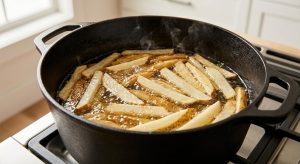
But instead of coating the bottom of the pan in a beautiful, even, shimmering layer, the oil immediately betrays you. It races away from the center, pooling into a deep, greasy moat around the outer edges of the skillet. The center of your pan is left completely bone-dry.
You sigh, grab the handle, and try to swirl the oil back into the middle, but as soon as you touch it, the entire pan spins like a top on your glass stove. It wobbles. It rocks. It refuses to sit flat. You throw the steak in anyway, and the result is entirely predictable: the center of the meat burns violently against the dry metal, while the edges boil sadly in the pooled oil, resulting in a gray, rubbery mess.
Welcome to the infuriating world of warped cookware. It is a completely avoidable kitchen disaster, and it is the secret culprit behind those unevenly cooked meals that are ruining your dinners.
As a home cook who has made every mistake in the book (and set off the smoke detector more times than I care to admit), I am here to tell you that you do not need a culinary degree to fix this. You just need to understand a little bit of basic physics. Today, we are going to dive deep into the science of why your frying pans keep bending out of shape, why cheap cookware is a scam, and exactly how you can manage your stovetop temperatures to ensure your skillets stay dead-flat for a lifetime of perfect searing.
The Science of the Wobble: Understanding Thermal Shock and Metal Expansion
To understand why your pan looks like a metal potato chip, we have to take a brief detour into the world of thermodynamics and metallurgy. Do not panic—I promise to keep the pretentious chef-speak out of this, but we do need to talk about atoms.
According to the fundamental principles of thermodynamics, when metals—whether they are cast iron, aluminum, or stainless steel—heat up, their atomic structures physically expand. When they cool down, they contract. This is an inescapable law of physics.
If you could somehow heat every single microscopic atom of your frying pan at the exact same millisecond to the exact same temperature, the pan would simply grow slightly larger in all directions without losing its shape. But in the real world of weekend cooking, heat is never applied perfectly evenly.
When you place a pan on a burner, the heat hits the bottom base first. The base gets hot and wants to expand outward. However, the base is attached to the walls of the pan. The walls, which are exposed to the ambient air of your kitchen, are still relatively cold and rigid.
This brings us to the “knee” of the pan—the curved transition area where the flat base ascends into the vertical wall. The knee acts as a structural containment ring, providing rigidity to the cookware. Because the cold walls refuse to expand, the expanding metal of the base has nowhere to go horizontally. It is trapped. Therefore, the immense microscopic stress forces the metal to seek the path of least resistance: it buckles vertically.
If the base buckles downward, you get a “cupped” or concave pan that wobbles endlessly on a flat surface. If the base buckles upward, you get a “crowned” or convex pan, which creates that dreaded moat where all your cooking oil pools at the edges.
This structural failure is exponentially worsened by a phenomenon known as “Thermal Shock”. Thermal shock occurs when a rapid, violent change in temperature forces the metal to expand or contract much faster than its crystalline structure can handle. When the temperature differential between the inside and outside of the metal is too extreme, the stress physically tears and permanently alters the shape of the pan.
The Three Deadly Sins of Temperature Management
If your pans are constantly warping, I say this with all the love and snark in my heart: it is probably your fault. Home cooks routinely commit three cardinal sins of temperature management that send their cookware to an early grave. Let’s break them down so you can stop doing them immediately.
Sin #1: The Cold Water Plunge (The Sizzle of Death)
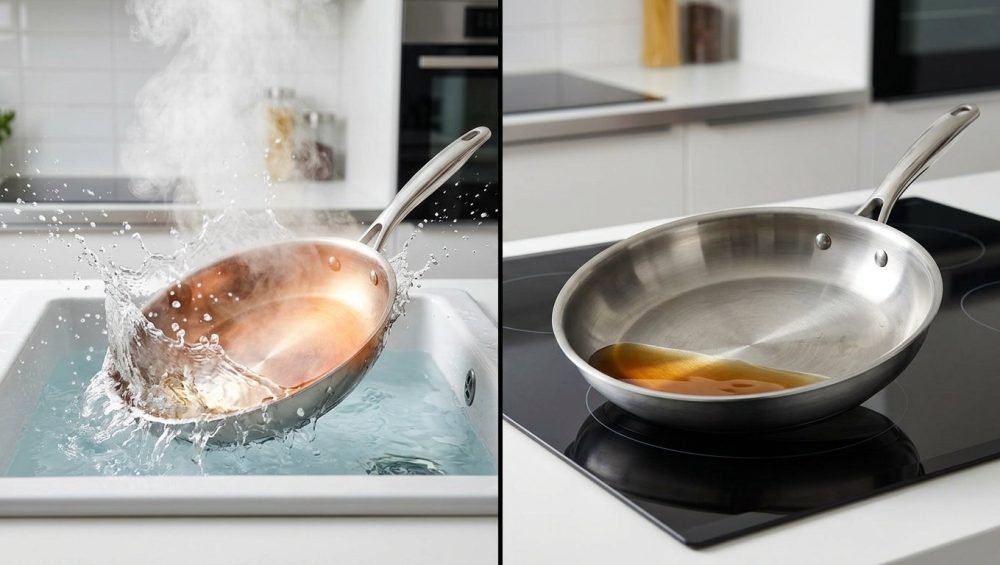
We have all been there. You just finished pan-searing a gorgeous batch of chicken thighs. The pan is sitting on the stove at a blistering 500°F, covered in sticky, caramelized fond. You want to get a head start on the dishes, so you carry the screaming-hot skillet directly to the sink and plunge it under the cold water tap.
Sizzle. A massive cloud of steam erupts into your face.
You might think you are being a highly efficient, time-saving weekday warrior. In reality, you are committing first-degree cookware murder. When that cold water hits the 500°F metal, it cools the exterior surface of the pan almost instantly. This sudden temperature plummet causes the exterior surface of the metal to shrink violently while the interior core is still expanded.
This uneven contraction creates immense torque that rips the metal’s structure apart, permanently bowing the base. It is the exact same brutal thermodynamic physics behind why your favorite glass baking dish shattered when you absentmindedly set it on a wet countertop. Never, ever wash a hot pan in cold water.
Sin #2: Blasting High Heat on a Cold Pan
I completely understand that when you get home at 6:00 PM, you want dinner on the table by 6:30 PM. Time is money, and patience is in short supply. But taking a cold frying pan out of the cabinet, throwing it on the stove, and immediately cranking the burner dial to “High” is a guaranteed way to destroy your gear.
When you blast a cold pan with maximum heat, the burner aggressively attacks the dead center of the base. The center heats up and expands in mere milliseconds, while the outer edges and the sidewalls remain at room temperature.
Because the center is expanding rapidly against the rigid, cold outer ring, the metal has no choice but to warp to relieve the stress. This massive thermal torque buckles the metal instantly. It is the exact same concept behind why thin, cheap baking sheets warp with a terrifying ‘pop’ sound the second you put them in a 425-degree oven.
Sin #3: Mismatched Burner Sizes
This sin is a matter of simple geometry. If you place a massive 12-inch skillet on a tiny 6-inch burner, you are asking for trouble. The small burner pumps concentrated, intense heat directly into the center of the pan, completely neglecting the outer edges.
The center of the cookware expands rapidly, while the outer three inches of the base remain completely cold and unyielding. The center pushes upward against the rigid outer boundary, creating a permanent, raised dome in the middle of your skillet. It is a fundamental mismatch of tools. Just like using a dull blade on a rock-hard bamboo surface is ruining your knives, using a tiny burner on a massive pan will permanently destroy the structural integrity of the metal. Always match the diameter of your pan’s base to the diameter of your burner.
The Flat-Top and Induction Dilemma
If you cook on a traditional gas stove, you have a bit of a safety net. Gas flames lick up the sides of the pan, providing a somewhat gentle, enveloping heat that warms the walls alongside the base. Furthermore, the heavy cast-iron grates of a gas stove can easily accommodate a pan with a slight wobble. You might not even notice your pan is warped on a gas stove.
But welcome to the modern era, where sleek, glass flat-top electric and induction stoves rule the kitchen. These stoves are ruthless interrogators of your cookware’s quality. Because the glass surface is perfectly flat, even a millimeter of warping becomes immediately, painfully obvious.
Induction stoves, in particular, are notorious pan-killers. Induction is a miracle of modern culinary science; instead of heating the air, it uses electromagnetic fields to heat the metal of the pan directly. It is incredibly fast and highly efficient. However, a high-quality commercial induction hob can dump up to 5000 watts of raw power into a pan base instantly.
If you apply that kind of brute force to a cold pan, the atoms in the base vibrate so violently and heat so rapidly that thermal shock is practically guaranteed.
When an induction pan warps and bows outward (becoming convex), it triggers a dangerous phenomenon known as the “Spinner Effect”. The pan turns into a rocker that spins freely on the smooth glass surface. You go to flip a delicate piece of fish, and the entire pan rotates 180 degrees. In a busy kitchen, a spinning pan is a massive safety hazard that can easily result in 400-degree oil splashing onto your arms.
Furthermore, induction relies on a magnetic link between the stove and the pan. If the base of the pan bows away from the glass, it increases the vertical distance between the magnetic coil and the metal. While a minor warp might still cook, a severe warp breaks the magnetic connection entirely, rendering the pan completely useless on an induction hob.
The Metal Matters: Why Cheap Pans Die Young (And Why I Hate Them)
Let’s get something straight: I absolutely despise cheap, toxic kitchenware. I have zero patience for mystery metals, flimsy stamped aluminum, and peeling synthetic coatings. You cannot expect professional-level results if you are cooking on a $12 pan you bought in the impulse aisle of the grocery store.
The method of manufacture plays a massive role in whether a pan will survive your kitchen. Cheap pans are often “stamped”—meaning a flat sheet of thin metal is forcefully punched into the shape of a pan by a giant machine. This process aggressively stretches the metal at the “knee” of the pan, creating inherent structural weaknesses that make it highly susceptible to warping the moment it touches heat.
Once a cheap pan warps, the synthetic coating is subjected to intense mechanical stress, causing it to micro-crack. We already know that aerosol ruins nonstick pans by baking into an impossible-to-remove lacquer, but a warped base accelerates the physical death of the pan by literally snapping the coating off the metal.
If you want a pan that stays flat, you have to look at the “gauge,” or the thickness of the metal. Thickness is the ultimate defense against thermal shock. A high-quality, general-purpose frying pan should have a base thickness of roughly 3 to 5 millimeters. The sidewalls can be slightly thinner (around 1.5 to 2.5 millimeters) to keep the pan from being too heavy to lift, but the base must be substantial.
A thick base acts as a thermal buffer. It absorbs the harsh, direct heat of the burner and gives the metal time to spread that heat evenly across the entire surface before it reaches your food. Pans with a base thinner than 2.5 millimeters are practically guaranteed to develop hot spots and warp under stress.
This is why I constantly preach the gospel of fully-clad (tri-ply or 5-ply) stainless steel cookware. Cladding is an engineering marvel that sandwiches a highly conductive core (like thick aluminum or copper) between durable layers of stainless steel. This unified, multi-layered structure distributes heat laterally, pulling the thermal energy away from the center of the base and pushing it up the sidewalls. This relieves the stress on the bottom of the pan and prevents warping.
If you are serious about upgrading your weekend culinary projects and making food that actually tastes good, you need to start banishing toxic kitchen gear from your cabinets immediately. Invest in heavy-gauge carbon steel, thick cast iron, or premium multi-clad stainless steel. Buy it once, treat it right, and you will never have to deal with a spinning pan again.
How to Stop Warping Your Cookware (The Sassy Sous-Chef’s Rules)
Alright, you have finally invested in a gorgeous, thick-gauge, high-quality skillet. How do we keep it looking and performing flawlessly? It all comes down to respecting the heat. Follow these strict rules, and your pans will outlive you.
Rule #1: The Gradual Preheat
I do not care how hungry you are; you must preheat your pans gradually. Never put a cold pan on a burner set to “High”. Place your pan on the stove and turn the burner to low or medium-low. Let it sit there for two to three minutes. Let the metal wake up. Let the heat spread evenly across the base.
If you need a hard sear for a steak, you can slowly increase the heat to medium-high after the pan has thoroughly warmed up. How do you know when a stainless steel skillet is properly preheated and ready for oil? You wait patiently until it perfectly passes the water drop test, where a bead of water glides across the surface like a bead of mercury. Only then do you add your oil and your food.
Rule #2: Let It Cool Naturally
When you are done cooking, remove the pan from the hot burner and set it on a cool burner, a wooden cutting board, or a heat-safe trivet. Walk away. Go eat your dinner. Let the pan cool down naturally to room temperature.
If you have stubborn, stuck-on fond that you want to remove, you can deglaze the pan with a splash of warm water or broth while the pan is still on the stove cooking, but you must never submerge a hot pan in a sink full of cold water. Even your indestructible, heavy-duty cast iron skillet needs to cool down to room temperature before you go at it with a chainmail scrubber in the sink. Patience is not just a virtue; it is a requirement for cookware maintenance.
Rule #3: Match the Burner to the Pan
As we discussed earlier, do not put a 12-inch pan on a 6-inch burner. If you absolutely must use a smaller burner for a larger pan due to limited stove space, you have to preheat the pan excruciatingly slowly. Give the thick conductive core time to move the heat from the center out to the edges before you start cooking.
Can You Actually Fix a Warped Pan?
I get this question in my inbox constantly: “I warped my expensive pan, how do I hammer it flat?”
I am going to give you the brutal, honest truth: In most cases, you can’t.
When a pan warps, the crystalline structure of the metal has undergone permanent plastic deformation. The metal has physically stretched and changed its shape at a molecular level.
If you have a warped multi-clad stainless steel pan or an aluminum pan with a non-stick coating, it is game over. If you take a hammer to a multi-clad pan, you risk shearing the delicate bonds between the layers of steel and aluminum, causing the pan to delaminate and separate. If you hammer a non-stick pan, you will instantly shatter and flake the toxic coating into your food.
If you have a cheap cast iron skillet that you have somehow managed to warp (which takes serious, dedicated effort, by the way), trying to hammer it flat will just crack it in half. Not to mention, overheating cast iron unevenly can burn off your hard-earned polymerized seasoning until it leaves black specks all over your morning eggs.
Now, if you have a solid carbon steel pan or a thick, single-ply commercial aluminum pan, there are some… aggressive, last-resort methods you can try.
In the commercial shipbuilding industry, welders fix warped steel plates by heating the metal to a dull red and rapidly quenching it with wet cloths, which shrinks the metal back into place. I highly advise against trying this in your home kitchen unless you are fond of third-degree steam burns and structural fires.
A slightly safer method for carbon steel involves placing the pan upside down, heating it gently in the oven to about 200°F (to make the metal slightly more pliable), placing a wooden 2×4 block over the warped bulge, and whacking it aggressively with a heavy rubber mallet. The wood distributes the force of the blow and prevents you from denting the steel.
But honestly? Even if you manage to beat it somewhat flat, the metal’s memory has been altered. It will likely just warp again the next time it gets too hot.
If your food constantly sticks to your stainless steel because the cooking oil is pooled around the outer edges leaving the center bone-dry, just accept the loss. Throw the warped pan in the recycling bin, buy a high-quality, thick-gauge replacement, and promise yourself that you will treat it right this time.
The Bottom Line
Cooking is not just about blindly following a list of ingredients; it is about understanding your tools and working with the laws of physics rather than against them. You do not need to be a Michelin-starred chef to master temperature control, but you do need to slow down.
Stop treating your stovetop like a drag race. Stop blasting thin metal with high heat, and stop torturing your hot skillets with ice-cold water. Give your pans the time they need to heat up gradually, match your burner sizes correctly, and invest in heavy, high-quality gear that can actually withstand the rigors of a busy kitchen. If you show your cookware a little respect, it will reward you with perfect sears, even heat distribution, and a lifetime of reliable service. Now, go pour yourself another glass of wine, turn that burner to medium-low, and let’s get cooking.