You are standing at your kitchen island, mascara running down your face, eyes burning with the intensity of a thousand tiny suns, blindly wiping your tears with the back of a garlic-scented hand. You are only halfway through dicing a single yellow onion for your Tuesday night chili, and you are already questioning every life choice that led you to this moment. You briefly consider ordering takeout, throwing the entire cutting board into the trash, or permanently adopting a diet that strictly consists of pre-packaged foods.
We have all been there. The dreaded onion weep is a universally despised kitchen bottleneck. It is the reason home cooks dread meal prep and the reason the internet is absolutely flooded with ridiculous, borderline humiliating “hacks” to stop the tears. I have seen weekend culinary hobbyists wearing literal swimming goggles in their own homes. I have seen people chewing on massive wads of gum, holding unlit matches in their teeth, or balancing a piece of bread on their lips like a golden retriever waiting for a command.
It is time to stop the madness. You do not need a scuba mask to make dinner. You do not need a culinary degree, and you certainly do not need to rely on silly internet folklore. What you need is a basic understanding of plant biology, a healthy respect for the physics of a cutting edge, and a commitment to gathering the essential tools for new cooks that actually work.
The brutal, unvarnished truth is this: the onion is not the problem. Your dull, neglected, factory-stamped knife is the problem.
In this definitive masterclass, we are going to dive deep into the fascinating microscopic warfare happening on your cutting board. We are going to connect the physical irritation of chopping alliums directly to your tool maintenance, proving once and for all that a razor-sharp knife is not just a tool for professional chefs—it is your ultimate culinary defense.
The Biology of the Tear-Jerker: What Actually Happens Inside an Onion
To understand why you are crying, we first have to understand what an onion actually is. Allium cepa (the common onion) is a bulb that grows underground. Because it spends its life buried in the dirt, it is highly vulnerable to hungry herbivores, burrowing insects, and ground-dwelling voles. Because the onion cannot run away, it has evolved a highly sophisticated, binary chemical weapon system to defend itself.
When an onion is sitting whole and undisturbed on your counter, it is completely harmless. The chemical weapons are kept strictly separated inside the plant’s rigid, microscopic cell walls. Each individual onion cell contains a central vacuole filled with an enzyme called alliinase, while the surrounding cytoplasm contains amino acid sulfoxides. As long as the cell remains intact, these two compounds never meet.
But the moment you breach that cell wall—whether you are a hungry vole taking a bite or a home cook dragging a blade through the bulb—the cell ruptures. The internal compartments break open, and the alliinase enzyme violently crashes into the amino acid sulfoxides.
This collision instantly breaks down the amino acid sulfoxides into unstable sulfenic acids. For decades, scientists believed that this reaction alone was responsible for the tears. However, in 2002, a team of Japanese researchers at the Somatech Center at House Foods Corp. in Chiba, Japan, published a groundbreaking study in the journal Nature. They discovered a previously overlooked, secondary enzyme that they named lachrymatory-factor synthase (LFS).
Here is where the real magic (and the misery) happens. The newly discovered LFS enzyme aggressively sweeps in and converts those unstable sulfenic acids into a highly volatile sulfur gas known as syn-propanethial-S-oxide.
Because syn-propanethial-S-oxide is a volatile liquid-turned-gas, it immediately vaporizes and floats upward from your cutting board. It diffuses through the air until it makes contact with the watery, protective layer of your eyes. When this specific sulfur gas mixes with the basal tears on your cornea, it creates a microscopic amount of sulfuric acid.
The delicate nerves in your cornea immediately detect this acidic attack and send a panic signal to your central nervous system. Your brain responds by triggering your lachrymal glands to flush the irritant away with a massive flood of reflex tears.
You are not crying because you are sad. You are crying because you have triggered a botanical landmine, and your eyes are desperately trying to dilute a cloud of airborne sulfuric acid.
The Anatomy of a Cut: Slicing vs. Crushing
Now that we understand the chemical payload inside the onion, we have to look at the delivery mechanism. Why does one cook chop an entire bag of onions without shedding a single tear, while another cook is weeping after a single slice? The answer lies entirely in the microscopic edge geometry of the blade.
If you were to look at plant tissue under a powerful microscope, you would see that plant cells are encased in rigid, polygonal cell walls made of a complex carbohydrate called cellulose. They look like a tightly packed brick wall.
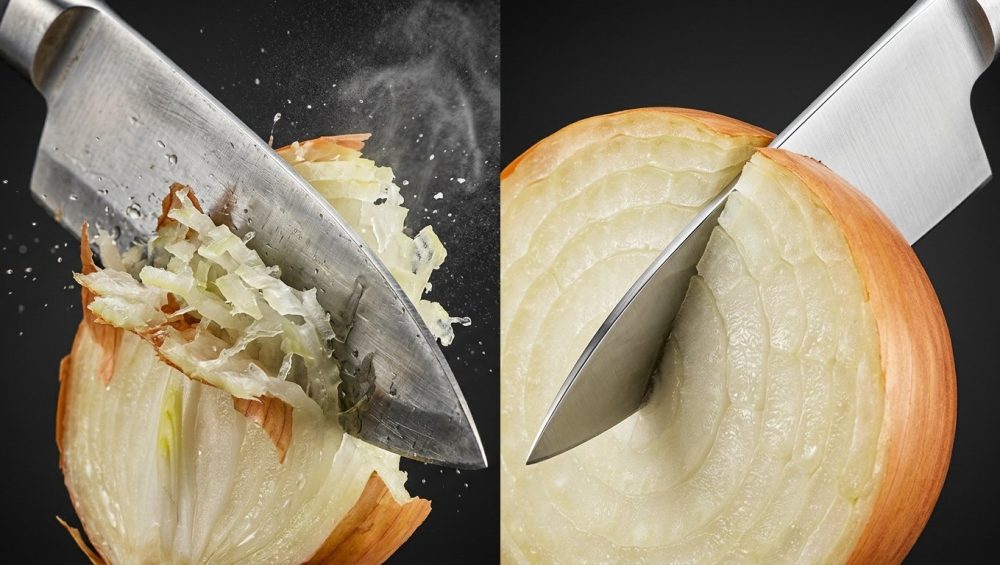
When you use a masterfully sharpened knife, the apex of the blade is incredibly thin. As you pull the blade through the onion, it acts like a microscopic surgeon’s scalpel. It glides cleanly through the intercellular matrix, parting the “bricks” and cleanly severing only the cell walls that are directly, unavoidably in the path of the edge. The cellular damage is highly localized. Because only a relatively small number of cells are breached, only a tiny, negligible amount of alliinase and lachrymatory-factor synthase is released. The resulting puff of syn-propanethial-S-oxide is so small that it dissipates before it ever reaches your eyes.
Now, let us look at what happens when you use a dull knife.
A dull edge is not a wedge; it is a microscopic U-shape. It is rounded, blunted, and rolled over. When you force a dull knife into an onion, you are no longer cutting. You are bludgeoning. The rounded edge acts like a microscopic baseball bat. Instead of slicing cleanly through the cell walls, the dull blade compresses the tissue. It pushes down with immense pressure until the structural integrity of the onion finally gives way, violently crushing thousands of surrounding cells in the process.
By crushing the tissue rather than slicing it, you are bursting exponentially more vacuoles. You are creating a massive, uncontrolled flood of alliinase and LFS. You are essentially detonating the onion’s chemical bomb at maximum yield.
This crushing effect is also why your herbs turn black and bruised when you chop them, and why your tomatoes leak all their juice onto the cutting board instead of staying intact. A dull knife destroys the cellular integrity of your food. If you want to elevate your cooking, understanding the blade geometry of Japanese knives and Western knives is not pretentious chef-speak; it is the fundamental physics of preparing ingredients correctly.
The Myth of the “Silly Hacks” Exposed
Because most home cooks do not realize their dull knife is the root cause of their suffering, they turn to the internet for salvation. The internet, as usual, provides a treasure trove of absolutely terrible advice. Let us systematically debunk these ridiculous kitchen hacks so you can stop embarrassing yourself in front of your dinner guests.
The Swimming Goggles
Yes, wearing an airtight pair of Speedo swimming goggles will physically block the syn-propanethial-S-oxide gas from reaching your corneas. Congratulations, your eyes are safe. However, you look completely unhinged, your peripheral vision is severely compromised (which is dangerous when handling a knife), and most importantly, you are still violently crushing your food with a dull blade. You have treated the symptom, but you have ignored the disease.
The Bread in the Mouth
The theory behind holding a piece of bread in your mouth, or aggressively chewing mint gum, is that you will be forced to breathe through your mouth rather than your nose, thereby sucking the gas into your mouth before it hits your eyes. This is scientific nonsense. The gas diffuses into the ambient air and will inevitably find the moisture in your eyes regardless of how heavily you are mouth-breathing.
Freezing the Onion
This hack actually has a tiny shred of scientific merit, but it ruins your food. Thermodynamics dictates that cold temperatures slow down kinetic energy and enzymatic reactions. If you freeze an onion, the alliinase and LFS enzymes react much slower, producing less gas. However, onions have a high water content. When you freeze them, that water turns into jagged ice crystals that puncture and destroy the cellulose cell walls from the inside out. When the onion thaws, it turns into a weeping, translucent, mushy puddle. If you want to stop serving mushy vegetables, you need to keep your fresh alliums far away from the freezer.
Lighting a Candle
The idea here is that a burning candle placed next to your cutting board will draw the sulfur gas into the flame and burn it off before it reaches your face. While an open flame does create a minor convection current, it is completely powerless against the massive, localized gas bomb you are detonating with your dull knife. Unless you are chopping onions inside an industrial fume hood, a vanilla-scented tealight is not going to save you.
The Dangerous Reality of Dull Knives: A Statistical Wake-Up Call
We need to take a brief, serious detour away from the annoyance of crying and address the actual danger in your kitchen. A dull knife is not just a culinary inconvenience; it is a massive liability.
There is an old kitchen adage that states, “A falling knife has no handle, and a dull knife is the most dangerous tool in the kitchen.” This is not just an old wives’ tale to guilt you into buying a whetstone. It is a verifiable, statistically proven fact.
According to data from the National Electronic Injury Surveillance System (NEISS) and the U.S. Consumer Product Safety Commission (CPSC), an estimated 350,000 to 434,000 knife-related injuries are treated in United States emergency departments every single year. That breaks down to roughly 1,190 severe knife injuries every single day. The injury rate is a staggering 1.56 injuries per 1,000 U.S. residents annually.
Unsurprisingly, 66% of these injuries strike the fingers or thumbs, and a massive 94% of them are lacerations.
Why are so many people ending up in the ER? The answer is slippage.
When a knife is razor-sharp, the microscopic apex of the blade bites into the ingredient the millisecond it makes contact. It requires almost zero downward force from the cook; the sheer weight of the blade and a gentle gliding motion is enough to initiate the cut.
When a knife is dull, the rounded edge cannot bite into the tough, papery outer skin of an onion or the waxy skin of a bell pepper. To force the blade through, the cook has to compensate by applying intense, aggressive downward pressure. Because the edge is rounded, it acts like a cylinder resting on a hard surface. The moment the ingredient offers resistance, the immense downward force causes the blade to roll and slip sideways. Because you are pushing down with all your might, the blade violently deflects off the onion and goes straight into your stabilizing hand.
A sharp knife does exactly what you tell it to do. A dull knife has a mind of its own. If you want to protect your fingers and speed up your weekday meal prep, investing in high-carbon Japanese steel knives or high-quality forged Western blades is non-negotiable.
The “No-Go” Rule: Toxic Gear and Edge Destroyers
As the Sassy Sous-Chef, I have zero patience for pretentious, thousand-dollar kitchen gadgets that do nothing but collect dust. However, I have even less patience for cheap, toxic, poorly manufactured gear that actively sabotages your cooking. You cannot maintain a sharp knife if you are constantly abusing it on terrible surfaces.
If you are serious about keeping your blades sharp and keeping the tears at bay, you must strictly adhere to the “No-Go” rule.
Glass and Marble Cutting Boards
I cannot overstate my absolute disdain for glass cutting boards. They are an abomination. They are the ultimate sin of the home kitchen. On the Mohs scale of mineral hardness, glass and stone are significantly harder than the steel of your kitchen knife. Every time your blade strikes a glass cutting board, the microscopic edge is instantly flattened, rolled, and destroyed. You can take a freshly sharpened, premium chef’s knife, chop one single onion on a glass board, and the knife will be completely dull by the time you finish. Furthermore, the sound of steel scraping against glass is culinary nails-on-a-chalkboard. Throw them in the recycling bin immediately.
Bamboo Cutting Boards
Bamboo is heavily marketed as an eco-friendly, sustainable alternative to traditional wood. While it looks nice, it is a nightmare for your knives. Bamboo is technically a grass, not a wood, and it is naturally packed with high levels of silica—the exact same mineral that makes up sand and glass. Furthermore, to make a bamboo cutting board, manufacturers have to glue thousands of tiny strips of bamboo together. Your knife is constantly hitting hard silica and industrial resin. It is an open secret in the culinary world that bamboo boards ruin your knives faster than almost any other wooden surface. Switch to edge-grain or end-grain boards made from softer woods like maple, walnut, or cherry.
Cheap, Mystery-Metal Knives
If you purchased a vibrant, neon-colored knife from a grocery store checkout aisle for twelve dollars, you are setting yourself up for failure. These knives are stamped out of cheap, low-carbon, mystery stainless steel that is too soft to hold an edge for more than a few days. Even worse, many of them are coated in cheap, non-stick paints that inevitably chip, peel, and flake toxic residue directly into your food. This is exactly why I am so relentlessly passionate about banishing toxic kitchen gear from your home. Buy one good, heavy, forged steel chef’s knife. It will last you a lifetime.
The Real Solution: Upgrading and Maintaining Your Blade
Buying a good knife is only half the battle; maintaining it is the other. A high-quality knife will still go dull if you do not care for it. To keep your blade slicing cleanly through cell walls, you need to understand the critical difference between honing and sharpening.
Honing (The Steel Rod)
That long metal rod that came with your knife block is not a sharpener; it is a honing steel. As you use your knife, the microscopic teeth at the very apex of the edge get bent and pushed out of alignment. The knife feels dull, but the metal is actually just rolled over. Running the blade along a honing steel at a 15-to-20-degree angle gently pushes those microscopic teeth back into a straight, perfectly aligned row. You should be honing your chef’s knife every single time you cook. It takes ten seconds and makes a world of difference.
Sharpening (The Whetstone)
Eventually, honing is no longer enough. The microscopic teeth break off, and the edge becomes physically rounded. At this point, the knife must be sharpened. Sharpening actually removes metal from the blade to grind a brand-new, razor-thin edge. You can use an electric sharpener, but a traditional water whetstone will give you the sharpest, most precise edge possible. Most home cooks should have their primary knives sharpened on a whetstone at least once every six to twelve months. If you are terrified of doing it yourself, take it to a local professional. It usually costs less than ten dollars a knife, and it will completely transform your prep work.
Practical Guide: How to Actually Chop an Onion Like a Boss
Now that your gear is sorted, your knife is honed, and your cutting board is made of soft, edge-friendly wood, it is time to actually chop the onion. Technique matters. Even with a sharp knife, haphazardly hacking at an onion will cause unnecessary cellular damage.
When it comes to fixing common kitchen mistakes, learning the proper, professional way to process an allium is the single most valuable skill you can acquire. It is safer, it is infinitely faster, and it minimizes the release of the dreaded lachrymatory factor.
Step 1: The Setup
Place your wooden cutting board on the counter. If it slides around, place a damp paper towel underneath it to lock it in place. A moving cutting board is a dangerous cutting board.
Step 2: The Root Stays Intact
The root end of the onion (the hairy side) contains the absolute highest concentration of sulfur compounds and enzymes. If you slice the root off first, you are immediately releasing a massive cloud of syn-propanethial-S-oxide. Leave the root perfectly intact. It will serve as a convenient handle that holds all the layers together while you chop.
Step 3: The Halving and Peeling
Place the onion firmly on the board. Slice off the stem end (the non-hairy side) to create a flat surface. Stand the onion up on that newly flat side, and slice straight down through the center of the root, cutting the onion into two equal halves. Peel back the papery outer skin from both halves.
Step 4: The Horizontal Cuts (Optional)
Lay one half flat on the board. Place your non-dominant hand flat on top of the onion to hold it steady. Carefully make one or two horizontal slices parallel to the cutting board, cutting into the onion but stopping just short of the root. The root holds the layers together.
Step 5: The Vertical Cuts
Now, make a series of vertical slices from the stem end toward the root end, again stopping just short of the root. The closer together your slices are, the finer your dice will be. Because your knife is sharp, you should not be pushing straight down. Use a gliding, locomotive motion—push the blade forward and down simultaneously. Let the sharp edge do the work. This clean slicing motion is the secret to mastering basic culinary techniques without destroying your ingredients.
Step 6: The Final Cross-Chop
Finally, turn the onion 90 degrees and slice downward across the vertical cuts. Beautiful, uniform, perfectly clean squares of onion will fall effortlessly onto the board. When you get down to the root, stop. Throw the intact root in your compost bin or save it in a freezer bag for homemade vegetable stock.
If you follow this method with a sharp knife, your cuts will be so clean and your speed will be so fast that the onion will be in your hot skillet before the syn-propanethial-S-oxide ever has a chance to reach your eyes. If you use a dull knife and mangle the cuts into a pulverized, watery mess, you will be crying over the cutting board, and you will quickly have to figure out how to rescue a ruined dinner.
Conclusion
Cooking should be a joy, not a punishment. You do not have to suffer through your evening meal prep, and you certainly do not have to resort to wearing plastic swimming goggles in your own kitchen. The physical irritation of chopping an onion is not a mandatory toll you have to pay; it is simply a chemical reaction that you have the power to control.
By understanding the cellular biology of your ingredients and respecting the physics of your tools, you can eliminate the bottlenecks that make weekday cooking feel like a chore. A sharp knife is the ultimate kitchen luxury, but it is also a fundamental necessity. It keeps your fingers attached to your hands, it preserves the structural integrity of your food, and it keeps the tear-inducing sulfur gases locked away where they belong.
Just like balancing flavors with acid or properly preheating your skillet, maintaining a sharp blade is a non-negotiable pillar of good cooking. So please, for your own sanity, take your dull, beaten-up chef’s knife to a professional sharpener this weekend. Throw away the glass cutting board. Throw away the chewing gum. Reclaim your kitchen, stop the weeping, and start cooking like the boss you are.