Picture this: You have just finished serving a beautiful, heavy, multi-course meal to your friends. The wine is flowing, the conversation is sparkling, and you want to offer something bright, acidic, and refreshing to cleanse the palate. You proudly march to the freezer to retrieve your artisanal, homemade raspberry sorbet—a recipe you spent all Saturday morning perfecting. You grab a spoon, press down, and… absolutely nothing happens. You press harder. The spoon bends. You are now sweating under the dining room lights, aggressively chiseling away at a fuchsia block of ice while your guests politely pretend not to notice your frantic kitchen workout.
Sound familiar? Welcome to the club. I have ruined enough dinner parties with frozen fruit bricks to know exactly how demoralizing this feels. But here is the good news: your failure is a matter of physics, not a lack of culinary talent. Consider this your completely comprehensive, highly scientific, yet entirely accessible essential kitchen survival guide for frozen desserts.
Look, I am a busy professional. During the week, I survive on clever twenty-minute meals and sheer willpower. But on the weekends? That is my time to be an absolute perfectionist. I firmly believe that anyone can achieve Michelin-level results in a standard home kitchen without a culinary degree, provided they understand the underlying science. Today, we are going to dive deep into the molecular thermodynamics of frozen fruit purees. I am going to tell you exactly why your dairy-free treats turn into rock-hard weapons, and more importantly, how to master the actual science of freezing point depression. By the time we are done, you will have the exact mathematical formulas needed to create a perfectly scoopable, stress-free DIY sundae bar.
The Cold, Hard Reality of Homemade Frozen Desserts
To understand why your sorbet is currently doubling as a doorstop, we need to understand the fundamental difference between ice cream and sorbet. Ice cream is an emulsion of water, sugar, milk fat, and proteins (often from egg yolks or milk solids). When water freezes, it naturally wants to expand and form a rigid, crystalline lattice. In ice cream, those microscopic fat globules and proteins physically get in the way. They coat the ice crystals, preventing them from linking up and growing into massive, gritty chunks.
Sorbet, on the other hand, is completely naked. It contains zero fat and zero protein. It is nothing but fruit, water, and sugar. Without fat to act as a physical barrier, the water molecules have free rein to lock together into a solid block of ice.
Furthermore, we have to talk about temperature. Commercial gelato and sorbet cases at your favorite artisanal scoop shop are typically held at a relatively balmy 10°F to 15°F (-12°C to -9°C). This is the ideal serving temperature for frozen desserts. Your standard home freezer, however, is designed to keep raw chicken safe for six months. It is set to a brutal 0°F (-18°C) or even colder. At 0°F, almost all the free water in your fruit puree freezes completely solid. If you put a commercially formulated sorbet into your home freezer, even it would become difficult to scoop. When you combine the lack of fat with the extreme cold of a residential freezer, you are practically begging for a kitchen disaster.
Freezing Point Depression: The Culinary Magic Trick
Since we cannot add fat to sorbet (because then it would be ice cream), and we cannot easily change the temperature of our home freezers without ruining our frozen groceries, we have to rely on our only available weapon: sugar.
In the culinary world, sugar is not just a sweetener; it is a vital structural ingredient. When you dissolve sugar into water, it lowers the temperature at which that water will freeze. This phenomenon is known as freezing point depression. In chemistry, freezing point depression is a colligative property. This means that the effect depends entirely on the number of solute particles dissolved in the solvent, not the identity of the particles. The more sugar molecules you have floating around in your fruit puree, the harder the water molecules have to work (i.e., the colder the environment must be) to bypass the sugar and lock together into ice.
If you want your sorbet to remain soft and scoopable at 0°F, a significant portion of the water must remain unfrozen, existing as a super-chilled syrup that lubricates the microscopic ice crystals. To achieve this, you need a very specific concentration of sugar.
Professional pastry chefs measure this sugar concentration using the Brix scale. Degrees Brix (°Bx) represents the sugar content of an aqueous solution, where one degree Brix is equal to 1 gram of sucrose in 100 grams of solution. Extensive food science testing has proven that the ideal Brix level for a perfectly scoopable, balanced fruit sorbet is between 25% and 30%. If your Brix is too low (under 20%), you get an icy, impenetrable brick. If your Brix is too high (over 32%), the freezing point is depressed so far that the sorbet never fully freezes, resulting in a slushy, cloying mess.
If you are serious about weekend culinary projects, a refractometer (a small optical device that measures Brix) is a cheap, indispensable tool that belongs in any beautifully organized dream kitchen. However, if you don’t have one, you can rely on precise kitchen scales and standardized ratios, which we will cover shortly.
The Secret Weapon: Why You Must Embrace Invert Sugars
Here is where most home cooks make a fatal error. They realize their sorbet is too icy, so the next time they make it, they simply dump an extra cup of white table sugar into the blender. The result? A sorbet that is slightly softer, but so aggressively, unpalatably sweet that it makes your teeth ache.
This happens because standard table sugar (sucrose) has a relatively high molecular weight (342.3 g/mol). Sucrose is a disaccharide, meaning it is composed of two simple sugars—glucose and fructose—bonded together. Because freezing point depression relies on the number of particles, sucrose is actually quite inefficient. You have to add a massive amount of it by weight to get enough individual molecules to soften the ice, and by the time you reach that threshold, the dessert is ruined by excessive sweetness.
Enter invert sugar. Invert sugar is created when the bond between the glucose and fructose in sucrose is broken (cleaved), resulting in a syrup of free-floating glucose and fructose monomers. Because the molecules have been split in half, a given weight of invert sugar provides twice as many molecules as the exact same weight of sucrose.
Let me repeat that, because it is the most important sentence in this entire masterclass: Invert sugar provides double the freezing point depression power of table sugar. In practical, thermodynamic terms, 100 grams of sucrose lowers the freezing point of a standard water solution by approximately 1.8°C. However, 100 grams of invert sugar lowers it by a massive 3.4°C.
You can buy commercial invert sugars like Trimoline, or you can use readily available supermarket alternatives like light corn syrup, glucose syrup, agave nectar, or mild honey. (And please, put down your pitchforks: standard Karo light corn syrup is not high-fructose corn syrup; it is simply a glucose syrup that is an absolute godsend for frozen desserts).
The golden rule for professional-grade home sorbet is to replace 15% to 25% of your total sugar weight with an invert sugar. This precise ratio lowers the freezing point enough to keep the sorbet beautifully soft and scoopable straight from a 0°F freezer, without making the final product overly sweet.
When you are prepping your master simple syrups and base purees in advance, I highly recommend storing them in heavy glass mason jars. We all know how stubborn plastic containers stay greasy and absorb weird, lingering fridge smells, which will absolutely ruin the delicate, fresh flavor of your expensive fruit purees.
Hydrocolloids and Stabilizers: The Unsung Heroes of Smooth Texture
Even if you perfectly balance your sucrose and invert sugars, you still have to battle the ultimate enemy of frozen desserts: temperature fluctuation. Every single time you open your freezer door to grab a bag of frozen peas, a rush of warm kitchen air enters the freezer. The microscopic ice crystals on the outer edges of your sorbet melt slightly. When you close the door, they refreeze. But here is the tragic part—they do not refreeze as separate, tiny crystals. They migrate and join together into larger, jagged, granular crystals. Over the course of a few days, this process (known as recrystallization) will turn a perfectly smooth sorbet into a gritty, icy mess.
To prevent this, commercial producers and smart home cooks use stabilizers. Stabilizers are hydrocolloids—complex carbohydrates that form a microscopic gel network within the water. They dramatically increase the viscosity of the unfrozen water matrix, effectively trapping the water molecules in place so they cannot migrate and form large ice crystals during freeze-thaw cycles.
You do not need industrial chemicals to achieve this. Natural stabilizers like pectin (found in apples and citrus), guar gum (derived from guar beans), xanthan gum (a natural fermentation product), or cellulose gum are readily available online and perfectly safe.
The trick to using stabilizers is extreme moderation. You only need an incredibly tiny amount—typically 0.1% to 0.3% of the total weight of your sorbet base. For a standard one-quart batch (roughly 1000 grams of liquid), you only need 1 to 3 grams of stabilizer. If you use too much, your sorbet will take on a bizarre, gummy, chewy texture that is deeply unpleasant.
Crucially, you must always thoroughly whisk your stabilizer powder into your dry sugar before introducing it to any liquid. If you dump raw stabilizer powder directly into a wet fruit puree, it will instantly hydrate on the outside, forming impenetrable, slimy lumps that no amount of blending will ever break down.
The Booze Factor: Using Alcohol as a Liquid Anti-Freeze
If you want to add an extra layer of insurance against rock-hard sorbet, you can leverage the power of ethanol. Pure alcohol has a freezing point of -173°F (-114°C), meaning that in a standard home kitchen, it will never freeze.
Adding a splash of alcohol to your sorbet base acts as a powerful, transient anti-freeze. It drastically lowers the freezing point of the overall solution. The key here is restraint. If you add too much alcohol, the freezing point will drop so low that your ice cream machine will just endlessly churn a cold soup.
A good rule of thumb is to add 1 to 2 tablespoons (15-30 ml) of alcohol per quart of sorbet base. You can use a neutral spirit like vodka, which will lower the freezing point without altering the flavor profile of your delicate fruit. Alternatively, you can use complementary liqueurs to enhance the flavor—think a splash of Grand Marnier in a strawberry sorbet, Limoncello in a basil-lemon sorbet, or a dark rum in a banana-passionfruit mix. Add the alcohol right at the end of the blending process, just before you chill the base for churning.
Fruit Anatomy: Not All Purees Are Created Equal
It is vital to understand that fruit is not just a flavor delivery system; it is a structural component. Different fruits contain vastly different levels of water, sugar, and natural fiber/pectin, all of which affect the final texture of your dessert.
High-pectin and high-fiber fruits—like mangoes, bananas, peaches, pears, and certain berries—are naturally predisposed to making incredibly creamy, thick sorbets. The natural pectin acts as a built-in stabilizer, binding the water and creating a luxurious mouthfeel. When working with these fruits, you can often get away with using slightly less invert sugar and fewer added stabilizers.
Conversely, high-water fruits—like watermelon, lemon, lime, and grapes—contain almost no natural fiber or pectin. They are essentially just flavored water. If you try to make a watermelon sorbet without meticulously balancing your invert sugars and adding a hydrocolloid stabilizer, you are guaranteed to end up with a solid block of flavored ice. These watery fruits require strict adherence to the 25-30% Brix rule and absolutely mandate the use of glucose or corn syrup to maintain a scoopable texture.
The “No-Go” Rule: Bin Your Toxic Ice Cream Scoops
Before we discuss the actual execution of our dessert bar, I need to take a brief, highly opinionated detour. As a dedicated home cook, I am fiercely passionate about banishing toxic kitchen gear from your home. I have zero patience for cheap, gimmicky equipment that actively ruins the food you spend hours preparing.
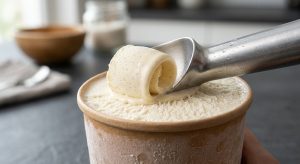
Nowhere is this problem more rampant than in the world of frozen desserts. You know exactly what tool I am talking about: that ubiquitous, lightweight aluminum ice cream scoop with the thick, sealed handle. Those handles are filled with a mysterious, chemical “defrosting fluid” designed to transfer the heat from your hand to the bowl of the scoop.
Here is the brutal truth about those scoops: they are made of cheap, reactive aluminum. If you accidentally put one in the dishwasher, the harsh, alkaline detergent will immediately strip the protective anodized coating. Have you ever pulled a utensil out of the wash and noticed your ice cream scoop turned gray and powdery? That is raw aluminum oxidation. Every time you use it after that, you are actively scraping microscopic metallic dust and chemical residue directly into your pristine, organic fruit sorbet.
Furthermore, do not even get me started on scoops with cheap non-stick Teflon coatings. Plunging a coated scoop into rock-hard ice cream causes micro-abrasions, and eventually, that toxic black coating will start peeling off and flaking into your dessert. You would not use spatulas that leach chemicals and ruin your food, much like when cheap silicone spatulas taste like soap, so why would you tolerate a toxic scoop?
Throw them away. Today. Instead, invest in a solid, heavy-duty 18/10 stainless steel spade or a spring-loaded stainless steel scoop. A high-quality stainless steel scoop does not rely on toxic antifreeze liquids; it relies on sheer thermal mass and mechanical leverage to carve through frozen treats smoothly and safely. It will last a lifetime, it is completely dishwasher safe, and it will never contaminate your food.
Designing the Relaxed DIY Sundae Bar
Now that you have mastered the thermodynamics of freezing point depression, formulated your base with invert sugars, stabilized it with hydrocolloids, and thrown your toxic scoops in the trash, it is time to actually serve this masterpiece.
The primary goal of a weekend gathering is connection, not culinary martyrdom. If you want to truly master the art of effortless hosting, you cannot be standing in the kitchen, sweating over a frozen pint container, trying to scoop perfect quenelles to order while your guests wait awkwardly at the table.
Prep Like a Professional
The secret to a flawless dessert presentation is doing all the messy, physical labor hours before anyone even rings your doorbell. This is the ultimate secret to a relaxed dinner party—separating the preparation from the presentation.
The afternoon of your gathering, take your perfectly churned sorbet out of the freezer. Place it in the refrigerator for 15 to 20 minutes to gently temper. This slight warming will make it beautifully pliable. While it tempers, line a heavy aluminum baking sheet with parchment paper and place it in the freezer to get ice-cold.
Once your sorbet is tempered, use your solid stainless steel scoop to portion out perfectly round, uniform spheres. Place these spheres directly onto the freezing cold parchment-lined baking sheet. Work quickly. Once all the spheres are scooped, immediately place the entire baking sheet back into the 0°F freezer. The spheres will freeze rock-solid in their perfect shapes.
The Execution and Thermal Holding
When it is time for dessert, you are going to bypass the traditional, rushed scooping entirely by utilizing proper thermal holding techniques. You need a vessel that will keep the pre-scooped spheres cold at room temperature for the duration of the dessert course.
Do not serve your sorbet in thin glass or cheap plastic bowls that offer zero insulation. Instead, invest in heavy, safe serving ware that retains the cold. Thick ceramic stoneware bowls or double-walled stainless steel serving dishes are perfect for this. Place your serving bowl in the freezer for at least an hour before dessert.
When you are ready to serve, simply pull the frozen serving bowl out, quickly transfer your pre-frozen sorbet spheres from the sheet pan into the chilled bowl, and carry it to the table. Because the spheres are deeply frozen and resting in a high-thermal-mass, freezing-cold bowl, they will hold their shape beautifully at room temperature while your guests serve themselves.
The Art of the Topping
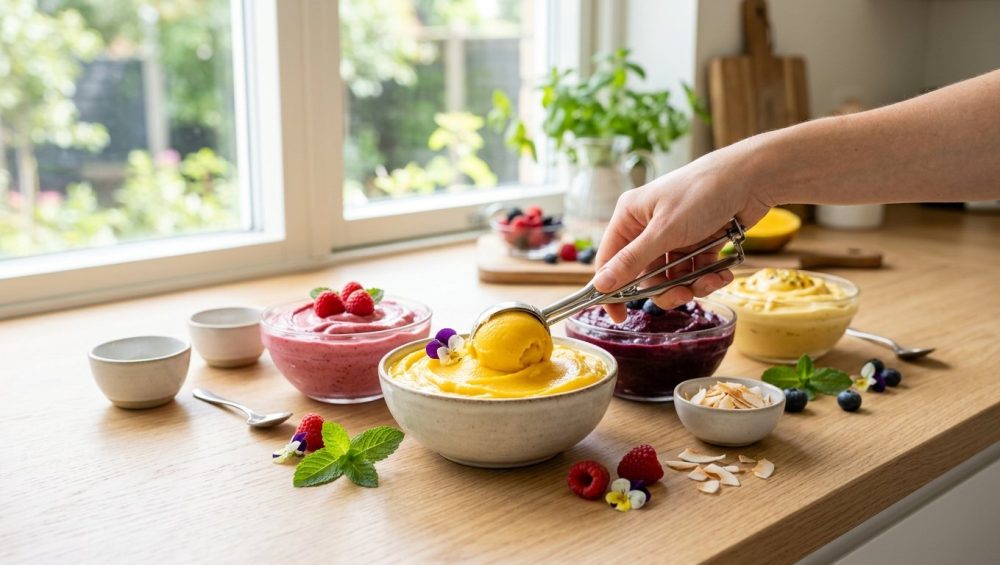
A DIY sundae bar is interactive, visually stunning, and requires zero plating effort on your part. Because sorbet is inherently sweet, acidic, and entirely lacking in fat, your toppings should provide contrasting textures and rich, fatty mouthfeels to balance the palate.
Set out an array of small, beautiful prep bowls featuring:
- A High-Quality Fat: A grassy, peppery extra-virgin olive oil for drizzling over fruit sorbets (especially lemon or strawberry) is a Michelin-level touch that blows people’s minds.
- A Salty Crunch: Flaky Maldon sea salt is mandatory. It amplifies the fruit flavor and cuts the sweetness. Add bowls of toasted, lightly salted Marcona almonds, crushed pistachios, or toasted coconut flakes.
- Fresh Aromatics: Tiny, hand-torn leaves of fresh basil, mint, or tarragon add a sophisticated, savory herbal note that pairs beautifully with bright fruit.
- A Rich Drizzle: A thick, aged balsamic glaze or a dark chocolate magic shell (made by melting high-quality dark chocolate with a spoonful of refined coconut oil) provides a necessary bitter contrast.
By setting up this interactive bar, you empower your guests to customize their own flavor profiles, sparking conversation and engagement, while you get to sit back, sip your wine, and actually enjoy the gathering you worked so hard to put together.
Troubleshooting Common Sorbet Disasters
Even with the best science, things can occasionally go sideways. Here is how to fix your mistakes without throwing away expensive ingredients.
The Problem: Your sorbet is an icy, impenetrable brick.
The Diagnosis: Your Brix level was too low (not enough sugar), you didn’t use any invert sugar, or your freezer is exceptionally cold.
The Fix: Do not throw it away. Let the brick melt completely in the refrigerator. Once it is a liquid puree again, whisk in 2 to 3 tablespoons of light corn syrup or agave nectar, and 1 tablespoon of vodka. Re-churn the base in your ice cream maker. The added invert sugar and alcohol will drastically lower the freezing point, and the second churn will break up the existing ice crystals.
The Problem: Your sorbet is a slushy, soupy mess that refuses to freeze.
The Diagnosis: You went overboard. Your Brix level is too high (over 32%), or you were far too generous with the vodka. You have depressed the freezing point so far that your home freezer cannot reach a temperature low enough to freeze the water.
The Fix: Let the slush melt. You need to dilute the solute concentration. Blend in more unsweetened fruit puree or a splash of water to raise the freezing point back to a manageable level, then re-churn.
The Problem: Your sorbet is crumbly and powdery.
The Diagnosis: This usually happens with high-water, low-pectin fruits (like lemon or watermelon) when no stabilizer is used, or if the base was churned for too long, introducing too much air (overrun) into a mixture that lacks the structure to hold it.
The Fix: Melt the base. Whisk 1 gram of xanthan gum or a commercial sorbet stabilizer into a tablespoon of dry sugar, blend it vigorously into the liquid base, let it rest for an hour to hydrate, and re-churn.
Final Thoughts for the Weekend Culinary Hobbyist
Cooking is not magic; it is chemistry, thermodynamics, and a little bit of stubborn perseverance. You do not need an expensive commercial PacoJet or a degree in food science to make mind-blowing, professional-quality sorbet. You simply need to respect the physics of water, embrace the power of invert sugars, utilize natural stabilizers, and ruthlessly banish toxic, cheap equipment from your kitchen.
By understanding how freezing point depression works, you take the guesswork out of dessert. You transform a stressful, unpredictable chore into a reliable, repeatable scientific process. So, this weekend, buy the good fruit. Make the simple syrup. Weigh your invert sugars. Pre-scoop your spheres. And when your guests marvel at the impossibly smooth, creamy texture of your dairy-free dessert, you can just smile, pass the flaky sea salt, and enjoy the relaxed, effortless gathering you deserve.