Picture this: You have spent the last three hours of your precious weekend meticulously measuring flour, proofing dough, and braising a gorgeous, sticky pork belly. You have carefully folded your dough into pristine, little pleated masterpieces. You place them into the steamer, feeling like an absolute culinary god. The timer dings. You eagerly rip the lid off the steamer, expecting to be greeted by a cloud of aromatic steam and a batch of snowy-white, plump, pillowy bao.
Instead, as the steam clears, your heart sinks. Staring back at you are sad, yellowing, deeply wrinkled dough balls that look more like deflated balloons or miniature brains than the fluffy clouds of carbohydrate joy you were promised.
Take a deep breath. Do not throw your steamer across the room, and do not immediately reach for your phone to order overpriced takeout. If you feel like mastering the art of the kitchen is a pipe dream reserved for people with culinary degrees, I am here to tell you to stop being so dramatic. You haven’t failed as a cook; you simply ran afoul of basic thermodynamics and material physics.
Restaurant chefs are not magicians wielding secret ancient spells. They are just people who understand the strict rules of steam pressure, gluten development, and temperature control. As a home cook, you are entirely capable of producing professional-grade, flawlessly smooth steamed buns in your own kitchen. You just need to understand the science of why dough behaves the way it does when subjected to intense, wet heat.
Today, we are going completely scorched-earth on the myths surrounding steamed buns. We are going to break down the exact chemistry of the dough, the physics of steam pressure, the absolute necessity of safe, high-quality cooking gear, and how to leverage all of this knowledge to host an incredibly interactive, stress-free DIY bao bar for your friends. Grab your digital scale and a strong cup of coffee. We are going deep.
The Anatomy of a Bao: Why Your Dough is Sabotaging You
Before we even talk about the steamer, we have to talk about the foundation of the bun itself. The vast majority of deflated, wrinkled steamed buns are doomed before they ever hit the heat. A bao is not a rustic European sourdough boule. It is a highly engineered, delicate structure that requires a very specific chemical makeup to survive the violent environment of a steam bath.
The Great Flour Deception
If you are using standard, high-protein bread flour—or even certain brands of robust, unbleached all-purpose flour—you are actively sabotaging your buns. Wheat flour contains two essential proteins: glutenin and gliadin. When hydrated and kneaded, they form gluten, the elastic network that gives bread its chew.
For a classic, fluffy Chinese steamed bun, you want a very delicate, tender crumb with just enough structural integrity to hold its shape. If your gluten network is too strong, the dough will fight back. It will become incredibly chewy, it will resist being rolled out, and worst of all, it will aggressively shrink and snap back upon cooling, leading to those dreaded wrinkles.
The ideal flour for bao has a protein content hovering right around 8% to 10%. If you look at standard supermarket flours, a heavy-duty all-purpose flour (like King Arthur) sits at a hefty 11.7% protein. That is far too high for a delicate steamed bun. Instead, you need to seek out a low-protein all-purpose flour, cake flour, or specialized “Hong Kong flour” (often labeled as “Top Flour” or “Bao Flour” in Asian markets). These soft wheat flours allow the dough to expand beautifully without turning into a rubber tire. Furthermore, if you want that iconic, snowy-white aesthetic, you must use a bleached flour. Unbleached flours will always yield a slightly yellowish, ivory-toned bun. While it tastes exactly the same, if you are chasing the restaurant-style aesthetic, bleaching is the non-negotiable variable.
The Two-Pronged Leavening Attack
A standard bread dough relies solely on yeast (a biological leavener) to produce carbon dioxide and inflate the dough. A proper bao dough, however, requires a two-pronged approach: yeast and baking powder (a chemical leavener).
Why both? Yeast provides the complex, slightly fermented flavor and the initial slow rise during the proofing stage. However, when the bun hits the intense heat of the steamer, the yeast dies off very quickly. This is where the baking powder tags in. The baking powder reacts to the sudden heat, providing a rapid, secondary burst of gas that “sets” the crumb of the bun and gives it that incredibly light, airy, sponge-like texture. If you omit the baking powder, your buns will be significantly denser. Just like when your dumplings fall apart in a violently rolling boil due to a weak wrapper, a bao dough without chemical leavening will lack the structural integrity to support its own expanded weight.
The Role of Fat and Sugar
You will also notice that authentic bao recipes call for a small amount of fat (usually a neutral oil or sometimes lard) and sugar. Do not skip these. The sugar feeds the yeast for a vigorous rise and adds the signature hint of sweetness. The fat is a tenderizer. It coats the flour proteins, physically shortening the gluten strands (hence the term “shortening”), which ensures the final bun is soft and yielding rather than tough and bready.
The Physics of Deflation: Why Your Buns Wrinkle and Die
Let’s assume you have mixed the perfect dough. You proofed it perfectly until it doubled in size. You shaped it into beautiful, smooth spheres. You steamed them for exactly twelve minutes. Then, you took the lid off, and before your very eyes, they shriveled up like a cheap sweater in a hot dryer.
Welcome to the brutal reality of thermal shock.
The Menace of Thermal Shock
To understand why this happens, we have to look at Charles’s Law of gases. When the dough is inside the steamer, the intense heat causes the gases trapped inside the dough’s cellular structure (carbon dioxide from the yeast and baking powder, plus expanding water vapor) to expand rapidly. The bun puffs up to its maximum volume. The starches in the flour gelatinize, and the proteins set, forming a delicate scaffolding around these expanded gas bubbles.
When you instantly rip the lid off a hot steamer, you are introducing a massive, violent wave of cold room-temperature air into the environment. The temperature plunges in a fraction of a second. Because gases contract as they cool, the steam and carbon dioxide inside the bun rapidly shrink. The steam condenses back into liquid water. Suddenly, the internal pressure supporting the bun vanishes. If the outer skin of the dough hasn’t fully hardened into a rigid crust (which it shouldn’t in a steamed bun), the entire structure collapses inward under the sudden vacuum, resulting in a deeply wrinkled, deflated surface.
The 5-Minute Rule
How do we defeat thermal shock? With patience. The absolute, non-negotiable, golden rule of steaming buns is the 5-Minute Rule. When your timer goes off, turn off the heat completely, but do not touch the lid.
Leave the steamer exactly where it is on the stove for at least three to five minutes. This allows the temperature inside the steamer to drop gradually. The pressure equalizes slowly, allowing the starches and proteins in the dough to firm up and solidify their structure before they are exposed to the cold air of your kitchen. It is a test of willpower, but it is the single most important step in preventing wrinkled buns.
The Internal Moisture Problem
Thermal shock from the outside isn’t the only enemy; you also have to worry about moisture from the inside. If you are making filled buns (like a classic Char Siu Bao), the filling itself can sabotage the dough. If your scrambled eggs are watery, you know how unappetizing excess moisture on a plate can be. In a closed dough system, it’s fatal.
If a filling is too wet, it will release excess steam from the inside of the bun during cooking. This internal steam will saturate the surrounding dough, turning it into a gummy, un-gelatinized paste. When the bun cools, this soggy interior cannot support the structure, and the bun will cave in on itself, usually resulting in a “blowout” at the bottom or a massive sunken crater on top. Always ensure your fillings are properly thickened (usually with a cornstarch slurry) and completely cooled before stuffing your dough.
The Gear: Why Cheap Metal Steamers Are Ruining Your Life
As your sassy sous-chef, I have a strict, zero-tolerance policy for cheap, toxic, poorly designed kitchenware. I am looking directly at those flimsy, peeling, non-stick electric steamers and the bargain-bin stainless steel tiered setups that warp after two uses. These are not tools; they are culinary hazards.
The “No-Go” Rule on Toxic and Inefficient Gear
Let’s get one thing straight: you are cooking with high-temperature steam. If you are using a cheap plastic steamer or an aluminum insert with a mystery non-stick coating that is actively flaking off into your cooking water, you are playing a dangerous game with your health and your food. Beyond the toxicity, metal and plastic steamers are functionally terrible for making delicate breads.
Why? Because metal and plastic are non-porous thermal mirrors. When hot steam rises and hits the relatively cooler metal lid of your stainless steel pot, it immediately condenses into heavy water droplets. Because the metal cannot absorb this moisture, the water pools together and inevitably rains back down directly onto your pristine buns.
When boiling water drips onto the delicate, expanding skin of a bao, it creates localized “dead spots.” The water physically prevents the dough in that specific spot from rising, resulting in hard, yellow, blistered craters on the surface of your buns. It is incredibly frustrating to ruin a perfect dough because your equipment literally rained on your parade. While I constantly warn you about why bamboo cutting boards will destroy your knife edges, bamboo is actually the undisputed, scientifically backed king of the steamer world.
The Superiority of the Bamboo Steamer
A traditional, multi-tiered bamboo steamer is not just a charming, rustic aesthetic choice; it is a highly functional, physics-defying piece of culinary engineering. Bamboo has been used for steaming for over 5,000 years for a very specific reason: moisture management.
Bamboo is a natural, porous material with a complex cellulose structure. When steam rises and hits the woven bamboo lid, the bamboo actually absorbs the condensation. Instead of pooling and dripping, the moisture is wicked away laterally through capillary action. This creates what culinary scientists refer to as “micro-ventilation.” The steam is allowed to circulate gently and evenly without creating a torrential downpour inside the cooking chamber.
In controlled gravimetric studies, bamboo steamers have been shown to reduce bottom-layer moisture retention by nearly 68% compared to identical stainless steel units. It is the difference between a perfectly fluffy bun and a soggy, water-logged puck. If you are serious about steaming, invest in a high-quality, tightly woven, 10-inch bamboo steamer. It will cost you less than thirty dollars and will completely revolutionize your results. Just remember to never wash it with harsh dish soap (as the porous wood will absorb the soapy flavor) and always let it dry completely in a well-ventilated area to prevent mold.
The Step-by-Step Masterclass for Flawless Steamed Buns
Now that we understand the science and have the proper gear, let’s walk through the actual technique. This is where your attention to detail matters.
Step 1: The Knead and Rest
After mixing your low-protein flour, yeast, baking powder, sugar, water, and fat, you must knead the dough until it is completely smooth. I am not talking about “mostly smooth.” I am talking about a surface that looks like polished porcelain. This usually takes about 10 to 15 minutes of vigorous hand kneading. You are aiming to develop just enough gluten to hold the shape, but more importantly, you are pressing out all the large, irregular air bubbles.
If you leave large air pockets in the dough, they will expand violently in the steamer and create massive, ugly blisters on the skin of your bun. Once kneaded, let it rest in a warm place until it has increased in size by about 50% to 75%. Do not let it double or triple in size. Over-proofed dough has a weakened gluten structure that will inevitably collapse in the steamer.
Step 2: The Roll and Fill
When rolling out your dough for filled buns, do not just flatten it into a uniform pancake. You must use a small rolling pin to thin out the edges of the circle while leaving a thicker “belly” in the center. The thicker center supports the weight and moisture of the filling, preventing the bottom from blowing out, while the thinner edges allow you to pleat and fold the top without creating a massive, dense knot of raw dough at the apex.
Step 3: The Steam Cycle
Line your bamboo steamer baskets. Do not use flat, solid parchment paper, or you will block the steam. Use perforated parchment rounds (you can buy these pre-cut) or line the baskets with large cabbage leaves.
Place your steamer over a wok or a wide skillet filled with water. You need to control the heat. Just like when your pasta pot boils over because you walked away, an unchecked, violently rolling boil will destroy your buns. You want a steady, vigorous simmer that produces a consistent column of steam, not a volcanic eruption that splashes boiling water onto the bottom tier.
If your dough is slightly under-proofed, start with cold water in the wok. As the water slowly comes to a boil, it provides a gentle, warm environment that allows the buns a final “spring” before the proteins set. If your dough is perfectly proofed, start with boiling water.
Step 4: The Crucial Cool Down
Steam the buns for 10 to 12 minutes (depending on size and filling). When the timer goes off, kill the heat. Do not touch the lid. Wait five minutes. Then, gently lift the lid away from you so any residual trapped steam escapes without burning your face.
The Relaxed Bao Bar: Hosting Without Losing Your Mind
Now that you possess the technical knowledge to produce flawless, wrinkle-free steamed buns, it is time to show off. But we are going to do it smartly. If you want to host a relaxed dinner party, forcing yourself to plate individual, complex courses while your guests sit in the other room is a rookie mistake. You will spend the entire night sweating over the stove, completely alienated from your own gathering.
The solution? The DIY Bao Bar.
According to recent hospitality data, communal dining and “Eatertainment” are massive trends for 2024 and 2025. Over 66% of Gen Z diners actively seek out interactive, shared meal formats. People do not want to be served; they want to participate. A bao bar is the ultimate expression of this trend. It is engaging, highly customizable, and completely eliminates the dreaded host bottleneck.
Prepping the Fillings
The beauty of a bao bar is that 90% of the work is done before anyone rings the doorbell. You can steam a massive batch of plain, folded “lotus leaf” buns (the taco-shaped ones) earlier in the day. Because you used the correct flour and the 5-minute cooldown rule, they will be perfectly smooth and fluffy. When it’s time to eat, you simply pop the bamboo steamer back over simmering water for 60 seconds to refresh them.
For the fillings, variety and moisture control are key. Stop ruining your salmon by trying to stuff raw fish into a steaming environment; instead, serve a platter of cold, cured salmon with quick-pickled cucumbers and a smear of hoisin-cream cheese for a fusion twist.
If your chicken always turns out dry, it’s because you are using lean breasts instead of fatty thighs. Braise some chicken thighs in soy sauce, star anise, and ginger until they fall apart. Keep them warm in a slow cooker.
For the vegetarians, offer deeply roasted mushrooms glazed in a sticky garlic-soy reduction. Nobody wants to eat mushy veggies, so make sure to offer plenty of crunchy, highly acidic toppings to cut through the rich, doughy buns. Quick-pickled daikon radishes, shredded carrots tossed in rice vinegar, fresh cilantro, and crushed roasted peanuts are mandatory.
If your garlic always burns in the wok, you need to lower the heat before tossing your aromatics into the chili oil you’ll serve on the side. A good, homemade chili crisp adds the necessary heat and textural contrast to the soft buns.
The Interactive Experience
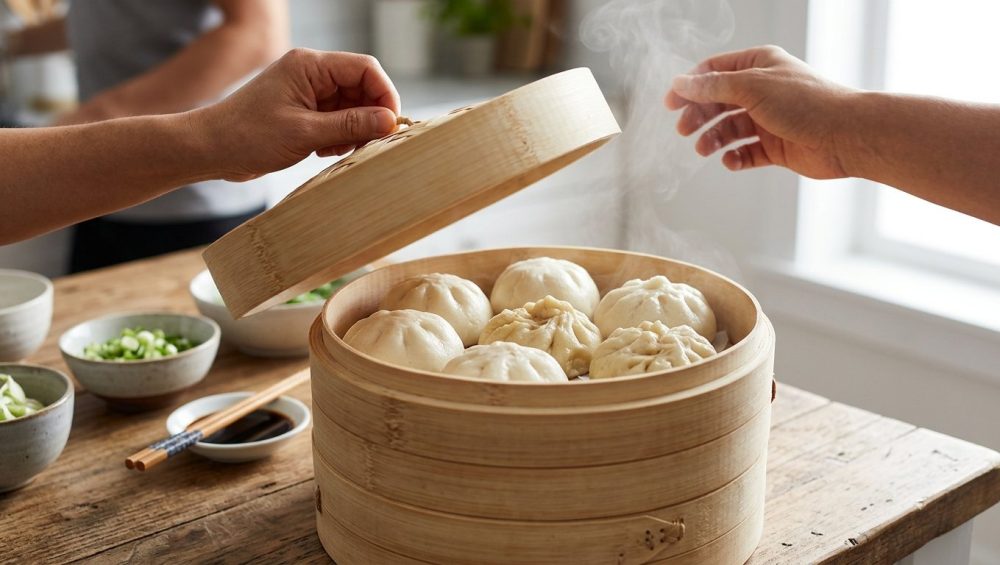
Set everything out on a large kitchen island or dining table. Place the steaming bamboo baskets of hot buns in the center. Arrange the proteins, the crunchy slaws, the pickles, and the sauces in a vibrant array of bowls around the steamer.
Hand your guests a plate and let them build their own masterpieces. It forces people to interact, to share flavor combinations, and to engage with their food. Meanwhile, you get to pour yourself a glass of crisp Riesling (which pairs beautifully with the salty, sweet, and spicy flavors of the bao) and actually enjoy the company of the people you invited over.
Troubleshooting Your Sad Buns (The FAQ)
Even with the best intentions, the kitchen can be an unpredictable laboratory. If your buns still aren’t coming out like pristine, edible clouds, consult this brutal diagnostic checklist:
1. Why do my buns have weird, hard yellow spots on them?
You either failed to sift your baking powder, resulting in concentrated chemical clumps that reacted poorly with the heat, or you used unpurified tap water in your steamer, and the alkaline minerals condensed onto the dough. Sift your dry ingredients thoroughly and consider using filtered water for steaming.
2. Why are the bottoms of my buns rock hard?
You let the wok boil dry. Steaming requires actual steam. If the water evaporates completely, the ambient temperature in the wok skyrockets, and you end up dry-baking the bottom of the bamboo steamer, scorching the base of your buns. Always check your water levels between batches.
3. The buns look fine, but the texture is dense and gummy, like chewing on a wet sponge.
This is a classic sign of over-proofing. When dough over-ferments, the yeast exhausts its food supply and produces excess alcohol and acids, which breaks down the gluten structure. The dough loses its ability to trap gas effectively. When steamed, it simply melts into a dense, gelatinous mass instead of rising. Watch the dough, not the clock. Proofing times vary wildly based on the ambient temperature and humidity of your kitchen.
4. The skin is blistered and looks like bubble wrap.
You didn’t knead the dough long enough. Those blisters are trapped pockets of air that expanded rapidly under the heat, pushing the thin outer skin of the dough outward until it bubbled. You must knead the dough until it is completely smooth and homogeneous, physically forcing those irregular air pockets out of the matrix.
The Final Word
Making flawless steamed buns at home is not a mystical art form reserved for dim sum masters. It is a highly logical, deeply satisfying exercise in applied physics and ingredient control. By respecting the protein limits of your flour, managing your leavening agents, utilizing the moisture-wicking magic of a natural bamboo steamer, and strictly adhering to the 5-Minute cooldown rule, you will permanently banish wrinkled, deflated dough from your kitchen.
More importantly, you will unlock the ultimate weekend hosting hack. A DIY bao bar transforms an intimidating dinner party into a relaxed, communal, and deeply memorable gathering. So throw out that peeling metal steamer, source some low-protein flour, and embrace the science of the steam. You’ve got this. Now go get your hands floury.