Picture this: It is a chaotic Tuesday evening. You are exhausted, starving, and trying to throw together a quick, flavorful meal. You reach into your pantry for the garlic powder, unscrew the lid, and turn it upside down over your skillet. Nothing happens. You shake it harder. Still nothing. You peer inside, only to discover that your once-fluffy, fragrant seasoning has transformed into an impenetrable, solid rock. You are now standing in your kitchen, chipping away at a nine-dollar jar of organic garlic powder with the handle of a butter knife like an amateur archaeologist excavating a dinosaur fossil.
It is infuriating, it is a massive waste of your precious time, and frankly, it is one of those entirely preventable bottlenecks that are ruining your dinners.
As a home cook, your time is your most valuable asset. You do not have the luxury of a prep cook standing behind you, meticulously sifting your dry ingredients. When you are trying to execute a 30-minute weeknight meal, a hardened block of onion powder is not just an annoyance; it is a structural failure of your kitchen workflow.
Today, we are going to put an end to the madness. We are going to break down the exact food science behind why your spices turn into concrete, how you are accidentally causing it, how to rescue the bricks you already have, and the bulletproof, scientifically backed storage methods that will prevent this from ever happening again. Grab a coffee, or perhaps a glass of wine, and let us get to work.
The Food Science Behind the Clump: Meet the Hygroscopic Culprits
To defeat the enemy, you must first understand the enemy. Spices do not harden maliciously to spite you; they harden because of basic chemistry and thermodynamics.
What Does “Hygroscopic” Even Mean?
The vast majority of ground spices and dehydrated aromatics are highly hygroscopic. In the realm of food science, a hygroscopic substance is one that actively attracts and absorbs moisture from its surrounding environment. When you expose a finely milled powder to ambient humidity, the particles act like millions of microscopic sponges.
This absorption triggers a complex, time-dependent phenomenon known as caking. First, water molecules bind to the surface of the spice particles. This creates surface tension and liquid bridges between the individual grains. As the environmental temperature fluctuates, these liquid bridges undergo a crystalline phase transition—essentially, they dry out and fuse the microcrystals together into a solid, unyielding monolith.
Furthermore, temperature plays a catastrophic role in this degradation. For every 10°C (18°F) rise in temperature, the rate of spice deterioration roughly doubles. High temperatures accelerate the chemical reactions that degrade the volatile essential oils, while sudden drops in temperature trigger condensation inside the jar. If you have ever wondered why your dinner tastes boring despite following a recipe to the letter, stale, moisture-compromised spices are often the primary culprit.
The Worst Offenders: Garlic, Onion, and Sugar
Not all spices are created equal when it comes to clumping. You have likely noticed that your dried oregano rarely turns into a brick, while your garlic powder requires a jackhammer.
Dehydrated garlic (Allium sativum) and onion (Allium cepa) are the most notorious offenders. Why? Because of their cellular structure and naturally high sugar content. When these aromatics are dehydrated and milled into a fine powder, their exposed surface area increases exponentially. A study published in the Journal of Food Science noted that highly hygroscopic powders like paprika can absorb up to 12% of their weight in moisture within just 48 hours when exposed to humid conditions.
Complex seasoning blends—like your favorite taco seasoning, BBQ rub, or steak seasoning—are even worse. A typical commercial blend is a highly reactive matrix of hygroscopic salts, amorphous sugars, and oleoresin-rich spices. When salt and sugar sit together in a jar, they aggressively pull moisture from the air, creating a microscopic layer of saturated syrup on their surfaces. Simultaneously, the natural oils from the spices seep out, creating capillary bridges that glue the entire mixture together.
The Industrial Secret: Anti-Caking Agents (And Why We Hate Them)
You might be thinking, “But my cheap supermarket garlic powder never clumps! Why does the expensive organic stuff turn into a brick?”
The answer lies in industrial food additives.
The Chemical Fillers in Your Supermarket Spices
To solve the caking problem, massive commercial spice conglomerates pump their products full of anti-caking agents. These are functional chemical additives designed to coat the spice particles, absorb excess moisture, and make the powder water-repellent.
If you look closely at the ingredient labels of cheap spice blends, you will likely see ingredients like Silicon Dioxide (E551) or Calcium Silicate (E552). What are these? Silicon dioxide is essentially finely powdered glass or sand, and calcium silicate is an inorganic mineral salt. While regulatory bodies classify these in small amounts as “Generally Recognized As Safe” (GRAS), they serve absolutely no nutritional or culinary purpose. They are industrial solutions to industrial problems.
Other common anti-caking agents include Sodium Aluminosilicate (E554), Magnesium Carbonate, and Tricalcium Phosphate (E341). When you pay a premium for 100% natural, high-quality spices, you are paying for pure flavor without the sand and chemical fillers. The trade-off for this purity is that your natural spices are stripped of their chemical armor, making them highly susceptible to clumping.
The Lactose Loophole in Commercial Blends
In the competitive landscape of savory manufacturing, some brands try to avoid E-numbers to maintain a “clean label” while still preventing clumping. Their structural solution? Lactose, or milk sugar.
Lactose acts as a physical “spacer”. In a dense seasoning blend, the lactose particles sit physically between the grains of sugar and the grains of garlic, acting as a barrier that prevents them from fusing. It acts as a moisture buffer that does not dissolve into sticky syrup, effectively insulating the hygroscopic components from atmospheric moisture. While clever, this is incredibly frustrating for home cooks with dairy allergies or vegan diets who cannot understand why there is milk powder in their BBQ rub.
The Cardinal Sin of Seasoning: Shaking Over a Steaming Pot
Now that we understand the chemistry, we need to address user error. You are likely sabotaging your own pantry through one incredibly common, disastrous kitchen habit.
The Steam Trap
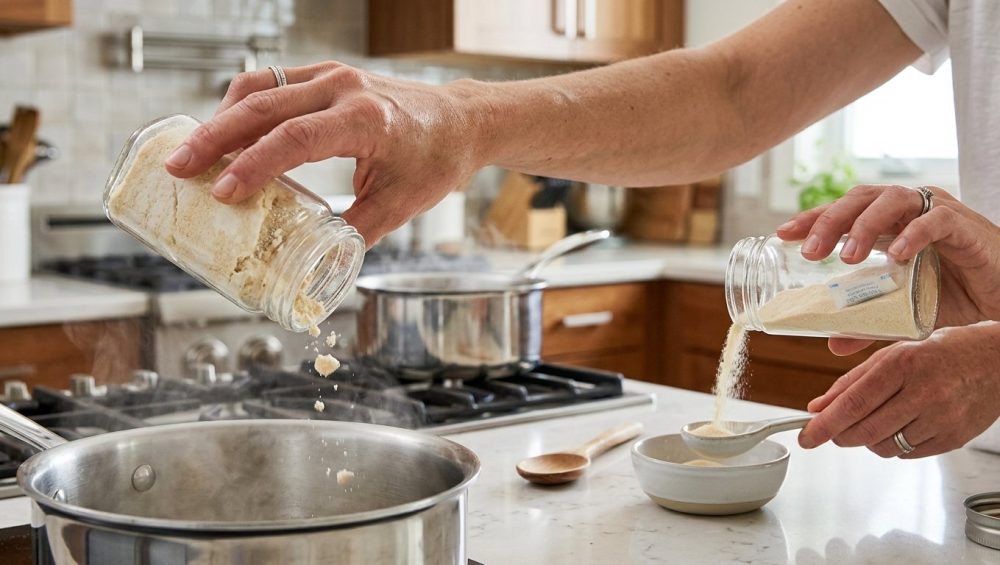
Picture your workflow: You are browning ground beef or simmering a pot of marinara sauce. The pan is hot, and a beautiful plume of steam is rising into the air. You grab your jar of expensive, filler-free onion powder, flip the shaker lid open, and aggressively shake it directly over the bubbling food.
Stop doing this immediately.
When you hold a spice jar over a hot pan, the rising steam enters the tiny holes of the shaker lid. You are injecting pure, concentrated water vapor directly into a jar of highly hygroscopic powder. The steam condenses on the inside of the relatively cooler glass or plastic walls. You snap the lid shut, trapping that moisture inside. As the jar cools down in your pantry, the water molecules bind to the spice particles, the crystalline bridges form, and by next Tuesday, you have a solid brick of onion powder.
The Pinch Bowl and Mise en Place Solution
Instead of surviving kitchen disasters caused by chaotic, improvised prep, you need to adopt the professional culinary habit of mise en place (everything in its place).
Keep your spice jars far away from the active cooking zone. Measure your spices into a small glass pinch bowl or a ramekin before you start cooking. When it is time to season your dish, you dump the contents of the pinch bowl into the pot.
If you want to absolutely maximize the flavor profile of your dish, measure your spices away from the stove, and consider blooming them in oil in the pan for thirty seconds before adding your wet ingredients. This technique unlocks the fat-soluble flavor compounds in the spices, elevating a mediocre meal to restaurant-quality status. But the golden rule remains: the spice jar never crosses the threshold of the steaming stove.
Environmental Sabotage: How Your Kitchen’s Microclimate is Ruining Your Spices
Even if you never shake a jar over a boiling pot, your kitchen’s ambient environment might be quietly destroying your pantry. Spices are complex biological materials containing volatile essential oils and pigments that are inherently unstable when exposed to unfavorable conditions.
Heat, Light, and Humidity: The Unholy Trinity
The three greatest enemies of dried spices are heat, light, and humidity.
- Heat: Heat accelerates the evaporation of the volatile oils that give spices their distinct aromas.
- Light: Ultraviolet radiation breaks down pigments. This is exactly why your vibrant red paprika and bright yellow turmeric turn into a sad, muted beige when left out on a counter.
- Humidity: As we have exhaustively covered, ambient moisture causes the caking and clumping.
Why the Stove-Adjacent Spice Rack is a Death Sentence
We have all seen those aesthetically pleasing, tiered spice racks designed to sit right next to the stovetop. They look beautiful on Instagram, but functionally, they are a death sentence for your ingredients.
Storing spices next to the stove subjects them to wild temperature fluctuations and constant plumes of boiling pasta water and simmering soups. You are essentially storing your hygroscopic powders in a sauna. Your spices must be stored in a cool, dark, and dry environment. A dedicated drawer away from the oven or a closed pantry shelf is mandatory.
And before you ask: No, you should not store your everyday spices in the refrigerator. While the cold environment does slow down the degradation of essential oils, refrigerators are inherently humid. More importantly, every time you take the cold jar out of the fridge and open it in a room-temperature kitchen, condensation immediately forms on the inside of the jar, accelerating the caking process.
The Definitive Guide to Rescuing a Hardened Spice Brick
Let us say the damage is already done. You have a solid block of garlic powder. Do you throw it away? Not necessarily. If the spice is relatively new and still possesses a strong, pungent aroma, you can absolutely salvage it.
The Mechanical Method: Mortar, Pestle, and Brute Force
The safest and most effective way to break up a hardened spice is mechanical force.
First, use a butter knife or a metal skewer to carefully chisel the block out of the jar. Once you have extracted the monolith, place it into a heavy granite or marble mortar and pestle. Grind it down with firm, circular motions until it returns to a fine powder.
If you do not own a mortar and pestle, place the brick inside a heavy-duty zip-top bag, seal it (pressing all the air out), wrap it in a kitchen towel, and gently smash it with a rolling pin or a meat mallet. For particularly stubborn, rock-hard blocks, you can even run them over a microplane grater to shave them back into a powder.
The Microwave Moisture-Zap (Proceed with Extreme Caution)
There is a thermodynamic shortcut to breaking up a spice brick, but it requires precision. You can use the dielectric heating of a microwave to turn the trapped moisture inside the clump into steam, which temporarily softens the crystalline bridges holding the block together.
Turn the hardened spice block out onto a ceramic plate. Place a dry paper towel over it. Microwave it on medium power for exactly 10 to 15 seconds. Do not exceed this time, or you will literally cook the essential oils and ruin the flavor. Carefully remove the plate (it may be warm) and immediately crush the softened block with the back of a spoon.
A crucial warning: Do not ever microwave the spice while it is still inside its plastic jar. If you are using cheap, flimsy plastic containers, you should be banishing toxic kitchen gear from your home entirely, but heating plastic is a hard line you must never cross. The heat will warp the plastic and rapidly accelerate the leaching of endocrine-disrupting chemicals directly into your food.
When to Surrender and Toss It
Spices do not technically spoil or become dangerous to eat in the way that dairy or meat does, but they do “die” from a culinary perspective.
If you chisel out a block of cumin and it smells like absolutely nothing, or if it smells faintly of dusty cardboard, throw it in the trash. The volatile oils have completely oxidized and evaporated. Cooking with dead spices is a guaranteed way to produce bland, disappointing food. As a general rule, ground spices lose their peak potency after about six to eight months. If your spice brick has been sitting in the pantry since the last presidential election, let it go.
Bulletproof Storage: How to Prevent Caking Forever
Rescuing a spice brick is annoying; preventing it from forming in the first place is the hallmark of a smart, efficient home cook. To achieve this, we need to completely overhaul your storage hardware and introduce industrial-grade moisture control to your pantry.
Upgrading Your Hardware: Ditching Cheap Plastics for Airtight Glass
This is where I, your Sassy Sous-Chef, must lay down the law. You must stop storing your spices in cheap plastic containers.
The plastic jars that most supermarket spices come in are fundamentally flawed. First, plastic is highly porous at a microscopic level. It allows micro-amounts of air and environmental humidity to continuously penetrate the barrier, accelerating the degradation and caking of your spices. Furthermore, plastic lids rarely provide a true, hermetic seal.
Beyond the moisture issue, there is a severe health and safety concern. Plastic containers degrade over time, especially when exposed to the ambient heat of a kitchen. As they degrade, they can leach harmful chemicals—like BPA and phthalates—directly into your seasonings. Furthermore, the mechanical friction of opening and closing plastic lids, or scraping the inside with a measuring spoon, causes the container to shed microplastics right into your food.
Glass, on the other hand, is the undisputed king of food storage. It is chemically inert, meaning it will never react with the acidic or oily components of your spices. It is completely non-porous, providing an absolute barrier against atmospheric moisture. It will never warp, it will never leach toxins, and it will never shed microplastics into your dinner.
If you are trying to build a beautifully organized dream kitchen, you must invest in high-quality, airtight glass storage. Look for borosilicate glass jars with heavy-duty silicone gaskets and metal or bamboo lids. If you want to be a true perfectionist, seek out amber or UV-blocking glass, which will protect the delicate pigments in your spices from light degradation. These are not luxury items; they are the fundamental beginner kitchen tools required to protect your ingredients and your health.
Food-Safe Desiccants: Your New Best Friend
Upgrading to airtight glass is step one. Step two is managing the moisture that is already inside the jar, or the humidity that enters during the brief seconds you have the lid open. To do this, we borrow a trick from the pharmaceutical and commercial packaging industries: desiccants.
Dropping a small desiccant packet into each of your spice jars is the single most effective way to prevent clumping. Desiccants actively adsorb vapor, physically pulling water molecules into their pores and holding them there, keeping the relative humidity inside the jar near zero.
However, you cannot just use any random desiccant you find in a shoebox. You must specifically purchase Food-Grade desiccants.
There are two primary types of food-safe desiccants suitable for home spice storage:
1. Silica Gel (Food Grade)
Silica gel is the highly versatile workhorse of moisture control. It is a synthetic, highly porous material that can adsorb up to 30% to 40% of its own weight in water. It reacts incredibly fast to sudden spikes in humidity—such as when you open a jar on a rainy day.
Crucial Safety Note: You must buy FDA-approved, food-grade silica gel packets. The beads inside should be white or clear. Never use the blue indicating silica gel packets near food, as they contain cobalt(II) chloride, which is toxic.
2. Bentonite Clay (Montmorillonite)
If you prefer a 100% natural, eco-friendly option, bentonite clay is phenomenal. It is a naturally occurring mineral that is FDA-approved for direct contact with dry foods like spices. While it absorbs slightly less moisture than silica gel (around 25% of its weight), it is incredibly effective at maintaining stable humidity in room-temperature environments. It is also biodegradable, making it the superior choice for the environmentally conscious cook.
Simply purchase a bulk bag of 1-gram or 2-gram food-grade silica or clay packets online, and drop one into every single spice jar you own. Your garlic powder will remain as free-flowing as desert sand for months on end.
The Rice Trick: Does It Actually Work?
If you have ever eaten at a retro diner, you have likely seen grains of raw, uncooked white rice sitting at the bottom of the salt shakers. Is this just an old wives’ tale, or does it actually work?
It does work, but not as well as you might think. Raw rice is mildly hygroscopic, so it will absorb a tiny fraction of ambient moisture. However, its primary mechanism of action is mechanical. The hard grains of rice act as physical agitators. When you shake the jar, the heavy rice grains smash into the salt or spice particles, physically breaking up microscopic clumps before they have a chance to fuse into larger bricks.
While adding a half-teaspoon of dry rice to your onion powder will certainly help, it is a vastly inferior solution compared to a dedicated, highly porous silica gel or bentonite clay desiccant packet.
The Sassy Sous-Chef’s Master Protocol for Spice Management
We have covered the chemistry, the hardware, and the preventative maintenance. Now, let us establish a permanent protocol for how you handle your pantry moving forward.
Auditing Your Collection
Tonight, I want you to pull every single spice jar out of your cabinet. Open them one by one. If the color is faded to a depressing gray-brown, throw it out. If you have to aggressively inhale just to detect a faint scent, throw it out.
Implementing a rigorous inventory system will transform your daily meals by ensuring you are always cooking with vibrant, aromatic ingredients.
Smart Purchasing Habits
Stop buying ground spices in massive, industrial-sized plastic vats unless you are actively running a commercial catering business. It takes the average home cook years to go through a pound of ground cumin. By the time you reach the bottom half of that container, the spice is dead, oxidized, and likely clumped into a solid mass.
Buy your spices in small, manageable quantities that you can reasonably consume within six months.
Better yet, transition to buying whole spices whenever possible. Whole cumin seeds, coriander seeds, and black peppercorns have exponentially less surface area exposed to the air compared to their pre-ground counterparts. Because their interior volatile oils are protected by the intact cellular structure of the seed, whole spices can last for years in a cool, dark pantry without losing their potency. When you need them, you simply toast them in a dry skillet for sixty seconds and grind them fresh in a mortar and pestle or a dedicated electric spice grinder. The flavor difference is staggering.
If you absolutely must buy pre-ground spices in bulk to save money, do not keep the entire bulk bag in your active cooking zone. Decant a small, one-month supply into your airtight, glass, desiccant-protected jar. Then, take the remaining bulk powder, vacuum-seal it in a heavy-duty bag to remove all the oxygen, and store it in the deepest, darkest, coolest corner of your pantry.
Conclusion: Reclaiming Your Prep Time
Cooking should be a joy, not a frustrating battle against petrified ingredients. You do not need a culinary degree to master the art of the kitchen. You simply need to respect the food science, understand how moisture and temperature interact with your ingredients, and refuse to settle for subpar, toxic storage equipment.
By keeping your spices away from the steaming stove, ditching the porous plastic for airtight glass, and utilizing food-safe desiccants, you will permanently eliminate the dreaded spice brick from your life. You have the power to survive the kitchen and produce restaurant-quality food without the unnecessary stress. Now, go clean out your spice cabinet, throw away that three-year-old rock of garlic powder, and get back to cooking like the boss you are.