Picture this: It is 7:00 PM on a Tuesday. You have survived the endless emails, the miserable commute, and the sheer existential dread of being a functioning adult. You decide to treat yourself to a comforting, carb-heavy bowl of pasta. You boil the noodles, heat up a jar of marinara, dump the pasta into a bowl, and slop the red stuff on top. But when you twirl your fork, you are met with a culinary tragedy: a watery, red puddle of sadness pooling at the bottom of your bowl, while dry, naked noodles sit on top, completely devoid of flavor. Your sauce has split. Your dinner is ruined. And frankly, you deserve better.
Listen to me. You do not need a culinary degree from Le Cordon Bleu to fix this. You do not need to spend hours making a complicated roux, and you certainly do not need to dump a pint of heavy cream into your skillet to force your sauce to behave. The secret to glossy, restaurant-quality pasta is literally pouring down your drain every single time you cook. I am talking about pasta water. Yes, that cloudy, salty, seemingly useless liquid gold is the ultimate culinary cheat code for elevating your simple weeknight dinners without breaking a sweat. Today, we are going to dive deep into the science of emulsification, banish the watery puddle for good, and teach you how to cook like an absolute pro. Grab a glass of wine, and let us get to work.
The Science of the Split: Why Oil and Water Hate Each Other
Before we can fix the problem, we need to understand why your sauce is throwing a tantrum in the first place. At its core, cooking is just edible chemistry. And the most fundamental rule of chemistry that applies to your dinner plate is this: oil and water absolutely despise each other.
Think about the components of a standard pasta dish. You have water (from the tomatoes, the vegetables, and the residual moisture on the boiled noodles) and you have fat (the olive oil you used to sauté the garlic, the butter you stirred in, or the fats naturally present in cheese and ground meat). When you simply mix these two elements together, they might temporarily co-exist, but they will inevitably separate as the electrochemical forces push the molecules apart. The fat droplets will merge together and rise to the top because they are less dense, while the water will pool at the bottom,. This is why you end up with a greasy slick on top of your spaghetti and a watery mess underneath.
In the culinary world, forcing oil and water to play nicely together is called an emulsion. An emulsion is a mixture of two liquids that normally want absolutely nothing to do with each other, where one is suspended in the other. To keep them from separating, you need an emulsifier—a functional, stabilizing agent that coats the fat droplets and prevents them from clumping back together,. In mayonnaise, the emulsifier is the lecithin found in egg yolks. In a classic vinaigrette, it is often the mucilage in mustard. But in pasta? Your emulsifier is starch. Failing to utilize this natural thickener is one of the most common rookie kitchen mistakes that separates the amateurs from the seasoned home cooks.
Enter the Hero: The Magic of Starch Gelatinization
So, what exactly is happening in that pot of boiling water? It is not just getting hot; it is undergoing a profound structural transformation known as starch gelatinization.
Pasta is primarily made from durum wheat semolina, which is packed with complex carbohydrates, specifically two types of starch molecules: amylose and amylopectin. When pasta is dry, these starch granules are tightly packed and highly crystalline. But when you drop that pasta into boiling water, the combination of intense heat and moisture triggers a violent reaction.
Between the temperatures of 60°C and 80°C (140°F to 176°F), those tightly packed starch granules begin to absorb water. They swell up like microscopic water balloons. Eventually, they swell so much that they burst, releasing long chains of amylose and amylopectin directly into the cooking water. Amylose, being a linear molecule, diffuses out into the water much more easily than the branched amylopectin. This is exactly why your pasta water turns cloudy. It is no longer just water; it is a dynamic, temperature-sensitive colloidal dispersion containing dissolved starch, sodium chloride, and suspended micro-particulates.
When you add this starchy water to your sauce, those long, sticky starch molecules act as a physical barrier. They form a microscopic “jacket” around the fat droplets in your olive oil or cheese, preventing them from coalescing and separating from the water. The result? A perfectly smooth, cohesive, velvety sauce that clings to every single noodle. No heavy cream required. No pretentious recipe jargon needed. Just pure, unadulterated food science working in your favor.
The Bronze-Die Difference: Not All Pasta is Created Equal
Now, before you go ladling water into your skillet, we need to have a serious talk about the pasta you are buying. If you are buying the absolute cheapest box of smooth, shiny pasta on the supermarket shelf, you are shooting yourself in the foot before the water even boils.
Commercial pasta is extruded through metal dies to give it its shape. Cheap, mass-produced brands use Teflon dies. Teflon is slick and fast, which is great for factory efficiency, but it leaves the pasta with a perfectly smooth, shiny surface. A smooth surface means less surface area, which means the pasta releases far less starch into the boiling water.
High-quality, artisanal pasta is extruded through traditional bronze dies. Bronze is rough and creates micro-abrasions on the surface of the pasta as it pushes through the machine. If you look closely at a box of bronze-cut pasta, it looks chalky, textured, and almost dusty. That rough surface area is an absolute starch-releasing powerhouse. It dumps massive amounts of amylose into your cooking water, giving you a significantly thicker, more effective emulsifying liquid. Upgrading to bronze-die pasta is one of my favorite latest kitchen discoveries that instantly elevates the texture of your final dish.
Furthermore, the way pasta is dried at the factory fundamentally alters how it releases starch. When pasta is dried at extremely high temperatures (around 95°C), the protein network coagulates rapidly, trapping the starch granules inside and restricting their ability to swell and gelatinize during cooking. However, artisanal pastas dried slowly at low temperatures (around 55°C) allow for a slower, more graceful protein denaturation when you boil them. This means the starch has time to swell, gelatinize, and disperse into your water, yielding a far superior emulsifying liquid. Spend the extra dollar on the slow-dried, bronze-cut pasta. Your sauce will thank you.
The Historical Context: How Italian Nonnas Mastered Chemistry Before Scientists
Long before physicists were publishing papers on interfacial rheology, Italian grandmothers were utilizing the magic of starch gelatinization to create some of the most iconic dishes in the world. They intuitively understood that pasta water was not waste; it was the foundational ingredient of the sauce itself.
Take Cacio e Pepe, for example. This Roman classic consists of literally just Pecorino Romano cheese, black pepper, and pasta. If you simply dump grated cheese onto wet pasta, you will get a clumpy, stringy, greasy disaster. But by incorporating the starchy pasta water, the amylose stabilizes the cheese proteins, preventing them from aggregating and turning into a homogenous, creamy sauce without a single drop of actual cream.
The same principle applies to Spaghetti Aglio e Olio (garlic and oil). Mixing oil and water should result in a split mess, but the starch-enriched water stabilizes the emulsion, preventing the oil from separating into suspended droplets and instead forming a luscious glaze. Even Carbonara relies on this chemistry; the starch released from the pasta, working in tandem with the lecithin from the egg yolks, acts as the ultimate emulsifier to bind the rendered pork fat and cheese into a thick, custard-like coating. These historical recipes are masterclasses in molecular gastronomy, disguised as humble peasant food.
The Great Water Myth: Stop Drowning Your Noodles
For decades, recipes have peddled a massive culinary lie: “Boil your pasta in a massive pot with a gallon of water so it has room to swim.” I am officially giving you permission to ignore this nonsense. When you boil a pound of pasta in six to eight quarts of water, you are heavily diluting the starch concentration. Drowning your noodles like they owe you money is actively ruining your sauce.
Remember, the entire goal here is to harvest starch. If you dilute that starch in an ocean of water, your liquid gold becomes weak, watery tin. Food science dictates that your pasta water needs to hit a specific starch concentration threshold—typically around 0.6% w/v or higher—for effective emulsification to occur.
Instead of lugging a giant stockpot out of your cabinet, use a wide saucepan or a standard pot and use just enough water to comfortably cover the noodles. A good rule of thumb is to use about two to four quarts of water per pound of pasta, rather than the traditional four to six,. By using less water, the starch that naturally releases from the pasta is concentrated. The resulting water will be opaque, dark, thick, and incredibly viscous. Some clever home cooks even use a frying pan pasta trick, cooking the noodles in a shallow skillet with minimal water to create a hyper-starchy slurry that binds sauces instantly. Time is money, especially on a busy Tuesday night, and boiling two quarts of water is drastically faster than boiling six.
The Golden Rules of Harvesting Liquid Gold
Now that we have established that starchy water is the glue holding your culinary life together, let us talk about how to properly extract and use it. There are three unbreakable rules you must follow to get this right.
First, salt your water correctly. You have probably heard the old, romanticized adage that pasta water should be “as salty as the sea”. While poetic, the actual ocean is about 3.5% salinity, which would make your pasta completely inedible. You want your water to be aggressively seasoned—about two tablespoons of kosher salt per gallon of water. The salt not only flavors the pasta from the inside out, but the dissolved sodium chloride actually plays a synergistic role with the starch in lubricating the granules and stabilizing the colloidal dispersion.
Second, timing is everything. Do not scoop your pasta water at the beginning of the boil. The starch needs time to gelatinize and leach into the water. Wait until the absolute last minute of cooking—right before you drain the pasta—to reserve your water. By this point, the starch concentration is at its absolute peak. Never reserve the water after draining by letting it sit in a cold bowl, because starch precipitates rapidly when the temperature drops below 60°C, forming insoluble aggregates that will not re-dissolve.
Third, and I cannot stress this enough: never, ever rinse your cooked pasta. Rinsing washes away the sticky surface starch that helps the sauce cling to the noodles. It is a crime against Italian grandmothers everywhere. By following these basic principles, you will be well on your way to conquering weeknight cooking anxiety and producing flawless, stress-free meals.
Mantecatura: The Italian Art of the Vigorous Toss
Having a mug of starchy water is only half the battle. The real magic happens in the pan, through a traditional Italian technique known as mantecare or mantecatura. This is the process of emulsifying fat and starchy water through violent, mechanical agitation.
Here is the step-by-step masterclass: You must pull your pasta out of the boiling water about two to three minutes before it reaches the al dente stage indicated on the box. The Italians call this al chiodo, meaning “to the nail”—it should still have a hard, uncooked core.
Transfer that undercooked pasta directly into a wide skillet containing your simmering sauce. Next, pour in a splash (about a quarter cup to start) of your reserved, hot pasta water. Now, turn up the heat slightly and start tossing. And I mean really tossing. You are not just gently stirring with a wooden spoon; you are vigorously shaking the pan back and forth, flipping the pasta through the air.
This physical agitation is non-negotiable. When you toss the pasta, you are engaging in interfacial rheology. The kinetic energy from your tossing physically shears the fat droplets, breaking them down into smaller and smaller microspheres. Simultaneously, the amylose polymers from the starchy water rush in and wrap around these newly formed micro-droplets,. Tensiometry tests have shown that this specific process reduces the surface tension of the sauce by up to 37%, creating a low-viscosity, high-adhesion colloidal suspension.
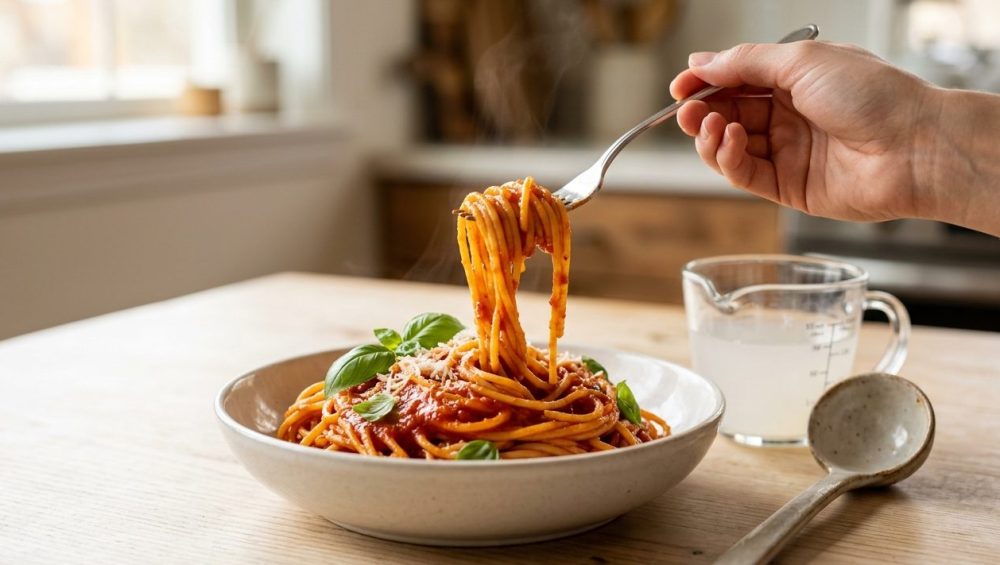
In layman’s terms: the sauce becomes incredibly sticky and clings to the pasta like a second skin. As the pasta finishes cooking in the sauce, it absorbs the seasoned liquid, releasing even more starch directly into the pan. Within 60 to 90 seconds, you will literally see the sauce transform. It will change from a watery, split mess into a glossy, opaque, velvety glaze that coats the back of a spoon. If you want a deeper dive into controlling heat and friction in the pan, understanding how to maintain stick-free searing will give you the confidence to toss aggressively without fear of scorching your dinner.
Troubleshooting: When Your Sauce Still Throws a Tantrum
Okay, so you bought the bronze-cut pasta, you used less water, and you tossed like a maniac, but your sauce still looks like a broken, greasy disaster. Do not panic. Let us troubleshoot the chemistry.
The most common culprit for a broken emulsion is temperature abuse. Starch is a great stabilizer, but it cannot perform miracles if you nuke your proteins. This is especially true in cheese-heavy sauces like Cacio e Pepe or Alfredo. If your pan is too hot when you add the cheese, the dairy proteins will rapidly denature and separate from their fats. In fact, food physicists have found that Pecorino Romano cheese mixed with water will form massive, stringy clumps at exactly 65°C (149°F) if there is not enough starch present,. To prevent this, you must take the pan completely off the heat before vigorously stirring in your cheese and starchy water. Let the ambient heat of the pasta melt the cheese gently. If you scorch it, your cheese sauce turns grainy and the damage is irreversible.
Another issue could be acidity. If you are making a highly acidic tomato sauce or using a lot of lemon juice, be aware that a pH lower than 4.2 can actually denature starch, reducing its viscosity by up to 70%. In these cases, you might need to add slightly more pasta water, or ensure you are using a very vigorous mechanical toss to compensate for the weakened starch.
What if you are cooking gluten-free pasta? The science changes drastically. Most gluten-free pastas made from rice, corn, or quinoa blends release very little amylose; their starch is overwhelmingly amylopectin-dominant. Amylopectin gels irreversibly and can turn your sauce into a gummy, sticky nightmare rather than a silky emulsion. If you are using GF pasta, reserve significantly less water (only about 30 to 40 mL) and add it during the last two minutes of cooking, not at the end, to avoid sudden, catastrophic thickening.
And what if you accidentally drained all your pasta water down the sink? We have all done it. Do not resort to heavy cream. You can fake pasta water by making a quick cornstarch slurry. Whisk a quarter teaspoon of cornstarch into a half cup of warm tap water and heat it until it turns clear. It will provide the exact same amylose chains needed to rescue your sauce and bind the fats.
The Gear Check: Why Your Toxic Pan is Ruining the Toss
I cannot end this masterclass without addressing the elephant in the room: your cookware. You can understand the molecular biology of starch gelatinization perfectly, but if you are trying to execute a mantecatura in a flimsy, scratched-up, $15 non-stick pan from a big-box store, you are setting yourself up for failure.
I have a strict “no-go” rule on toxic, cheap kitchenware. Those synthetic non-stick coatings are not only terrible for your health when they inevitably start flaking into your food, but they are also functionally useless for this technique. A proper emulsion requires high heat to evaporate excess moisture rapidly, and vigorous friction to bind the sauce. Cheap non-stick pans cannot handle high heat without degrading, and their slippery surfaces actively discourage the friction needed to build a cohesive sauce. Plus, there is nothing more tragic than a pan losing their slip right in the middle of dinner prep.
Let us also talk about thermal mass and heat retention. When you drop cold, wet pasta into a skillet of hot sauce, the temperature of the pan plummets. A cheap, thin aluminum pan will struggle to recover that heat. The temperature drop stalls the evaporation of the excess water, leaving you with a soggy mess. A heavy-bottomed, multi-clad stainless steel pan, however, has immense thermal mass. It retains its heat, rapidly bringing the liquid back to a simmer, which is essential for boiling off the excess water and tightening the emulsion before the pasta overcooks.
If you want to cook like a pro, you need to invest in safe, durable gear. In professional Italian kitchens, chefs use a saltapasta—a lightweight, high-walled aluminum sauté pan specifically engineered for tossing pasta. For the home cook, a high-quality, fully-clad stainless steel skillet or a well-seasoned carbon steel pan is absolutely essential. The high, curved walls allow you to flip the pasta aggressively without launching marinara across your kitchen walls. If you are serious about banishing toxic kitchen gear, upgrading your skillet is the single most impactful change you can make for your weeknight pasta game.
At the end of the day, cooking is not about blindly following a list of arbitrary steps; it is about understanding the simple “whys” behind the food. Your pasta sauce separates because oil and water are natural enemies. Starchy pasta water is the diplomatic mediator that forces them to get along. By utilizing the hidden magic of starch gelatinization, restricting your boiling water, and mastering the vigorous toss, you can instantly transform a mediocre, watery weeknight dinner into a glossy, restaurant-caliber masterpiece. You do not need professional training, and you certainly do not need to rely on heavy cream to cheat your way to a thick sauce. You just need a little bit of science, a good pan, and the confidence to toss your noodles like you mean it. Now get into the kitchen, save that liquid gold, and stop eating sad pasta.