Listen, I love you, but we need to have a serious talk about your spice cabinet. Specifically, we need to talk about that sad, dusty jar of generic cumin sitting in the dark recesses of your pantry since the pre-pandemic era. You know the one. You pull it out on Taco Tuesday, dump a powdery spoonful directly into a simmering pot of watery tomato sauce, and then stand over the stove wondering why your food tastes like seasoned cardboard. You blame the recipe. You blame your lack of culinary school training. You might even blame the grocery store.
Stop it. Put the jar down and listen to me.
The problem isn’t that you lack a Michelin-starred palate, and it certainly isn’t that you need to spend eighty dollars on artisanal, hand-forged spice blends. The problem is your technique. You are fundamentally misunderstanding how flavor works on a molecular level. You are treating spices like magic pixie dust that you can just sprinkle over a finished dish to make it taste good. But spices aren’t magic. They are tiny, stubborn little vaults of chemical compounds, and they refuse to give up their goods unless you know the combination to the safe.
That combination is hot fat.
Welcome to the masterclass on “blooming” spices. This is the single most transformative, low-effort, high-impact cooking hack you will ever learn. It takes exactly thirty seconds, costs absolutely nothing, and will instantly bridge the gap between amateur weeknight slop and restaurant-quality depth. If you want to know how to extract massive, mind-blowing flavor from the basic pantry staples you already own, buckle up. We are about to change the way you cook forever.
The Dusty Spice Cabinet Intervention
Let’s paint a picture of the average weeknight cooking scenario. You’re exhausted, you’re hungry, and you’re trying to throw together a quick curry or a pot of chili. The recipe calls for a tablespoon of chili powder, a teaspoon of turmeric, and a dash of coriander. You dutifully measure out these dry, powdery substances and dump them straight into your simmering broth or crushed tomatoes. You stir it up, take a taste, and sigh. It tastes flat. It tastes gritty. It tastes like the ghost of a flavor rather than the real thing.
This is because raw, dry spices are essentially dormant. When spices are dried and ground, their volatile aromatic oils are locked away behind tough cellular walls. Tossing them into a watery liquid is the culinary equivalent of throwing a locked treasure chest into the ocean and hoping it opens on its own. It won’t. Water is a terrible solvent for the complex flavor molecules trapped inside your spices.
This is one of the most common rookie kitchen mistakes that keeps home cooks trapped in a cycle of bland, uninspiring meals. You can add all the salt in the world, but it won’t fix the underlying issue. Sure, sometimes your dinner actually needs acid to brighten up a heavy dish, but if the foundational spices haven’t been properly awakened, a squeeze of lemon is just putting lipstick on a pig. To get the flavor out of the spice and into your food, you have to run it through a medium that actually understands its chemistry.
What Exactly Is “Blooming” Spices?
Blooming—also known in various global cuisines as tempering, tadka, chhonk, or sofrito—is the process of briefly frying whole or ground spices in hot fat (like oil, butter, ghee, or animal fat) before adding any liquid to the pan. It is a foundational technique that has been used for centuries across India, Latin America, the Middle East, and Southeast Asia to maximize the potency of aromatics.
Think of blooming as a hyper-efficient extraction process. By exposing the spices to direct heat and lipids, you are fundamentally altering their physical and chemical structure, turning them from dry, dusty fragments into a liquid flavor bomb that will coat every single molecule of your finished dish.
The Science of Fat-Soluble Flavors
To understand why blooming is non-negotiable, we have to talk about science. Don’t roll your eyes; I promise to keep the pretentious chef-speak to a minimum.
The distinctive aromas and tastes of your favorite spices come from complex organic molecules—specifically terpenes, aldehydes, phenols, and esters. For example, the fiery kick of a chili pepper comes from capsaicin. The sharp, nose-tingling punch of black pepper comes from piperine. The earthy, herbaceous aroma of thyme comes from thymol.
Here is the crucial scientific fact that changes everything: the vast majority of these potent flavor compounds are fat-soluble, not water-soluble.
When you heat spices in oil, several things happen in rapid succession. First, the intense heat of the fat physically ruptures the tough cellular walls of the dried spice, forcing the plant material to release its trapped compounds. Second, because these compounds are lipophilic (fat-loving), they instantly dissolve into the surrounding oil. The oil acts as a perfect solvent, pulling the flavor out of the solid spice and infusing it into the liquid fat.
Furthermore, the heat triggers the Maillard reaction—the same complex chemical browning process that makes a seared steak or a toasted marshmallow taste so incredible. Sugars and amino acids within the spices undergo chemical changes, creating entirely new, deeper, and nuttier flavor profiles that simply do not exist in the raw spice.
Water vs. Oil: The Flavor Extraction Battle
If you try to execute this extraction process in water—say, by simmering your spices in a soup or a watery tomato sauce—you are fighting a losing battle. Water cannot dissolve fat-soluble compounds. Simmering spices in water will eventually soften them, but the essential oils will largely remain trapped inside the plant fibers, or worse, they will evaporate into the steam and make your kitchen smell great while leaving your food tasting exceptionally bland.
In a rigorous laboratory test conducted by the culinary scientists at Cook’s Illustrated, researchers found that steeping spices in hot oil extracted up to ten times more flavor compounds than steeping those exact same spices in water. Let that sink in. By skipping the blooming step, you are leaving 90% of your spice’s flavor potential entirely on the table.
Moreover, fat is a phenomenal flavor carrier. It coats the tongue and adheres to your taste receptors much more strongly than water does, ensuring that those extracted flavor molecules linger on your palate, creating a rich, sustained, and full-bodied sensory experience.
Why You Need to Stop Dumping Raw Spices into Liquids
If the science hasn’t convinced you, let’s talk about the physical experience of eating raw spices.
The “Powdery” Mouthfeel Phenomenon
Have you ever taken a bite of a homemade chili or a quick weeknight curry and noticed a distinct, gritty, dusty texture on your tongue? It feels a bit like you’ve just eaten a spoonful of flavored sand. That is the unmistakable signature of unbloomed ground spices. When you dump ground cumin, paprika, or coriander directly into a liquid, the powder clumps together. It hydrates unevenly, creating microscopic pockets of raw, bitter, dusty plant matter. Blooming in hot fat completely eliminates this issue. The fat lubricates and disperses the spice particles, transforming them into a silky, integrated paste that melts seamlessly into your sauce.
The Lost Potential of Your Grocery Store Spices
Let’s be brutally honest: most of the spices sitting in the average home kitchen are past their prime. Unless you are meticulously grinding your own whole spices every single night (and let’s be real, you have a day job, you aren’t doing that), your pre-ground grocery store spices have already lost a significant portion of their volatile oils to evaporation and oxidation.
Blooming is the ultimate resuscitation technique for tired spices. The intense heat and lipid extraction can coax an astonishing amount of flavor out of even the most mediocre, six-month-old jar of generic supermarket oregano. It is one of my absolute foolproof cooking secrets for making cheap ingredients taste incredibly expensive.
The Masterclass: How to Bloom Spices Like a Pro (Without Burning Your House Down)
Alright, enough theory. Let’s get into the mechanics of how you actually execute this technique on a busy Tuesday night. It is incredibly simple, but it requires your undivided attention. Spices can go from beautifully toasted to a bitter, acrid disaster in a matter of seconds.
Step 1: Choosing the Right Fat
The fat you choose will dictate the background flavor profile of your entire dish.
- Ghee or Clarified Butter: The absolute gold standard for Indian and Middle Eastern cooking. It has a high smoke point and contributes a rich, nutty, luxurious flavor.
- Olive Oil: Perfect for Mediterranean, Italian, and Latin American dishes. Extra virgin is fine for gentle blooming, but a standard olive oil offers a safer smoke point.
- Neutral Oils (Avocado, Canola, Grapeseed): Ideal for Asian stir-fries or dishes where you want the pure, unadulterated flavor of the spice to shine without any interference from the oil itself.
- Animal Fats (Bacon Fat, Schmaltz, Beef Tallow): If you are making chili or tacos, blooming your spices in rendered animal fat is a cheat code for unbelievable savory depth.
Step 2: The Temperature Sweet Spot
You want your oil hot, but not smoking. If the oil is smoking, it is too hot, and your spices will instantly incinerate. For whole spices, you are aiming for an oil temperature around 350°F (175°C). You can test the oil by dropping a single cumin seed or mustard seed into the pan. If it sinks and does nothing, the oil is too cold. If it instantly turns black and emits a plume of acrid smoke, take the pan off the heat immediately. If it hits the oil, sizzles happily, and dances on the surface, you are in the sweet spot.
Step 3: Timing is Everything (The 30-Second Rule)
Once your oil is ready, add your spices. This is an active process. You cannot walk away to check your phone or yell at your kids.
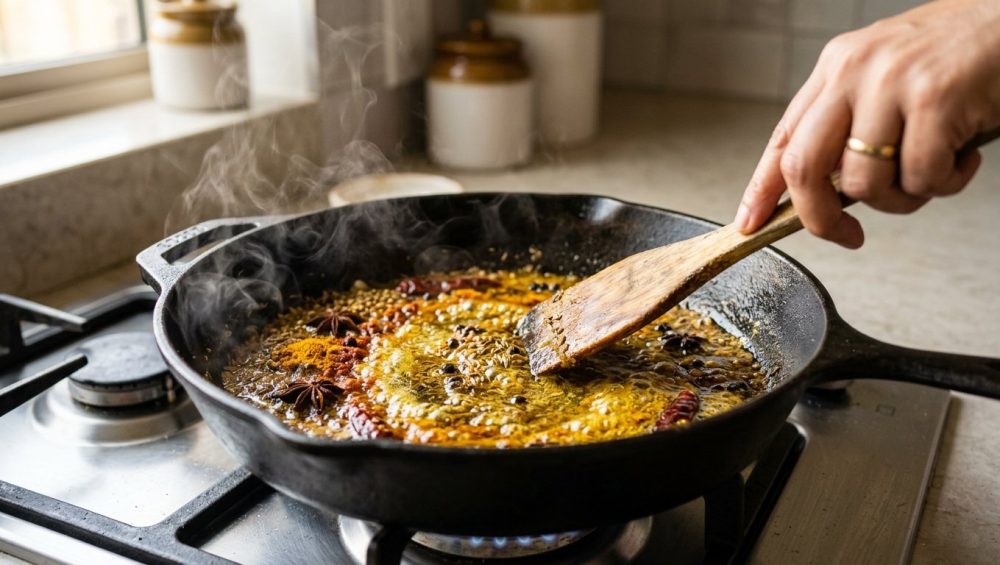
- Whole Spices: These need about 30 to 60 seconds. You will visually see them darken slightly, and you will hear them crackle, pop, and sputter. When your kitchen suddenly smells like a five-star restaurant, they are ready.
- Ground Spices: These are highly delicate and burn incredibly fast because of their massive surface area. They only need about 15 to 30 seconds in the hot fat. In many traditional recipes, ground spices are actually added off the heat, using only the residual heat of the oil to bloom them safely.
Step 4: The Liquid Quench
This is the most critical step. Once the spices have bloomed, you must immediately halt the cooking process to prevent them from burning. You do this by quenching the pan with your liquid or moisture-heavy ingredients. This could be tossing in your diced onions (which release water to drop the pan’s temperature), pouring in canned crushed tomatoes, splashing in some broth, or adding a squeeze of citrus. The sudden drop in temperature locks in the extracted flavors and protects the fragile spice compounds from scorching.
The “No-Go” Rule: Why Your Pan Matters (A Warning on Toxic Gear)
As your favorite Sassy Sous-Chef, I have zero patience for pretentious culinary gatekeeping, but I have even less patience for dangerous, toxic garbage in the kitchen. My crusade for banishing toxic kitchen gear from your home is not just about aesthetics; it is a matter of basic health and safety.
When you bloom spices, you are heating a thin layer of oil in an otherwise empty pan over medium to medium-high heat. If you are doing this in a cheap, scratched-up Teflon (PTFE) non-stick skillet, you are playing a very dangerous game.
The Dangers of Cheap Non-Stick at High Heat
PTFE non-stick coatings are fundamentally unstable at high temperatures. When a non-stick pan is heated empty or with just a tiny splash of oil, its surface temperature can skyrocket past 500°F (260°C) in less than three minutes. At these temperatures, the chemical bonds in the PTFE coating begin to break down and degrade.
When this degradation occurs, the pan off-gasses a cocktail of invisible, highly toxic fluorocarbon fumes. Inhaling these fumes causes a medical condition known as “polymer fume fever,” widely referred to in the industry as the “Teflon flu”. Symptoms include severe chills, fever, body aches, chest tightness, and a hacking cough. Furthermore, these exact same fumes are notoriously lethal to pet birds; a phenomenon known as “Teflon toxicosis” can kill a parrot or canary in minutes just from being in the same house as an overheating non-stick pan.
Do not bloom spices in cheap non-stick pans. Period.
The Best Pans for Blooming Spices
To execute this technique safely and effectively, you need cookware that can handle localized high heat without releasing chemical warfare agents into your kitchen.
- Carbon Steel: The reigning champion of the professional kitchen. It heats quickly, responds instantly to temperature changes, and is virtually indestructible.
- Stainless Steel: A heavy-bottomed, multi-clad stainless steel skillet is perfect for this. It distributes heat evenly and allows you to clearly see the color of your oil and spices so you can gauge the bloom perfectly. And yes, with proper technique you can prevent food sticking to the pan entirely, rendering non-stick coatings obsolete.
- Cast Iron: Fantastic for heat retention, though its dark color can make it slightly tricky to see when your spices are perfectly browned versus burnt.
Whole vs. Ground Spices: The Blooming Hierarchy
Not all spices are created equal, and they cannot be treated the same way in the pan. Understanding the hierarchy of spices will save you from bitter, acrid disasters.
Blooming Whole Spices (The Foundation)
Whole spices—like cumin seeds, coriander seeds, brown mustard seeds, fennel seeds, and whole dried chilies—are the robust, heavy lifters of the spice world. They have a much smaller surface area exposed to the hot oil, meaning they can withstand higher temperatures for a longer period of time without burning.
When you drop whole spices into hot fat, the transformation is highly visual and auditory. Mustard seeds will literally pop and bounce around the pan. Cumin seeds will sizzle, darken in color, and release an intoxicating, earthy fragrance. Dried chilies will puff up, their skins blistering as the heat activates their capsaicin oils. This process takes about 30 to 60 seconds.
This is where the magic of chemistry happens. Much like mastering the Maillard reaction on a beautifully seared steak, the high heat forces the amino acids and sugars inside the whole spices to interact, creating entirely new, savory, complex flavor compounds.
Blooming Ground Spices (The Quick Fix)
Ground spices—like paprika, turmeric, cayenne pepper, and ground cumin—are incredibly delicate. Because they have been pulverized into dust, their surface area is massive. If you drop a spoonful of ground paprika into 350°F oil, it will scorch and turn into bitter, black ash in less than five seconds.
To bloom ground spices safely, you must alter your technique. The best method is to bloom your whole spices and aromatics (like onions and garlic) first. Once the onions have released some moisture and slightly cooled the pan, drop your heat to low. Add your ground spices, stir vigorously for exactly 15 to 30 seconds until they become fiercely fragrant, and then immediately dump in your liquid (broth, tomatoes, coconut milk) to quench the pan.
Global Traditions: Who Invented Blooming?
I want to be very clear: I did not invent this technique, and neither did some twenty-two-year-old food influencer on TikTok. Blooming is an ancient, revered culinary tradition that forms the absolute backbone of several of the world’s greatest cuisines.
The Indian Tadka (Chhonk or Tempering)
In Indian cuisine, the technique of blooming spices in hot fat is an art form known as tadka, chhonk, baghaar, or phoron, depending on the specific region. It is not just a cooking step; it is considered the soul of the dish.
A traditional tadka is often prepared in a dedicated, tiny, deep-welled pan. Ghee or mustard oil is heated until shimmering. Whole spices like black mustard seeds, cumin seeds, and dried red chilies are added, followed by fresh aromatics like ginger, garlic, and curry leaves, and finally, a pinch of pungent hing (asafoetida).
The brilliance of the tadka is in its application. While spices are often bloomed at the beginning of a curry to build a foundation, a tadka is frequently poured over a finished dish—like a pot of creamy dal—right before serving. The hot, spiced ghee hits the surface of the lentils with a dramatic, sizzling sound (the Hindi word chaunk is actually an onomatopoeia for this exact “chunnnn” sound). The fat pools on the surface, carrying the fierce, freshly extracted volatile oils directly to the diner’s palate. In Ayurvedic tradition, this is more than just flavor building; it is a sacred act that unlocks the medicinal and digestive properties of the spices, infusing the food with prana (life force).
Latin American Sofrito and Achiote Oil
The concept of fat-extraction is equally crucial in Latin American and Caribbean cooking. Consider the creation of achiote oil, where hard, red annatto seeds are gently heated in oil or lard until they release their vibrant, fiery orange color and earthy, peppery flavor. This bloomed oil then becomes the foundation for rice dishes, tamales, and stews. Similarly, a proper sofrito relies on sizzling aromatics and spices in fat to create a concentrated flavor base before any liquids are introduced.
Middle Eastern and Mediterranean Applications
If you’ve ever had a truly spectacular bowl of Turkish eggs (Çılbır) or a vibrant Lebanese hummus, you have experienced blooming. The dazzling drizzle of red oil over the top is created by blooming Aleppo pepper, Urfa biber, or dried mint in hot olive oil or butter. The fat extracts the vibrant color and the fruity, smoky compounds of the chilies, creating a finishing oil that elevates a simple bowl of yogurt into a masterpiece.
Five Weeknight Meals Transformed by Blooming
I know what you’re thinking. “This all sounds great, but I don’t have time to make an elaborate Indian feast on a Wednesday night.” I hear you. But blooming isn’t just for complex recipes. It is a fundamental technique that will instantly elevate your simple weeknight dinners without any extra effort. Here are five everyday scenarios where thirty seconds of blooming changes everything.
1. The Upgraded Canned Soup
We all have those nights where dinner is just a can of black bean soup or minestrone. Instead of microwaving it and eating a bowl of mediocrity, try this: Heat one tablespoon of olive oil in a small saucepan. Add a pinch of cumin, a dash of smoked paprika, and some crushed red pepper flakes. Let them sizzle for 30 seconds until the oil turns a beautiful, fiery red. Pour your canned soup directly into that spiced oil, stir, and heat. You have just transformed a $2 can of soup into something that tastes like it simmered all day.
2. The “Next Level” Taco Meat
Most people brown their ground beef, drain the fat, dump in a packet of raw taco seasoning, add water, and boil it. This is a tragedy. Instead, brown your beef and push it to the side of the pan. In the rendered beef fat pooling in the center, dump your chili powder, cumin, oregano, and garlic powder. Let the spices sizzle in the hot beef fat for 30 seconds. The fat will extract the fat-soluble capsaicin from the chili powder, turning the oil a deep crimson. Toss the beef in the bloomed spice oil before adding your tomato paste or water. The depth of flavor will blow your mind.
3. The 10-Minute Curry Hack
If you rely on store-bought curry powder, you absolutely must bloom it. Heat a generous knob of butter or coconut oil in your pan. Add your diced onions and cook until soft. Then, add a massive tablespoon of your curry powder directly into the hot fat. Stir constantly for 30 seconds. The raw, dusty, harsh notes of the turmeric and coriander will instantly mellow, transforming into a warm, fragrant, deeply roasted profile. Then, and only then, pour in your can of coconut milk.
4. Roasted Vegetables That Don’t Suck
Tossing raw broccoli or carrots in dry spices before roasting often results in the spices burning in the dry heat of the oven, turning bitter. Instead, warm your olive oil in a small pan, bloom your garlic powder, red pepper flakes, and dried thyme for 30 seconds, and then toss your raw vegetables in this infused, flavored oil. The fat carries the flavor evenly across every crevice of the vegetable. This technique pairs beautifully with the secret to perfect mushrooms, guaranteeing a deeply savory, umami-packed side dish.
5. The Ultimate Pasta Sauce Revival
Making a quick marinara from canned crushed tomatoes? Do not just sprinkle dried oregano and basil into the simmering sauce. The flavor compounds in dried herbs are notoriously tightly bound. Heat your olive oil, add your minced garlic, and immediately toss in your dried oregano and red pepper flakes. Let them sizzle in the oil for 30 seconds before quenching the pan with your tomatoes. The oil will pull the fat-soluble thymol and carvacrol out of the dried herbs, infusing the entire pot of sauce with a vibrant, herbaceous punch.
Troubleshooting: When Blooming Goes Wrong
Because blooming relies on hot fat and dry ingredients, things can go sideways if you aren’t paying attention. Here is how to avoid ruining your dinner.
“My Spices Burnt Instantly!”
If your spices turn black the second they hit the pan, your oil was far too hot. Spices contain volatile sugars that will instantly carbonize if subjected to smoking-hot fat. You must control your heat. If you want to know how I finally stopped burning dinner when I was a beginner, the secret was mise en place. Have your quenching liquid (broth, tomatoes, or even just a splash of water) sitting right next to the stove, already opened and ready to pour. If the spices start to darken too quickly, dump the liquid in instantly to drop the temperature and save the dish.
“My Oil Tastes Bitter!”
Bitterness usually comes from two sources: you either used a delicate finishing oil (like unrefined flaxseed or a super-premium, grassy extra virgin olive oil) that degraded under the heat, or you scorched your garlic. Garlic burns notoriously fast. When making a tadka or a flavor base, always bloom your whole spices first, add your ground spices second, and add your minced garlic at the absolute last second, right before you add your liquids.
“It Spattered Everywhere!”
Hot oil and water despise each other. If you are blooming fresh ingredients alongside your spices—like fresh curry leaves, whole green chilies, or minced ginger—they contain water. When that water hits the 350°F oil, it will instantly vaporize into steam, causing the oil to violently spatter. Stand back, use a deeper pot if necessary, and ensure your fresh ingredients are reasonably dry before dropping them in. Just like you need to understand why your chicken always turns out dry if you don’t manage its moisture properly, understanding moisture control in hot oil is a fundamental survival skill in the kitchen.
Conclusion: Your Weeknight Cooking Just Got an Upgrade
Cooking is not about possessing some innate, magical talent, and it certainly isn’t about buying twenty-dollar jars of artisanal sea salt to sprinkle over mediocre food. Incredible, mind-blowing, restaurant-quality cooking is simply the result of understanding how your ingredients behave, and applying the right techniques to coax the absolute best out of them.
By taking thirty seconds to bloom your spices in hot fat, you are honoring the chemistry of the food. You are unlocking flavors that were literally trapped behind microscopic walls, and you are building a foundational depth that no amount of last-minute seasoning can ever replicate.
So, the next time you reach for that jar of cumin, don’t you dare dump it into a pot of boiling water. Grab your skillet, heat up some fat, and let those spices sizzle. Your kitchen will smell like heaven, your palate will thank you, and you will never look at your dusty spice cabinet the same way again. Now get in the kitchen, turn on the stove, and go make something amazing. Just make sure you aren’t using a cheap Teflon pan to do it.