Let’s face a harsh, undeniable culinary reality: most home-cooked tofu is an absolute tragedy. You know exactly what I’m talking about. You buy a block of firm tofu with grand visions of recreating that flawlessly crispy, golden-brown, sauce-clinging masterpiece you had at your favorite local pan-Asian spot. You take it home, you press it under a precarious, leaning tower of heavy cookbooks and canned beans for an hour, you throw it in a pan, and… it turns into a sad, pale, crumbly, waterlogged sponge that aggressively sticks to the skillet and tastes vaguely of disappointment.
It is no secret that plant-based eating is on a massive upward trajectory. In fact, the global tofu market is projected to reach a staggering $4.9 billion by 2034, driven by a massive surge in health-conscious home cooks trying to incorporate more plant-based proteins into their diets. That means millions of well-intentioned people are bringing those little water-filled plastic tubs into their kitchens every single day, only to ruin their weeknight dinners.
But here is the good news: you are not the problem. Your prep method is the problem.
For decades, the standard advice for prepping tofu has been to press it. The logic seems sound—tofu is packed in water, so you must squeeze the water out. But pressing takes forever, it rarely extracts enough moisture from the center of the block, and it often results in the tofu fracturing and crumbling before it even hits the heat. Some folks swear by freezing their tofu, which does yield a respectable 55% water reduction, but it also completely alters the cellular structure, leaving you with a spongy, porous texture that is great for soaking up heavy stews, but terrible if you want a silky, tender interior with a shattering crust.
So, how do the pros do it? How do you get restaurant-quality, mind-blowingly crispy tofu in a standard home kitchen without waiting two hours for a tofu press to do its mediocre job?
You boil it.
Yes, you read that correctly. You are going to submerge a water-logged block of soybean curd into a pot of violently boiling water to make it drier. It sounds like I have completely lost my culinary mind, but I promise you, once you understand the science of heat and osmosis, you’ll uncover one of those rare techniques that will transform your daily meals without requiring a culinary degree.
Enter the Boiling Water Trick: A Counterintuitive Miracle
I know what you are thinking. “Sassy Sous-Chef, you are telling me to put wet food into more wet hot water to make it dry? Have you been day-drinking the cooking wine again?”
While I never say no to a splash of weekday Chablis, I am completely sober about this technique. The boiling water trick is an ancient Asian culinary method that has recently taken the internet by storm, and for good reason. Food scientists have tested this extensively, proving that while a traditional 30-minute pressing session only yields about a 40% reduction in water weight, a quick 3 to 5-minute boil in salted water can achieve a 60% moisture reduction while simultaneously vastly improving the texture.
It is not magic; it is thermodynamic and chemical science. By subjecting the raw tofu to sudden, intense heat and a highly saline environment, you trigger a rapid series of molecular changes that fundamentally alter the structure of the bean curd. Let’s break down exactly why this counterintuitive miracle works so you can stop blindly following bad recipe blogs and start cooking with actual authority.
The Science of Heat: Tightening the Protein Matrix
Tofu is essentially a matrix of coagulated soy proteins—primarily glycinin and β-conglycinin—suspended in a whole lot of water. When you pull it straight from the fridge, that protein network is relaxed and holding onto moisture for dear life.
When you drop that tofu into boiling water, you cross the thermal denaturation threshold for soy proteins, which generally sits between 70°C and 80°C (158°F to 176°F). The sudden heat shock causes those proteins to rapidly unfold, denature, and then tightly aggregate or contract. Think of it like a muscle tensing up when you jump into a cold pool, except in reverse. As the protein network tightens and shrinks, it physically squeezes out the excess water trapped inside its structure.
Furthermore, this brief application of heat relaxes the “pores” of the tofu. Instead of being a dense, water-logged brick, the surface becomes highly porous and primed for flavor absorption. If you boil it for just five minutes, you achieve partial denaturation—meaning the tofu retains a beautiful, bouncy elasticity on the inside while expelling surface moisture. (Boil it for twenty minutes, however, and you break down the network entirely, resulting in mush, so keep your eye on the clock.)
The Science of Salt: Osmosis on Overdrive
Heat is only half of the equation. The real magic happens because we heavily salt the boiling water.
When you submerge a low-salt object (the tofu) into a high-salt environment (the boiling water), you create an aggressive osmotic gradient. Mother Nature hates an imbalance, so the universe immediately tries to equalize the salinity. To do this, the pure water trapped inside the tofu rushes out into the boiling pot, while a small amount of the sodium and chloride ions diffuses into the tofu.
This is Fick’s laws of diffusion in action: the higher the temperature of the water, the faster the ion migration and moisture exchange occurs. The salt acts as a powerful magnet, pulling the internal moisture out of the tofu matrix far more effectively than a heavy cookbook ever could.
As a brilliant side effect, the salt that diffuses into the tofu gently seasons the block from the inside out. Have you ever bitten into a piece of crispy tofu only to find the center tastes like absolutely nothing? The salted boiling water trick eliminates that problem entirely, giving you a perfectly seasoned, internally flavorful bite every single time.
Step-by-Step: How to Execute the Boiling Water Trick Perfectly
Now that you are thoroughly convinced by the science, it is time to put it into practice. This is a fast, efficient weeknight process, but precision matters. Do not just blindly throw an entire, uncut block of tofu into a pot of unsalted lukewarm water and expect a miracle.
Step 1: Slice First, Ask Questions Later
First, get your tofu out of the package and slice it on a proper cutting board—please, for the love of all things holy, stop ruining your knives on cheap bamboo or glass. You must cut the tofu before you boil it.
Why? Surface area. The osmotic reaction and the protein denaturation happen at the surface level and work their way inward. If you boil a massive, thick block, the heat and salt will never penetrate the center in the 5 minutes you have allotted, leaving you with a weirdly textured exterior and a raw, watery middle.
Cut your firm or extra-firm tofu into your desired final shape. I highly recommend 3/4-inch cubes or 1/2-inch thick slabs. If you want a more rustic, “meaty” texture, you can even tear the tofu into irregular chunks with your hands. Tearing creates jagged, uneven edges that crisp up beautifully in the pan.
Step 2: The Salty Spa Bath
Bring a medium saucepan of water to a rolling boil. You want enough water to completely submerge your tofu pieces.
Once the water is boiling, aggressively salt it. A good rule of thumb is about 1 tablespoon of kosher salt for every 4 cups (1 liter) of water. It should taste like the ocean. Do not panic about your sodium intake; the vast majority of this salt stays in the pot, and only a fraction diffuses into the tofu to season it.
When it’s time to move those perfectly cubed pieces from the board to the pot, you need a bench scraper to scoop them up gently. Drop the tofu pieces into the boiling salted water. The temperature of the water will drop slightly, so let it come back to a gentle simmer.
Set a timer for exactly 5 minutes. Do not walk away to scroll on your phone. If you leave it in there for 15 minutes, you will over-denature the proteins and end up with rubber.
Step 3: The Rapid Press
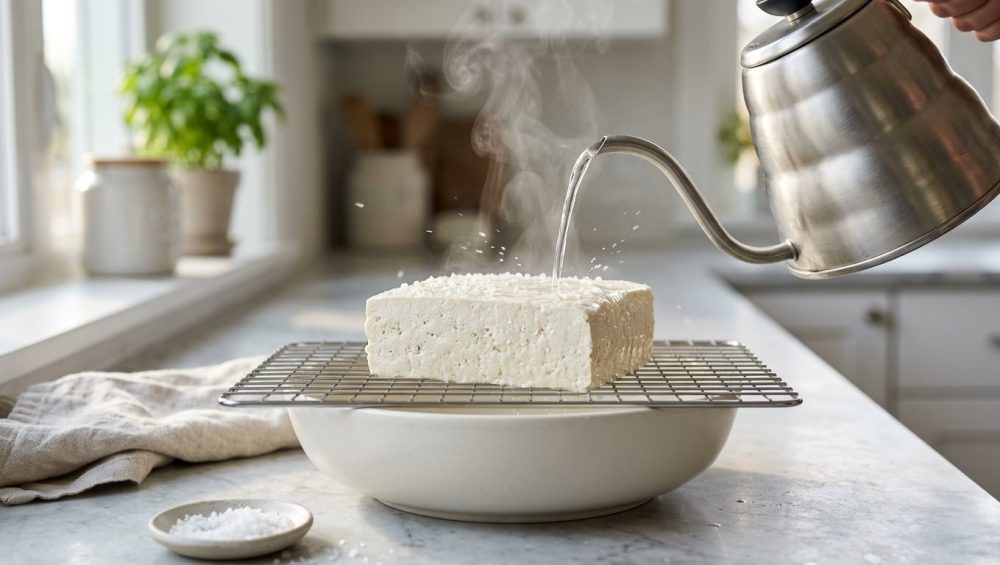
After 5 minutes, use a slotted spoon to carefully remove the tofu pieces. A good slotted spoon or spider skimmer is one of those essential beginner kitchen tools that makes retrieving delicate foods a breeze. Transfer the hot tofu to a wire cooling rack lined with a clean kitchen towel or heavy-duty paper towels.
You will immediately notice that the tofu feels different. It will be firmer, tighter, and noticeably more resilient to the touch.
Because you have already forced the internal water out via osmosis and heat, you do not need to press this for an hour. Simply place another towel on top of the tofu cubes, place a cutting board on top of that, and rest a light weight (like a single can of tomatoes) on it. Wait just 10 minutes. The residual heat will cause the remaining surface moisture to evaporate rapidly, leaving you with a perfectly prepped, dry, seasoned canvas ready for the frying pan.
The Anatomy of Crispiness: What Happens When It Hits the Pan
You have successfully executed the boiling water trick. Your tofu is dry, seasoned, and structurally sound. Now comes the fun part: creating that shatteringly crisp exterior.
The Maillard Reaction Explained (Without the Pretentious Chef-Speak)
Crispiness and flavor development in the pan come down to the Maillard reaction—a chemical reaction between amino acids and reducing sugars that gives browned food its distinctive flavor. For the Maillard reaction to occur, the surface temperature of the food must exceed the boiling point of water (212°F / 100°C).
If your tofu is full of water, that water will seep out into the hot oil, dropping the temperature of the pan and effectively steaming the tofu instead of frying it. Steam is the enemy of crispiness. Because your boiled tofu is already heavily depleted of internal moisture, the surface temperature can rapidly shoot past the boiling point the second it hits the hot oil, triggering a beautiful, even Maillard browning.
Starch Coatings: To Cornstarch or Not to Cornstarch?
While your boiled tofu will crisp up nicely on its own in a hot pan, adding a starch coating takes it to a restaurant-quality level. Starch acts as a sponge for any microscopic surface moisture left on the tofu, gelatinizing in the hot oil to form a rigid, crunchy shell.
- Cornstarch: The everyday hero. It is cheap, accessible, and provides a very solid, reliable crunch. Toss your dried tofu cubes in a few tablespoons of cornstarch right before they hit the pan. Do not let them sit in the starch for too long, or it will turn into a gummy paste.
- Potato Starch: The absolute gold standard for frying. Potato starch granules are larger and crisp up lighter and airier than cornstarch. If you want that delicate, shattering crunch you find on Japanese agedashi tofu, seek out potato starch.
- Arrowroot Powder: A great grain-free alternative, but it tends to get a bit slimy if it sits in a wet sauce for too long post-fry. Use this only if you are serving the tofu immediately without a heavy glaze.
The Gear Check: Ditch the Toxic Non-Stick
We need to have a very serious conversation about the pan you are using to fry this beautiful tofu. I am a massive advocate for banishing toxic kitchen gear from your life forever, and cheap non-stick pans are enemy number one.
Why Cheap Teflon Ruins Your Tofu (And Your Health)
For decades, we have been sold the lie that we need a delicate, easily scratched Teflon pan to cook sticky foods like tofu. But those traditional non-stick coatings are made with PTFE, which belongs to a family of “forever chemicals” known as PFAS.
The era of the toxic non-stick pan is rapidly coming to an end. In fact, as of January 2025, Minnesota legally banned the sale of cookware containing intentionally added PFAS, and states like Colorado, Maine, and Connecticut have enacted identical bans taking effect in 2026.
When you heat a cheap PTFE pan past 500°F—which is incredibly easy to do when you are trying to get a hard sear on a batch of tofu—the coating begins to break down and off-gas toxic fumes. This can cause a condition literally called “polymer fume fever,” presenting with flu-like symptoms, breathing difficulties, and sore throats. Furthermore, independent lab tests and court records in 2025 and 2026 have repeatedly exposed major cookware brands for hiding PFAS compounds behind clever “PFOA-free” marketing loopholes.
You do not need these toxic chemicals in your food, in your air, or in your kitchen.
The Safe, High-Heat Alternatives You Actually Need
To get a proper crust on your tofu, you need high, sustained heat. Toxic non-stick pans cannot safely handle high heat, which is why your food ends up pale and soggy.
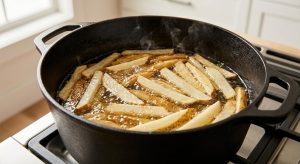
Instead, invest in a heavy-duty Carbon Steel skillet or a high-quality fully clad Stainless Steel pan. Carbon steel, once properly seasoned, is naturally non-stick, can withstand blazing hot temperatures, and will last several lifetimes. While we are on the topic of preserving your cookware, remember that aerosol cooking sprays will ruin the seasoning on your carbon steel skillet, so stick to regular liquid high-heat oils like avocado or grapeseed.
If you are using stainless steel, simply employ the water drop test to ensure your pan is at the exact right temperature before adding oil. Heat the dry pan over medium heat, drop a bead of water into it, and if the water forms a cohesive mercury-like ball that glides across the surface (the Leidenfrost effect), your pan is ready. Add your oil, wait for it to shimmer, and lay your tofu down. It will not stick.
Flavor Bombs: Marinating the Right Way
One of the biggest complaints home cooks have is that their tofu tastes like a void, even after sitting in a marinade for 24 hours. The boiling water trick actually solves this problem entirely.
Why Pre-Marinating is a Trap
Cold tofu is dense. Its protein network is tight, and it is fully saturated with water. If you take a cold, wet block of tofu and submerge it in a cold marinade overnight, absolutely nothing happens. The marinade cannot penetrate the water barrier. You are just wasting soy sauce and time.
As food scientists and traditional Asian chefs have known for centuries: tofu absorbs flavor when it is hot, not when it is cold.
Because you boiled your tofu, you relaxed its pores and expelled the internal water. If you want to marinate it, do it the second it comes out of the boiling water and has been quickly patted dry. The hot, porous tofu will literally drink up a marinade in seconds rather than hours.
The Post-Fry Glaze Method
Personally, my favorite way to flavor tofu is to skip the pre-marinade entirely. The boiling salt water already seasoned the interior perfectly.
Instead, I fry the starch-coated tofu until it is shatteringly crisp. Then, I remove it from the pan, wipe out the excess oil, and build a quick, sticky sauce in the same skillet. If your sauce involves dry spices, blooming them in oil for a few seconds before adding the liquid will extract fat-soluble flavor compounds and elevate the whole dish.
Once your sauce reduces to a thick, syrupy glaze, toss your crispy tofu back into the pan for exactly 15 seconds—just long enough to coat the exterior, but not long enough for the moisture in the sauce to ruin your hard-earned crunchy starch shell.
Troubleshooting Your Tofu Nightmares
Even with the boiling water trick, the kitchen can be a chaotic place. If things go sideways, here is how to troubleshoot.
“My Tofu Still Stuck to the Pan!”
If your boiled, starched tofu glued itself to your stainless steel or carbon steel pan, you made one of two rookie errors:
- Your pan wasn’t hot enough. If the oil isn’t shimmering when the tofu hits it, the starch will immediately absorb the warm oil and fuse to the metal.
- You panicked and poked it too early. Tofu, like meat, will naturally release from a hot pan once a proper crust has formed. If you try to flip it after 30 seconds, it will tear. Leave it alone for at least 3 to 4 minutes per side. Have patience.
“It’s Crispy on the Outside, But Dry Inside!”
There is nothing worse than biting into a piece of protein only to find it turns out dry and chalky in the center. If your tofu feels like eating a pencil eraser, you boiled it for way too long. Remember, the sweet spot is 3 to 5 minutes. Anything past 10 minutes will cause the protein matrix to contract so violently that it squeezes out all the moisture, leaving you with a leathery, unchewable mess. Set a timer.
“My Tofu Crumbled into a Mess!”
If your tofu is falling apart during the boiling or frying process, you likely bought the wrong type of tofu. This method is specifically designed for Firm or Extra-Firm block tofu. If you attempt to boil Silken tofu or soft tofu, it will disintegrate into a cloudy, soupy disaster the moment the water starts bubbling. Always check your labels.
The Final Verdict on the Boiling Water Trick
Cooking should not be an exercise in frustration. You do not need to settle for mediocre, soggy, bland plant-based meals just because you are cooking on a Tuesday night. The boiling salted water trick is the ultimate proof that a tiny bit of culinary science can completely override hours of tedious, outdated prep work.
By utilizing the power of heat denaturation and osmotic pressure, you can force the moisture out of your tofu, season it from the inside out, and prep it for a flawless, golden sear in a fraction of the time it takes to press it.
Mastering this technique is a rite of passage in the art of the home kitchen, proving that you don’t need a restaurant setup to create mind-blowing food. You just need good technique, a safe, non-toxic pan, and the confidence to try something that sounds a little bit crazy.
So tonight, put away the heavy textbooks. Stop squishing your groceries. Boil some water, heavily salt it, and get ready to eat the best crispy tofu of your life. You’ve got this.