Look, I get it. It’s a Tuesday night, you just walked through the door, your brain is functioning at roughly four percent capacity, and that convenient little plastic bag of pre-shredded sharp cheddar is staring at you from the dairy drawer like a culinary life raft. You want macaroni and cheese. You want a bubbling, velvety queso dip to salvage the evening. You figure, “Cheese is cheese, right? Why should I dirty a grater when the supermarket already did the work for me?”
I am going to stop you right there. Put the bag down. Step away from the dairy drawer.
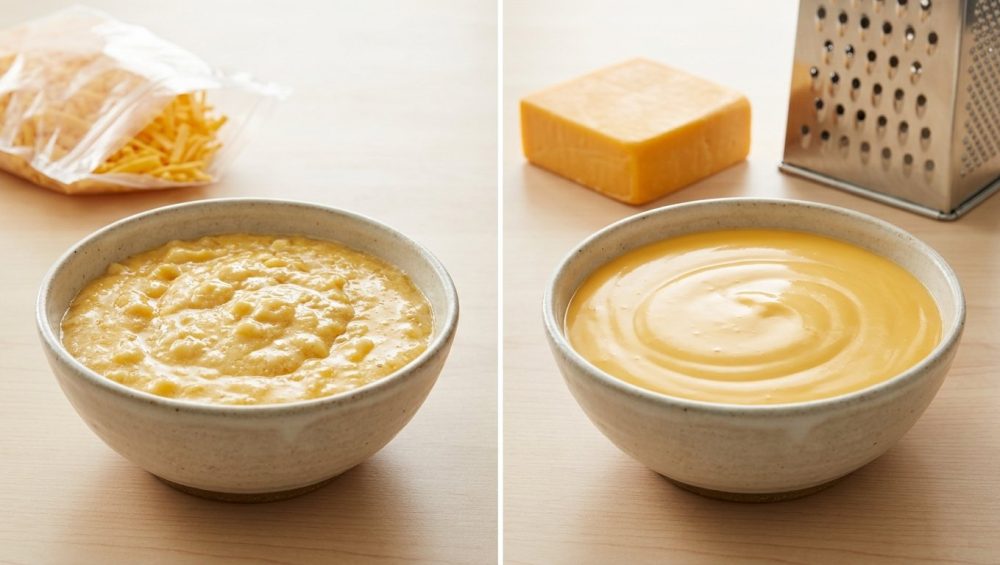
I have zero patience for pretentious, gatekeeping chef-speak, but I have even less patience for food industry shortcuts that actively sabotage your dinners. If you have ever tried to make a cheese sauce from a bag of pre-shredded cheese, you already know the heartbreak I am talking about. Instead of transforming into a glossy, restaurant-quality pool of liquid gold, your sauce turns into a horrifying, gritty, clumpy nightmare. It looks like wet sand sitting in a puddle of fluorescent orange grease. You panic. You whisk harder. But the damage is done.
Unlike dealing with watery pan sauces that just need a quick reduction on the stove, a broken, grainy cheese sauce is a fundamental chemical failure. But here is the good news: it is not your fault. You are not a bad cook. You were simply set up to fail by the contents of that convenient little plastic bag.
Today, we are stripping away the culinary mystery. We are going to dive deep into the fascinating, slightly terrifying chemistry of melting cheese, expose exactly what those anti-caking agents are doing to your food, and teach you the foolproof, scientifically backed methods to achieve flawlessly smooth, silky cheese sauces every single time. Grab a glass of wine, take a deep breath, and let’s fix your comfort food.
The Anatomy of a Culinary Disaster: Why Your Sauce Broke
Before we can solve the problem, we have to understand the crime scene. When a cheese sauce “breaks,” it is experiencing a catastrophic failure of its emulsion.
In the culinary world, an emulsion is the delicate, forced marriage of two things that naturally hate each other: fat and water. In a perfect, harmonious cheese sauce, the dairy fats are suspended evenly throughout the liquid (milk, water, or broth), held together by a matrix of dairy proteins. The result is a smooth, opaque, luxurious texture that coats the back of a spoon and clings beautifully to your pasta.
When that emulsion breaks, the marriage ends in a violent divorce. The protein matrix seizes up, contracting into tight, microscopic rubbery clumps (this is the “grainy” or “gritty” texture you feel on your tongue). Because the proteins have tightened up, they can no longer hold onto the fat or the water. The fat separates and pools on the surface as a slick, unappetizing layer of grease. If you have spent any amount of time researching the dark art of fixing broken cheese sauces, you know that once this separation happens, whisking it aggressively will not save you. You cannot bully a broken emulsion back together with sheer elbow grease.
So, what triggers this catastrophic separation? Two things: excessive heat, and the introduction of foreign, moisture-stealing ingredients. And unfortunately, that bag of pre-shredded cheese is absolutely loaded with the latter.
The Culprit: What Exactly Is Inside That Bag of Pre-Shredded Cheese?
We need to talk about the sheer scale of the pre-shredded cheese industrial complex. In the United States alone, the cheese shreds market is projected to reach a staggering $1.66 billion in 2025, and is forecasted to climb to $2.42 billion by 2035. Mozzarella and cheddar shreds dominate this space, driven entirely by our desperate need for weeknight convenience. We are literally spending billions of dollars a year on products that are chemically engineered to ruin our sauces.
To understand why pre-shredded cheese refuses to melt properly, you have to look at the ingredient list. When a manufacturer shreds cheese at the factory and dumps it into a plastic pouch, those shreds naturally want to stick back together and reform into a solid brick. To prevent this, manufacturers tumble the cheese in a cocktail of anti-caking agents and preservatives.
Cellulose: The “Wood Pulp” Reality
The most infamous ingredient in bagged cheese is powdered cellulose. If you have ever heard the rumor that pre-shredded cheese contains “wood pulp,” this is what they are talking about. Cellulose is a naturally occurring plant fiber that provides structural support to plant cell walls. Commercially, it is often derived from wood pulp or cotton lint.
Let me be clear: cellulose is not toxic. It is essentially just insoluble dietary fiber, and humans consume it safely all the time. However, from a culinary perspective, it is a disaster. Cellulose is an ultra-fine, tasteless powder that coats every individual shred of cheese, creating a physical and chemical barrier. When you apply heat, the cheese inside the shred tries to melt, but the cellulose coating refuses to break down. It acts like microscopic grit, preventing the cheese proteins from fusing together into a smooth liquid.
Potato Starch and Corn Starch: The Moisture Thieves
Because cellulose can leave a visually unappealing, dusty white coating on the cheese, manufacturers often cut it with potato starch or corn starch, which are translucent. Starch is a hydrocolloid; its primary job in a hot environment is to absorb surrounding water and swell.
When you drop starch-coated cheese into hot milk to make a mac and cheese base, the starch immediately violently absorbs the moisture. Just like the messy phenomenon where your pasta water boils over due to excess starch foaming up, the starch in the cheese bag wreaks havoc on your fluid dynamics. It steals the water that your cheese proteins desperately need to stay suspended, causing the sauce to become artificially thick, sludgy, and ultimately, grainy.
Natamycin: The Mold Killer
Finally, because shredding cheese exponentially increases its surface area, it becomes highly susceptible to mold growth. To combat this, manufacturers spray the shreds with natamycin, a natural anti-fungal preservative. While it keeps your cheese from turning blue in the fridge, it is just one more foreign additive sitting on the surface of your cheese, interfering with the pure, unadulterated melt you are trying to achieve.
The Chemistry of Cheese Melting: A Masterclass in Emulsions
To truly master the kitchen, you do not need a culinary degree, but you do need to understand a little bit of basic science. Let’s look at what actually happens on a molecular level when you heat up a block of cheese.
The Casein Matrix and Calcium Bridges
Cheese is essentially a highly concentrated, fermented dairy matrix. Its structural backbone is made of casein proteins. These casein proteins cluster together into microscopic spheres called micelles. Think of these micelles as a sponge. Trapped inside the pockets of this protein sponge are droplets of milk fat and water.
What holds this entire protein sponge together? Calcium ions. The calcium ions (Ca²⁺) act like microscopic bridges, crosslinking the negatively charged casein proteins to one another, maintaining the structural integrity of the cheese.
The Syneresis Effect (Why the Oil Pools)
When you apply heat to a hard cheese like cheddar or gruyere, the thermal energy causes the milk fat trapped inside the sponge to liquefy and expand. As the temperature rises above 150°F (65°C), the casein proteins begin to panic. They contract and tighten their calcium bridges.
As the protein matrix squeezes tightly together, it violently wrings out the liquefied fat and water—a chemical process known as syneresis. This is why melting a block of cheddar in a dry pan results in a hard, rubbery puck of protein swimming in a pool of clear, separated butterfat.
How Anti-Caking Agents Actively Destroy Emulsions
To prevent syneresis and create a smooth sauce, we have to introduce extra liquid (like milk) and gently coax the tight casein proteins to relax and accept the new liquid into their matrix.
When you use pre-shredded cheese, the cellulose and potato starch physically block the added liquid from reaching the proteins. The starch absorbs the milk, the cellulose creates a gritty friction, and the casein proteins, starved of moisture and unable to bind with the liquid, immediately seize up and contract. The result is a grainy, broken sauce that tastes exactly like the starchy, powdery additives it is covered in.
The Sassy Sous-Chef’s Golden Rules for Flawless Cheese Sauce
Alright, enough doom and gloom. You now understand the science of why your sauces are failing. Now, I am going to teach you how to win. As a busy professional who values time, I promise you that these rules are not complicated. They do not require hours of prep. They just require you to work smarter, not harder.
Rule 1: Grate It Yourself (The Math of Time vs. Quality)
This is the non-negotiable golden rule. You must buy cheese in block form and grate it yourself. I know, I know. It sounds like extra work. But let’s do the math: it takes exactly 90 seconds to run an 8-ounce block of sharp cheddar down the side of a box grater. Ninety seconds.
If you use bagged cheese, your sauce will break. You will then spend ten minutes frantically whisking it, Googling how to fix it, and eventually throwing it in the trash and ordering a $35 pizza out of sheer frustration. Grating your own cheese is the ultimate time-saving hack because it guarantees success on the first try. Pure, unadulterated block cheese contains no cellulose, no added starches, and no mold inhibitors. It is perfectly primed to melt into a silky, luxurious pool.
Rule 2: Temperature Control (Respect the Heat)
Cheese is a diva. It demands gentle, indirect heat. The absolute fastest way to ruin a cheese sauce—even if you grated the cheese yourself—is to boil it.
Remember syneresis? If you drop cheese into a liquid that is actively boiling (212°F / 100°C), the extreme heat will instantly denature the casein proteins, causing them to contract violently and squeeze out all their fat.
When making a cheese sauce, you should always remove your hot liquid base (whether it is a béchamel or evaporated milk) from the direct heat source before adding the cheese. The residual heat of the liquid is more than enough to gently melt the cheese shreds. Add the cheese in small handfuls, stirring gently until completely smooth before adding the next handful. Patience here is the difference between a Michelin-star texture and a gritty mess.
Rule 3: The Magic of Modern Emulsifiers (Enter Sodium Citrate)
If you want to completely bulletproof your cheese sauce and achieve that impossibly glossy, liquid-gold texture of stadium nacho cheese—but with the complex flavor of high-end aged cheddar—you need to embrace modern culinary science. You need Sodium Citrate.
Sodium citrate (Na₃C₆H₅O₇) is a food-grade salt derived from citric acid. Coincidentally, its chemical formula literally spells NaCHO. It is the absolute holy grail of cheese melting. Historically, it was actually used in 1914 as an experimental anticoagulant for blood transfusions, but today, it is the secret weapon of every modern chef.
Here is how the magic works: Remember those stubborn calcium bridges that hold the cheese proteins tightly together and cause them to clump when heated? Sodium citrate is an exceptionally strong chelating agent. When you dissolve a tiny amount of sodium citrate into a splash of water or milk and heat it up, the citrate ions actively hunt down and bind to the calcium ions in the cheese.
By sequestering the calcium, the sodium citrate effectively dismantles the tight protein bridges without destroying the proteins themselves. The casein proteins relax, uncoil, and become incredibly powerful emulsifiers. They seamlessly bind the fat and water together, creating an indestructible, velvety smooth sauce that will never break, never separate, and never turn grainy, even if you reheat it the next day.
To use it, you generally need about 2% to 3% of the total weight of your cheese and liquid in sodium citrate. Dissolve the salt in simmering liquid, slowly whisk in your freshly grated block cheese, and watch in awe as science does the heavy lifting.
Rule 4: The Traditional Béchamel Backup
If you do not want to buy a bag of sodium citrate online, you must rely on the traditional French method: the Béchamel.
You start by cooking equal parts butter and all-purpose flour in a pan to create a roux. You then slowly whisk in whole milk until it thickens into a creamy white sauce. Finally, you remove it from the heat and stir in your freshly grated cheese (turning the Béchamel into a Mornay sauce).
The flour in the roux acts as a physical buffer. The starch molecules swell and get in between the cheese proteins, physically preventing them from clumping together. While a Mornay sauce will never be quite as glossy or intensely cheesy as a sodium citrate sauce (because the flour mutes the flavor slightly), it is a highly reliable, time-tested method for weeknight macaroni and cheese.
The Right Tools for the Job (And What to Throw in the Trash)
You can have the best ingredients in the world, but if your kitchen equipment is working against you, you are fighting a losing battle. I am incredibly passionate about banishing toxic kitchen gear from your home. We are not just cooking for flavor; we are cooking for our health.
Ditch the Cheap, Toxic Non-Stick Pans
Listen to me very carefully: if you are making a delicate cheese sauce in a scratched, peeling, lightweight aluminum non-stick pan you bought at a big-box store for fifteen dollars, you need to stop immediately. I have a strict “No-Go” rule on this garbage.
There is absolutely no excuse for ruining your nonstick pans with cheap aerosol sprays, but even if you treat them perfectly, cheap Teflon (PTFE) coatings degrade rapidly. Once these cheap coatings inevitably begin losing their slip, they flake microscopic plastic polymers directly into your food. Furthermore, thin aluminum pans have terrible thermal mass. They create aggressive “hot spots” that will instantly scorch your dairy and break your cheese emulsion.
What You Actually Need: The Saucier
If you want to make perfect sauces, you need heavy, multi-clad stainless steel or enameled cast iron. These materials distribute heat evenly and gently, which is exactly what temperamental dairy proteins demand.
This is exactly why you need a heavy-bottomed curved saucier pan to ensure that your whisk can reach every single corner of the pot. A standard saucepan has sharp 90-degree internal corners where flour and cheese love to hide, burn, and ruin your meal. A saucier has a sloping, rounded bottom that makes continuous whisking an absolute breeze. And if you are tired of endlessly scrubbing stainless steel pans after making a cheese sauce, just remember that a proper, gentle heat prevents the cheese from fusing to the metal in the first place.
The Grating and Stirring Arsenal
You do not need an expensive food processor to grate cheese unless you are cooking for an army. A heavy-duty, stainless steel box grater is the undisputed king of the home kitchen. It is easy to clean, requires no electricity, and builds a little character. If you want to save your knuckles, a high-quality rotary cheese grater (the kind with a hand crank and a suction base) is a fantastic, safe alternative that will shred an entire block of cheddar in literal seconds.
When it comes to stirring, throw away those flimsy, melting nylon spatulas. You will also want to utilize a sturdy flat-edged wooden spoon to scrape the bottom of your saucier cleanly without scratching the metal. And please, throw away that cheap wire whisk that constantly leaks gross dishwater into your pristine food from its unsealed handle. Invest in a fully sealed, professional-grade stainless steel balloon whisk. It will cost you twenty dollars and last the rest of your life.
Troubleshooting Your Broken Sauce: Can It Be Saved?
Let’s say you messed up. Maybe you accidentally let the milk boil, or maybe someone else in your household snuck a handful of pre-shredded cellulose-coated cheese into the pot when you weren’t looking. The sauce has broken. The oil is pooling. Is dinner ruined?
Not necessarily. While you cannot un-cook denatured protein, you can sometimes force a broken emulsion back together using sheer mechanical force and a temperature shock.
The Cold Liquid Rescue
If your sauce is actively separating and looking greasy, immediately remove it from the heat. The proteins are contracting because they are too hot. Vigorously whisk in a tablespoon of ice-cold milk or a splash of cold heavy cream. The sudden drop in temperature can sometimes shock the proteins into relaxing their grip, while the added water and dairy fat give the emulsion the raw materials it needs to re-stabilize. Whisk like your life depends on it.
The Immersion Blender Method
If the cold milk trick fails, it is time to bring out the heavy artillery. Pour the broken sauce into a tall, narrow container and hit it with an immersion blender. The high-speed mechanical shearing force of the blender blades physically smashes the fat globules into microscopic droplets, forcefully dispersing them back into the protein matrix. It is a violent correction, but it often yields a perfectly smooth sauce in under thirty seconds.
The “American Cheese” Cheat Code
If all else fails, and you do not have pure sodium citrate in your pantry, you can utilize a culinary Trojan horse: a single slice of processed American cheese. High-quality deli American cheese is manufactured with a massive dose of melting salts (usually sodium citrate or sodium hexametaphosphate). By tossing one torn-up slice of American cheese into your broken cheddar sauce and whisking vigorously over low heat, you are introducing those powerful emulsifying salts into the environment. The salts will immediately go to work on the stubborn cheddar proteins, relaxing them and pulling the broken emulsion back from the brink of death.
Conclusion: Reclaiming Your Comfort Food
Cooking should not be a source of stress, and you certainly should not have to settle for gritty, greasy, unappetizing meals just because it is a busy weeknight. The food industry wants you to believe that their pre-shredded, chemically coated shortcuts are doing you a favor. They are not. They are charging you a premium for an inferior product that actively fights against the basic laws of culinary chemistry.
By taking exactly ninety seconds out of your evening to grate a fresh block of cheese, respecting the gentle heat that dairy requires, and perhaps dabbling in the absolute magic of sodium citrate, you are taking control of your kitchen. You do not need a culinary degree to make mind-blowing food. You just need the right knowledge, the right tools, and the refusal to accept mediocrity.
Now go grab your box grater, ditch the plastic bags, and go make the most spectacular, velvety, life-changing cheese sauce you have ever tasted. You’ve got this.