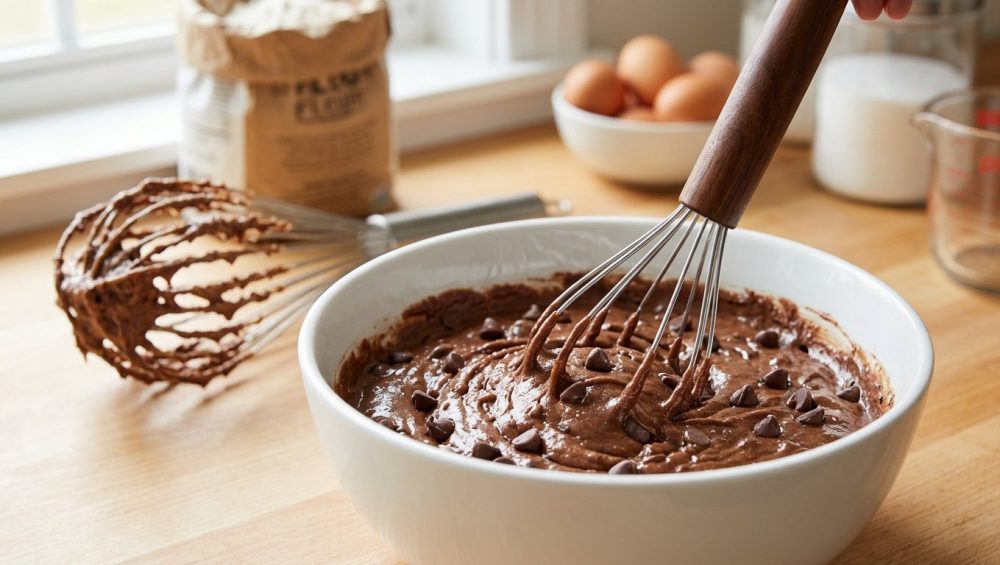
Listen up, weekend warriors. We need to have a serious, sit-down conversation about the medieval torture device currently sitting in your utensil crock. You know the one I am talking about. It is bulbous, it is made of a dozen overlapping, flimsy wires, and it is entirely responsible for ruining your Sunday morning baking sessions.
I am talking about the standard balloon whisk.
If you have ever tried to whip up a batch of blueberry muffins, fudgy brownies, or buttermilk pancakes, only to find half of your thick, glorious batter hopelessly trapped inside the cage of your whisk, you already know the frustration. You stand over the mixing bowl, aggressively tapping the whisk against the rim, sending rogue splatters of flour and wet batter across your countertops. Then, in a desperate bid to free the hostage dough, you grab a spatula and try to scrape it out, making an even bigger mess. By the time you finally get the batter into the pan, you are irritated, your kitchen is a disaster zone, and worst of all, your baked goods are destined to come out tough and dense.
You do not need a culinary degree to make bakery-level food at home, but you absolutely need to stop sabotaging yourself with the wrong equipment. The balloon whisk was designed for one primary purpose: aerating thin liquids. It is a master at whipping egg whites into stiff peaks and turning heavy cream into fluffy clouds. But when it comes to thick, viscous batters, it is a catastrophic failure.
It is time to ditch the frustration and embrace the minimalist magic of the Danish dough whisk.
The Balloon Whisk Betrayal: Why Your Batter Is Held Hostage
To understand why we need a better tool, we first have to understand why the standard tool fails so spectacularly. We have been conditioned by glossy food magazines and television cooking shows to view the balloon whisk as a universal, all-purpose mixing wand. It is not. Using a balloon whisk to mix a thick muffin batter is like using a lawnmower to trim a bonsai tree. It is the wrong tool for the job, and the physics of its design prove it.
The Physics of the Trap: Surface Area and Tension
When you are mixing a thick batter, you are dealing with a substance that has an incredibly high viscosity. In fluid dynamics, viscosity is essentially a measure of a fluid’s resistance to flow. While water has a low viscosity, bread doughs and thick quick-bread batters can exceed 100,000 centipoise (cP). They are heavy, sticky, and highly cohesive.
A standard balloon whisk consists of eight to twelve overlapping wires that converge at the top and bottom, creating a tight, three-dimensional cage. When you plunge this cage into a high-viscosity batter, the laws of physics turn against you. The hydrated flour and sticky sugars adhere to the massive surface area of the wires. Because the wires are spaced so closely together, the surface tension of the batter bridges the gaps between them.
Instead of cutting through the mixture, the whisk acts as a net. It scoops up a massive, solid clump of dough and traps it in the center of the cage. Dense, overworked batter cooks unevenly, which is exactly why your pancakes burn on the outside while the inside remains a gooey, unappetizing mess. You are no longer mixing your ingredients; you are just dragging a heavy, batter-filled club through a bowl of dry flour.
The Flimsy Metal and Toxic Coating Rant
As if the mechanical failure of the balloon whisk was not bad enough, we have to talk about the materials. The kitchenware industry is notorious for pumping out cheap, poorly constructed tools that are practically designed to fail.
Many budget balloon whisks are coated in non-stick materials, such as Teflon (PTFE) or other synthetic polymers, marketed as “easy clean.” Let me be crystal clear: I despise cheap, toxic kitchenware. When you aggressively tap a coated whisk against the side of a ceramic or glass mixing bowl to dislodge trapped batter, that delicate non-stick coating micro-chips. Where do those synthetic flakes go? Directly into your family’s breakfast.
Furthermore, cheap whisks are often made with mystery metals that are highly susceptible to rust. If your whisk leaks dishwater from the handle after a run through the wash, you are dealing with a bacterial hazard. Water gets trapped in the unsealed joint where the wires meet the handle, ferments with old food particles, and drips rusty, contaminated sludge into your next meal. You deserve better than this. Your food deserves better than this.
Enter the Danish Dough Whisk: The Minimalist Magic Wand
If the balloon whisk is a chaotic, over-engineered cage, the Danish dough whisk is a masterclass in minimalist efficiency. At first glance, it looks bizarre. It resembles a two-dimensional wire rendering of a crop circle, or perhaps a vintage rug beater. But the moment you drag it through a bowl of thick, shaggy dough, you will experience a culinary epiphany.
What Actually Is a Danish Dough Whisk (Brotpeitsche)?
Originating in mid-20th-century Danish bakeries, this tool is known locally as a brodpisker, which literally translates to “bread whisk.” It was not designed by a marketing team trying to sell you a shiny new gadget; it was engineered by working bakers who needed a solution for mixing heavy, highly hydrated doughs without exhausting their arms or over-oxidizing their flour.
The design is brilliantly simple. It consists of a solid, ergonomic handle attached to a single, continuous piece of thick, hand-forged stainless steel wire. This wire is bent into three flat, concentric loops—an outer circle, an inner oval, and a central U-shape.
Unlike the balloon whisk, there is no cage. There is no center cavity for the batter to hide in. It is completely flat, meaning it operates on an entirely different set of physical principles.
The Hydrodynamics of Stiff-Wire Loops
The secret to the Danish dough whisk lies in its low surface-area ratio and its specific wire spacing. The wires on a high-quality brodpisker are typically spaced about 1.8 to 2.2 centimeters apart. According to food science and grain morphology studies, this specific spacing perfectly accommodates the average particle size distribution of hydrated wheat starch granules.
In plain English? The gaps are wide enough to let thick batter pass through effortlessly, but tight enough to break up hidden pockets of dry flour.
When you move a Danish dough whisk through a bowl, you are not pushing the batter; you are slicing through it. The thick, rigid wire acts like a series of blunt blades. It cuts through the viscous matrix of the dough, forcing the wet and dry ingredients to fold over one another in a smooth, laminar flow. Because there is no cage, the batter simply glides through the loops and falls back into the bowl. Nothing gets stuck. Nothing gets trapped. Just like when a cheap baking sheet pops in the oven, using the wrong whisk is a fundamental mechanical failure that ruins your workflow. The Danish dough whisk eliminates that failure entirely.
The Science of Gluten: Why Over-Mixing Ruins Your Weekend Baking
Now that we have established that the Danish dough whisk saves you from a sticky, frustrating mess, we need to talk about why it actually makes your food taste significantly better. To do that, we have to put on our lab coats and dive into the chemistry of baking.
The Anatomy of a Quick Bread
When home cooks bake on the weekends, they are usually making what the culinary world calls “quick breads.” This category includes muffins, pancakes, waffles, banana bread, scones, and brownies. They are called “quick” because they rely on chemical leaveners—like baking soda and baking powder—to rise, rather than waiting hours for living yeast to ferment.
The ultimate goal of any quick bread is a tender, fluffy, melt-in-your-mouth crumb. You want your blueberry muffin to be soft and delicate. You want your pancakes to be pillowy. You absolutely do not want them to be chewy, dense, or elastic. Over-mixing destroys the delicate crumb structure, which is the primary reason your beautiful loaf sinks in the middle the second it hits the cooling rack.
Gluten Development: Friend to Bread, Foe to Muffins
Wheat flour contains two vital proteins: glutenin and gliadin. In their dry state, they just sit there, minding their own business. But the second you add a liquid—like milk, water, or buttermilk—these two proteins wake up, find each other, and bond together to form a complex, microscopic network called gluten.
Gluten is highly elastic. Think of it like a web of microscopic rubber bands. In yeast breads, like a chewy sourdough or a crusty French baguette, you want a massive, strong gluten network. You knead the dough aggressively to build those rubber bands, which trap the yeast’s gases and give the bread its signature chew.
But in a muffin or a pancake? Gluten is your worst enemy.
The more you mix, stir, and agitate wet flour, the stronger those gluten bonds become. When you use a balloon whisk to make pancake batter, the batter gets trapped in the cage. To compensate, you end up stirring harder, longer, and more aggressively just to get the ingredients incorporated. Every extra rotation of your wrist is stretching and strengthening those microscopic rubber bands. This aggressive gluten development is the exact scientific reason why your pancakes are rubbery instead of melt-in-your-mouth tender.
The Danish dough whisk prevents this entirely. Because it cuts through the batter so efficiently, it reduces your total mixing time by up to 65%. You can fully hydrate the flour in just a few gentle folds, leaving the gluten network weak and underdeveloped. The result? The softest, most tender baked goods you have ever pulled out of your oven.
Head-to-Head: Balloon Whisk vs. Danish Dough Whisk
Let’s take this out of the theoretical realm and put these two tools head-to-head in real-world, weekend kitchen scenarios.
The Pancake Batter Test
It is Sunday morning, and you are craving thick, diner-style buttermilk pancakes. You combine your flour, sugar, baking powder, and salt in a bowl. You pour in your buttermilk, melted butter, and eggs.
If you use a balloon whisk, the thick buttermilk immediately binds with the flour and creates a gluey mass that lodges itself in the center of the wire cage. You now have a whisk full of wet dough, and a bowl full of dry, unmixed flour. You start beating the mixture to force the wet dough out of the wires. By the time the dry flour is finally mixed in, you have completely overworked the batter. If you frantically try to stir out the lumps with a balloon whisk, you are actively ruining breakfast. The pancakes will cook up flat, tough, and chewy.
If you use a Danish dough whisk, you simply drag the stiff wire loops through the bowl. The wires slice through the buttermilk and flour, folding them together. In about six strokes, the batter is perfectly combined. It will still be slightly lumpy—which is exactly what you want for pancakes—but the flour is fully hydrated. You stop mixing, the gluten remains relaxed, and your pancakes rise into towering, fluffy masterpieces.
The Brownie Batter Test
You are making a batch of dense, fudgy brownies. The batter is essentially a mixture of melted chocolate, butter, sugar, eggs, and a small amount of flour and cocoa powder. It is incredibly thick and heavy.
If you use a balloon whisk, the sheer viscosity of the brownie batter bends the flimsy wires. The batter traps itself inside, and you end up having to use a secondary tool—a spatula—just to clean your primary tool. Furthermore, the balloon whisk is designed to incorporate air. It whips tiny air bubbles into the eggs and butter. While this sounds nice, those air bubbles will expand in the oven and then collapse, leaving you with a cakey, crumbly brownie rather than a dense, fudgy one.
The Danish dough whisk, on the other hand, does not incorporate air. Its flat profile and minimal loop curvature produce negligible air incorporation (confirmed by food scientists using dissolved oxygen probes). It effortlessly folds the heavy cocoa powder into the melted butter, giving you a smooth, glossy, ultra-dense batter with zero trapped air and zero elbow grease.
The Muffin Batter Test
You are making bakery-style blueberry muffins. The batter is thick, and you need to fold in delicate, fresh blueberries without crushing them into a purple, bruised mush.
A balloon whisk is completely useless here. The wires will literally mash the blueberries against the side of the bowl. A wooden spoon is better, but its wide surface area requires a lot of force to push through the heavy batter, which again, develops unwanted gluten. While achieving that perfect bakery-style dome requires a blast of high heat in the oven, it all starts with a gently folded batter.
The Danish dough whisk is the ultimate folding tool. The wide gaps between the wires allow the blueberries to pass through unharmed while the stiff metal cuts the flour into the wet ingredients. You get perfectly intact berries, zero purple streaks in your batter, and a tender, delicate crumb.
The Cleanup Crisis: Reclaiming Your Time
I am a busy professional, and I know you are too. My core philosophy in the kitchen is that time is money. I refuse to spend my precious weekend hours meticulously detailing my kitchen equipment like I am cleaning a classic car.
Why Dishwashers Hate Balloon Whisks
Cleaning a batter-coated balloon whisk is a nightmare. The overlapping wires create tight, acute angles at the base where they meet the handle. Thick batter cements itself into these crevices. If you throw it in the dishwasher, the heat of the drying cycle bakes that residual batter into a rock-hard crust.
You eventually have to stand over the sink with a sponge, threading it between the wires, inevitably flicking soapy water into your own eyes. Silicone spatulas are great, but cheap ones degrade and taste like soap if they absorb heavy dishwasher detergents, making them poor substitutes for heavy mixing.
The Swish-and-Rinse Miracle
Because the Danish dough whisk is essentially a flat, two-dimensional plane of wire, there are no cages, no crevices, and no overlapping joints for food to hide in.
Cleaning it takes exactly three seconds. The moment you are done mixing your batter, you simply swish the whisk in a bowl of warm, soapy water, or run it under the tap. The batter falls right off the smooth stainless steel. A quick wipe with a sponge, and it is pristine. It is the ultimate low-maintenance tool for the high-efficiency cook.
How to Choose a Safe, High-Quality Danish Dough Whisk
Not all Danish dough whisks are created equal. Because this tool has surged in popularity recently, the market has been flooded with cheap, poorly manufactured knockoffs. If you are going to upgrade your kitchen arsenal, you need to buy a tool that will last a lifetime, not one that will fall apart in a month.
The “No-Go” Rule: Avoiding Mystery Metals and Toxic Glues
You all know I am absolutely ruthless when it comes to banishing toxic kitchen gear from my home, and you should be too. When shopping for a Danish dough whisk, the wire head must be made of food-grade stainless steel—specifically AISI 304 grade. This grade of steel is highly resistant to corrosion, rust, and acidic foods (like buttermilk or lemon juice).
Do not buy whisks made from unbranded “metal” or aluminum, as they will oxidize and turn your food gray. Furthermore, inspect the joint where the wire meets the handle. Cheap manufacturers use toxic epoxies or glues to hold the wire in place. Over time, hot water and mechanical stress will cause that glue to crack, allowing bacteria to fester inside the handle. Look for a whisk where the wire is deeply embedded and securely sealed, or better yet, a whisk that boasts a seamless, fully stainless-steel construction from head to handle.
Handle Ergonomics and Wire Gauge Specs
The thickness of the wire matters. If the wire is too thin (under 2 mm), it will bend and warp when you try to mix a heavy sourdough or a dense brownie batter. Look for a wire gauge of around 2.3 mm to 3 mm. It should feel incredibly stiff and rigid; you should not be able to bend the loops with your bare hands.
For the handle, ergonomics are key. You want a handle that is stout and comfortable to grip. Traditional brodpiskers feature turned wooden handles (usually oak or walnut). If you opt for wood, ensure it is treated with a food-safe mineral oil, and never put it in the dishwasher, as the heat will cause the wood to splinter and crack. If you prefer the convenience of a dishwasher, opt for a fully integrated stainless steel model. A total length of 11 to 13 inches provides the perfect amount of leverage without feeling unwieldy.
Mastering the Technique: How to Wield Your New Favorite Tool
Buying the right tool is only half the battle; you also have to know how to use it. If you grab a Danish dough whisk and try to aggressively beat your batter in rapid, chaotic circles like you would with a balloon whisk, you are defeating the entire purpose of its engineering.
The Fold and Cut Method
The Danish dough whisk is designed for orbital motion and load modulation. Start with a wide, straight-sided mixing bowl. Hold the handle firmly and tilt the whisk to a 45-degree angle. Do not hold it straight up and down (which forces downward compression) and do not hold it flat against the surface.
Move your wrist in smooth, continuous, clockwise orbits. Instead of stirring, think of the motion as “folding and cutting.” Drag the whisk along the bottom of the bowl, pulling the dry flour up from the depths and cutting it into the wet ingredients on the surface. Let the heavy weight of the steel wire do the work for you. You do not need to apply downward force; just guide the tool through the matrix of the dough. Within a handful of rotations, your batter will be perfectly, gently incorporated.
Expanding Your Repertoire: Beyond Batters
Once you experience the magic of the Danish dough whisk, you will find yourself reaching for it constantly. It is not just for baking.
Because it excels at mixing without overworking, it is the absolute best tool for combining ground meats. If you are making meatballs or a meatloaf, using your hands can melt the fat, and using a spoon can turn the meat into a dense paste. The stiff wires of the dough whisk cut the seasonings and breadcrumbs into the ground beef perfectly, keeping the meat loose and tender.
It is also phenomenal for stirring thick, bubbling pots of polenta or oatmeal on the stove, as the flat bottom of the loops easily scrapes the bottom of the pan to prevent scorching. You can even use it to gently fold butter into starches, ensuring you never serve gluey mashed potatoes at a dinner party again.
The Final Verdict on Better Baking
Cooking and baking should be a joy, not a battle against your own equipment. For too long, we have accepted the messy, frustrating reality of the balloon whisk simply because it is what came in the standard utensil set we bought in our twenties.
But you are a smarter cook now. You understand the physics of viscosity, the chemistry of gluten development, and the absolute necessity of keeping toxic, peeling metals out of your food.
The Danish dough whisk is more than just a quirky-looking gadget. It is a rigorously validated, historically proven tool that solves one of the most annoying pain points in the home kitchen. It saves you time, it saves you from a massive cleanup, and most importantly, it guarantees that your weekend muffins, pancakes, and brownies will emerge from the oven with the tender, perfect texture you actually intended.
Ditch the flimsy wire cage. Upgrade to the magic wand of the baking world. Your sanity—and your Sunday morning pancakes—will thank you.