The Universal Tragedy of the Sunday Side Dish
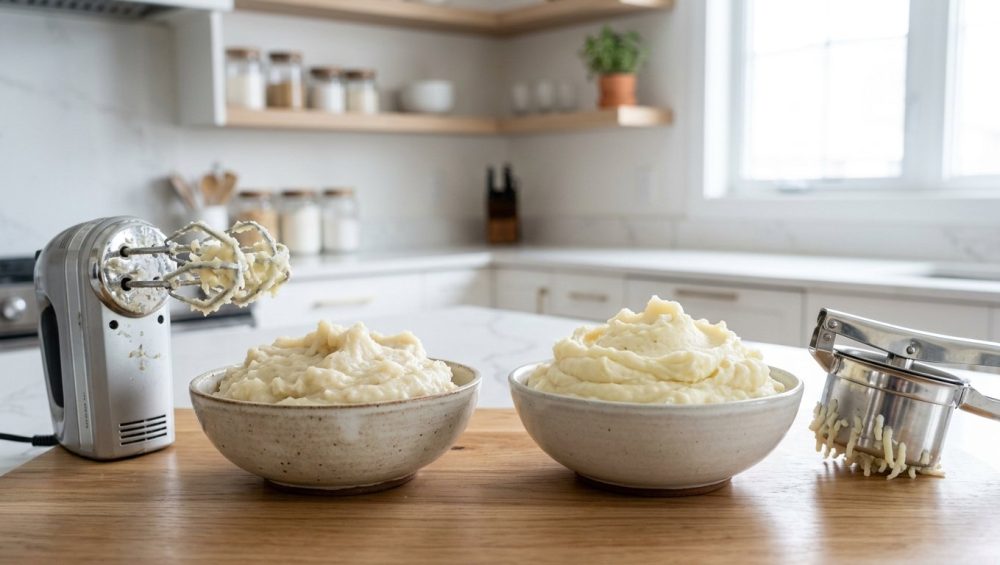
Picture this: It is a beautiful Sunday afternoon. You have spent the better part of your weekend meticulously tending to a gorgeous, expensive roast. Your kitchen smells like a rustic French bistro. You have perfectly timed the resting of the meat, your gravy is simmering away with a glossy sheen, and all that stands between you and a triumphant, restaurant-quality dinner is the humble side dish. You drain your boiled potatoes, toss them into a bowl, and—because time is money and you are exhausted—you reach for your trusty electric hand mixer. You flip the switch, watch the blades blur, and whip those spuds into submission.
But when you sit down and take a bite, your heart sinks. Instead of light, airy, cloud-like perfection, your mouth is coated in a dense, sticky, unappetizing paste. You haven’t made mashed potatoes; you have successfully manufactured edible spackle.
Listen, I get it. I am the first person to advocate for clever weeknight shortcuts to get food on the table before you collapse from exhaustion. But taking a high-speed power tool to a delicate starch matrix isn’t a shortcut—it is a culinary crime scene. If you want to cure cooking anxiety, the very first step is understanding that cooking is essentially just applied chemistry. When you understand the “why” behind the “what,” you stop making blind mistakes and start cooking with intention.
The brutal truth is that your gummy, gluey mashed potatoes are not the result of bad luck, a cursed kitchen, or a flawed recipe. They are the direct result of mechanical shear force violently destroying the biological structure of the potato. Today, we are going to strip away the pretentious chef-speak and take a deep, uncompromising dive into the food science of potato starch. We are going to look at exactly what happens on a molecular level when you boil a tuber, why high-speed appliances are the ultimate enemy of a fluffy mash, and how to achieve consistently mind-blowing results using nothing but proper technique and a little bit of respect for your ingredients.
The Biological Architecture of the Spud
To understand why your side dish turned into wallpaper paste, we have to talk about what a potato actually is. Before you even pick up a dull knife to start peeling, you need to realize that a potato is not just a dead, inert rock of carbohydrates. It is a highly complex, living biological structure.
Inside a raw potato, starch is stored in microscopic cellular sacs called amyloplasts. These sacs are tightly packed within the potato’s cellular walls. The starch inside these amyloplasts is primarily composed of two distinct types of carbohydrate polymers: amylose and amylopectin. Understanding the behavioral differences between these two molecules is the absolute key to mastering mashed potatoes.
Amylose: The Well-Behaved Linear Chain
Amylose is a linear, straight-chain polymer. Because of its neat, orderly structure, it behaves incredibly well in the kitchen. When cooked, amylose helps the potato break down easily, creating a light, fluffy texture that eagerly absorbs butter and cream without becoming sticky. Potatoes with a high ratio of amylose are your best friends when it comes to mashing, baking, and frying.
Amylopectin: The Chaotic Glue
Amylopectin, on the other hand, is a massive, highly branched, chaotic molecule. Its sprawling, tree-like structure makes it incredibly effective at binding with water. When amylopectin is released from the potato cell and introduced to liquid, it acts as a powerful thickening agent. In small, controlled amounts, this provides a pleasant, creamy mouthfeel. But when released in excess, this highly branched polymer cross-links and forms a literal, inescapable adhesive.
When you make mashed potatoes, your ultimate goal is to separate the potato cells from one another while keeping the individual amyloplasts (the starch sacs) as intact as humanly possible. You want to gently coax the cells apart, not blow them to smithereens.
The Thermodynamics of Gelatinization
You cannot eat a raw potato. Well, you could, but your digestive system would forcefully object. To make the starch digestible and palatable, we have to apply heat and water. This triggers a chemical process known as starch gelatinization.
When you heat a potato in water, the thermal energy penetrates the cellular walls. As the internal temperature of the potato reaches between 140°F and 158°F (60°C to 70°C), the starch granules inside the amyloplasts begin to absorb the surrounding moisture. As they drink in this water, the granules swell up to many times their original size, transforming from hard, crystalline structures into soft, amorphous gels.
Imagine millions of microscopic water balloons inflating inside the potato. This swelling is what softens the vegetable, turning the hard, raw flesh into a tender, edible state. However, as these starch granules swell to their maximum capacity, they become incredibly fragile. The cellular walls holding them in are now stretched thin and highly vulnerable to physical stress.
This brings us to the most critical juncture of the cooking process. You now have a pot full of swollen, delicate, microscopic starch balloons. How you choose to handle them next will dictate whether you end up with a Michelin-star-worthy puree or a sticky disaster.
The Crime of High-Shear Mixing
This is where the tragedy usually occurs. You drain your perfectly gelatinized potatoes, place them in a bowl, and introduce an electric hand mixer, a food processor, or—heaven forbid—an immersion blender.
In mechanical engineering and fluid dynamics, there is a concept known as “shear force.” Shear force is the unaligned, lateral physical stress applied to a material. When you turn on an electric hand mixer, the metal beaters whip through the food at hundreds of revolutions per minute. Blenders and food processors are even more violent, utilizing sharp blades rotating at thousands of RPMs.
These appliances are engineered for high-shear emulsification. They are designed to violently tear apart ingredients to create smooth liquids, like smoothies or vinaigrettes. When you apply this extreme shear force to your fragile, swollen potato cells, it is an absolute massacre.
The high-speed metal blades do not gently separate the potato cells; they physically slice, crush, and rupture the delicate cellular walls. When those millions of microscopic water balloons burst open, they simultaneously vomit their payload of highly branched amylopectin directly into the surrounding liquid.
Because amylopectin binds so aggressively with water, this sudden flood of branched starch immediately forms a dense, non-Newtonian gel. The more you mix, the more cells you rupture, and the more amylopectin is released. Within a matter of seconds, the texture transforms from light and fluffy to a heavy, rubbery paste. Food scientists refer to this as viscosity hysteresis—a state where the starch network binds irreversibly, resisting smooth flow and creating that dreaded, gluey mouthfeel.
You simply cannot outsmart physics. No amount of butter, cream, or prayer will reverse this chemical reaction. If you want light, fluffy results, you absolutely need a potato ricer or a similarly gentle tool. Put the power tools away.
The Potato Selection Protocol
Of course, technique only matters if you start with the right foundation. Understanding your raw ingredients is half the battle in the culinary arts. Just as you eventually learned that using aerosol cooking spray is ruining your nonstick pans, you must learn that choosing the wrong potato will completely sabotage your side dish.
Potatoes are generally classified into three categories based on their starch-to-moisture ratio: starchy, all-purpose (medium starch), and waxy.
The Gold Standard: Starchy Potatoes
If you want the absolute fluffiest, lightest mashed potatoes possible, you must use a high-starch variety, such as the classic Russet Burbank. Russets have a high solids content (averaging around 21%) and a low moisture content. More importantly, their starch makeup is heavily skewed toward linear amylose rather than branched amylopectin. Because of this, their cells naturally want to separate and flake apart when cooked, making them incredibly easy to mash gently. Their dry, mealy texture acts like a sponge, eagerly soaking up dairy and fat without turning into a watery mess.
The Rich Alternative: Medium-Starch Potatoes
If you prefer a denser, creamier, more buttery mash, medium-starch potatoes like the Yukon Gold are your best bet. Originally crossbred from russets and waxier yellow potatoes, Yukon Golds strike a beautiful balance. They have enough starch to break down smoothly, but enough moisture to provide a rich, velvety mouthfeel and a naturally buttery flavor.
The Absolute No-Go: Waxy Potatoes
Waxy potatoes, such as Red Bliss, New potatoes, and Fingerlings, have a very low starch content and a very high moisture content. Their cellular structure is dense, and they contain a higher proportion of amylopectin. Waxy potatoes are fantastic for roasting or boiling for potato salad because they hold their shape perfectly under heat. However, because their cells fiercely cling together, attempting to mash them requires excessive mechanical force. By the time you finally smash a waxy potato into a smooth puree, you have ruptured entirely too many cells, resulting in a gummy, unappetizing sludge. Do not mash waxy potatoes.
The Cold Water Rule: Physics in the Pot
The mistakes that lead to gluey mashed potatoes often begin long before the mashing phase. One of the most common rookie errors is bringing a pot of water to a rolling boil and then dropping the raw, chopped potatoes into it.
When you drop cold or room-temperature potatoes into 212°F (100°C) water, you create a massive thermal shock. The exterior of the potato chunk begins to cook and gelatinize instantly, while the dense interior remains raw and cold. By the time the thermal energy finally penetrates to the center of the potato to cook it through, the exterior has been severely overcooked.
This overcooked exterior begins to slough off and disintegrate into the boiling water, becoming completely waterlogged. When starch absorbs too much excess water during the boiling phase, it becomes incredibly prone to rupturing later on. Furthermore, the uneven cooking means you will inevitably encounter hard, undercooked lumps when you try to mash them. If you try to aggressively mash out those hard lumps, you will overwork the rest of the potato, releasing—you guessed it—more amylopectin.
There is real, measurable food science behind starting in cold water. You must place your peeled, evenly chunked potatoes into a pot, cover them with cold water, add a generous handful of salt, and then bring the entire pot up to a simmer together. This allows the thermal gradient to rise gently and evenly. The interior and exterior of the potato will reach the gelatinization temperature at the exact same time, ensuring a perfectly uniform, tender cook without any waterlogged, disintegrating edges.
The Heroes of the Kitchen: Embracing Low-Shear Tools
We have established that high-speed appliances are weapons of mass destruction for potato cells. So, how do we achieve a perfectly smooth, lump-free texture without triggering an amylopectin avalanche? We rely on low-shear, manual tools that separate the cells through gentle extrusion rather than violent slicing.
I am a relentless advocate for banishing toxic kitchen gear from your home, and this applies heavily to the tools you choose for mashing.
The Potato Ricer
The potato ricer is the undisputed king of fluffy mashed potatoes. It looks like a giant garlic press. You place your cooked potato chunks into the hopper and squeeze the handles together, forcing the potato through a plate composed of dozens of tiny holes.
Why is this so effective? Because it operates on the principle of low-friction extrusion. The ricer pushes the potato through the holes in a single, gentle motion, separating the flesh into tiny, uniform strands (resembling grains of rice) without repeatedly crushing or tearing the cell walls. Because the cells remain largely intact, the amylopectin stays locked safely inside.
A crucial warning on gear: Do not buy a cheap, flimsy plastic ricer. Pushing dense root vegetables through small holes requires significant mechanical leverage. Cheap plastic handles will flex, warp, and eventually snap under the pressure. Furthermore, you do not want cheap, mystery plastics coming into contact with boiling hot food. Invest in a heavy-duty, commercial-grade stainless steel ricer. Investing in solid, durable equipment is non-negotiable; if you’ve ever wondered why your wooden spoons keep cracking after just a few months, it is because cheap manufacturing always fails under pressure.
The Food Mill
If you are making a massive batch of potatoes for a holiday gathering, a food mill is your best friend. This is the classic French technique used in high-end restaurant kitchens. A food mill consists of a bowl with a perforated bottom and a hand-cranked blade that sweeps across the surface.
As you turn the crank, the angled blade gently presses the potatoes through the holes. Like the ricer, this is a low-shear extrusion process that prevents starch damage. It is incredibly efficient for large volumes and yields a silky, luxurious texture.
The Humble Hand Masher
If you prefer a more rustic, homestyle mash with a bit of texture, a standard manual hand masher is perfectly fine. The key here is restraint. Press straight down to crush the potatoes, and stop the exact second you reach your desired consistency. Do not stir, whip, or beat the potatoes with the masher.
The Dairy Emulsion Dynamics (Butter First, Always)
Once your potatoes are perfectly riced or milled, you are still not out of the woods. The way you introduce your fats and liquids can make or break the final texture. Mashed potatoes are, at their core, a fat-in-water emulsion. You are trying to bind the natural water inside the potato with the water in your milk and the fat in your butter.
One of the most catastrophic mistakes home cooks make is dumping cold milk directly into the hot, dry potatoes.
First, let’s talk about the order of operations. You must always, always add your fat (butter) before you add your liquid (milk or cream). When you fold melted butter into the hot, riced potatoes, the fat molecules coat the exterior of the starch granules. This fatty coating acts as a vital lubricant. When you subsequently add your milk, the water in the dairy is prevented from aggressively interacting with the starch. If you add the milk first, the starch immediately absorbs the water, swelling further and dramatically increasing the risk of turning gummy.
When folding in your dairy, use a high-quality utensil. If you have ever noticed why your silicone spatulas taste like soap, it is because cheap, filler-laden silicone absorbs harsh dishwasher detergents, which will instantly ruin the delicate flavor of your potatoes. Use a premium, 100% platinum silicone spatula or a sturdy wooden spoon to gently fold—never aggressively stir—the ingredients together.
Secondly, we must discuss temperature. Your dairy must be warm. Cold milk straight from the fridge is the enemy of a smooth emulsion.
When you introduce ice-cold milk to hot, gelatinized starch, you trigger a rapid drop in temperature. This thermal shock causes the starch molecules to violently contract and begin a process called retrogradation, where the starch attempts to recrystallize. This results in a grainy, separated, or unpleasantly stiff texture.
Temperature control is everything in the culinary arts. Just as you wouldn’t try to sear a thick steak in cold stainless steel pans, you should never shock hot, sensitive starch with ice-cold milk. Gently warm your butter and cream in a small saucepan to around 135°F to 145°F before folding them into your potatoes. The warm dairy will seamlessly integrate into the starch matrix, creating a glossy, stable, and velvety emulsion.
Fixing the Unfixable: Salvaging a Gluey Disaster
I am going to give it to you straight, without any sugar-coating. If you ignored the science, used a hand mixer, and are now frantically googling how to fix gluey mashed potatoes, the brutal truth is that you cannot reverse the chemical reaction.
You cannot un-burst a starch cell. Once that highly branched amylopectin has been released and cross-linked with the water in your pot, the viscosity hysteresis is permanent. Adding more milk will just give you a runny glue. Adding more butter will just give you a greasy glue.
However, a smart home cook never throws away food. If your mashed potatoes have turned to paste, you must pivot and lean into the starch structure you have created.
Pivot 1: Potato Croquettes
Since your potatoes are already acting like an adhesive, use that binding power to your advantage. Let the gluey potatoes cool completely in the fridge so they firm up. Roll them into small balls, bread them in flour, egg wash, and panko breadcrumbs, and deep fry them. The dense, sticky interior will transform into a molten, creamy center when fried, and the crispy exterior will provide much-needed textural contrast.
Pivot 2: Pommes Aligot
If you can’t beat the stretch, embrace it. Pommes Aligot is a traditional French dish from the Aubrac region that is famous for its fondue-like, elastic texture. Take your gluey potatoes, put them back on low heat, and aggressively stir in a massive amount of grated cheese—traditionally Tomme de Laguiole, but a mix of Gruyère and low-moisture mozzarella works brilliantly. The proteins and fats in the melting cheese will bind with the overworked potato starch, creating a rich, savory, incredibly stretchy side dish that looks entirely intentional.
The Final Word on Flawless Spuds
Cooking at a high level does not require a culinary degree, a brigade of sous-chefs, or a kitchen outfitted with thousands of dollars of commercial equipment. What it does require is a fundamental respect for the ingredients you are working with and an understanding of the basic physics that govern them.
Your potatoes are not out to get you. They are simply reacting to the environment and the mechanical forces you subject them to. By choosing the right high-starch potato, managing your thermal gradients with a cold-water start, treating the delicate starch cells with the utmost respect using a low-shear ricer, and carefully managing your dairy emulsion, you take complete control of the final outcome.
Leave the electric hand mixers for whipping cream and creaming butter and sugar. Treat your potatoes with the gentle touch they deserve, and you will be rewarded with a side dish so ethereally light, fluffy, and perfectly textured that it will completely steal the show from whatever roast you spent all weekend preparing. Now get into the kitchen, throw out that cheap plastic ricer, and start cooking with intention. You’ve got this.