Let us set the scene. It is a lazy Sunday afternoon, and you have finally decided to tackle those aggressively spotted, fruit-fly-attracting bananas sitting on your counter. You spend your precious weekend downtime mashing, measuring, and mixing. You slide the loaf pan into the oven, and for the next hour, your entire house smells like a warm, cinnamon-spiced bakery. You peek through the oven window, and there it is: a gorgeously domed, golden-brown masterpiece rising triumphantly above the rim of the pan. You feel like a culinary genius.
But then, tragedy strikes.
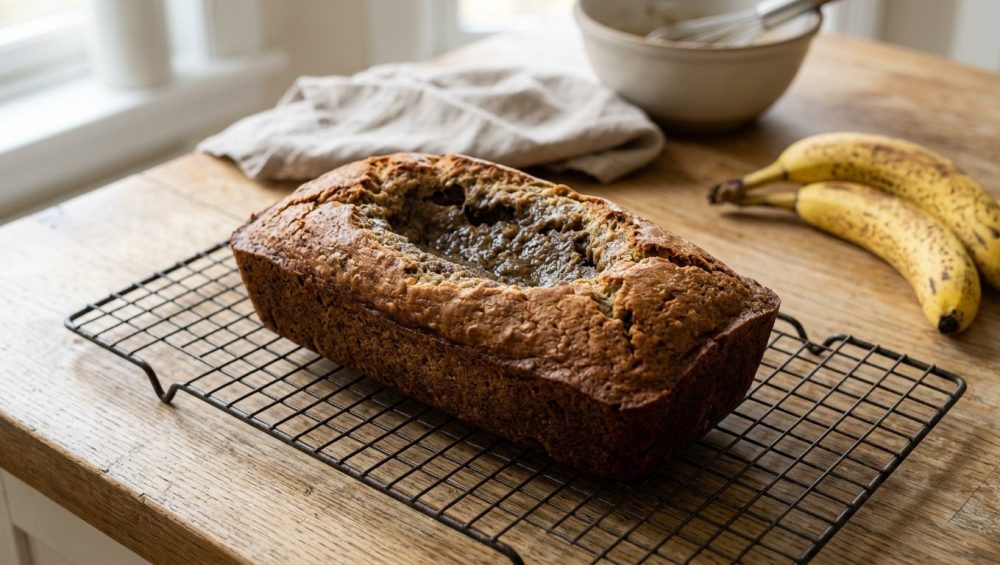
You pull the pan out of the oven and set it on the cooling rack. Within five minutes, that beautiful, majestic dome starts to deflate. It sinks. It collapses. By the time it has completely cooled down to room temperature, your once-proud loaf looks like a tragic, dense, gummy crater. You slice into it, only to discover a wet, heavy, underbaked streak running right through the exact center. Sound familiar?
Listen, I have been there. Before I learned the actual science of baking, I spent years pulling sad, sunken quick breads out of my oven, wondering if I was somehow cursed by the pastry gods. But you are not cursed, and you absolutely do not need a degree in pastry arts to fix this. You just need to understand the basic chemistry of what is happening inside that pan. As a home cook, you are entirely capable of achieving professional, bakery-level results in a standard residential kitchen. You just have to stop making the same beginner cooking mistakes that everyone else makes when they blindly follow a poorly written internet recipe.
During the week, I am all about shortcuts and efficiency to get dinner on the table. But on the weekends? We take our time, and we demand perfection. Today, we are leaving absolutely no stone unturned. We are going to dissect the anatomy of banana bread, translate the complex science of leavening agents and batter hydration, and outline the exact, foolproof steps to guarantee a perfectly domed loaf every single time. Grab a cup of coffee, put on your metaphorical lab coat, and let us get to work.
The Anatomy of a Quick Bread: It Is Not Actually Bread
Let us get one thing straight right out of the gate: banana bread is not bread. It is a giant muffin baked in a loaf pan. There is no yeast, there is no vigorous kneading, and there is no prolonged fermentation process to develop complex flavors. It belongs to the category of baked goods known as “quick breads,” which rely entirely on chemical leavening agents to achieve their lift.
The Delicate Balance of Structure and Moisture
Baking is not like making a weeknight stir-fry where you can just toss in a handful of this, a splash of that, and hope for the best. Baking is an exact science, and quick breads are a delicate, precarious balancing act between two opposing forces: structural ingredients and tenderizing ingredients.
Your structural ingredients are flour and eggs. The proteins in the flour (gliadin and glutenin) form gluten when mixed with moisture, which creates an elastic web that traps air bubbles. The proteins in the eggs coagulate as they heat up in the oven, essentially building the firm scaffolding that holds the loaf upright.
On the other side of the equation, you have your tenderizing ingredients: sugar, fat (butter or oil), and the mashed bananas themselves. These ingredients actively interfere with gluten formation. They coat the flour proteins, preventing them from linking up too tightly, which is what gives the bread that soft, melt-in-your-mouth texture. Sugar, in particular, is highly hygroscopic, meaning it attracts and holds onto water, preventing the flour from absorbing it all. If you are the type of person who likes toasting your oats first before folding them into your batter for extra texture, you are already thinking about how different ingredients absorb moisture and provide structure.
When your banana bread sinks in the middle, it means this delicate balance has been violently disrupted. The tenderizers have overpowered the structural ingredients, or the leavening gases have expanded too quickly for the scaffolding to support them. The result? A complete structural collapse.
Culprit Number One: The Leavening Agent Betrayal
If your loaf rises beautifully in the oven and then aggressively caves in on itself the second it hits the room-temperature air, your leavening agents are usually the prime suspects. Most home bakers assume that if a little baking soda makes a loaf rise, more baking soda will make it rise higher. This is a catastrophic misunderstanding of baking chemistry.
The Difference Between Baking Soda and Baking Powder
To fix the sink, you need to understand the chemical tools at your disposal. Baking soda (sodium bicarbonate) is an alkaline base. It requires an acidic ingredient—like buttermilk, yogurt, brown sugar, or the natural acidity of mashed bananas—to activate. The moment it touches that acid, it begins producing carbon dioxide gas. If you use too much baking soda without enough acid to neutralize it, you will be left with sodium carbonate, which gives your baked goods a horrific, metallic, soapy aftertaste.
Baking powder, on the other hand, is a complete leavening package. It contains both baking soda and a powdered acid (usually cream of tartar or sodium aluminum sulfate), plus a little cornstarch to keep them from reacting in the container. Most commercial baking powders are “double-acting,” meaning they react once when they get wet (when you mix the batter) and a second time when they hit the intense heat of the oven. Just as you know your pancake batter needs to rest to allow these chemical reactions to fully develop, quick bread batters undergo the exact same process.
The Danger of the Over-Rise
Here is exactly why your bread is collapsing: you used too much leavening, or you measured it sloppily. When a recipe contains too much baking soda or baking powder, the batter produces an excessive amount of carbon dioxide gas very rapidly. The air bubbles inside the batter expand violently, pushing the dome higher and higher.
However, because the bread has not finished baking, the structural scaffolding (the gluten and egg proteins) has not yet set into a rigid form. The bubbles grow so large that they pop and merge, creating massive, unstable caverns inside the loaf. Once you take the pan out of the oven and the gases begin to cool and contract, there is no solid structure to hold the dome up. Gravity takes over, and the middle of your loaf plummets.
Furthermore, leavening agents expire. If your baking soda has been sitting in the back of your pantry since the last presidential election, it has likely lost its potency. A weak leavener will fail to provide enough initial lift, resulting in a dense, flat brick. Always test your baking soda by dropping a spoonful into some vinegar (it should fizz violently) and your baking powder into hot water (it should bubble immediately). If they do not, throw them away immediately.
Culprit Number Two: The Unpredictable Banana Variable
Let us talk about the star of the show. The banana is the most critical ingredient in the recipe, yet it is also the most volatile and unpredictable variable you can introduce to a baking formula.
The Chemistry of a Ripening Banana
As a banana sits on your counter and transforms from bright yellow to heavily speckled to completely black, a profound chemical shift is occurring. Enzymes inside the fruit are actively breaking down complex starches into simple sugars (fructose, glucose, and sucrose). This is why a black banana tastes exponentially sweeter and more intensely flavored than a firm yellow one.
But it is not just the sugar content that changes. As the starches break down, the cell walls of the fruit begin to collapse, releasing trapped water. Scientific analyses of fruit ripening have demonstrated that overripe bananas have a massive moisture content, hovering around 78.6% water by weight. When you mash a completely black banana, you are essentially creating a sugary, highly hydrated fruit puree.
Some bakers like to freeze their aging bananas to save them for the weekend. This is a great trick, but freezing causes the water inside the cells to expand into ice crystals, which completely shatters the cell walls. When you thaw those bananas, they will release a massive pool of dark “banana juice.” Do not throw that liquid away! It contains all the flavor. But you must account for that extreme hydration in your batter.
Hydration Ratios and Why You Must Weigh Your Fruit
This brings us to the most infuriating instruction found in vintage cookbooks and lazy internet recipes: “Use 3 medium bananas.”
What on earth is a “medium” banana? A medium banana in a standard grocery store today is massive compared to a medium banana from twenty years ago. If you blindly grab three bananas and mash them up, you could be adding anywhere from 1 cup to over 1.5 cups of highly hydrated fruit puree to your batter.
If you add too much banana puree, you are flooding the batter with excess liquid. The flour simply cannot absorb all that extra moisture, and the egg proteins cannot coagulate properly in a swamp of fruit juice. The result is a loaf that stays perpetually wet and gummy in the center, no matter how long you bake it. When the loaf cools, that heavy, wet center drags the entire structure downward.
To achieve consistent, professional results, you must invest in a digital kitchen scale. A standard recipe usually requires exactly 1 cup, or roughly 225 to 230 grams, of mashed banana. Weighing your ingredients completely eliminates the hydration guesswork. And please, use a sturdy tool to mash them; if you find your silicone spatulas taste like soap because they absorbed your harsh dishwasher detergent, do not use them to fold your delicate fruit purees. Use a proper stainless steel potato masher or a heavy fork.
Culprit Number Three: Gluten Sabotage and the Muffin Method
Even if your leavening ratios are mathematically perfect and your banana hydration is precise to the gram, you can still completely ruin the loaf in the final sixty seconds before it goes into the pan. The way you combine your wet and dry ingredients dictates the final crumb structure of the bread.
The Science of Gluten in Quick Breads
When flour comes into contact with water, the proteins gliadin and glutenin bind together to form gluten. In yeast breads, we want a massive amount of gluten. We knead the dough aggressively to create a strong, chewy, elastic network. In quick breads, we want the exact opposite. We want a tender, soft, cake-like crumb that breaks apart easily.
The standard technique for banana bread is the “Muffin Method.” You whisk all your dry ingredients (flour, salt, baking soda, spices) in one large bowl, and all your wet ingredients (mashed bananas, melted butter or oil, eggs, sugar, vanilla) in another. Then, you pour the wet ingredients into the dry ingredients and fold them together gently.
The Perils of Overmixing
If you take a whisk or a motorized electric hand mixer to your batter and beat it until it is perfectly smooth and uniform, you have overmixed it. Overmixing develops excessive gluten, creating a tough, rubbery scaffolding. Worse, aggressive mixing incorporates way too much air into the batter. That extra air will expand rapidly in the oven (contributing to the dreaded over-rise) and then collapse when it cools.
You should fold the batter with a spatula just until the last streak of dry white flour disappears. The batter should look lumpy, thick, and slightly ugly. Do not try to smooth it out. If you are aggressively stirring so hard that your wooden spoons keep cracking under the pressure, you are completely destroying the delicate texture of your loaf. Stop mixing.
Culprit Number Four: Your Cheap, Toxic Loaf Pan
I am going to get on my soapbox for a minute because this is a hill I will absolutely die on. The pan you use drastically alters the thermodynamics of your bake, and far too many home cooks are using absolute garbage equipment that ruins their food and potentially harms their health.
The 2025 and 2026 PFAS Bakeware Bans
If you bought a cheap, dark, non-stick loaf pan from a discount store five years ago, and the black coating is starting to peel or flake off onto your baked goods, throw it in the trash immediately. We are officially in an era where state legislatures are finally cracking down on “forever chemicals.” Throughout 2025 and into 2026, states like Maine, Colorado, Minnesota, and New York have enacted sweeping bans on intentionally added PFAS (per- and polyfluoroalkyl substances) in consumer cookware and bakeware. These synthetic chemicals are toxic, they accumulate in the human body, and they have absolutely no business being anywhere near your food.
If you are serious about banishing toxic kitchen gear from your life, your bakeware drawer is the first place to start.
Glass vs. Dark Metal vs. Light Aluminized Steel
Aside from the glaring health hazards, cheap dark non-stick pans ruin quick breads mechanically. Dark colors absorb heat rapidly. When you put a dark metal pan into a 350°F oven, the edges of the batter heat up and set way too fast. The outside of the loaf burns and forms a hard, impenetrable crust before the center has had any time to rise and bake. The heat cannot penetrate the dense batter efficiently, leaving you with a raw, sunken middle.
Glass is equally problematic. Glass is an insulator, not a conductor. It takes a very long time to heat up, but once it gets hot, it holds onto that heat aggressively. Baking in glass often results in gummy edges and an undercooked center because the heat transfer is so poor. Plus, the extreme temperature fluctuations of a hot oven can cause thermal shock. If you have ever had a glass baking dish shattered into a thousand pieces while pulling it out of the oven, you know exactly what I mean.
The absolute best pan for banana bread is a heavy-duty, light-colored, uncoated aluminized steel loaf pan. Light-colored metal reflects heat, allowing for a slow, even, steady bake. This gives the center of the loaf plenty of time to catch up with the edges, ensuring a uniform rise and a perfectly cooked middle.
Culprit Number Five: Oven Thermodynamics and the Illusion of Doneness
You have mixed the perfect batter, you are using a professional-grade pan, and you slide it into the oven. Now, you have to know exactly when to take it out. This is where 90% of home bakers fail.
Why the Toothpick Test is a Liar
For generations, recipes have told us to “insert a toothpick into the center; if it comes out clean, the bread is done.” This is terrible, outdated advice for high-moisture quick breads.
A toothpick will often come out clean when the batter has merely coagulated into a semi-solid state, but before the internal structure has fully stabilized. Furthermore, banana bread is loaded with gooey pockets of fruit, melted sugar, and often chocolate chips. Your toothpick is going to hit a pocket of molten banana, come out wet, and trick you into overbaking the edges into charcoal. Or, it will slide through a dry pocket of crumb, come out clean, and trick you into pulling the bread out twenty minutes too early. When you pull an underbaked loaf, the center has not reached the temperature required to permanently set the starches and proteins. It will instantly collapse upon hitting the cool kitchen air.
The Magic Number: 200°F to 205°F
Stop guessing. Baking is science, and science relies on hard data. The only foolproof way to know if your banana bread is structurally sound and fully baked is to measure its internal temperature.
You need a high-quality, instant-read digital thermometer. Insert the probe directly into the absolute center of the loaf, pushing it down until the tip is right in the middle of the deepest, thickest part of the batter. The target temperature for a perfectly baked, structurally stable banana bread is between 200°F and 205°F (93°C to 96°C).
If your thermometer reads 185°F, it is still raw in the middle. Put it back in the oven. If the top is getting too dark but the inside is not done, loosely tent a piece of aluminum foil over the pan to deflect the radiant heat and prevent the crust from burning. If you suspect your cheap meat thermometer is lying to you because it has not been calibrated since 2018, test it in a glass of ice water (it should read exactly 32°F) before trusting it with your weekend baking project.
The Sassy Sous-Chef’s Masterclass Fixes for a Perfect Dome
Now that we have diagnosed every possible reason your bread is sinking, let us talk about the proactive, professional techniques you can use to guarantee a towering, bakery-style dome.
The Power of Resting the Batter
Here is a brilliant trick that professional bakers use but rarely share with home cooks: let the batter rest before baking.
Once you have folded your wet and dry ingredients together, leave the bowl sitting on the counter for 15 to 20 minutes before pouring it into the pan. This resting period does two crucial things. First, it allows the flour to fully hydrate. The starches slowly absorb the moisture from the bananas and the eggs, thickening the batter naturally without the need for extra flour. A thicker batter provides more physical resistance to the expanding leavening gases, creating a stronger, more stable dome that will not easily collapse.
Second, if you are using double-acting baking powder, this resting phase allows the initial chemical reaction to occur in the bowl rather than in the oven. The batter will become slightly aerated, puffy, and light.
The Dual-Temperature Baking Hack
If you want that dramatic, cracked, towering dome that you see in artisanal coffee shops, you need to actively manipulate your oven’s thermodynamics.
Most recipes tell you to bake at 350°F for 60 to 70 minutes. That is fine, but it produces a relatively flat top. Instead, try the dual-temperature method. Preheat your oven to 400°F. When you put the loaf in, the intense initial blast of heat causes the leavening agents to react rapidly and the steam to expand forcefully, thrusting the batter upward before the crust has a chance to set and harden.
Bake the loaf at 400°F for exactly 15 minutes. Then, without opening the oven door (which would cause a catastrophic drop in pressure and temperature, much like the sudden thermal shock that makes cheap baking sheets pop in the oven), turn the temperature down to 350°F. Continue baking for another 40 to 50 minutes until the internal temperature reaches that magical 200°F to 205°F mark. The high heat builds the majestic dome; the lower heat bakes the center evenly without burning the exterior.
And please, when you prep your pan, use a sling of parchment paper or rub the interior with actual butter. Aerosol cooking spray is the enemy of high-quality bakeware. The soy lecithin in those sprays polymerizes under high heat, leaving a sticky, impossible-to-remove residue that will permanently ruin the finish of your pan over time.
The Final Step: The Science of Cooling and Starch Retrogradation
You have hit 205°F. You pull the pan from the oven. You are not done yet. The way you cool the bread is the final hurdle in preventing a sunken middle.
When the loaf comes out of the oven, the starches inside are still gelatinized, and the structural proteins are incredibly fragile. If you try to dump the bread out of the pan immediately, the physical shock can cause the delicate crumb to compress and collapse under its own weight.
Leave the bread in the hot pan for exactly 10 to 15 minutes. This allows the residual heat to gently finish setting the crumb, a process known as starch retrogradation. The structure firms up as it begins to cool, and carryover cooking will push the internal temperature up just a few more degrees to finalize the bake.
However, do not leave it in the pan for longer than 15 minutes. As the loaf cools, it releases a significant amount of steam. If it remains trapped inside the metal pan, that steam will condense on the sides and bottom of the bread, turning your perfectly baked crust into a soggy, wet sponge. That excess moisture can seep back into the bottom of the loaf, creating a dense, gummy layer that drags the center down.
After 10 to 15 minutes, carefully run a butter knife around the edges, invert the pan, and transfer the loaf to a wire cooling rack. The wire rack allows air to circulate completely around the bread, letting the steam escape harmlessly into the kitchen. Do not slice into it for at least an hour. I know it is tempting, but cutting into a piping hot loaf releases all the trapped steam, leaving the remaining bread dry and crumbly.
Baking is not magic; it is applied chemistry wrapped in a delicious package. When your banana bread sinks in the middle, it is simply your ingredients communicating that their structural limits were exceeded. By understanding the balance of leavening agents, controlling the hydration of your overripe bananas, using safe and high-quality bakeware, and relying on a digital thermometer instead of a wooden stick, you take all the guesswork out of the equation.
You do not need a culinary degree to bake like a professional. You just need patience, precision, and the willingness to respect the science of the oven. Next weekend, when those bananas turn black and the fruit flies start circling, you will know exactly what to do. Weigh your ingredients, rest your batter, blast it with heat, and watch that perfect dome rise. Now get out of here and go preheat your oven.