Listen up, folks. I have ruined enough dinner parties for the both of us, and I am here to tell you that there is nothing quite as tragic as a beautifully curated, farm-fresh salad completely destroyed by a broken vinaigrette. You know exactly what I am talking about. You spend twenty minutes chopping pristine produce, you whisk together a dressing that looks gorgeous for exactly four seconds, and by the time the bowl hits the dining table, it has separated into a depressing slick of oil floating on top of a harsh, biting pool of vinegar. It looks unappetizing, it tastes uneven, and it makes you look like you don’t know your way around a kitchen.
But here is the truth: you do not need a culinary degree to fix this. You just need a basic understanding of kitchen chemistry. If you are serious about breaking your takeout habit, mastering a permanently stable vinaigrette is step one. We are going to dive deep into the science of amphiphilic emulsifiers and mechanical shearing. Why? Because when you understand the mechanics of an emulsion, you can make your dressings days in advance. You can store them in the fridge without them breaking. You can finally host a relaxed, build-your-own DIY salad bar where your only job is pouring the wine and enjoying the company of your guests, rather than frantically whisking a split dressing in the corner while sweating through your nice shirt.
The Science of Separation: Why Oil and Vinegar Hate Each Other
Before we can force oil and vinegar to play nicely together, we have to understand why they despise each other in the first place. This isn’t just a culinary quirk; it is a fundamental law of thermodynamics.
The Chemistry of Repulsion
At a molecular level, water (and by extension, vinegar, lemon juice, and any other water-based acid) is a polar molecule. It has a slight positive charge on one end and a slight negative charge on the other. Because of this, water molecules love to stick together. They are hydrophilic (water-loving) and highly sociable with other polar molecules.
Oil, on the other hand, is completely non-polar. It has no charge. It is hydrophobic (water-fearing). When you pour oil into vinegar, the water molecules essentially lock arms, forming a tight, exclusive club that physically pushes the oil molecules out. The oil molecules have no choice but to clump together. This is why your cheap plastic containers stay greasy even after a run through the dishwasher—oil desperately clings to other hydrophobic surfaces to avoid water.
The Density Dilemma
To make matters worse, oil and water don’t just repel each other; they have different densities. Oil is less dense than water, which means gravity is constantly working against you. Even if you manage to momentarily mix them up, the lighter oil will invariably float to the top, while the heavier water-based acid sinks to the bottom. In the scientific community, a system always seeks its lowest energy state. For a vinaigrette, that lowest energy state is complete, stubborn separation.
Enter the Emulsion: Forcing Peace Between Culinary Enemies
So, how do we defeat the laws of physics? We create an emulsion. An emulsion is simply a mixture of two liquids that normally would not mix. In the case of a vinaigrette, we are creating an oil-in-water emulsion, where millions of microscopic oil droplets are suspended throughout the water phase.
What Exactly is an Emulsion?
There are two types of emulsions in the culinary world: temporary and permanent. A temporary emulsion is what happens when you just violently shake oil and vinegar together. You physically smash the oil into smaller droplets, and for a few fleeting minutes, it looks cloudy and combined. But the moment you stop shaking, those droplets start bumping into each other, merging back together (a process called coalescence), and floating back to the top.
A permanent (or at least, highly stable) emulsion stays together for days or even weeks. To achieve this, we have to introduce a mediator.
The Magic of Surfactants and Amphiphilic Molecules
To keep those microscopic oil droplets from merging back together, we need a chemical peacekeeper. Enter the amphiphilic molecule. “Amphi” means both, and “philic” means loving. These brilliant little molecules have a split personality: one end is hydrophilic (loves water) and the other end is lipophilic (loves fat/oil).
If you’ve ever wondered why your cheap silicone spatulas taste like soap, it’s because dish soap acts as an intense surfactant—a type of amphiphilic molecule that strips away oils by binding to both the oil and the wash water. In cooking, we use edible surfactants to do the exact opposite: we use them to bind our ingredients together. When you whisk an emulsifier into your dressing, the fat-loving tails bury themselves into the microscopic oil droplets, while the water-loving heads point outward into the vinegar. This creates a protective, water-friendly shell around every single drop of oil, preventing them from touching each other and merging. Boom. Science.
The VIP Emulsifiers: Your Kitchen’s Peacekeepers
You can whisk until your arm falls off, but without the right emulsifiers, your dressing will eventually fail. Here are the heavy hitters you need in your pantry to build a bulletproof vinaigrette.
Dijon Mustard: The Undisputed Heavyweight Champion
If there is one ingredient you take away from this masterclass, let it be Dijon mustard. It is the absolute gold standard for home vinaigrettes. Mustard seeds naturally contain a complex carbohydrate called mucilage, which surrounds the seed hull. When the seeds are ground into a paste (like in Dijon), this mucilage is released. It acts as a powerful emulsifier, coating the oil droplets and stabilizing the mixture. Plus, Dijon adds a sharp, complex tang that elevates the entire flavor profile. A single teaspoon of high-quality Dijon is enough to permanently stabilize a cup of dressing.
Honey and Maple Syrup: The Viscosity Boosters
While honey and maple syrup are not true chemical emulsifiers in the way that mustard is, they play a critical supporting role by altering the viscosity of the continuous phase (the vinegar). By making the water phase thicker and more sluggish, honey physically slows down the movement of the oil droplets. If the droplets can’t move quickly, they can’t crash into each other and coalesce. Combining a true emulsifier like Dijon with a viscosity booster like honey creates an almost indestructible dressing.
Egg Yolks and Mayonnaise: The Creamy Cheats
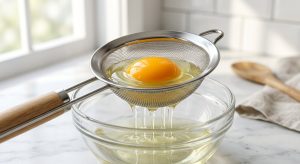
If you are making a Caesar dressing or a creamy vinaigrette, egg yolks are your best friend. Egg yolks are packed with lecithin, one of nature’s most potent amphiphilic molecules. If you are nervous about using raw egg yolks, a dollop of high-quality store-bought mayonnaise works just as well. Mayonnaise is already a perfectly stable emulsion, so adding a spoonful to your vinaigrette essentially “seeds” the mixture with pre-stabilized lecithin, locking your dressing together instantly.
Garlic and Shallots: The Unsung Particulate Heroes
Finely minced aromatics do more than just provide flavor. When you mince garlic or shallots into a microscopic paste, those tiny solid particles get physically wedged between the oil droplets, creating what chemists call a Pickering emulsion. The solid particles act as a physical barricade, preventing the oil droplets from merging. Just remember, when mincing garlic for your dressing, the secret to bitter-free meals is using a sharp knife rather than a dull blade that crushes and oxidizes the harsh allicin compounds.
Mechanical Shearing: Beating Your Dressing Into Submission
Having the right chemicals is only half the battle. You also have to provide the mechanical energy to break the oil down into droplets small enough to be coated by the emulsifiers. This process is called shearing. Just as you enhance the flavor of whole spices by blooming them in oil, you enhance the texture of your dressing by properly shearing the oil into the acid.
The Whisking Method: Technique Over Brute Force
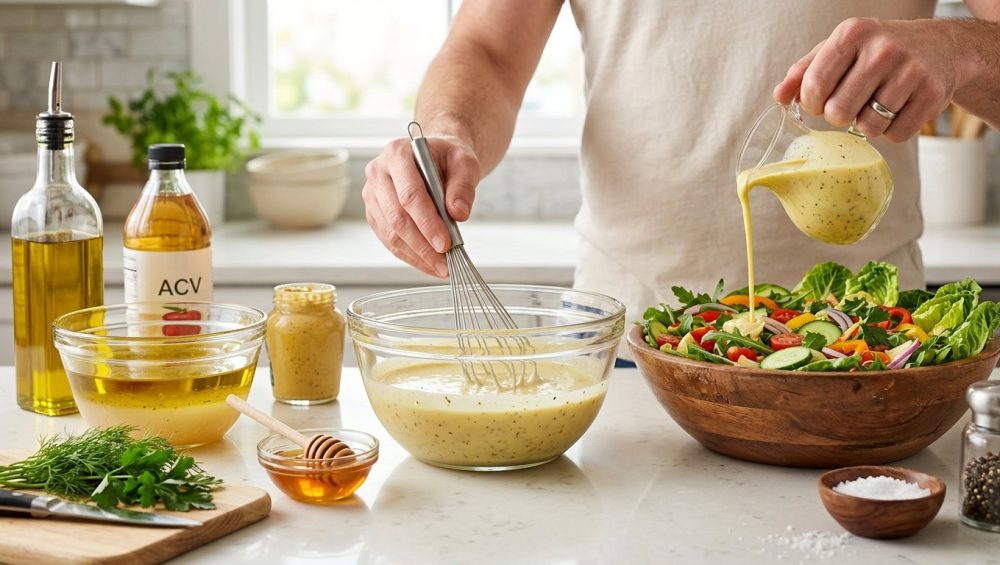
The classic method requires a mixing bowl, a wire whisk, and a little patience. The absolute most critical rule of whisking a vinaigrette is this: you must start with your acid and your emulsifiers in the bowl first. Whisk them together until they are completely uniform. Then, and only then, do you begin adding the oil.
You must add the oil drop by literal drop at first. If you dump all the oil in at once, the emulsifiers will be overwhelmed, the oil will pool together, and the emulsion will immediately break. By adding the oil in a slow, painfully thin stream while whisking furiously, you are mechanically tearing the oil apart into tiny droplets, giving the Dijon and honey time to coat each one. Once the emulsion starts to build and thicken, you can pour the oil slightly faster.
The Mason Jar Shake: Why It Usually Fails (and How to Fix It)
We all love the convenience of throwing everything into a mason jar and shaking it like a maraca. It saves time and dishes. But here is the brutal truth: human arms simply cannot generate enough shear force to create microscopic oil droplets through shaking alone.
If you use the mason jar method without a heavy dose of emulsifiers, your dressing will separate within twenty minutes. To make the jar method work, you must overcompensate with your stabilizers. Use a full tablespoon of Dijon and a teaspoon of honey. The extra mucilage and viscosity will make up for the lack of mechanical shear force.
The Immersion Blender: The Ultimate Emulsion Weapon
If you want a truly professional, creamy, homogenized vinaigrette that will stay emulsified in your fridge for three weeks, you need an immersion blender. The high-speed rotary blades generate massive shear force, pulverizing the oil into microscopic droplets that a whisk could never achieve. You just dump all your ingredients into a tall, narrow beaker and blend for fifteen seconds. It is foolproof, instantaneous, and life-changing for weekday meal prep.
The Polyphenol Trap: Why Blending EVOO Ruins It
However, there is a massive, incredibly important caveat to using a blender. You must never, ever use high-speed mechanical shearing on high-quality Extra Virgin Olive Oil (EVOO).
Extra virgin olive oil is packed with polyphenols, which are bitter-tasting antioxidant compounds. Normally, these polyphenols are safely locked away inside tiny fatty acid structures within the oil. When you whisk EVOO by hand, those structures remain intact. But when you hit EVOO with the violent, high-speed blades of a blender or food processor, you completely obliterate those structures, releasing all the polyphenols at once. The result is a dressing that tastes aggressively, unpalatably bitter. It will completely ruin your meal.
If you want to use an immersion blender for a vinaigrette, you must use a neutral oil (like avocado oil, grapeseed oil, or light olive oil) for the blending process. If you want the flavor of EVOO, whisk it in gently by hand after the base emulsion has been created.
The Golden Ratio: Rethinking the 3:1 Oil-to-Acid Rule
Every old-school cookbook will tell you that a vinaigrette must be exactly three parts oil to one part acid. I am here to tell you that this rule is outdated, rigid, and often leads to greasy, heavy salads.
Why 3:1 Isn’t Always Right
The 3:1 ratio was popularized by the French, who traditionally used very harsh, highly acidic vinegars. To balance that intense bite, they needed a massive amount of oil. But modern home cooks have access to a wide variety of milder, sweeter acids—like balsamic vinegar, rice vinegar, Meyer lemon juice, and apple cider vinegar.
If you use a 3:1 ratio with a sweet, aged balsamic, your dressing will taste like a mouthful of plain oil. For milder acids, a 1:1 or 2:1 ratio is often far superior. The goal is balance. Sometimes your dinner actually needs acid more than it needs another pinch of salt to cut through the richness of the main course. Taste your dressing by dipping a leaf of lettuce into it—never taste it straight from a spoon, as the flavor profile changes dramatically once dispersed over greens.
Choosing the Right Oils
Your choice of fat dictates the entire personality of the dressing.
- Extra Virgin Olive Oil: Peppery, robust, and fruity. Best for Mediterranean flavor profiles. Must be whisked by hand.
- Avocado Oil: Buttery, rich, and completely neutral. The absolute best choice for immersion blender vinaigrettes.
- Walnut or Sesame Oil: Highly pungent finishing oils. Never use these as the base; use a neutral oil and add just a splash of these at the end for aroma.
Acid Selection: Vinegars, Citrus, and Beyond
The acid is the backbone of the vinaigrette.
- White Wine & Champagne Vinegar: Crisp, clean, and versatile. The little black dress of vinegars.
- Apple Cider Vinegar: Fruity and slightly funky. Perfect for autumn salads with apples and sharp cheddar.
- Fresh Citrus: Lemon, lime, and grapefruit juices bring a bright, volatile acidity that vinegars lack. However, citrus juices contain water and pulp, which can destabilize an emulsion faster than pure vinegar. Always up your mustard quotient when using citrus.
Equipment Check: Ditch the Toxic Junk
I cannot write a masterclass without addressing the absolute garbage equipment being sold to home cooks. You cannot create culinary art with toxic, poorly manufactured tools.
The Danger of Cheap Gear
Stop buying those flimsy plastic salad dressing shakers with the little plastic mixing wheels inside. They are impossible to clean, they hold onto old garlic smells forever, and cheap plastics degrade over time, leaching microplastics into your acidic dressings.
Likewise, throw away any whisk that has a peeling non-stick or silicone coating. When you are aggressively whisking an acidic mixture in a bowl, those cheap coatings flake off directly into your food. It is disgusting, it is unsafe, and I have zero tolerance for it in my kitchen.
The Only Gear You Actually Need
To protect your expensive oils from going rancid, you absolutely need an opaque dispenser to block UV light. But for making and storing the dressing itself, keep it simple, durable, and non-reactive.
- Glass Mason Jars: The ultimate storage vessel. Glass is non-reactive, completely impermeable, and won’t hold onto odors.
- A Balloon Whisk: You want a large, stainless steel balloon whisk with plenty of thin, flexible tines. The more tines, the more shear force you can generate per stroke.
- A Stainless Steel Mixing Bowl: Heavy-bottomed stainless steel won’t react with your vinegar and won’t chip. Pro tip: wrap a damp dish towel around the base of the bowl to keep it from spinning on the counter while you whisk.
- A Stainless Steel Immersion Blender: If you are upgrading your setup, this is the holy grail. Ensure the blending wand is made of solid stainless steel, not plastic, so it can withstand acidic mixtures without degrading.
The Make-Ahead Strategy: Prepping for a Relaxed DIY Salad Bar
Now that you understand the science of a permanent emulsion, we can talk about how this transforms your weekend gatherings. If you want to truly master the art of effortless hosting, you have to eliminate day-of bottlenecks. Vinaigrettes are the ultimate make-ahead component.
Why Stable Emulsions Change the Hosting Game
When you rely on temporary, shaken emulsions, you are forced to make the dressing at the very last second. You are stuck in the kitchen, frantically shaking a jar while your guests are sitting at the table.
By utilizing Dijon mustard, honey, and high-shear blending, you can make your vinaigrettes on a Thursday for a Saturday night dinner party. The emulsion will hold perfectly. The flavors will actually meld and mature in the fridge, rounding out the harsh edges of the garlic and vinegar.
Storing and Reviving Your Masterpiece
Store your emulsified vinaigrette in a tightly sealed glass jar in the refrigerator. Because you are using oil, it will likely solidify or become extremely thick when chilled. This does not mean the emulsion has broken! It simply means the fat has congealed.
To revive it, take the jar out of the fridge an hour before your guests arrive and let it sit at room temperature. Once the oil warms up, give it a gentle shake, and it will be perfectly creamy and ready to pour.
Setting Up the Ultimate Build-Your-Own Salad Station
A DIY salad bar is the most relaxed, interactive way to feed a crowd. It accommodates picky eaters, food allergies, and vegans all at once.
Set out a massive wooden bowl of washed, thoroughly dried greens. (Wet greens will instantly repel your oil-based dressing, ruining all your hard work). Surround the greens with small bowls of prepped toppings: toasted nuts, crumbled cheeses, shaved radishes, roasted chickpeas, and sliced fruits.
Finally, place your beautifully emulsified, room-temperature vinaigrettes in small glass pitchers with pouring spouts. Because the dressing is perfectly stable, it won’t separate in the pitchers. Your guests can drizzle a smooth, cohesive sauce over their custom creations, ensuring every single bite is perfectly coated.
Troubleshooting the Broken Vinaigrette (Because We All Mess Up)
Even with the best intentions, sometimes we rush. We pour the oil too fast, we forget the mustard, and suddenly, we are staring at a split, greasy mess. Do not panic, and do not throw it away.
How to Rescue a Split Dressing
A broken dressing can almost always be revived, much like the magic of a lemon squeeze revives a dull, flat soup. You just need to re-establish the continuous phase.
The Boiling Water Trick: Sometimes, the emulsion breaks because the ratio of oil to water is too high, and the oil droplets literally have no room to swim. Vigorously whisk exactly one teaspoon of boiling hot water into the broken dressing. The heat helps relax the oil, and the added water gives the emulsion room to reform.
The Fresh Bowl Reset: If the water trick fails, grab a clean mixing bowl. Add one teaspoon of Dijon mustard and one teaspoon of your vinegar. Whisk them together. Now, treat your broken, split vinaigrette as if it were your pure oil. Slowly, drop by drop, whisk the broken dressing into the new mustard mixture. The fresh emulsifiers will grab onto the oil and pull the whole thing back together into a thick, creamy masterpiece.
The Temperature Factor: Why Cold Oil is the Enemy
Emulsions rely on molecules being able to move and coat each other quickly. If your oil or your mustard is ice cold straight from the fridge, the molecules are sluggish. The fats are stiff, and they will resist breaking down into microscopic droplets. Always let your ingredients come to room temperature before attempting to build a vinaigrette by hand. It makes the mechanical shearing infinitely easier and significantly reduces the risk of the emulsion breaking.
Conclusion
Cooking is not magic; it is just applied physics and chemistry that you get to eat at the end of the day. Once you understand how amphiphilic molecules work, and once you respect the power of mechanical shearing, you are no longer at the mercy of your ingredients. You are the boss of the bowl.
You can banish those sad, separated oil slicks from your dinner table forever. You can prep your dressings days in advance, reclaim your time, and actually enjoy the gatherings you host. Build that DIY salad bar, trust in the power of Dijon, and please, for the love of all things holy, stop adding salt too early to your greens. Now get out of here, grab a whisk, and go emulsify something. You’ve got this.