Listen up, weekend warriors. We need to have a serious, brutally honest conversation about the state of your kitchen prep routine. It is that time of year again—the season when the farmers’ markets and grocery store aisles are overflowing with gorgeous, autumnal root vegetables and winter gourds. You see a beautiful, bulbous butternut squash and think to yourself, “I’m going to make a stunning, velvety roasted squash soup tonight.”
Fast forward an hour. Your cutting board looks like a crime scene. Your hands are covered in a bizarre, sticky, orange sap that feels like superglue. Your wrist is throbbing, your patience is entirely depleted, and you are seriously considering ordering takeout and throwing the mangled remains of that squash directly into the compost bin.
You are not alone in this struggle. Every single day, enthusiastic home cooks walk into their kitchens and go to war with dense, tough-skinned produce, and every single day, they lose. But here is the secret the culinary world doesn’t want to admit: the problem isn’t your lack of a culinary degree, and the problem certainly isn’t the squash. The problem is that flimsy, dull, plastic-handled swivel peeler you bought in a grocery store checkout aisle a decade ago.
It is time to stop wrestling with your produce. Mastering the art of the home kitchen means working smarter, not harder. Today, we are diving deep into the mechanical flaws of standard kitchen peelers, the hidden dangers of dull blades, and the absolute genius of the carbon steel Y-peeler. This is your definitive masterclass on reclaiming your prep time, saving your wrists, and effortlessly conquering the most intimidating vegetables in the produce aisle.
The Butternut Squash Battle: Why You’re Losing
Before we can fix the problem, we have to understand the enemy. Winter squashes, sweet potatoes, and root vegetables like celery root are botanically designed to be incredibly resilient. They are meant to survive harsh conditions, sitting in root cellars for months on end without rotting. To achieve this, nature equipped them with a thick, waxy, heavily fortified outer rind (the exocarp) that is highly resistant to punctures and abrasions.
But the butternut squash has an additional, highly devious defense mechanism. When you pierce the skin of a raw butternut squash, it releases a protective sap containing a compound called cucurbitacin. In the wild, this sap is meant to cauterize wounds on the fruit and deter animals from eating it. In your kitchen, this sap acts as a wildly effective sabotage agent. As you peel the squash, the sap leaks onto your hands and begins to dry. It creates a stiff, sticky, orange film that tightens the skin on your palms and fingers, sometimes even causing a mild contact dermatitis affectionately known by prep cooks as “squash hands”.
Not only is this sap irritating to your skin, but it transforms the heavy, oddly shaped squash into a slippery, unpredictable projectile. When you combine a dense, waxy skin, an unstable bulbous shape, a coating of slippery sap, and a dull peeling tool, you have the perfect recipe for a catastrophic kitchen injury. Every holiday season, emergency rooms see a massive spike in hand lacerations because home cooks are applying maximum physical force to dull blades that inevitably slip off the vegetable and slice directly into their fingers.
If you constantly wonder why your roasted veggies turn mushy, it might be because you spent so much time fighting the peel that you rushed the roasting process out of sheer exhaustion. Time is money, honey, and you are wasting both by using the wrong tools for the job.
The Mechanical Flaws of the Standard Swivel Peeler
Let us take a long, hard look at the classic swivel peeler—also known as the straight peeler. You know the one. It has a long handle, with a blade running parallel to the grip. It is the peeler that your mother used, and it is likely the peeler currently sitting in your utensil drawer. While this design is perfectly adequate for peeling a single, slender carrot or a small apple, it is a mechanical and ergonomic nightmare when faced with heavy-duty prep work.
The Ergonomic Nightmare of the Inline Grip
The fundamental flaw of the straight swivel peeler lies in its geometry. Because the blade is parallel to the handle, using it requires you to hold your wrist in a state of ulnar deviation (bent outward toward the pinky finger) while performing a repetitive, short flicking motion.
When you use a straight peeler, you are relying almost entirely on the small, delicate tendons and muscles of your wrist, hand, and thumb to generate the necessary force to break through the vegetable’s skin. When you are dealing with the armor-plated skin of a butternut squash, those small muscles have to work in overdrive. Within minutes, hand fatigue sets in. Your grip weakens, your wrist begins to ache, and your control over the blade diminishes drastically.
This is not just annoying; it is dangerous. The moment your hand fatigue compromises your grip, the blade is going to skip over the waxy surface of the squash and head straight for your thumb.
The Dull Blade Dilemma and Mystery Metals
We all know why kitchen knives go dull, but we rarely think about the edge on our peelers. The vast majority of consumer-grade straight peelers are manufactured using cheap, stamped stainless steel. While stainless steel is highly resistant to rust, the low-grade alloys used in cheap kitchen gadgets have a relatively coarse grain structure.
What does this mean for your prep work? It means the factory edge on that peeler was never truly sharp to begin with, and it will lose whatever edge it did have after just a few uses. A dull peeler cannot bite into the smooth, hard surface of a winter squash. Instead of slicing beneath the skin, it skids across the top. To compensate for this skidding, your natural instinct is to press down harder. Applying extreme downward pressure on a dull, unstable blade is the cardinal sin of knife safety.
Furthermore, I am a firm believer in banishing toxic kitchen gear from your home, and those dollar-store peelers with flaking chrome definitely qualify. I have zero patience for kitchen tools made from mystery metals that bend under pressure, or cheap plastic handles that snap in half when you are bearing down on a stubborn sweet potato. You deserve better, and your food deserves better.
Enter the Carbon Steel Y-Peeler: The Professional’s Secret Weapon
If you walk into the prep kitchen of any high-end restaurant, Michelin-starred bistro, or bustling catering company, you will not see a single cook using a plastic straight peeler to tackle a 50-pound bag of potatoes or a crate of winter squash. Instead, you will see them wielding a small, unassuming, slingshot-shaped tool: the carbon steel Y-peeler.
This is the undisputed champion of the professional kitchen, and it is time you brought it into your home.
What Exactly is a Y-Peeler?
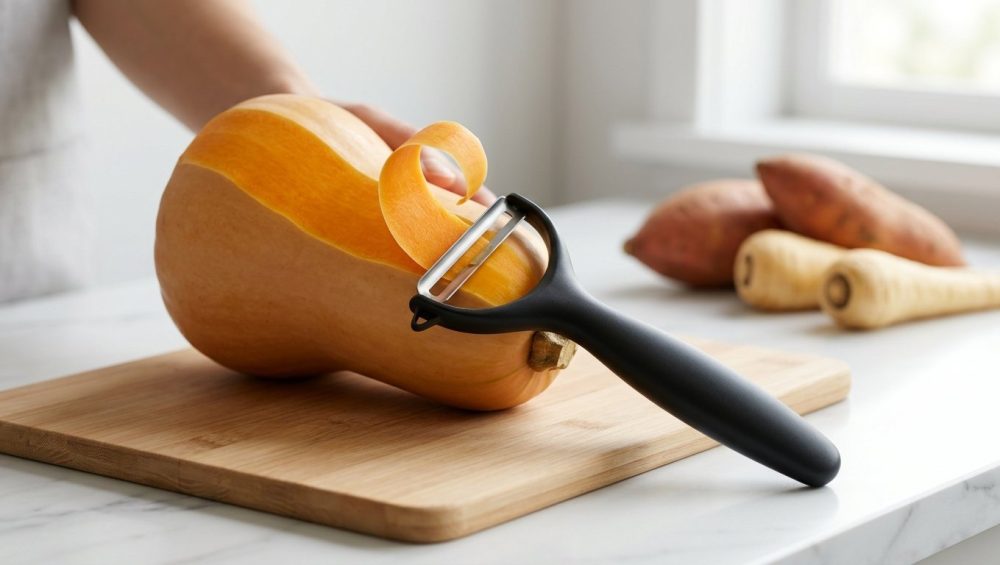
A Y-peeler gets its name from its distinct shape. The handle splits into a “Y” formation, holding a wide blade perfectly perpendicular to the handle. It looks somewhat like a traditional shaving razor. This perpendicular blade orientation fundamentally changes the way you interact with your produce.
Instead of flicking your wrist side-to-side, the Y-peeler is designed to be pulled straight down toward your body. This allows you to make long, continuous, sweeping strokes down the entire length of the vegetable.
Why Carbon Steel is Non-Negotiable
While you can find Y-peelers made with stainless steel blades, the true professional secret is seeking out a peeler with a carbon steel blade (such as the legendary Kuhn Rikon original Swiss peeler).
Let’s talk metallurgy for a moment. Carbon steel differs from stainless steel primarily because it lacks a high percentage of chromium. Chromium is the element that makes stainless steel resistant to rust, but it also forms large, hard carbides within the steel’s matrix. These large carbides make stainless steel more difficult to sharpen to an ultra-fine, razor-like edge.
Carbon steel, on the other hand, possesses a much finer, tighter grain structure. Because of this fine-grain structure, a carbon steel blade can be sharpened to a microscopic, sub-micron edge that is staggeringly sharp. When a carbon steel peeler meets the thick, waxy skin of a butternut squash, it doesn’t skid. It instantly bites into the flesh with surgical precision, requiring almost zero downward pressure from the user.
Just as aerosol sprays are ruining your nonstick pans, dull peeling blades are ruining your prep time. Carbon steel holds its terrifyingly sharp edge significantly better through aggressive, heavy-duty prep tasks, ensuring that your hundredth stroke is just as effortless as your first.
The Physics of Peeling: Why the Y-Peeler Wins Every Time
The superiority of the carbon steel Y-peeler isn’t just a matter of culinary preference; it is a matter of basic physics and biomechanics. Upgrading to this tool fundamentally alters the leverage and torque you are able to apply to the vegetable.
Leverage, Torque, and the Perpendicular Pull
When you use a Y-peeler, you anchor the blade at the top of the vegetable and pull directly downward. By doing this, you are no longer relying on the weak, isolated muscles of your wrist. Instead, you are locking your wrist in a strong, neutral position and utilizing the much larger, more powerful muscles of your bicep, tricep, and shoulder.
More importantly, you are enlisting the help of gravity. By pulling downward, the natural weight of your arm assists the blade in gliding through the tough skin. This mechanical advantage means you have to exert a fraction of the physical effort to achieve a much deeper, cleaner cut. It’s the same frustration as when food sticks to your stainless steel skillet; it means you are using the wrong technique and fighting against the physics of your kitchen rather than working with them.
Eliminating Hand Fatigue and Wrist Strain
Because the Y-peeler distributes the physical workload across your entire arm rather than isolating it in your wrist, hand fatigue is virtually eliminated. You can peel a massive, three-pound butternut squash in a matter of seconds, rather than agonizing minutes.
If you are hosting a holiday dinner and need to peel ten pounds of potatoes, a celery root, and three squashes, the ergonomic advantage of the Y-peeler is the difference between enjoying a glass of wine with your guests and icing your swollen wrist in the bathroom.
The Toxic Gear Trap: Why Cheap Peelers Are Ruining Your Prep
I have a strict “No-Go” rule when it comes to toxic, poorly manufactured kitchen gear, and consumer-grade peelers are some of the worst offenders on the market.
When you buy a three-dollar peeler with a plastic handle and a mystery-metal blade, you are inviting disaster into your kitchen. These tools are assembled with cheap glues and flimsy plastic joints that degrade rapidly when exposed to the high heat of a dishwasher. When you apply the heavy torque required to peel a dense root vegetable, these plastic handles flex, warp, and eventually snap, sending sharp pieces of plastic and metal flying across your cutting board.
Furthermore, many cheap peelers feature a faux-chrome or nickel plating to make them look shiny and high-quality on the store shelf. After a few months of use, this toxic plating begins to flake and peel off, depositing microscopic shards of mystery metal directly into your food.
Just like using cheap bamboo cutting boards will destroy your chef’s knife, a bad peeler will destroy your patience and potentially contaminate your meals. A high-quality carbon steel Y-peeler is incredibly affordable—often costing less than ten dollars—and is constructed with a minimalist, highly durable frame that will last for years if properly maintained. There is absolutely no excuse to keep that peeling, bending, plastic hazard in your drawer.
Masterclass: How to Actually Use a Y-Peeler Safely
Owning the right tool is only half the battle; knowing how to wield it with professional efficiency is what separates the weekend hobbyist from the confident home chef. Here is your definitive guide to tackling the toughest vegetables in the produce aisle without shedding a drop of blood.
The “Anchor and Pull” Technique
The most common mistake home cooks make when peeling is holding the vegetable awkwardly in mid-air and hacking away at it. This is unstable and dangerous.
- Create a Stable Base: Before you even pick up your peeler, take your chef’s knife and slice a half-inch off the top and bottom of the vegetable. This creates two perfectly flat, stable surfaces.
- Stand it Up: Stand the vegetable upright on your cutting board, resting on one of the flat bases you just created. Your non-dominant hand should rest lightly on the very top of the vegetable to hold it steady.
- Anchor the Blade: Take your Y-peeler in your dominant hand. Anchor the carbon steel blade at the very top edge of the vegetable, just below where your non-dominant hand is resting.
- The Pull: Keeping your wrist locked and neutral, pull the peeler straight down the side of the vegetable, all the way to the cutting board. Let your shoulder and bicep do the work.
- Rotate and Repeat: Rotate the vegetable slightly and repeat the downward stroke. You should be peeling off long, continuous ribbons of skin with effortless grace.
You should treat your prep station with respect, utilizing tools like a stainless steel bench scraper to effortlessly move your freshly peeled squash cubes into your roasting pan or stockpot, keeping your workspace clean and organized.
Tackling the Notorious Butternut Squash
Because of its bulbous, bell-like shape, the butternut squash requires a slightly modified approach.
First, slice off the top stem and the bottom base to create your flat surfaces. Next, look at the anatomy of the squash. It consists of a long, solid, cylindrical “neck” and a round, hollow “bulb” at the bottom that contains the seeds.
Do not try to peel the entire squash in one long stroke; the curve of the bulb will mess up your leverage. Instead, take your chef’s knife and cut the squash completely in half horizontally, separating the solid neck from the bulbous base.
Now, treat them as two separate vegetables. Stand the neck upright on its flat base and use the “Anchor and Pull” technique to strip away the skin in long, satisfying ribbons. Then, take the bulb, stand it on its flat base, and peel downward following the curve of the sphere. By breaking the squash down into manageable geometric shapes, the carbon steel Y-peeler will make quick work of that formidable armor.
After you finally finish prepping that squash, you’ll probably notice your plastic containers stain orange from the beta-carotene, but at least your hands won’t be aching and your prep time will be cut in half.
Conquering Celery Root, Sweet Potatoes, and Winter Squash
The Y-peeler isn’t just for butternut squash; it is the ultimate weapon against all dense, intimidating produce.
- Celery Root (Celeriac): This gnarly, knobby root looks like a brain pulled from the dirt. A straight peeler will get caught on every single ridge. The wide, perpendicular blade of the Y-peeler can bridge the gaps between the knobs, allowing you to aggressively shave away the tough, dirt-caked exterior to reveal the pristine, ivory flesh beneath.
- Sweet Potatoes: Sweet potatoes are incredibly dense and often covered in a tough, fibrous skin. The sub-micron edge of a carbon steel blade slices through this fibrous exterior without snagging or requiring dangerous amounts of pressure.
- Kabocha and Acorn Squash: While these squashes have deep ridges that can be tricky, the maneuverability of a lightweight Y-peeler allows you to pull the blade smoothly down the valleys of the squash, removing the skin without sacrificing the precious flesh.
Much like preheating the pan is a non-negotiable step for caramelization, upgrading your peeler is non-negotiable for root vegetables. You simply cannot achieve professional results if you skip the foundational techniques.
The Care and Keeping of Carbon Steel
Now that you understand the sheer brilliance of the carbon steel Y-peeler, we need to have a serious talk about maintenance. Carbon steel is a high-performance material, and like a high-performance sports car, it requires a specific standard of care.
The very thing that makes carbon steel so incredibly sharp—its lack of chromium—also makes it highly susceptible to oxidation. In plain English: if you leave this peeler wet, it will rust. It will rust quickly, and it will rust aggressively.
Do not let this intimidate you. The maintenance routine takes exactly ten seconds, and the reward is a lifetime of effortless peeling.
Washing and Drying: The Golden Rules
Rule Number One: Never, under any circumstances, put a carbon steel peeler in the dishwasher. The harsh, abrasive detergents and prolonged exposure to hot water and steam will strip the blade, dull the edge, and cover the steel in a thick layer of orange rust before the cycle is even finished.
Rule Number Two: Wash it by hand, immediately after use. Do not let it sit in a sink full of soapy water. Give the blade a quick scrub with a sponge and warm, soapy water to remove any starches or sticky squash sap.
Rule Number Three: Dry it instantly. Do not leave it on a dish rack to air dry. Take a clean kitchen towel and thoroughly dry the blade and the handle.
The Mineral Oil Trick
If you want to ensure your carbon steel blade lasts for decades, you need to protect the metal from the ambient humidity in your kitchen. Once the peeler is completely dry, take a paper towel, apply a single drop of food-safe mineral oil, and carefully wipe a microscopic layer of oil over the carbon steel blade.
This tiny layer of oil acts as an impenetrable barrier against moisture, ensuring the blade remains pristine and rust-free in your utensil drawer. Over time, as you use the peeler on acidic foods like apples or citrus, the carbon steel blade will naturally darken and develop a gray or blueish tint. This is called a patina. Do not try to scrub it off! A patina is a natural, protective layer of oxidation that actually helps shield the steel from harmful red rust. In the culinary world, a deep, dark patina on a carbon steel tool is a badge of honor, proving that the tool is well-loved and frequently used.
The Verdict: Reclaiming Your Prep Time
You do not need to attend culinary school to cook like an expert, and you certainly do not need to risk a trip to the emergency room just to make a batch of mashed sweet potatoes or a roasted squash salad. The difference between a stressful, chaotic kitchen and a peaceful, efficient one usually comes down to having the right tool for the job.
The standard, plastic-handled swivel peeler is a relic of bad ergonomic design and cheap manufacturing. It forces your wrist into unnatural angles, relies on dull, low-grade metal, and turns the simple act of peeling a butternut squash into an agonizing, dangerous chore.
By upgrading to a carbon steel Y-peeler, you are aligning yourself with the physics of your own body. You are leveraging gravity, engaging your strongest muscles, and utilizing a blade material that is revered by professional chefs worldwide for its unmatched sharpness and durability.
Stop wrestling with your produce. Stop settling for toxic, flimsy gear that bends under pressure. Spend the ten dollars, buy a high-quality carbon steel Y-peeler, and transform your daily prep work from a dreaded battle into a swift, effortless victory. Now go conquer that squash—your soup is waiting.