Listen closely, because I am about to save you hundreds of dollars, a whole lot of kitchen heartache, and potentially a trip to the emergency room.
Picture this: You are standing at your kitchen counter, prepping dinner. You have just spent five minutes meticulously dicing a mountain of celery, carrots, and onions for a beautiful mirepoix. The pieces are scattered across your heavy wooden cutting board in a chaotic, fragrant pile. What do you do next?
If you are like ninety percent of home cooks, you do the unthinkable. You turn your beautiful, expensive chef’s knife completely sideways, press the razor-sharp edge directly into the cutting board, and drag it horizontally across the wood to scoop up the vegetables and transfer them to your waiting skillet.
I can literally hear the sound of the metal grinding and scraping against the board from here, and it is making my left eye twitch.
Put the knife down. Step away from the cutting board. You are treating a precision culinary instrument like a rusty snowplow, and it has to stop today. I firmly believe that transforming your chaotic cooking routine into a peaceful daily habit requires two things: learning basic techniques, and fiercely respecting your tools. Your chef’s knife is designed to do one thing brilliantly: slice vertically through food. It is absolutely not designed to endure the brutal lateral shear force of being dragged sideways across a hard surface.
Today, we are going to dive deep into the microscopic murder you are committing against your cutlery, the very real dangers of cooking with a dull blade, and the ultimate, inexpensive solution that will revolutionize your meal prep. Enter the stainless steel bench scraper—the unsung hero of the professional kitchen that is about to become your absolute favorite tool.
The Microscopic Murder of Your Chef’s Knife
To understand why scraping your cutting board with a knife blade is a culinary cardinal sin, we need to get a little nerdy and look at the actual physics and metallurgy of a knife edge.
When you look at your chef’s knife with the naked eye, the edge looks like a solid, continuous line of steel. But if you were to place that blade under an electron microscope, you would see something entirely different. A well-sharpened kitchen knife has an edge apex (the very tip of the cutting edge) that measures roughly 0.1 to 0.3 microns in thickness. To put that microscopic number into perspective, a single human hair is about 50 to 100 microns thick. The very edge of your knife is significantly thinner than the cuticle of a human hair. It is a delicate, microscopic wedge of engineered steel.
Knives are explicitly designed to withstand vertical pressure. When you push down to slice a tomato or chop a carrot, the microscopic wedge is supported by the thicker steel directly above it (the bevel and the spine). The physics of the blade allow it to part the cellular structure of the food efficiently.
However, when you turn that knife sideways and drag it across a hard cutting board, you are introducing severe lateral (horizontal) shear force. The microscopic apex of the blade has absolutely no structural support against sideways pressure. When subjected to this scraping motion, the delicate edge literally bends and folds over on itself. In the culinary and metallurgy worlds, this is known as “edge rolling.”
Once the edge rolls, the knife is effectively dull. Instead of a microscopic wedge piercing your food, you now have a rounded, blunt piece of steel trying to smash its way through your ingredients. You can temporarily realign a rolled edge using a honing steel, but if you constantly scrape your board, you will subject the steel to metal fatigue. Eventually, that microscopic folded edge will simply snap off, leading to micro-chipping. At that point, a honing rod won’t save you; you will have to grind away a significant amount of steel on a whetstone to establish a brand-new edge. You are actively grinding away the lifespan of your expensive cutlery just to move some diced onions from point A to point B.
The True Cost of a Dull Blade
You might be thinking, “So what if my knife gets a little dull? I’m just a home cook, not a Michelin-starred chef.” I have zero patience for this excuse, because a dull knife is the single most dangerous item in your entire house.
According to safety data and emergency room statistics, an estimated 350,000 people visit the emergency department every single year for knife-related injuries. The vast majority of these injuries are not caused by terrifyingly sharp knives; they are caused by dull ones.
Here is the mechanical reality: a sharp knife bites directly into the skin of a vegetable and glides through with minimal effort. A dull knife, suffering from a rolled edge caused by your incessant board-scraping, requires you to apply a massive amount of downward physical force to break the skin of the food. When you are pushing down with all your body weight on a round onion or a slick tomato, and that blunt blade fails to bite into the skin, it is going to slip. And when it slips, all of that pent-up kinetic energy is going to send the blade sliding off the vegetable and plunging directly into your index finger.
Beyond the very real threat of needing stitches on a Tuesday night, a dull knife actively ruins the flavor and texture of your food. Because a dull blade crushes rather than slices, it violently ruptures the cellular walls of your ingredients. When you crush delicate herbs like basil or cilantro, they instantly oxidize, turning black and tasting like bruised grass. When you crush an onion instead of slicing it cleanly, you rupture thousands of extra cells, releasing a massive cloud of propanethial S-oxide—the volatile chemical gas that makes you cry chopping onions.
If you want to cook safely, efficiently, and without weeping over your cutting board, you must protect your knife’s edge at all costs. And that means you need a dedicated tool for scraping.
Enter the Bench Scraper: The Kitchen’s Unsung Hero
The bench scraper—also widely known as a bench knife, dough scraper, or board scraper—is a masterclass in utilitarian design. It consists of a simple, wide, rectangular piece of metal with a handle attached to one of the long edges. The opposite edge is tapered and blunt, designed to scrape without cutting.
Historically, this tool was born in the bustling, flour-dusted bakeries of Europe. Bakers needed a rigid, wide tool to manipulate massive, sticky mounds of high-hydration bread dough. They used it to fold dough, divide it into equal portions, and, crucially, to scrape the stubborn, dried bits of flour and water off their wooden workbenches at the end of a long shift.
Eventually, savory chefs looked across the kitchen at the pastry station and realized they were missing out on a massive workflow upgrade. The bench scraper naturally migrated to the prep station, where it quickly became the ultimate tool for shuttling massive quantities of chopped mirepoix, clearing debris into the trash, and maintaining a pristine workspace.
Today, it is widely considered by culinary professionals to be one of the absolute essential tools every beginner needs to bridge the gap between amateur flailing and professional-level kitchen efficiency. It acts as an extension of your hand—a wide, indestructible metal palm that does all the dirty work your delicate knife shouldn’t touch.
The “No-Go” Rule: Why Cheap Plastic and Mystery Metal Scrapers Are Toxic Trash
If you have read any of my previous guides, you know my core philosophy: I despise cheap, toxic kitchenware. I would rather you own three high-quality, indestructible tools than a drawer full of cheap plastic garbage that breaks, melts, and poisons your food. When it comes to buying a bench scraper, you must adhere strictly to the “No-Go” rule.
First, absolutely no plastic or silicone-only bench scrapers for heavy-duty savory prep. While a flexible plastic bowl scraper is great for getting the last bit of cake batter out of a mixing bowl, it is useless on a wooden cutting board. Hard plastic scrapers will quickly develop nicks, burrs, and gouges. Once the plastic edge is compromised, you will inadvertently shave microscopic plastic particles directly into your family’s dinner every time you scrape the board. We are not seasoning our food with microplastics in this house.
Second, you must be hyper-vigilant about the type of metal you are buying. The market is flooded with incredibly cheap metal scrapers made from “mystery metal” or 430-grade stainless steel. Let’s talk metallurgy for a moment. 430-grade stainless steel is a ferritic alloy that contains chromium but contains virtually zero nickel. Because it lacks nickel, it is highly susceptible to pitting, corrosion, and rust, especially when it comes into contact with highly acidic ingredients like tomatoes, citrus juice, or vinegar.
Just like how those cheap supermarket baking sheets keep warping and rusting after three trips through the oven, a 430-grade scraper will develop ugly orange rust spots the second you leave it in the sink overnight.
You must demand a bench scraper made from 304-grade (or 316-grade) stainless steel. 304 stainless steel contains a high percentage of nickel, which alters the alloy’s microscopic structure, making it incredibly durable and highly resistant to rust and acidic corrosion. It is completely food-safe, non-reactive, and will literally outlive you. Stop throwing your money at disposable garbage and start banishing toxic kitchen gear from your life for good. Spend the extra four dollars to get real, high-quality 304 stainless steel.
10 Genius Ways a Stainless Steel Bench Scraper Will Revolutionize Your Weekday Prep
You might be hesitant to buy a tool that you think only does one thing. But the bench scraper is the ultimate multitasker. It is the culinary equivalent of a Swiss Army Knife. Here are ten ways this simple piece of metal will completely revolutionize the way you cook.
1. The One-Swoop Scoop
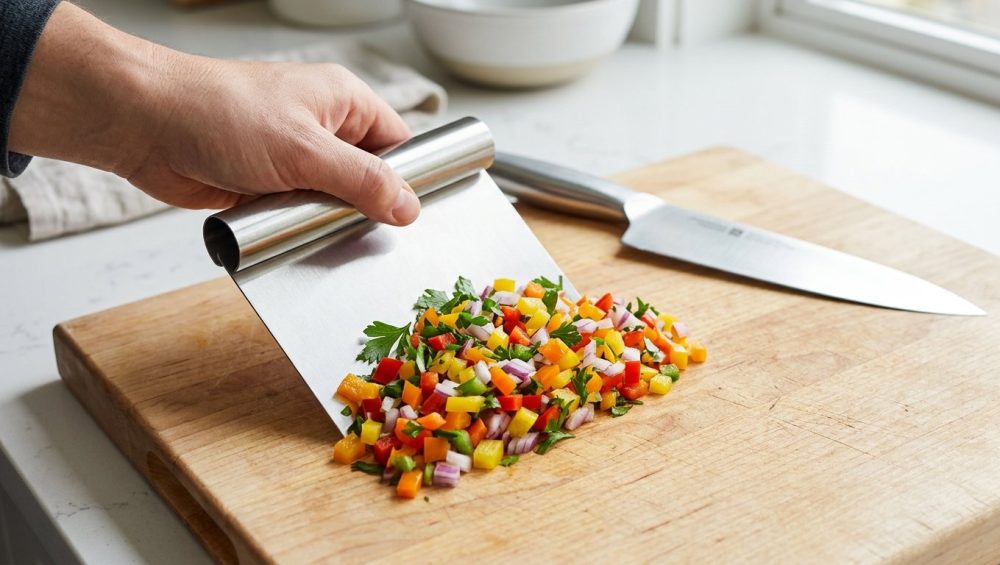
Time is money, especially on a Tuesday night when you just got home from work and everyone is starving. When you are trying to throw together simple weeknight dinners, you do not have time to make five trips back and forth from the cutting board to the stove, carrying tiny, precarious handfuls of diced onions that inevitably spill all over the floor. With a bench scraper, you simply slide the wide metal blade under your massive pile of chopped vegetables, cup your hand gently over the top, and carry the entire mound to the skillet in one effortless, professional swoop. It cuts your prep transfer time in half and saves you from sweeping the floor later.
2. The Board Clearing Bulldozer
A cluttered cutting board leads to a cluttered mind, and eventually, a kitchen disaster. You cannot safely chop a chicken breast if your board is covered in carrot peels, onion skins, and celery ends. The bench scraper acts as a bulldozer. With one quick swipe, you can push all of your organic waste directly off the edge of the board and into your waiting garbage bowl or compost bin. It instantly resets your workspace to zero, keeping you organized and stress-free.
3. Smashing Garlic Like a Pro
Many home cooks try to smash garlic cloves by placing the side of their chef’s knife over the clove and whacking it with their hand. This is incredibly dangerous. If your hand slips, or the knife twists, you are bringing your palm directly down onto an exposed razor-sharp edge. Instead, place your garlic cloves on the board, rest the wide, blunt surface of your bench scraper over them, and give the handle a firm bop with the heel of your hand. The skins will split perfectly, making peeling a breeze. Plus, you can use the edge of the scraper to easily crush the garlic into a paste—a crucial technique if your minced garlic always burns the moment it hits the hot oil.
4. Portioning Dough with Precision
If you have ever tried to cut a sticky ball of pizza dough or bread dough with a chef’s knife, you know it is a nightmare. The dough sticks to the blade, stretches, and tears. Tearing dough damages the delicate gluten network you just spent ten minutes kneading to perfection. A bench scraper is designed to act like a guillotine. You simply press straight down to cleanly sever the dough into perfectly equal portions without any tearing or stretching.
5. Cutting Butter into Flour for Flaky Pastry
Making pie crusts, biscuits, or scones requires cutting ice-cold butter into dry flour. The absolute enemy of flaky pastry is heat, and your hands are essentially 98-degree space heaters. If you use your fingers to rub the butter into the flour, the butter melts, and your biscuits turn out like dense hockey pucks. A bench scraper allows you to chop the butter directly into the flour pile on your counter, keeping your hot hands completely out of the equation. The metal stays cold, the butter stays solid, and your pastry turns out incredibly flaky.
6. Transferring Fragile Items
Have you ever rolled out a beautiful, perfectly circular pie crust, only to have it tear into pieces when you try to lift it into the pie dish? Or have you ever tried to move a delicate, raw fish fillet off your board, only for it to fall apart? The bench scraper acts as a wide, supportive spatula. You can gently slide it under fragile doughs, delicate proteins, or intricately shaped fresh pastas to lift and transfer them with zero breakage.
7. Smoothing Cake Frosting to Bakery Perfection
You do not need a culinary degree or a fancy offset spatula to make a cake look like it came from a high-end bakery. Once you have applied buttercream to your layer cake, simply hold your bench scraper perfectly vertical against the side of the cake. Keep your hand steady and slowly rotate the cake stand. The long, perfectly straight metal edge of the scraper will sheer off the excess frosting, leaving you with a flawless, razor-sharp, smooth finish that will make your dinner guests gasp.
8. Slicing Soft Foods in the Pan
When you bake a batch of gooey brownies, a delicate lasagna, or a deep-dish casserole in a glass or ceramic baking dish, the last thing you want to do is drag a sharp metal knife through it. A chef’s knife will permanently scratch and ruin the bottom of your expensive ceramic bakeware. The blunt, tapered edge of a bench scraper is rigid enough to cleanly slice through soft baked goods and casseroles, but blunt enough that it won’t scratch your beautiful baking dishes.
9. Measuring on the Fly
The best stainless steel bench scrapers come with a laser-etched ruler along the bottom edge, usually measuring up to six inches. This is an absolute godsend for weekend baking projects. Need to roll out dough to exactly a quarter-inch thickness? Need to cut cinnamon rolls into exactly one-and-a-half-inch segments? Need to ensure your gnocchi are uniform in size? You don’t have to go digging through your junk drawer for a plastic ruler covered in glitter; the measuring tool is already in your hand.
10. Taming the Messy Counter
After a long session of kneading dough, making fresh pasta, or dredging chicken in flour and egg wash, your kitchen counter is likely covered in a cement-like paste of dried flour and water. If you try to wipe up a massive flour-and-egg spill with a wet sponge, you just create a thick glue. That glue permanently ruins your sponges, and when you use those same ruined sponges to wash your dishes, your plastic containers stay greasy forever. Instead, take your bench scraper and aggressively scrape the dry counter. The metal edge will effortlessly pop all the dried dough and crusted flour right off the surface, allowing you to sweep it into the trash. Then, you can wipe the counter down with a clean, damp cloth in seconds.
The Anatomy of the Ultimate Bench Scraper
Not all bench scrapers are created equal. When you are ready to make this massive upgrade to your kitchen arsenal, you need to know exactly what to look for to ensure you are buying a tool that will last a lifetime.
The Handle Material:
The handle is where you interface with the tool, so ergonomics are critical.
- Wood Handles: These look incredibly classic and rustic. However, wood requires maintenance. You must hand-wash them and occasionally rub them with mineral oil. If you throw a wooden-handled scraper in the dishwasher, the extreme heat and harsh detergents will strip the natural oils, and the handle will eventually split, just like your wooden spoons keep cracking when you neglect them.
- Plastic/Nylon Handles: These are highly utilitarian, textured for grip, and completely dishwasher safe. They aren’t the prettiest, but they are the workhorses of the commercial kitchen.
- Rolled Steel Handles: Some modern scrapers are forged from a single, continuous piece of stainless steel, where the top is simply rolled over to form a handle. These are incredibly sleek, virtually indestructible, and harbor zero bacteria because there are no seams or crevices.
The Blade Geometry:
You want a blade that is roughly six inches wide and three to four inches tall. It needs to be made of thick enough steel that it does not flex or bend when you press down on it. The cutting edge should be tapered (beveled) on one or both sides. You do not want it to be razor-sharp like a knife—you shouldn’t be able to cut yourself with it—but it needs to be thin enough to easily slide under a piece of dough or scrape away stubborn debris.
The Measurements:
If you are buying a scraper with a ruler on the edge, you must ensure the markings are laser-etched or engraved directly into the steel. Do not buy a scraper where the numbers are simply printed on with black ink. After a few weeks of heavy use and hot water, that printed ink will completely wash away, leaving you with a blank piece of metal.
The Economics of Knife Maintenance
Let’s talk about money, because at the end of the day, a bench scraper is the best financial investment you can make for your kitchen.
A high-quality, 304-grade stainless steel bench scraper will cost you somewhere between $10 and $20. It is a one-time purchase that will literally outlast you.
Now, let’s look at your chef’s knife. A decent quality chef’s knife costs anywhere from $80 to $200. If you are constantly scraping that knife across your cutting board, rolling the edge, and causing micro-abrasions, you are going to ruin its cutting ability within weeks. To get that edge back, you either have to spend hours learning how to properly use a whetstone, or you have to take it to a professional knife sharpener. Professional sharpening costs about $10 to $15 per knife.
If your bad habits force you to get your knife professionally sharpened three or four times a year, you are bleeding money. Furthermore, every time a knife is sharpened on a grinding wheel, a layer of steel is permanently removed. You are literally grinding away the lifespan of your expensive investment.
And let’s not forget the collateral damage to your cutting board. Scraping a sharp blade horizontally across a wooden or plastic board creates deep gouges and micro-scratches in the surface. These gouges become breeding grounds for dangerous bacteria that are impossible to wash out. We already know how cheap bamboo cutting boards destroy edges because they are too hard; dragging a knife laterally across any board is a dual death sentence for both the blade and the board itself.
By spending $15 once on a bench scraper, you protect your $150 knife, you protect your $50 cutting board, and you save yourself $50 a year in sharpening fees. The math is undeniable.
The Final Scoop
I know that changing deeply ingrained kitchen habits is difficult. When you are rushing to get dinner on the table, it feels so natural to just turn your knife sideways and scoop up those onions. But I promise you, the moment you force yourself to put the knife down and pick up a bench scraper, your entire workflow will change.
You will move faster. Your workspace will be cleaner. Your hands will be safer. And most importantly, your beautiful chef’s knife will remain razor-sharp, ready to effortlessly glide through tomorrow night’s dinner.
Stop abusing your expensive cutlery. Stop making your prep work harder than it needs to be. Treat yourself to a high-quality stainless steel bench scraper, and start cooking with the speed, efficiency, and swagger of a true culinary professional. You’ve got this. Now go chop something—and for the love of all things holy, scoop it up properly.