We need to have a serious, sit-down conversation about the biggest lie the recipe industry has ever sold you.
If you have ever cracked open a standard weeknight cookbook or scrolled through a food blog, you have undoubtedly encountered this exact, infuriating instruction: “Heat two tablespoons of olive oil over medium heat. Add the diced onions and minced garlic, and sauté for five to seven minutes until soft and translucent.”
If you have ever followed this instruction to the letter, you already know exactly how this story ends. By minute three, the onions are barely starting to sweat, but the garlic has transformed into dark, hard, aggressively bitter little pebbles of resentment. Your entire kitchen smells like acrid smoke, and the foundational flavor base of your meal is completely ruined before you have even added the main ingredients.
I have zero patience for pretentious chef-speak, but I have even less patience for bad recipe writing that sets everyday home cooks up for failure. You do not need a culinary degree to make mind-blowing food, but you do need to understand how the ingredients in your pan actually behave. Tossing these two aromatics into a hot skillet at the exact same time is a foundational error. If you are tired of committing rookie kitchen mistakes that turn your expensive groceries into a bitter, inedible mess, it is time to learn the science of staging.
Here is the definitive, no-nonsense masterclass on why your garlic is always burning, the hidden chemical traps in your skillet, and the dead-simple technique that will instantly fix the base of your soups, sauces, and stir-fries forever.
The Botanical Breakdown: Why Garlic and Onions Are Not Equals
The fundamental flaw in the “dump and stir” method is the assumption that onions and garlic are culinary equals just because they belong to the same botanical family (Allium). In the reality of a hot skillet, they behave entirely differently. Treating them as a package deal ignores their drastically different physical and chemical compositions.
The Water Weight Discrepancy
When you drop vegetables into a hot pan, the water inside their cellular structure acts as a built-in thermal buffer. As the heat hits the vegetable, the internal water begins to evaporate, creating steam. This evaporative cooling process prevents the exterior of the vegetable from instantly scorching.
Onions are incredibly watery. Depending on the variety, a standard onion consists of roughly 81% to 82% water. When you toss diced onions into hot oil, they immediately drop the temperature of the pan. They hiss, they spit, and they spend the first several minutes simply releasing their massive water reserves. They are effectively steaming themselves in their own juices before they even begin the browning process.
Garlic, on the other hand, is significantly drier. Fresh garlic cloves contain only about 65% to 71% moisture. Because it lacks that heavy water buffer, garlic absorbs the intense heat of the pan almost instantly. While the onion is taking a leisurely, luxurious steam bath, the garlic is being violently deep-fried.
The Sugar Trap: Fructans and Caramelization
If the lack of water wasn’t enough of a liability, garlic is also packed with sugar. Specifically, it contains high concentrations of complex carbohydrates called fructans. While a standard brown onion might contain anywhere from 1.1% to 7.5% fructans, garlic boasts a massive fructan content ranging from 9.8% to 17.4%.
In the culinary world, high heat plus high sugar equals rapid caramelization. When you combine a low water content with a sky-high sugar content, the timeline between beautifully golden-brown and completely incinerated is measured in seconds, not minutes. You have probably googled why your minced garlic always burns in a fit of rage, and this botanical reality is exactly why. It is physically impossible for minced garlic to survive a seven-minute sauté alongside a watery onion without turning into a charred nightmare.
The Chemistry of Flavor: Allicin and the Burn
To truly understand why burnt garlic is so offensive to the human palate, we have to look at the fascinating, slightly aggressive chemistry of the clove itself. Garlic does not actually taste or smell like “garlic” when it is sitting whole on your countertop. It only develops its signature pungency when you attack it.
The Defense Mechanism in Your Skillet
Inside the cells of a garlic clove, there is an amino acid called alliin and an enzyme called alliinase. In a whole clove, these two compounds are kept strictly separated in different cellular compartments. But when you smash, slice, or mince the garlic, you rupture those cell walls. The alliin and alliinase crash into each other, triggering a rapid chemical reaction that produces a new compound: allicin.
Allicin is the potent, pungent, sulfur-heavy compound that gives raw garlic its fiery bite. It is literally a botanical defense mechanism designed to deter animals from eating the plant. When you eat raw garlic, the allicin activates the TRPA1 and TRPV1 ion channels in your mouth—the exact same pain receptors that are triggered by hot chili peppers.
However, allicin is highly unstable and incredibly sensitive to heat. When you cook garlic, the heat denatures the alliinase enzyme, stopping the production of allicin, which is why cooked garlic tastes sweet and mellow rather than sharp and spicy.
Crossing the Line: Pyrolysis and Bitter Compounds
Cooking garlic perfectly relies on the Maillard reaction—the complex chemical process where amino acids and reducing sugars transform under heat to create hundreds of new, delicious flavor compounds. This is what gives properly sautéed garlic its savory, nutty, golden-brown perfection.
But there is a very fine line between the Maillard reaction and pyrolysis (the scientific term for burning). When garlic is exposed to prolonged high heat, the Maillard reaction crosses its limit and the cellular structure begins to carbonize. The sugars burn, and the delicate sulfur compounds mutate. The allicin breaks down into harsh, acrid chemicals like diallyl disulfide and acrolein.
The resulting flavor is sharp, dry, and aggressively bitter. Humans are evolutionarily wired to reject bitter tastes because bitterness is nature’s warning sign for toxicity. When you burn garlic, you are not just slightly overcooking your food; you are fundamentally altering its chemical structure into something your brain actively wants to spit out.
The Anatomy of the Mistake: The “Dump and Stir” Method
Let’s walk through the exact timeline of what happens when you follow that terrible recipe instruction and dump your onions and garlic into the pan at the same time.
Minute One: The False Sense of Security
You drop the diced onions and minced garlic into the hot oil. It sizzles beautifully. You feel like a culinary genius. The onions begin to release their water, and the garlic starts to fry in the oil. The kitchen smells amazing. You stir the pan, confident that you are on your way to a great meal.
Minute Three: The Point of No Return
The water from the exterior of the onions has evaporated, but the onions themselves are still rigid and opaque. They need at least four more minutes to soften. Meanwhile, the garlic has already exhausted its meager water supply. The sugars in the garlic have caramelized, and the minced pieces have turned golden brown.
If you were to stop cooking right now, the garlic would be perfect. But you can’t stop, because you are eating chopping onions that are still raw, crunchy, and pungent. So, you keep the heat on.
The Collateral Damage
By minute five, the garlic has crossed the threshold. It turns from golden to dark brown, and finally to black. The acrid smell of burning sulfur fills the air. But the damage is not just confined to the garlic pieces themselves.
Garlic is fat-soluble, which means it releases its flavors directly into the cooking oil. When the garlic burns, it infuses the entire pool of oil in your skillet with bitter, burnt compounds. Even if you try to pick the burnt pieces of garlic out of the pan with a pair of tweezers, it is too late. Every single ingredient you add to that pan—the chicken, the tomatoes, the broth—will be coated in bitter, ruined oil.
The Influence of Surface Area: How Your Knife Skills Dictate the Clock
Time is money in a weeknight kitchen, but efficiency should never come at the cost of flavor. The speed at which your garlic burns is directly tied to how you prep it. Surface area dictates heat absorption. The smaller the piece of garlic, the faster it cooks, and the faster it burns.
The Micro-Mince and the Grater
If you run your garlic through a garlic press, grate it on a microplane, or chop it into a fine micro-mince, you are creating maximum surface area. You are also maximizing the cellular damage, which creates a massive amount of allicin. This form of garlic offers the most intense, pungent flavor, but it is incredibly fragile. Finely grated garlic will burn in hot oil in less than 15 seconds. It requires extreme vigilance.
The Thin Slice (The “Goodfellas” Method)
Slicing your garlic into thin, elegant slivers reduces the surface area compared to mincing. It also causes less cellular damage, resulting in a milder, sweeter garlic flavor. Sliced garlic can withstand the heat of a pan for about 60 to 90 seconds before it starts to scorch. It offers a beautiful textural element to pasta sauces and stir-fries.
The Crush and Smash
Taking a whole peeled clove and simply smashing it flat with the side of your chef’s knife is one of the most underutilized techniques in the home kitchen. A smashed clove releases its oils and flavors into the cooking fat slowly and steadily. Because the clove is mostly intact, it can survive in a hot pan for several minutes without burning. This is the ideal method when you want to infuse a cooking oil with garlic flavor before searing a steak or frying eggs.
The Whole Clove
Whole, uncrushed cloves have the least surface area and release almost no allicin. They can be slowly roasted or simmered in oil (confit) for hours without burning, transforming into sweet, spreadable, caramelized garlic butter.
The Proper Staging Technique: The 30-Second Rule
The solution to the burnt garlic dilemma is embarrassingly simple, yet it fundamentally changes the way you cook. You must stage your ingredients based on their specific heat tolerances. In the culinary world, this is known as managing your aromatics. Here is the foolproof, step-by-step method for building a flavor base without the bitterness.
Phase One: Sweating the Onions
Heat your skillet and add your cooking oil or butter. Once the fat is shimmering, add your diced onions. Do not add the garlic.
Allow the onions to cook undisturbed for a minute, then stir occasionally. Let them release their moisture, soften, and turn translucent. Depending on the size of your dice and the heat of your pan, this will take anywhere from five to eight minutes. If you are cooking a classic mirepoix (onions, carrots, and celery) or a holy trinity (onions, bell peppers, and celery), they all go into the pan together during this phase. They are high-moisture vegetables that require time to break down.
Phase Two: The Golden Window
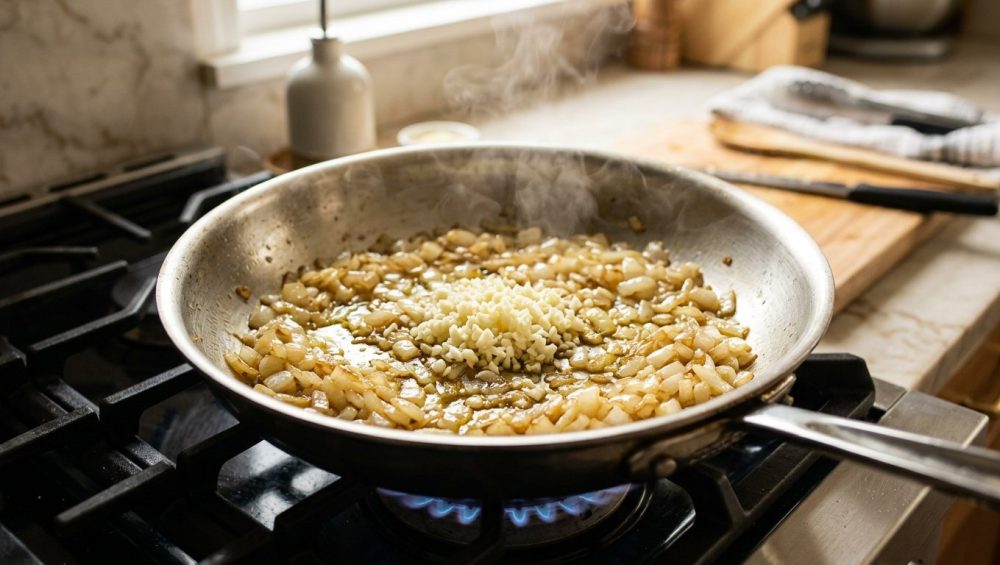
Once the onions are perfectly soft, translucent, and just beginning to take on a golden color around the edges, it is time for the garlic.
Push the onions slightly to the edges of the pan to create a small clearing in the center. Drop your minced garlic directly into that clearing. You will immediately smell the pungent, beautiful aroma of the garlic hitting the hot oil.
You now have a golden window of exactly 30 to 60 seconds. Stir the garlic constantly, mixing it in with the onions. You are simply looking to cook off the raw, aggressive bite of the allicin. As soon as the garlic becomes highly fragrant and turns a very pale, sandy blonde color, your window is closing.
Phase Three: The Liquid Buffer
To stop the garlic from burning, you must instantly drop the temperature of the pan. You do this by introducing a liquid or a high-moisture ingredient.
If you are making a soup or a pan sauce, this is the exact moment you pour in your chicken broth, wine, or vinegar to deglaze the pan. If you are making a marinara, this is when you dump in the crushed tomatoes. If you are making a stir-fry, this is when you add your soy sauce mixture or your raw, watery vegetables (like zucchini or bok choy).
The liquid immediately halts the frying process. The temperature of the pan drops below the boiling point of water (212°F / 100°C), which is well below the temperature required for garlic to burn. Your flavor base is now perfectly locked in—sweet onions, fragrant, golden garlic, and absolutely zero bitterness.
The Kitchenware Rant: Why Your Pan is Sabotaging Your Garlic
We need to take a brief detour, because technique is only half the battle. If you are executing the 30-second rule flawlessly and your garlic is still scorching, the problem is not you. The problem is your equipment.
I am a massive advocate for toxic kitchen gear being thrown straight into the trash where it belongs. I have zero patience for cheap, lightweight, peeling non-stick pans that you bought for twelve dollars at a discount store.
The Curse of Cheap, Thin Pans
Thin aluminum or cheap non-stick skillets have absolutely no thermal mass. They cannot retain or distribute heat evenly. When you place a thin pan over a burner, the exact spot touching the flame becomes rocket-hot, while the edges remain lukewarm. These “hot spots” are the ultimate enemy of delicate aromatics. You might drop your minced garlic into the pan, and the pieces sitting on the hot spot will instantly incinerate into black ash before you even have a chance to stir them.
Furthermore, when cheap non-stick coatings (like Teflon/PTFE) are heated past 500°F, they begin to degrade and release toxic fumes. If your pan is thin enough to flash-burn your garlic, it is highly likely you are pushing the temperature limits of that chemical coating.
The Heat Retention Heroes: Carbon Steel and Multi-Clad Stainless
If you want to cook like an expert, you need to invest in safe, durable cookware that respects your ingredients. When you are stocking your kitchen with beginner kitchen tools, a heavy-bottomed skillet is non-negotiable.
You need a pan with substantial thermal mass—specifically, multi-clad stainless steel or heavy-gauge carbon steel. These materials absorb heat slowly and distribute it evenly across the entire cooking surface. There are no hot spots. When you add your garlic, it cooks gently and uniformly.
Yes, cooking in stainless steel requires a bit of technique to prevent protein adhesion when searing meats, but for sautéing vegetables and managing delicate aromatics, it is unparalleled. It gives you total control over the heat, allowing you to ride that fine line between golden-brown and burnt with absolute confidence.
Exceptions to the Rule: When Garlic Actually Goes First
Because cooking is an art as much as it is a science, there are always a few exceptions to the rules. While you should never add minced garlic to hot oil at the same time as onions, there are a few specific scenarios where garlic does go into the pan early.
The Cold Oil Start
If a recipe calls for infusing oil with garlic flavor—common in many traditional Italian pasta dishes like Aglio e Olio—you do not heat the pan first. Instead, you place minced or sliced garlic into a cold skillet, pour the cold olive oil over it, and then turn the burner to medium-low.
As the pan slowly comes up to temperature, the garlic gently poaches in the warming oil. This slow extraction pulls the flavor compounds out of the garlic and into the fat without shocking the exterior of the clove. By the time the oil is hot enough to actually fry the garlic, the flavor has already been distributed, and you can easily monitor the garlic to ensure it turns a pale gold before adding your pasta water to halt the cooking.
The Spice Blooming Technique
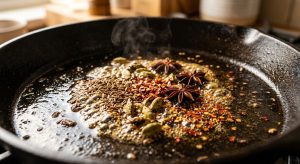
In many Indian, Middle Eastern, and Latin American cuisines, building a flavor base involves blooming whole or ground spices in hot fat to release their essential oils. Very often, aromatics like ginger and garlic are added during this phase.
Similar to the technique of blooming them in oil, garlic needs a brief exposure to heat to unlock its flavor. When making a curry base, you might add a garlic-ginger paste to the hot oil just seconds before adding your dry spices, and then immediately follow it with a splash of water or tomato puree. The garlic technically goes in early, but it is only exposed to the raw heat for a few seconds before a liquid buffer is introduced.
Troubleshooting: Can You Save Burnt Garlic?
Let’s say you got distracted. You added your garlic, your phone rang, you turned your back for two minutes, and now you are staring at a pan full of blackened, smoking garlic bits. What do you do?
The Brutal Truth
You throw it in the trash.
I am a massive advocate for reducing food waste and saving ruined meals, but there is absolutely no culinary CPR that can resuscitate burnt garlic. Once the sugars have carbonized and the allicin has degraded into acrolein, the chemical structure is permanently altered. You cannot mask the bitterness with extra salt, you cannot hide it with acid, and you certainly cannot balance it with sugar.
If you proceed with the recipe, instead of meticulously burnt bits into sauce, you are just making a bitter, acrid broth that will ruin the expensive chicken, seafood, or fresh vegetables you add next.
Repurposing the Pan
Do not just wipe the pan out with a paper towel. The bitter, fat-soluble compounds from the burnt garlic are lingering in the residual oil clinging to the metal. You must take the pan to the sink, wash it with soap and hot water, dry it, and start over.
It is incredibly frustrating to throw away a chopped onion and three cloves of garlic. You might even need a bench scraper to furiously scrape the ruined mess straight into the compost bin. But sacrificing fifty cents worth of aromatics to save a thirty-dollar dinner is the smartest, most professional decision you can make in the kitchen. Every great cook has burnt garlic. The difference between a rookie and a pro is that the pro knows when to cut their losses and start over.
The Final Verdict for the Home Cook
Cooking is not about blindly following a list of instructions printed on a blog; it is about observing, adapting, and understanding the physical realities of the food in front of you.
While soggy roasted veggies are a tragedy of their own, burnt garlic is a flavor-ruining crime that can be entirely prevented with a simple shift in timing. Onions are watery sponges that need time to sweat and break down. Garlic is a dry, sugary, highly volatile flavor bomb that requires a brief, supervised flash of heat.
The next time you pull out your cutting board, ignore the poorly written recipe telling you to dump everything in at once. Give your onions the time they deserve. Respect the fragility of your minced garlic. Wait for that golden 30-second window before you add your liquids. By mastering this one simple rule of staging, you will instantly elevate the baseline flavor of every single meal you cook, banishing the bitter ghost of burnt garlic from your kitchen forever.