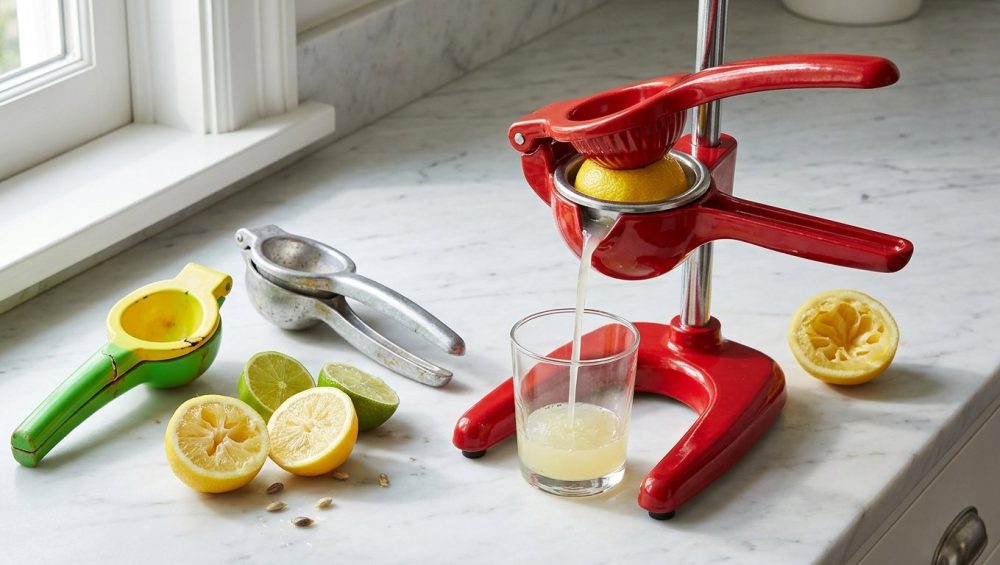
Look, I get it. You are busy. I am busy. We do not have the time or the patience to stand over a cutting board, performing desperate CPR on a sad, dried-up lemon, trying to wring out three pathetic drops of juice while simultaneously fishing rogue seeds out of our vinaigrette. We are home cooks trying to get a spectacular meal on the table before midnight, and we need tools that actually work.
If you are wondering why your dinner tastes boring, the lack of fresh, properly extracted acidity is almost always the culprit. But here is the brutal truth: if you are still squeezing lemons with your bare hands, or worse, using one of those flimsy, neon-yellow plastic contraptions you bought in a college panic, you are actively sabotaging your food. You are wasting money, you are wasting time, and you are leaving a shocking amount of liquid gold behind in the rind.
It is time to grow up, ditch the useless gadgets, and embrace the absolute workhorse of the modern kitchen: the enameled die-cast citrus press. This is not just another unit-tasker destined to collect dust in your junk drawer. It is a masterpiece of mechanical leverage and material science that will fundamentally change how you cook, bake, and mix cocktails. Let us take a deep, highly-researched dive into why hand-squeezing is a fool’s errand, why cheap materials are secretly poisoning your food, and why an enameled press is the only tool you will ever need for the job.
The Mechanics of Citrus Extraction: Why Your Hands (and Forks) Aren’t Enough
To understand why a dedicated press is so vital, we first need to understand what we are actually fighting against. A lemon is not just a water balloon waiting to be popped; it is a complex, heavily fortified biological structure designed by nature to protect its seeds.
The Anatomy of a Citrus Fruit
Every citrus fruit is composed of three primary layers. The outermost layer is the flavedo, commonly known as the zest, which is packed with volatile essential oils. Beneath that lies the albedo, or the white pith. The pith is spongy, highly absorbent, and loaded with limonin precursors—compounds that turn aggressively bitter when crushed or exposed to heat. Finally, the interior consists of the endocarp, which contains dozens of tightly packed, juice-filled vesicles trapped inside tough membranous segments.
When you squeeze a lemon with your bare hands, you are fighting against the structural integrity of the albedo and the membranes. Human grip strength is simply not distributed evenly enough to rupture all of those microscopic vesicles. Instead, you end up squishing the fruit, bruising the pith, and leaving a massive percentage of the juice trapped inside the unruptured cells. If you want to stop reaching for the salt and start properly balancing your dishes with acid, you need a tool that can systematically crush those vesicles without over-extracting the bitter pith.
The Inefficiency of the “Fork Twist” Method
We have all seen the “hack” floating around the internet: stab a lemon half with a fork and aggressively twist it while squeezing. Let me be perfectly clear—this is a culinary disaster. If you want to fix common beginner cooking mistakes, you must stop doing this immediately.
The fork twist method aggressively tears the internal membranes, which sounds like a good thing until you realize it also shreds the bitter albedo. Furthermore, it creates an uncontrollable, spraying mess that guarantees you will get lemon juice in your eye, on your countertop, and everywhere except inside your mixing bowl. It also fails to apply uniform pressure, meaning you are still leaving a significant amount of juice behind.
Mechanical Advantage: How a Press Multiplies Your Force
This is where the physics of a handheld citrus press come into play. A quality citrus press operates as a Class 2 lever system. In a Class 2 lever, the load (the lemon) is situated between the fulcrum (the hinge of the press) and the effort (your hands squeezing the handles).
This mechanical arrangement is brilliant because it acts as a force multiplier. When you apply pressure to the ends of the handles, the lever action magnifies that force exponentially by the time it reaches the fruit. The rigid dome of the press forces the citrus half to invert—literally turning it inside out—which systematically ruptures the juice vesicles from the center outward.
The data on this is staggering. Studies and controlled yield tests show that hand-squeezing a standard medium lemon yields an average of just 1.3 to 1.8 tablespoons of juice. A high-quality lever-style press, however, consistently extracts 2.4 to 2.7 tablespoons from the exact same size fruit. That is a 20% to 35% increase in juice yield. Over the course of a year, that difference equates to dozens of wasted lemons and a whole lot of money thrown in the compost bin.
The Material World: Why Most Citrus Squeezers Are Total Garbage
So, we have established that you need a lever-style press. But before you run out and buy the first one you see, we need to have a serious conversation about materials. The market is flooded with catastrophically bad kitchen gadgets, and citrus presses are among the worst offenders.
The Plastic Peril: Flexibility is the Enemy of Yield
There is a special place in culinary hell for plastic citrus squeezers. When you are curating the essential tools every beginner needs, you must rigorously avoid anything made of cheap, injection-molded plastic.
Here is the mechanical problem with plastic: it flexes. When you squeeze the handles of a plastic press, the material absorbs a massive amount of your kinetic energy. Instead of that force being transferred directly into the lemon to rupture the vesicles, it is wasted on bending the handles. You have to squeeze twice as hard to get half the result.
Furthermore, plastic is notoriously brittle under repetitive stress. The hinge on a plastic citrus press is a ticking time bomb. It is only a matter of time before you are aggressively squeezing a particularly stubborn lime for Taco Tuesday, and the handle snaps clean off, sending a jagged piece of plastic flying across your kitchen. Plastic presses are not cheap; they are disposable. And disposable kitchenware is a waste of your hard-earned money.
Bare Aluminum: The Toxic Truth About Reactive Metals
If plastic is out, you might think a bare metal press is the solution. Think again. I am a massive advocate for banishing toxic kitchen gear from your home, and bare, unlined aluminum is a massive red flag when it comes to acidic foods.
Let us dive into a quick chemistry lesson. Lemon juice and lime juice are highly acidic, boasting a pH level of around 2.0 to 2.5. The primary acid responsible for this is citric acid, which is a triprotic acid. When highly concentrated citric acid comes into direct, pressurized contact with bare, untreated aluminum, a chemical reaction occurs. The acid actually corrodes the metal, forming a compound called aluminum citrate.
This reaction causes aluminum to actively leach into your freshly squeezed juice. Not only is ingesting leached aluminum a heavily debated health concern, but it also immediately ruins the flavor profile of your food. It imparts a harsh, metallic, tinny off-flavor that will completely destroy the bright, fresh notes of a delicate pan sauce or a carefully crafted cocktail.
To make matters worse, bare aluminum is incredibly reactive to alkaline environments. If you ever make the mistake of putting a bare aluminum press into a modern dishwasher, the highly alkaline dishwasher detergents will aggressively strip away the metal’s natural protective oxide layer. You will pull it out of the wash cycle to find it covered in a dark, chalky, gray residue that will rub off onto your hands and your food.
Stainless Steel: The Heavyweight Contender (and Why It Often Fails)
Stainless steel is non-reactive, meaning it will not leach metallic flavors into your juice. In theory, a solid cast stainless steel press would be the ultimate kitchen tool. However, in reality, manufacturing a solid, heavy-gauge cast stainless steel press is prohibitively expensive.
To keep costs down, manufacturers usually make stainless steel presses out of thin, stamped sheet metal. While they will not react with the acid, these stamped metal presses suffer from the exact same flexing problem as plastic. The handles bend under pressure, digging painfully into your palms. Additionally, the hinge pins on cheap stainless models are rarely made of high-quality steel, meaning they will eventually rust and seize up.
The Enameled Die-Cast Press: The Uncontested Champion of the Kitchen
This brings us to the holy grail of citrus extraction: the enameled die-cast aluminum press. This specific combination of manufacturing technique and material coating solves every single problem we have discussed. It is the only type of press you should ever allow in your kitchen.
What is Enamel, Anyway? (And Why Citric Acid Hates It)
Just as you might wonder why your silicone spatulas taste like soap, you should question why your lemon juice tastes like a battery. The solution to the aluminum leaching problem is a high-quality enamel coating.
Enamel is essentially a type of glass or ceramic powder that is electrostatically applied to the metal body of the press and then baked at extremely high temperatures. This curing process melts the powder into a smooth, completely impermeable, non-reactive barrier.
Because the enamel completely encases the aluminum core, the citric acid never actually touches the reactive metal. You get zero leaching, zero metallic off-flavors, and zero risk of aluminum citrate forming in your food. The enamel is also incredibly slick, meaning the acidic juice beads up and rolls right off, making it exceptionally easy to clean.
Die-Cast Construction: Unyielding Leverage for Maximum Extraction
The core of these superior presses is made using a die-casting process. Molten aluminum is forced under high pressure into a reusable mold. This creates a solid, incredibly dense, and thick piece of metal that possesses the rigid strength of cast iron, but at a fraction of the weight.
Because a die-cast aluminum press is completely rigid, it experiences zero flex when you squeeze the handles. Every single ounce of kinetic energy generated by your grip and multiplied by the lever mechanism is driven directly into the fruit. It forcefully inverts the lemon rind, effortlessly popping every single juice vesicle and leaving behind a dry, flattened husk.
The Ergonomics of an Effortless Squeeze
A well-designed enameled die-cast press is also a triumph of ergonomics. The handles are typically thick and gently rounded, distributing the pressure evenly across the palm of your hand. If you want to host a relaxed dinner party, you cannot spend twenty minutes wrestling with a bag of limes, destroying your wrists in the process.
The mechanical advantage of a rigid die-cast press means that even home cooks with limited grip strength or arthritis can easily extract maximum juice with minimal physical strain. It transforms a frustrating, messy chore into a satisfying, three-second task.
The Hidden Costs of Cheap Kitchen Gadgets
It is time to address the financial elephant in the room. I constantly hear people complain that spending $25 or $30 on an enameled citrus press is too expensive when they can buy a plastic one for $8 at the grocery store. This is a classic example of false economy.
The “Buy It For Life” Philosophy
Much like understanding why your wooden spoons keep cracking, you need to understand material science to buy things that last. If you buy an $8 plastic press, it will break within a year. You will then buy another one. Over a decade, you will have spent $80 on plastic garbage that frustrated you every single time you used it.
An enameled die-cast press, barring extreme misuse, is a lifetime purchase. It will not snap, it will not bend, and the enamel will protect it from corrosion. You buy it once, and you are done forever.
Wasted Fruit is Wasted Money
Let us do some quick culinary math. As we established earlier, hand-squeezing or using a flimsy press leaves up to 35% of the juice behind. Let us be conservative and say you are leaving 30% of the juice in the rind.
That means for every ten lemons you buy, you are effectively throwing three of them directly into the trash without getting any use out of them. If you cook regularly, bake, or make cocktails, you are likely going through dozens of lemons and limes a month. At current grocery store prices, that wasted fruit adds up to a staggering amount of money over the course of a year. An efficient, rigid enameled press literally pays for itself in fruit savings within the first few months of ownership.
Pro-Level Techniques for Maximizing Your Citrus Yield
Owning the right tool is only half the battle; you also need to know how to use it correctly. Even with a high-end enameled press, there are professional techniques you can employ to ensure you are extracting every last microscopic drop of juice.
The Microwave Trick: Fact or Fiction?
You have probably heard that microwaving a lemon before juicing it yields more liquid. This is actually based on sound science, but it comes with a major caveat.
Citrus juice is trapped inside vesicles, which are essentially tiny water balloons made of complex carbohydrates. When you gently heat the fruit, the moisture inside those vesicles expands, and the cell walls soften and weaken. This makes them much easier to burst when you apply pressure.
However, if you microwave the fruit for too long, you will literally cook the juice. Cooked lemon juice loses its bright, sharp, fresh flavor and takes on a flat, muddy profile. If you choose to use this trick, microwave the whole fruit for no more than 10 to 15 seconds. It should be slightly warm to the touch, not hot.
The Roll-and-Press Method
If you prefer not to use the microwave, the traditional roll-and-press method is highly effective. Before slicing the fruit, place it on a hard countertop. Press down firmly with the heel of your hand and roll the fruit back and forth for about ten seconds.
You will actually feel the internal structure of the fruit yielding and softening under your hand. This physical manipulation pre-ruptures many of the internal vesicles and loosens the tough membranes, making the press’s job significantly easier.
The “Cut the Tip” Secret for Larger Fruit
One of the few drawbacks of a handheld press is that the bowl size is fixed. If you buy a massive, mutant lemon that barely fits into the cup of your press, you are going to have a hard time inverting it properly.
The professional workaround for this is incredibly simple: after cutting the lemon in half across its equator, slice off the very tip of the blossom end (the pointy end) of each half. This flattens the top of the dome, allowing the fruit to sit much deeper and more securely inside the bowl of the press. When you squeeze the handles, the press will be able to achieve full inversion without the thick rind getting in the way.
The Inversion Principle: Cut Side Down
It constantly amazes me how many people put the fruit into a press backward. Because the top handle of the press is dome-shaped, human intuition tells us to place the fruit in so the dome fits perfectly over the rounded rind.
This is completely wrong. You must always place the citrus half cut-side down, facing the drainage holes. The entire mechanical purpose of the press is to force the rounded dome into the center of the rind, pushing the fruit inside out. If you put it in cut-side up, the juice will spray everywhere, and you will extract a fraction of the liquid. Cut side down. Always.
Caring for Your Enameled Citrus Press
While an enameled die-cast press is incredibly durable, it is not entirely indestructible. If you want it to last a lifetime, you need to treat it with a basic level of respect.
Why the Dishwasher is the Enemy of Longevity
I do not care if the packaging claims the press is “dishwasher safe.” Keep it out of the dishwasher. Just as you need to stop dulling your knives on glass cutting boards, you need to stop ruining your presses in the dishwasher.
While the enamel coating itself is highly resistant to the alkaline detergents used in dishwashers, the hinge pin that holds the two handles together is almost always made of exposed steel or untreated metal. The intense heat, prolonged moisture, and caustic chemicals of a dishwasher cycle will cause that hinge pin to rust, corrode, and eventually seize up completely. Furthermore, if there is even a microscopic chip in the enamel, the dishwasher detergent will find it, get underneath the coating, and begin corroding the aluminum core from the inside out.
Proper Cleaning and Storage
Cleaning your press takes exactly ten seconds. The moment you are done juicing, take it to the sink and run it under warm water. Because nothing sticks to the slick enamel, the pulp and oils will rinse right off. If you let it sit on the counter for three days until the pulp turns into citrus cement, you will have to scrub it, which risks scratching the enamel.
Wash it by hand with a soft sponge and mild dish soap, dry it thoroughly with a towel—paying special attention to the hinge area—and put it away in a drawer.
Preventing Hinge Failure
If you want to be a true kitchen perfectionist, give the hinge of your press a tiny bit of maintenance once a year. A single drop of food-safe mineral oil applied directly to the metal hinge pin will keep the mechanism moving smoothly and provide a barrier against ambient moisture and rust.
The Culinary Impact of Proper Citrus Extraction
Upgrading to an enameled die-cast press is not just about saving money on fruit or geeking out over lever physics; it is about fundamentally improving the quality of the food and drinks you serve.
Brightening Weeknight Dinners
Acid is the unsung hero of the savory kitchen. It cuts through rich fats, balances heavy starches, and wakes up muted flavors. When you have a tool that allows you to effortlessly extract perfect, seedless lemon juice in three seconds, you will start using it more often.
You will squeeze it over a piece of pan-seared salmon right before serving. You will whisk it into a quick weeknight vinaigrette instead of using bottled dressing. A clean drizzle of lemon juice over a finished dish not only adds flavor but also enhances the beautiful art of food plating by adding a glossy, vibrant finish to your greens and proteins.
Cocktail Hour Perfection
If you have any interest in mixology, a proper press is non-negotiable. The quality of a Margarita, a Daiquiri, or a Whiskey Sour relies entirely on the freshness and purity of the citrus juice.
When you use a cheap plastic press or hand-squeeze, you crush the albedo and release limonin into the juice, giving your cocktails an astringent, bitter finish. An enameled die-cast press extracts the juice cleanly and quickly, leaving the bitter pith intact and ensuring your cocktails are bright, crisp, and perfectly balanced.
Conclusion: Elevate Your Culinary Game with One Simple Tool
Cooking at home should be a joy, not a frustrating battle against your own equipment. We endure enough stress in our daily lives; we do not need to fight with our lemons.
The enameled die-cast citrus press is the embodiment of smart, efficient kitchen design. It leverages basic physics to multiply your strength, utilizes advanced material science to protect your food from toxic leaching, and saves you a measurable amount of money by maximizing your yield.
So do yourself, your wrists, and your dinner guests a massive favor. Open your kitchen drawer, take out that flimsy plastic squeezer or that corroded aluminum monstrosity, and throw it directly into the garbage where it belongs. Invest in a heavy-duty, enameled die-cast press. Your marinades, your pan sauces, and your Friday night margaritas will thank you for decades to come. Now go buy a bag of lemons and get to work.