Let’s get one thing straight right out of the gate: the internet has completely lost its mind when it comes to cast iron. If you spend more than five minutes browsing culinary forums, you will inevitably stumble into the “cast iron cult.” These are the folks who treat a twenty-dollar hunk of forged iron like it’s a fragile, colicky newborn that must be swaddled in artisan beeswax, sung ancient lullabies, and shielded from the harsh realities of the modern kitchen.
I don’t have time for that, and neither do you. You are a busy home cook who wants to sear a gorgeous ribeye on a Friday night without spending your entire Saturday morning aggressively scrubbing burnt fond off the bottom of a skillet. You want professional-level results without the pretentious chef-speak, and you certainly don’t want to baby a piece of cookware that literally survived the Oregon Trail strapped to the side of a covered wagon.
The widespread anxiety surrounding cast iron maintenance is entirely fabricated. Your pan is not delicate. What is delicate, however, is the microscopic layer of polymerized oil that gives the pan its magical, non-stick properties. The reason you are frustrated, the reason your food is sticking, and the reason your cleanup routine takes forever is not because you are a bad cook. It is because you are using the wrong tools. Specifically, you are likely using abrasive, bacteria-laden kitchen sponges that are systematically destroying your cookware.
It is time to ditch the toxic, cheap kitchenware and embrace a little bit of culinary physics. Today, we are going to tear down the myths, dive deep into the chemistry of cooking, and introduce you to the ultimate, buy-it-for-life kitchen tool: the 316-grade stainless steel chainmail scrubber.
The Chemistry of Cast Iron Seasoning: What You Are Actually Trying to Protect
To understand why standard cleaning methods are ruining your skillet, we have to take a brief detour into the fascinating world of culinary chemistry. When we talk about a “seasoned” cast iron pan, we are not talking about salt, pepper, or garlic powder. We are talking about a highly specific chemical reaction.
When you apply a thin layer of liquid fat—preferably an unsaturated fat like grapeseed, canola, or flaxseed oil—to raw iron and heat it past its smoke point, the oil undergoes a radical transformation. Unsaturated fats contain double bonds within their carbon chains. Under intense heat, these bonds break apart and frantically look for new things to bond with. They end up cross-linking with each other in a massive chain reaction.
This process transforms the liquid oil into a hard, slick, solid bioplastic that bonds directly to the porous surface of the iron matrix. Understanding the science of polymerization is the key to unlocking stress-free cooking. This biopolymer layer is hydrophobic, meaning it repels water, which is exactly what prevents your eggs from fusing to the metal.
When you build up multiple, microscopically thin layers of this cross-linked biopolymer, you achieve perfect polymerization. The result is a jet-black, glossy surface that rivals the slickness of any chemical Teflon pan on the market.
But here is the catch: while this polymerized layer is incredibly resilient against heat and thermal shock, it is still a polymer. It is not titanium. It is highly vulnerable to mechanical degradation. If you attack it with the wrong kind of friction, you will strip it right off.
The Green Sponge Trap: Why Your Scouring Pads Are Destroying Your Pan
Picture this: you’ve just cooked a beautiful batch of smashed burgers. The pan is covered in sticky, caramelized meat juices and rendered fat. You take the pan to the sink, grab that ubiquitous green-and-yellow kitchen sponge, and start scrubbing with the rough green side.
Stop. You are committing culinary sabotage.
What exactly do you think that green scouring pad is made of? It is not just stiff plastic. The vast majority of heavy-duty commercial scouring pads (like the classic Scotch-Brite green pads) are manufactured from a synthetic fiber web that is heavily impregnated with a mineral called aluminum oxide.
If that name sounds familiar, it should. Aluminum oxide is an industrial abrasive. It is the exact same mineral used to manufacture sandpaper, heavy-duty grinding wheels, and the abrasive blasting media used to strip paint off the hulls of cargo ships. On the Mohs scale of mineral hardness, aluminum oxide sits at a 9. To put that into perspective, a diamond is a 10.
Your cast iron’s polymerized seasoning is essentially a hard plastic. When you take a level-9 industrial abrasive to a bioplastic surface, you are quite literally sanding your seasoning off. You are creating thousands of microscopic scratches in the polymer matrix, exposing the raw iron underneath, and creating a jagged landscape where food will inevitably stick the next time you cook.
If you have ever wiped down your skillet after washing it and noticed that your cast iron leaves black specks all over your paper towel, you are witnessing the tragic results of abrasive scrubbing. Those black specks are not burnt food; they are flakes of your hard-earned seasoning that you just mechanically shredded with a green sponge.
And let’s be clear, this doesn’t just apply to cast iron. The rampant use of these hidden industrial abrasives is exactly why your expensive, chemical-coated skillets end up losing their slip months before they actually should.
The Microbe Menace: A Sanitary Revelation About Kitchen Sponges
If the physical destruction of your cookware wasn’t enough to make you throw that sponge in the trash, let’s talk about the biological nightmare sitting next to your kitchen faucet. I have a strict “no-go” rule when it comes to toxic, unsafe kitchen environments, and the standard kitchen sponge is public enemy number one.
In a landmark 2017 microbiological study published in the journal Scientific Reports (and corroborated by massive follow-up studies in 2022 and 2026), researchers put standard household kitchen sponges under the microscope. The results were nothing short of horrifying.
The researchers discovered a staggering 362 different species of bacteria thriving inside the porous matrix of the sponges. The bacterial density reached up to 45 billion bacteria per square centimeter. To put that into perspective, your kitchen sponge likely harbors a higher concentration of active bacteria than the inside of your toilet bowl.
Why are sponges such a biohazard? Because they are perfectly designed incubators. They are highly porous, they hold onto moisture for days, and they trap microscopic particles of food (carbohydrates and proteins) deep within their foam cells. They provide warmth, moisture, and an endless food supply for microbes.
The studies found massive colonies of Acinetobacter, Chryseobacterium, and Moraxella osloensis—the specific bacteria responsible for that sour, dirty-laundry smell your sponge gets after a week. More concerningly, they are prime real estate for foodborne pathogens like Salmonella and E. coli.
The Microwave Myth
“But wait!” you say. “I microwave my sponge to sanitize it!”
I am going to stop you right there. Microbiologists have thoroughly debunked the sponge-microwaving myth. When you boil or microwave a kitchen sponge, you do indeed kill off a large percentage of the weaker bacteria. However, you do not kill the strongest, most resilient, and often most pathogenic strains.
By killing off the weak bacteria, you effectively clear out the real estate. The strong, surviving bacteria suddenly have zero competition for the food trapped in the sponge. They rapidly reproduce and recolonize the sponge, creating a super-colony of highly resilient microbes.
Taking a bio-hazardous, bacteria-laden sponge and aggressively rubbing it into the porous surface of a cast iron skillet that you are about to cook your family’s dinner in is a terrible idea. We need a tool that is physically incapable of harboring bacteria, and physically incapable of scratching your seasoning.
Enter the Chainmail Scrubber: Physics Meets Kitchen Efficiency
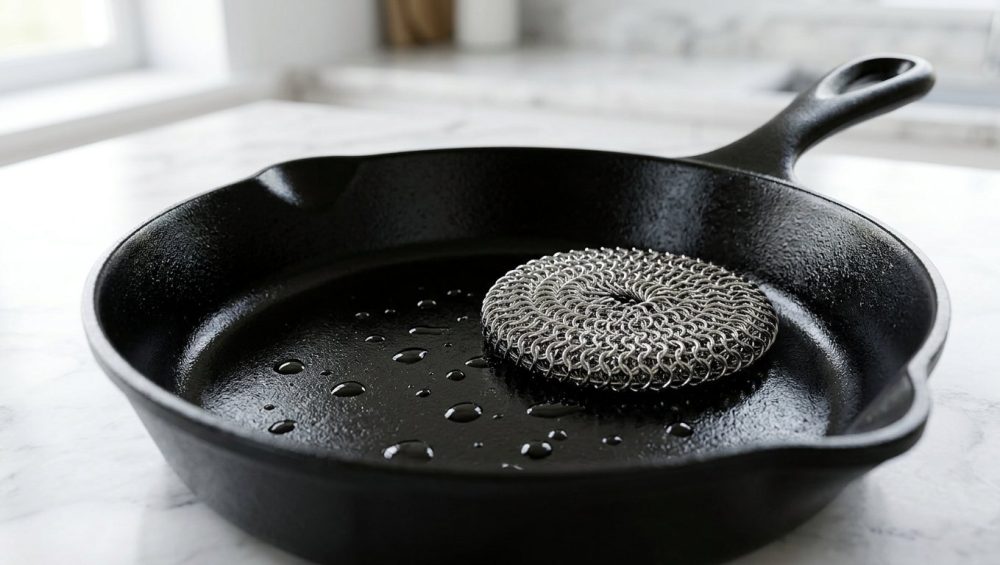
The absolute best tool for cleaning cast iron is a chainmail scrubber. It looks exactly like a small square of medieval armor, consisting of hundreds of interlocking metal rings. At first glance, it looks like it would be incredibly harsh on a pan, but the reality is a beautiful demonstration of kitchen physics.
To understand why chainmail is a genius invention, we have to look at how force is applied. Abrasive pads (like the green sponges or steel wool) work through sharp, microscopic scratching. They dig into the surface and tear away material.
Chainmail, on the other hand, works through blunt shearing force. Every single ring on a high-quality chainmail scrubber is completely smooth and perfectly rounded. There are no sharp edges. When you press a chainmail scrubber against the bottom of your skillet and move it in a circular motion, the smooth metal rings glide effortlessly over the flat, polymerized bioplastic layer without digging into it.
However, when those smooth rings encounter a raised obstacle—like a stubborn piece of burnt-on steak crust or caramelized onion—they catch the edge of the debris and shear it off cleanly at the base.
It is the mechanical equivalent of using a snowplow on a paved road. The plow clears the snow entirely without tearing up the asphalt underneath. A chainmail scrubber pops off the baked-on grime in seconds, leaving your precious seasoning completely untouched. It is the ultimate shortcut, especially when you are too exhausted to worry about turning burnt bits into sauce and just want the kitchen clean before bed.
Furthermore, because it is made entirely of smooth metal rings, a chainmail scrubber has zero porosity. It cannot absorb water. It cannot trap microscopic food particles. It cannot harbor bacteria. When you are done using it, you rinse it under the tap, and it is perfectly, immaculately clean. You can even throw it in the dishwasher.
Material Matters: Why 316-Grade Stainless Steel is Absolutely Non-Negotiable
As a home cook who values time and money, you need to be fiercely protective of what you bring into your kitchen. I am a massive advocate for banishing toxic kitchen gear and refusing to waste money on cheap, poorly manufactured junk that will end up in a landfill in six months.
When you go online to buy a chainmail scrubber, you will be bombarded with hundreds of cheap options from no-name brands. Do not buy them. The metallurgy of your scrubber is the single most important factor in this purchase. You must specifically seek out a scrubber made from 316-grade stainless steel.
The Metallurgy of Stainless Steel
To understand why, we need a quick lesson in metallurgy. The vast majority of standard stainless steel kitchenware (like mixing bowls, cheap flatware, and discount scrubbers) is made from 304-grade stainless steel. You will often see this advertised as 18/8 or 18/10 stainless, which refers to its composition of 18% chromium and 8% or 10% nickel.
304-grade is perfectly fine for a mixing bowl. But a chainmail scrubber lives a uniquely brutal life. It spends its days wet, sitting on the edge of your sink. More importantly, it is constantly exposed to salt (sodium chloride) from your cooking, as well as acidic residues from tomatoes, vinegars, and citrus.
When 304-grade stainless steel is repeatedly exposed to chlorides and moisture, it is highly susceptible to a phenomenon called “pitting corrosion.” The salt breaks down the protective chromium oxide layer on the steel, causing microscopic pits that rapidly bloom into red rust. If your scrubber rusts, you will literally be grinding iron oxide into your food the next time you clean your pan.
The 316-Grade Advantage
This is where 316-grade stainless steel changes the game. 316-grade takes the standard chromium and nickel alloy and adds 2% to 3% molybdenum.
That small addition of molybdenum works a metallurgical miracle. It drastically alters the chemical resistance of the steel, creating a robust, self-healing passive layer that is virtually immune to chloride pitting and acidic corrosion. 316-grade is so resilient that it is the standard metal used in marine environments (where it is constantly battered by saltwater) and in surgical instruments.
A 316-grade chainmail scrubber will never rust, never degrade, and never harbor bacteria. It is a true buy-it-for-life tool. When you buy cheap mystery metal, you are setting yourself up for failure. Cry once, buy once, and get the 316.
The No-Nonsense Masterclass: How to Actually Clean Your Cast Iron
Alright, we have covered the science, the biology, and the metallurgy. Now let’s get down to the practical application. How do you actually use this thing?
Here is my foolproof, hyper-efficient, step-by-step guide to cleaning cast iron on a busy weeknight.
Step 1: The Cool Down (Avoiding Thermal Shock)
Never, under any circumstances, take a screaming hot cast iron skillet off the stove and immediately plunge it under cold water. Cast iron is incredibly strong, but it is also brittle. Rapid changes in temperature cause the metal to contract violently and unevenly, which can permanently warp the bottom of your pan (turning it into a wobbly spinner on your glass cooktop) or cause it to crack right down the middle.
Let the pan cool on the stove while you eat your dinner. By the time you are ready to do the dishes, the pan should be warm to the touch, but not dangerously hot. If you are ever unsure if a pan is too hot to wash, you can use the water drop test—flick a single drop of water into the pan. If it violently explodes into steam, let it cool longer.
Step 2: The Hot Water Flush
Turn your sink tap to the hottest setting you can comfortably handle. Run the warm skillet under the hot water. The heat of the water will immediately begin to soften and melt any congealed cooking fats, making the debris much easier to remove.
Step 3: The Chainmail Glide
Toss your 316-grade chainmail scrubber directly into the wet pan. Place your fingers flat against the chainmail and begin rubbing it around the pan in gentle, circular motions.
Do not press down with all your body weight. You are not trying to sand a floorboard. Let the weight of the metal rings do the work. You will feel the rings catch on the crusty bits of food, and you will feel them shear off instantly. Pay special attention to the corners where the flat bottom meets the sidewalls. The whole process should take no more than 15 to 20 seconds.
Step 4: The Rinse and Inspect
Rinse the pan out with hot water to wash away the dislodged food particles. Run your bare hand over the surface of the wet pan. It should feel completely smooth, like a sheet of glass. If you feel any rough patches of carbonized food, hit that specific spot with the chainmail one more time.
Step 5: The Crucial Dry
This is the step where most beginners fail. Iron rusts when exposed to oxygen and water. Period. You must remove all moisture from the pan immediately.
Wipe the pan down thoroughly with a dry towel or a paper towel. But towel drying is not enough, as microscopic moisture will remain in the pores of the metal. Place the towel-dried skillet back on your stove over medium-low heat for about three to five minutes. This will evaporate every last molecule of water. Trust me, air drying your cast iron on a dish rack is a guaranteed path to waking up to a pan covered in bright orange rust.
Step 6: The Micro-Oil
Once the pan is bone dry and still warm from the stove, it is time to protect it. Add a tiny amount of neutral cooking oil (like canola or grapeseed) to the pan. I am talking about a drop the size of a dime.
Take a paper towel and buff that oil all over the inside of the pan, coating the bottom and the sides. Now, here is the secret to preventing your pan from getting sticky and rancid in the cupboard: take a clean, dry paper towel and aggressively wipe the pan out, as if you made a mistake and are trying to remove all the oil you just put in.
You only want a microscopic, invisible barrier of oil to protect the iron from the humidity in the air. If the pan looks wet or greasy, you have left too much oil in it.
Debunking the Most Annoying Cast Iron Cleaning Myths
Because the internet is a loud and chaotic place, I need to take a moment to aggressively debunk a few of the most pervasive, annoying myths about cast iron maintenance that refuse to die.
Myth 1: “You Can Never, Ever Use Soap on Cast Iron.”
This is the most famous myth of all, and it is entirely based on outdated historical facts. A hundred years ago, our great-grandmothers made dish soap by mixing rendered animal fat with lye (sodium hydroxide). Lye is a highly caustic base. If you recall our chemistry lesson from earlier, a caustic base will absolutely dissolve and strip polymerized bioplastics. Using historical lye soap on a cast iron pan would indeed strip the seasoning right down to the raw metal.
However, it is not 1920 anymore. Modern dish soaps (like Dawn or Palmolive) do not contain lye. They are formulated with mild, synthetic surfactants. These surfactants are chemically designed to bind to loose, un-polymerized oils and wash them away. They are not chemically strong enough to break the cross-linked carbon bonds of your polymerized seasoning.
If you just cooked a pungent batch of salmon, or a highly aromatic curry, please, for the love of all things culinary, put a drop of modern dish soap in your pan and wash it. Your seasoning will be perfectly fine, and your next batch of pancakes won’t taste like fish.
Myth 2: “Just Use a Coarse Salt Scrub and Half a Potato.”
If you read lifestyle blogs, you have probably seen the advice to pour a cup of coarse kosher salt into your dirty skillet, cut a potato in half, and use the potato as a scouring pad to grind the salt into the burnt food.
Let me be perfectly clear: this works. Salt is a mild abrasive, and the moisture from the potato helps bind it. But why on earth would you do this? It is a massive waste of expensive kosher salt, it wastes a perfectly good potato, and it takes ten times longer than just using a chainmail scrubber. We are cooking on a Tuesday night; we are not performing a rustic culinary arts ritual. Buy the chainmail and save your potatoes for mashing.
Myth 3: “If My Food Sticks, My Seasoning is Ruined.”
Home cooks often panic when a piece of chicken tears and sticks to the pan, assuming they have somehow destroyed their seasoning. 99% of the time, your seasoning is completely fine. Sticking is almost always a temperature control failure, not a seasoning failure.
When you put cold protein into a cold or lukewarm pan, the proteins will bond chemically with the metal. Properly preheating the pan allows the metal to expand fully and ensures that the moisture in the food instantly vaporizes upon contact (the Leidenfrost effect), creating a microscopic barrier of steam that prevents sticking. Don’t blame the pan; check your burner.
Conclusion: Reclaiming Your Time and Your Sanity
Cooking should be an empowering, joyful experience. It should be a time to pour a glass of wine, put on some good music, and create something spectacular with your own two hands. It should absolutely not end with you standing over a sink for twenty minutes, sweating, swearing, and scrubbing a heavy piece of iron with a toxic, bacteria-filled sponge.
You do not need a culinary degree to make mind-blowing food, and you do not need to treat your cookware like a museum artifact. You just need to understand the basic mechanics of your kitchen and invest in the right tools.
By throwing away those abrasive green sponges and investing in a 316-grade stainless steel chainmail scrubber, you are instantly eliminating the single biggest pain point of cast iron cooking. Just like a high-quality stainless steel bench scraper or a razor-sharp chef’s knife, the chainmail scrubber is an indestructible, buy-it-for-life tool that respects your time and elevates your kitchen efficiency.
So go ahead. Sear that steak. Caramelize those onions. Bake that cornbread. Make a massive, sticky mess. Because now, you know exactly how to clean it up in under a minute.