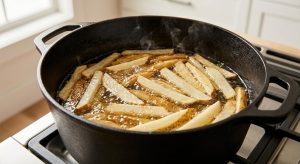
We need to have a serious talk about eggplant. You know the scenario. You’ve brought home a gorgeous, glossy, deep-purple globe from the farmer’s market. You have grand visions of a perfectly layered parmigiana, a silky baba ganoush, or a crisp, pan-fried medallion that shatters on the outside and melts on the inside. You slice it up, drop it into a hot pan with a generous glug of expensive olive oil, and then… tragedy strikes. Within three seconds, the pan is bone dry. The eggplant has inhaled every single drop of fat like a parched desert traveler. You panic, pour in more oil, and watch in horror as it drinks that up too.
By the time you pull it off the stove, you are left with a heavy, flabby, oil-logged sponge that leaves a greasy slick on your palate and a profound sense of regret in your soul. If you are nodding your head right now, welcome to the club. This is the universal struggle of the weekend culinary hobbyist. But here is the good news: you do not need a culinary degree to fix this. You just need a rudimentary understanding of high school biology and about thirty minutes of patience.
The secret to transforming this notoriously difficult nightshade from a culinary nightmare into a perfectly tender, rich, and structurally sound bite comes down to one single ingredient: salt.
But we are not just going to tell you to “salt your eggplant” and leave you to figure out the rest. We are going to dive deep into the cellular structure of this bizarre botanical berry, explore the fascinating physics of osmosis, and teach you a prep step so effective it will permanently alter your relationship with cooking. Consider this your masterclass in vegetable thermodynamics.
The Anatomy of an Eggplant: Why It Hates You
To understand why your eggplant behaves like a kitchen sponge, we first have to look at what it actually is. Botanically speaking, the eggplant (Solanum melongena) is a berry. Culinarily speaking, it is a hydrophilic nightmare designed to ruin your dinner if you do not treat it with respect.
The Aerenchyma Tissue Sponge
If you were to look at a raw slice of eggplant under a microscope, you would not see a dense, tightly packed wall of cells like you would in a carrot or a potato. Instead, you would see something that looks remarkably like bubble wrap or a natural sea sponge. Eggplant flesh is comprised of spongy parenchyma tissue. This structure is essentially a vast network of microscopic air pockets trapped between rigid cell walls.
In fact, raw eggplant tissue is incredibly porous, with a massive volume fraction of air. When you drop a raw slice of this vegetable into a hot frying pan, those tiny air pockets act as microscopic vacuums. As the heat hits the eggplant, the air inside those pockets expands and escapes, leaving behind a void. Because nature abhors a vacuum, the eggplant immediately sucks up whatever liquid is surrounding it to fill the empty space. If that liquid happens to be a quarter-cup of your best extra virgin olive oil, the eggplant will happily drink it all.
This is exactly why your eggplant absorbs so much oil. It can soak up to three times its own weight in fat if left to its own devices. You are not cooking a vegetable; you are deep-frying a sponge.
The Water Weight Problem
Compounding the issue of the air pockets is the sheer volume of water trapped inside the vegetable. Eggplants are roughly 90 to 93 percent water by weight. However, unlike a zucchini or a cucumber where the water is bound intracellularly (inside the cells), much of the water in an eggplant is trapped in extracellular spaces (between the cells).
When you attempt to cook raw, un-prepped eggplant, this massive volume of water begins to steam. Instead of searing and developing a beautiful, caramelized crust via the Maillard reaction, the eggplant simply boils in its own juices. The result? A mushy, gray, unappetizing mess. If you have ever wondered why your roasted veggies are mushy, excessive unmanaged water content is almost always the prime suspect.
To achieve that coveted crispy exterior and creamy, custard-like interior, we have to fundamentally alter the physical architecture of the vegetable before it ever touches the heat. We have to collapse the sponge. And to do that, we rely on the magic of osmosis.
The Science of Osmosis: Your Kitchen Superpower
You might remember osmosis from your middle school science classes. It is the process by which a solvent (like water) moves across a semi-permeable membrane (like a plant cell wall) from an area of low solute concentration to an area of high solute concentration. In plain English: water always wants to dilute salt.
When you generously coat the surface of a raw eggplant slice with salt, you create an extreme imbalance. The environment outside the eggplant cells is suddenly hypertonic—it has a much higher concentration of salt than the watery environment inside the cells.
The Great Cellular Collapse
Because the cell walls are semi-permeable, the water trapped inside the eggplant’s extracellular spaces and within the cells themselves rushes out to dilute the salt sitting on the surface. Within minutes of salting, you will notice beads of moisture forming on the cut flesh. This is the vegetable “sweating.”
But the real magic happens beneath the surface. As the water leaves the cellular structure, those rigid, air-filled pockets begin to deflate. Without the internal water pressure (turgor pressure) holding them open, the spongy aerenchyma tissue literally collapses in on itself. The matrix tightens, the flesh condenses, and the microscopic voids that previously acted as oil-sucking vacuums are squeezed shut.
By the time you are done salting, the eggplant has lost a significant portion of its water weight and, more importantly, its physical volume has shrunk. You have effectively closed the sponge. When this dense, collapsed slice finally hits the hot oil, there are no empty air pockets left to fill. The oil stays in the pan where it belongs, conducting heat and creating a crispy, golden-brown crust, while the interior of the eggplant cooks into a rich, silky puree.
Flavor Concentration and Seasoning
Beyond the structural transformation, osmosis provides a massive upgrade to the flavor of the dish. As the water exits the vegetable, the salt slowly diffuses into the plant material. You are seasoning the eggplant from the inside out, rather than just coating the surface.
Furthermore, by removing a large percentage of the water, you are concentrating the natural sugars and savory compounds left behind. Think of it like reducing a stock on the stove. Less water equals a more intense, robust flavor. A properly salted eggplant does not taste salty; it simply tastes more profoundly like itself.
Debunking the Bitterness Myth
If you ask your grandmother why she salts her eggplant, she will almost certainly tell you it is to “draw out the bitter juices.” For decades, this was the primary gospel of Italian and Mediterranean home cooks. And historically, she was absolutely right.
Eggplants are members of the nightshade family (Solanaceae), closely related to tomatoes, potatoes, and bell peppers. In the wild, nightshades produce bitter alkaloid compounds (like solanine) and phenolic enzymes as a natural defense mechanism to stop pests from eating them. Older, heirloom varieties of eggplant were notoriously bitter, and the salting process was absolutely mandatory to leach out these harsh, astringent compounds.
The Marvel of Modern Agriculture
However, we live in the future. Over the last few decades, agricultural scientists and plant breeders have aggressively selected against these bitter traits. The vast majority of modern eggplants you find in a standard grocery store—particularly the large, dark purple globe varieties (often called American or Italian eggplants)—have been bred to be incredibly mild and sweet.
Today, if you encounter a bitter eggplant, it is usually not a genetic trait, but rather an issue of age or storage. The longer an eggplant sits on a supermarket shelf after being harvested, the more those bitter phenolic compounds develop. Additionally, overripe eggplants with fully developed, hard brown seeds will carry a much sharper, more astringent flavor, as the bitterness is heavily concentrated in the seeds.
Why We Still Salt
So, if modern eggplants are rarely bitter, can we skip the salting step? Absolutely not. While the original intent of the technique may have been flavor correction, the structural benefits—collapsing the sponge and preventing oil absorption—remain entirely relevant.
Salting is no longer about saving your palate from bitterness; it is about saving your dinner from a greasy, unappetizing texture. Even the freshest, sweetest, most perfectly grown farmer’s market eggplant still possesses that porous, oil-thirsty cellular structure. Skipping the salt means accepting a soggy, oil-logged fate.
The Masterclass: How to Salt Eggplant Like a Pro
Now that we understand the underlying physics and botany, let us translate this science into practical, weeknight-friendly kitchen technique. If you want to elevate your cooking, you need an essential kitchen survival guide mentality: respect the process, use the right tools, and never skip the prep.
Step 1: The Cut
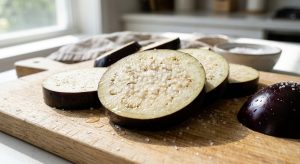
The way you slice your eggplant dictates how effectively the salt can do its job. Because the water is trapped in vertical capillary channels, cutting the eggplant crosswise into thick rounds actually makes it harder for the water to escape.
For the best textural results, especially if you are pan-frying or making a stir-fry, slice the eggplant lengthwise into planks or thick batons. If you must cut it into rounds for a traditional parmigiana, keep the slices relatively uniform, about half an inch thick.
A quick note on knife skills: A dull knife is the enemy of the eggplant. A blunt blade will crush the delicate cell walls rather than slicing cleanly through them, releasing enzymes that cause the flesh to oxidize and turn an ugly, muddy brown within seconds. If you find yourself sawing through the skin, your culprit is your dull knife. Keep your blades honed.
Step 2: The Application
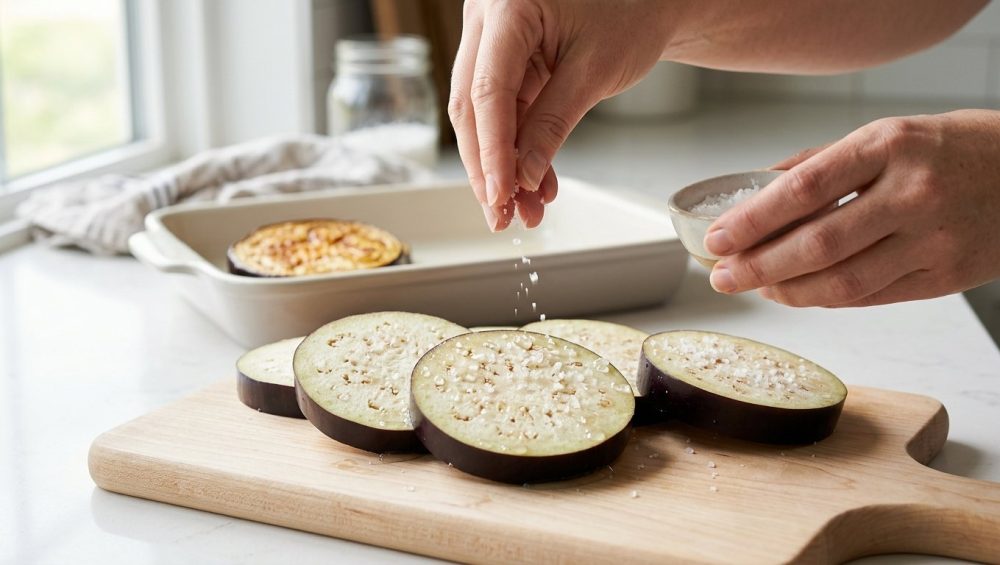
Do not be timid with the salt. You are not finishing a delicate salad; you are initiating a heavy-duty osmotic reaction. You need a coarse salt, preferably Kosher salt. Table salt is too fine, too dense, and often contains anti-caking agents that can leave a metallic aftertaste.
Lay your eggplant slices out on a wire cooling rack set over a baking sheet. This setup is crucial. If you just pile the salted slices on a plate, the eggplant at the bottom will end up sitting in a puddle of its own extracted, murky water, reabsorbing the very liquid you are trying to expel. The wire rack allows for air circulation and gives the moisture somewhere to go.
Sprinkle the salt generously over both sides of the slices. You want a visible, even coating. It will look like too much salt. Trust the process.
Step 3: The Wait
This is the hardest part for the impatient weekday cook. You must walk away. The osmotic process takes time to fully collapse the aerenchyma tissue.
Give the eggplant an absolute minimum of 30 minutes. If you have 45 minutes to an hour, even better. During this time, you will see the surface of the eggplant transform. First, it will look damp. Then, large beads of brown-tinted water will pool on the surface. Finally, the slices will visibly shrink, taking on a slightly floppy, dense, leather-like texture. This is exactly what you want. The sponge has been defeated.
Step 4: The Clean-Up
This is where most beginners ruin the dish. If you take these heavily salted, wet slices and throw them directly into a hot pan, you will end up with a meal so aggressively salty it will be inedible, and the surface moisture will cause the hot oil to violently splatter.
You must remove the excess salt and the extracted water. Take a clean, dry paper towel or a lint-free kitchen towel and firmly press it against the eggplant slices. Wipe away the beads of moisture and brush off the visible salt crystals. You want the surface of the eggplant to be as dry as possible before cooking.
Some cooks prefer to briefly rinse the slices under cold running water to remove the salt, followed by a rigorous pat-down with paper towels. This is perfectly acceptable, provided you are meticulous about drying them afterward. Moisture is the enemy of searing.
To Peel or Not to Peel?
A common point of contention among home cooks is whether the eggplant skin should be left intact or aggressively peeled away. The answer depends entirely on the age of the vegetable, the specific variety, and the cooking method you are employing.
The skin of an eggplant is rich in anthocyanins—specifically a powerful antioxidant called nasunin, which gives the vegetable its striking, deep purple hue. From a nutritional standpoint, the skin is the most valuable part of the plant. Furthermore, the skin provides crucial structural integrity. When the interior flesh cooks down into a soft, creamy puree, the skin acts as a natural casing, holding the slice together so it doesn’t disintegrate into a pile of mush in your pan.
However, as an eggplant ages, its skin becomes incredibly tough, thick, and leathery. If you are working with a massive, out-of-season globe eggplant that feels light for its size (a sign of moisture loss and age), the skin will likely be unpleasantly chewy, no matter how long you cook it. In this scenario, peeling is highly recommended.
If you are making a delicate dip like baba ganoush, where the flesh is roasted whole and scooped out, the skin is discarded anyway. But for pan-frying or roasting, try the “zebra stripe” method: use a Y-peeler to remove alternating strips of skin. This gives you the best of both worlds—enough skin to hold the vegetable together and provide a pleasant textural contrast, without overwhelming the bite with tough, chewy fiber.
Alternative Methods: Brining vs. Microwaving
While the dry-salting method is the gold standard for collapsing the cellular structure of an eggplant, it is not the only weapon in your culinary arsenal. Depending on your time constraints and the final dish, you might want to consider a few science-backed alternatives.
The Wet Brine
If you are preparing a large batch of eggplant and do not have the counter space to lay out dozens of slices on wire racks, a wet brine is a fantastic alternative.
Dissolve a quarter cup of Kosher salt in a large bowl of warm water, then drop in your eggplant cubes or slices. Because eggplant is so porous and full of air, it will float to the top like a buoy. You will need to submerge the pieces by placing a heavy plate on top of them.
Let the eggplant sit in the saltwater bath for 30 to 45 minutes. The osmotic reaction still occurs, but the brine also prevents the cut flesh from oxidizing and turning brown. When you are ready to cook, drain the eggplant thoroughly and—this is the crucial step—squeeze the pieces aggressively between a clean kitchen towel to wring out the excess water. The brined flesh will compress beautifully, ready to hit the pan without soaking up excess oil.
The Microwave Shortcut
We firmly believe in taking the time to cook properly, but we also acknowledge the reality of a frantic Tuesday night. When you do not have 45 minutes to wait for osmosis to do its job, you can use thermal energy to force the cellular collapse.
Line a microwave-safe plate with a double layer of paper towels. Arrange your eggplant slices in a single layer, lightly salt them, and cover them with another layer of paper towels. Microwave on high for 3 to 5 minutes.
The intense, rapid dielectric heating of the microwave causes the water trapped inside the aerenchyma tissue to instantly turn to steam. This steam bursts through the cell walls, and the paper towels immediately absorb the expelled moisture. When you pull the plate out, the eggplant slices will be shrunken, dense, and partially cooked. They are now perfectly prepped to be quickly seared in a hot pan to develop a crust, without absorbing a drop of unnecessary oil.
Cooking the Perfectly Prepped Eggplant
You have successfully collapsed the sponge. Your eggplant is dense, dry, and perfectly seasoned. Now, you must execute the cook without ruining all your hard prep work.
Heat Management is Everything
The biggest mistake you can make at this stage is dropping your meticulously prepped eggplant into a lukewarm pan. If the oil is not shimmering and hot, the eggplant will still try to absorb it, regardless of your salting efforts.
You need high, sustained heat to immediately trigger the Maillard reaction—the chemical process that browns amino acids and sugars, creating a complex, savory crust. When the eggplant hits the hot oil, the surface moisture should instantly vaporize, creating a microscopic barrier of steam that physically pushes the oil away, preventing it from penetrating the flesh.
Choosing the Right Gear
To maintain that high, even heat, you need cookware with excellent thermal mass. A heavy-bottomed stainless steel skillet, a carbon steel pan, or a classic cast-iron skillet are your best options.
We need to take a brief, highly opinionated detour here: stop cooking your vegetables in cheap, scratched Teflon pans. Thin, lightweight non-stick pans cannot hold heat. When you add a large batch of eggplant to a flimsy non-stick skillet, the temperature of the pan plummets. The searing stops, the steaming begins, and your eggplant turns to mush.
Furthermore, relying on aerosol cooking sprays on these cheap pans leaves a polymerized, sticky residue that ruins the coating over time. If you are ruining your nonstick pans with aerosol sprays and high heat, it is time for an upgrade. We are passionate about banishing toxic kitchen gear from the home. Invest in a solid stainless steel or carbon steel pan. They will last a lifetime, they can handle the high heat required for a proper sear, and they won’t flake mystery chemicals into your dinner.
If you are intimidated by stainless steel because your food always sticks to it, you simply need to learn temperature control. Preheat the dry pan until it is hot enough that a drop of water beads up and dances rapidly across the surface like a mercury marble. This indicates that the pan has reached the Leidenfrost point. If you master the water drop test, you will never have to scrape burnt food off the bottom of a pan again. It is the exact same principle that explains why your meat sticks to stainless steel when the pan is too cold. Heat it properly, add your oil, and let it shimmer before adding the eggplant.
The Pan-Frying Process
Once the oil is hot, lay your eggplant slices into the pan in a single layer. Do not crowd the pan. If the slices are touching, they will trap steam and boil rather than fry. Work in batches if necessary.
Let the eggplant sear undisturbed for 3 to 4 minutes. You are looking for a deep, rich, mahogany brown crust. Flip the slices and repeat on the other side. Because you collapsed the cellular structure during the salting phase, the interior of the eggplant will quickly soften into a luxurious, creamy texture while the exterior remains crisp.
When the slices are done, transfer them to a wire cooling rack or a paper-towel-lined plate to drain any residual surface oil.
Pro-tip: When transferring your cooked vegetables, or when scooping up your prepped ingredients from the cutting board, do not drag the sharp edge of your chef’s knife across the board. You need a bench scraper for this exact task. It saves your knife edge and makes transferring ingredients seamless and professional.
Flavor Profiles and Pairings: Completing the Dish
Eggplant is a culinary blank canvas. Its mild, slightly earthy flavor and incredibly rich, creamy texture make it the perfect vehicle for bold, aggressive seasonings. Now that you have mastered the texture, you need to balance the flavor.
The Power of Acid
Eggplant is heavy. Even when properly prepped and cooked to avoid excess oil absorption, the creamy, custard-like interior feels incredibly rich on the palate. To cut through that richness and wake up the dish, you absolutely must introduce an acid.
A splash of high-quality red wine vinegar, a squeeze of fresh lemon juice, or a drizzle of syrupy balsamic glaze applied right before serving will completely transform the profile of the vegetable. The sharp, bright acidity provides a necessary counterpoint to the dense, savory depth of the eggplant.
Blooming Your Aromatics
If you are incorporating garlic, chili flakes, or hard spices into your eggplant dish, do not just dump them into the pan at the end. Spices need fat and heat to release their volatile aromatic compounds.
Push your perfectly seared eggplant to the edges of the skillet, add a tiny drop of fresh oil to the center, and briefly fry your minced garlic and spices until they are fragrant (usually about 30 seconds). Then toss everything together. This technique prevents the garlic from burning and turning acrid, which is a simple secret to bitter-free meals.
Fresh Herbs and Finishing Touches
Because eggplant takes so well to high-heat roasting and aggressive searing, it benefits immensely from the addition of fresh, tender herbs added off the heat.
Torn basil, fresh mint, or roughly chopped flat-leaf parsley will add a burst of fresh, green flavor that lifts the entire dish. A final sprinkle of flaky sea salt (for a textural crunch) and a grating of hard, salty cheese like Pecorino Romano or Parmigiano-Reggiano will elevate a simple pan-fried eggplant from a humble weeknight side dish into a restaurant-quality centerpiece.
Conclusion: Embrace the Process
Cooking is not just about following a list of arbitrary steps; it is about understanding the physical properties of your ingredients and manipulating them to achieve a specific result.
Eggplant is not a difficult vegetable. It does not hate you. It is simply a highly porous, water-logged sponge that requires a little bit of scientific intervention before it can shine. By taking the extra thirty minutes to generously salt your raw slices, you are actively utilizing the power of osmosis to draw out excess moisture, collapse the airy cellular structure, and permanently prevent the vegetable from turning into a greasy, oil-logged mess.
Yes, it requires a bit of patience. Yes, it adds an extra step to your prep routine. But the difference between a rubbery, oil-soaked eggplant and a perfectly tender, deeply caramelized, creamy medallion is entirely worth the wait.
So the next time you bring home one of those beautiful purple globes, do not rush the process. Sharpen your knife, grab your Kosher salt, and let the science of osmosis do the heavy lifting. Your palate, your dinner guests, and your sanity will thank you. Now get back in the kitchen and show that eggplant who is boss. You’ve got this.