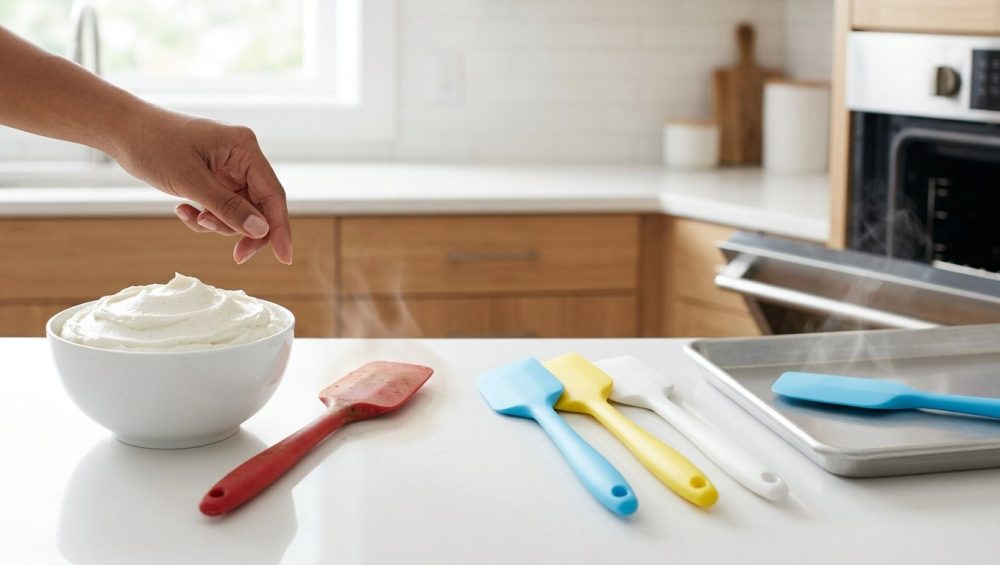
Picture this: It is a gorgeous Sunday afternoon, and you have finally carved out a few precious hours for yourself. You have spent the better part of the morning meticulously measuring out cake flour, whipping egg whites to gloriously stiff peaks, and folding in an obscenely expensive jar of Madagascar vanilla bean paste. You pour the delicate batter into your prepared pans, bake it to golden perfection, and let it cool. You whip up a pristine, fluffy, cloud-like Swiss meringue buttercream. You take a triumphant, well-deserved bite of your culinary masterpiece, expecting a symphony of sweet vanilla and butter to dance across your palate.
Instead, you are violently assaulted by the distinct, unmistakable flavor of last Tuesday’s spicy garlic shrimp stir-fry.
Cue the dramatic music. Your dessert has been compromised. The culprit? Your seemingly innocent, brightly colored, “professional” silicone spatula.
Welcome back to the kitchen, my friends. I’m your resident Sassy Sous-Chef, and today we are tackling one of the most infuriating, day-ruining mysteries of the modern culinary world. Why do our modern cooking tools betray us? Why does a material lauded by every marketing department for its non-porous, hyper-hygienic properties suddenly decide to hoard the ghosts of dinners past? And more importantly, how do we fix it before another batch of brownies falls victim to the curse of the phantom onion?
This is not just about bad luck; it is about advanced polymer chemistry, volatile organic compounds, and the infuriating fact that the kitchenware industry loves to sell us cheap, sub-par garbage disguised as “chef-grade” equipment. Today, we are diving deep into the microscopic science of silicone. We are going to explore exactly why your silicone spatulas taste like soap or garlic, the crucial and often hidden differences between platinum-cured and peroxide-cured materials, and the definitive, science-backed methods to exorcise those savory demons from your baking tools for good. Grab a cup of coffee (or a glass of wine; I won’t judge), and let’s get into the chemistry of the stink.
The Molecular Battlefield: Understanding the Anatomy of Silicone
You have probably been told by countless aggressive online advertisements that silicone is completely inert, entirely non-porous, and impervious to everything short of a direct nuclear blast. That is a lovely marketing fairy tale, but it is not the whole truth. To understand why your spatula is currently masquerading as a garlic clove, we have to look closely at the microscopic structure of the material itself.
Silicone rubber is a synthetic polymer. Unlike organic rubbers which are built on a backbone of carbon-to-carbon bonds, silicone is built on an inorganic backbone of alternating silicon and oxygen atoms (known as siloxane bonds). Flanking this incredibly stable, heat-resistant backbone are organic side groups, typically methyl or vinyl groups. This unique hybrid structure—part inorganic, part organic—is what gives silicone its famous flexibility, its water-repelling properties, and its ability to withstand the blazing heat of a hot skillet without melting into a puddle of toxic goo.
However, while silicone does not have large, visible, fibrous pores like wood (which, by the way, is exactly why your wooden spoons keep cracking if you ruthlessly abuse them in the dishwasher), it does possess a semi-permeable microscopic matrix. In the realm of polymer chemistry, this is referred to as “free volume.” Between those long, flexible, twisting polymer chains, there are microscopic empty spaces. The material is essentially a microscopic molecular sponge. Under normal room-temperature conditions, these spaces are relatively tight. But the kitchen is not a room-temperature environment; it is a thermal battleground.
Volatile Organic Compounds: The Invisible Culinary Hijackers
Enter Volatile Organic Compounds (VOCs). These are the chemical compounds responsible for the aromas and flavors in our food. When you mince a fresh clove of garlic, you are mechanically breaking down cell walls and releasing allicin, a sulfur-rich compound that gives garlic its aggressively pungent, savory smell. When you zest a lemon, you release limonene. When you toast cumin seeds, you release cuminaldehyde.
These aroma molecules share two very specific, very frustrating traits: they are highly volatile (meaning they readily vaporize into the air), and they are heavily fat-soluble (lipophilic). Because silicone’s organic side chains are non-polar, they act as a magnet for other non-polar, fat-soluble molecules.
Now, let’s add the catalyst of heat to the equation. When you are standing over a hot stove, aggressively stirring a bubbling, simmering pot of marinara sauce, the intense heat transfers directly to the head of your spatula. As the silicone heats up, the kinetic energy of its polymer chains increases. The matrix expands, and those microscopic free spaces between the chains open up significantly. This expansion creates the perfect, welcoming entryway for the hot, fat-soluble VOCs from your garlic, onions, and spices to slip right into the deep structural pockets of the material.
When dinner is finally plated and you take the spatula out of the hot pan, tossing it onto the counter, the silicone rapidly cools down. The thermal energy dissipates, the polymer matrix tightly contracts, and it effectively traps those pungent little aroma molecules deep inside the core of the material.
This is the exact moment the trap is sprung. Standard dish soap and warm water are designed with surfactants that only clean the surface of a material. They simply do not have the chemical ability to penetrate the contracted polymer chains to reach the trapped oils. So, the next time you use that seemingly clean spatula to mix a room-temperature vanilla buttercream, the mechanical friction of stirring, combined with the fats in your butter, causes the silicone to slowly, agonizingly release those trapped VOCs right into your dessert. Congratulations, you have just invented garlic frosting.
The “Food-Grade” Deception: Platinum-Cured vs. Peroxide-Cured Silicone
This brings us to one of my absolute, non-negotiable, strictest rules in the kitchen: it is time you start banishing toxic kitchen gear from your home immediately. I have zero patience for cheap, mystery-material tools that ruin our food, frustrate our cooking efforts, and potentially leach weird industrial chemicals into our weekday dinners. If you want to stop your tools from hoarding odors, you need to understand exactly how silicone is manufactured, because the industry is lying to you through omission.
Not all silicone is created equal. The journey from raw silica (derived from sand) to a flexible, heat-resistant spatula requires a highly controlled chemical process called curing, or vulcanization. This process cross-links the free-floating polymers to make the material solid yet flexible. In the commercial culinary world, there are two primary ways this is achieved: peroxide curing and platinum curing.
The Peroxide-Cured Problem
If you bought a generic, brightly colored set of ten spatulas online for fifteen bucks, I can almost guarantee with absolute certainty that they are peroxide-cured. This older manufacturing method uses organic peroxides as a catalyst to initiate a free-radical polymerization process. From a manufacturing standpoint, it is incredibly cheap, fast, and highly efficient for mass production. However, from a culinary standpoint, it is fundamentally flawed for high-heat, food-contact applications.
Peroxide curing leaves behind acidic byproducts and volatile chemical residues within the material. These residual compounds not only give the silicone a faint, unpleasant, rubbery “factory” smell right out of the box, but they also result in a looser, less stable polymer matrix. This structurally compromised matrix is highly susceptible to absorbing odors, staining permanently from tomato sauce, and degrading over time. Worse, when exposed to the high heat of a skillet or the harsh, highly alkaline environment of your dishwasher detergent, peroxide-cured silicone can develop a cloudy, sticky, greasy film. It is the exact same chemical degradation reason why your cheap plastic containers stay greasy no matter how aggressively you scrub them with a sponge—the material itself is compromised and breaking down.
The Platinum-Cured Gold Standard
If you want to cook like a genuine professional without dropping a small fortune on a culinary degree, you need to invest exclusively in platinum-cured silicone. This advanced process uses a pure platinum-based catalyst to bond the polymers through an addition-polymerization reaction. It is a much cleaner, more precise chemical reaction that produces absolutely zero toxic byproducts.
The result is magnificent. Platinum-cured silicone boasts a tightly cross-linked, incredibly pure, medical-grade matrix. It is vastly less permeable than its cheap peroxide cousin, meaning it physically lacks the large molecular gaps needed to trap garlic oils. It has superior heat resistance (often safely withstanding up to 600°F without warping), incredible tensile strength, and is significantly less likely to absorb or retain volatile organic compounds. It is completely odorless, non-leaching, and will not degrade into a sticky mess after a few runs through the dishwasher.
How do you know what you are actually buying? First, look for reputable brands that explicitly advertise their tools as “100% Platinum-Cured” or boast “LFGB Certification”. LFGB is the European safety standard, which requires far more rigorous extraction and material testing than the standard American FDA food-grade label. Second, perform the infamous “pinch test.” If you aggressively pinch, twist, or stretch a piece of silicone and the stretched area turns stark, cloudy white, it is likely filled with cheap plastic fillers and is not pure silicone. Pure, high-quality platinum silicone retains its solid, uniform color even when stretched to its limits. Stop buying cheap tools that actively sabotage your cooking. Your time is money, and spending an hour trying to rescue a ruined dessert costs a lot more than a twenty-dollar pro-grade spatula.
The Masterclass Solutions: Science-Backed Deodorizing Protocols
Alright, let us be realistic. You likely already own a drawer full of smelly spatulas, and you aren’t ready to throw them all in the trash just yet. I get it. We are resourceful home cooks, and we know how to fix our mistakes. If you want to host a beautiful dinner party without serving onion-flavored chocolate mousse to your guests, you need to know how to deep-clean your tools at a molecular level.
Standard washing in the sink is utterly useless here. We have to use applied science to force the silicone matrix to open up and release the trapped VOCs. Forget the old wives’ tales and Pinterest hacks; here are the only four scientifically proven methods that actually work.
Method 1: The Thermodynamic Reset (Oven Outgassing)
Remember how heat causes the silicone matrix to expand and absorb odors in the first place? We can use that exact same thermodynamic principle in reverse to force the odors back out. This process is known in the manufacturing industry as “outgassing,” and it is the absolute gold standard for deeply deodorizing silicone.
Here is the exact, foolproof protocol:
- Thoroughly wash your smelly spatulas with hot water and a heavy-duty, grease-cutting dish soap to remove any superficial surface oils. Dry them completely with a clean microfiber cloth.
- Preheat your oven to 350°F (180°C).
- Place your silicone tools directly on a clean, ungreased baking sheet. (Crucial Note: You must ensure your tools are 100% silicone and do not have wooden handles, nylon cores, or cheap plastic grips that will melt, burn, or release toxic fumes in the oven).
- Bake the tools for 30 to 60 minutes.
- Open a kitchen window and turn on your exhaust fan. As the silicone heats up and the matrix expands, the trapped volatile organic compounds will rapidly vaporize and be released into the air. Your kitchen will temporarily smell like baked garlic, old curry, and regret. Do not panic; this means the chemical extraction is working flawlessly.
- Carefully remove the baking sheet from the oven using tongs and let the spatulas cool completely at room temperature. As they cool, the freshly cleaned matrix will contract tightly, leaving you with an odorless, pristine tool.
Method 2: The Alkaline-Terpene Extraction (Baking Soda & Lemon Zest)
If you are dealing with a spatula that has a wooden handle and cannot safely go into a hot oven, we have to rely on localized chemical reactions rather than pure ambient heat. Many amateur blogs suggest soaking silicone in plain white vinegar, but a weak acid alone is rarely enough to break down heavy, stubborn sulfur-based compounds. (Incidentally, misunderstanding chemical reactions is exactly why your garlic always burns and turns acrid if you don’t manage the heat and pH of your pan correctly).
Instead, we are going to use a synergistic combination of mild alkalinity and natural, highly active solvents.
- Create a thick, abrasive paste using three tablespoons of baking soda (sodium bicarbonate) and one tablespoon of finely grated fresh lemon zest. Add just enough warm water to bind it.
- Slather this paste aggressively all over the silicone head of your spatula, rubbing it in to ensure maximum surface contact.
- Why this works: Baking soda acts as an alkaline buffer that effectively hydrolyzes acidic odor precursors, breaking down sulfides from onions and garlic. Meanwhile, limonene—the dominant, highly reactive terpene found in the essential oils of lemon zest—functions as a powerful natural solvent. It lifts embedded oils out of the microscopic pores without leaving a chemical residue behind.
- Let the paste sit undisturbed on the spatula for at least two hours, or overnight for severe, pungent cases.
- Rinse thoroughly with hot water. The combination of the alkaline breakdown and the terpene solvent will leave the tool smelling completely neutral and fresh.
Method 3: The Acetic Acid Purge (Boiling Vinegar)
For tools that are heavily coated in a greasy, soapy film—a very common issue if you use cheap dishwasher pods that leave behind strong, artificial floral fragrances—a boiling liquid purge is highly effective.
- Fill a large stainless steel stockpot with a 1:1 ratio of water and distilled white vinegar.
- Bring the highly acidic mixture to a rolling, vigorous boil.
- Submerge the silicone ends of your tools in the boiling liquid and let them simmer for 15 to 20 minutes.
- The sustained, aggressive heat of the boiling water forces the silicone pores to expand to their absolute maximum capacity, while the acetic acid in the vinegar actively breaks down the fat-soluble aroma molecules, mineral deposits, and soapy residues.
- Remove the tools with tongs, wash them immediately with mild dish soap to neutralize the acid, and let them air dry in a well-ventilated area.
Method 4: The Photolytic Degradation Method (UV Sunlight)
If you live in a sunny climate, you have access to a natural, highly effective sanitizing agent: ultraviolet radiation. UV rays from direct sunlight are capable of breaking the chemical bonds of many volatile organic compounds through photolytic degradation.
After washing your tools, simply leave them outside in direct, bright sunlight for a few hours. The UV rays act as a natural bleach and deodorizer, neutralizing lingering smells and even fading those stubborn orange stains left behind by heavy tomato sauces or turmeric-laced curries.
The Pro-Kitchen Protocol: Preventing Cross-Contamination
As the old culinary adage goes, an ounce of prevention is worth a pound of ruined buttercream. If you want to permanently cure cooking anxiety, you need to implement rigid professional systems in your kitchen that prevent disasters from happening in the first place. You do not see professional pastry chefs using the exact same spatula that the grill cook just used to toss a mound of caramelized onions. Your home kitchen should operate with the same level of respect for ingredients.
Establish a Color-Coded System
This is the easiest, most foolproof, and aesthetically pleasing hack in the culinary world. You need to physically segregate your tools. Buy two distinct sets of high-quality, platinum-cured silicone spatulas.
- The Savory Squad: Choose dark, opaque colors—matte black, dark charcoal gray, or deep crimson red. These are your designated tools for scrambling eggs, stirring robust curries, tossing garlic-heavy stir-fries, and simmering tomato sauces. Dark colors naturally hide the inevitable turmeric and tomato stains, keeping your tool crock looking sharp.
- The Sweet Syndicate: Choose light, airy colors—pure white, soft pastel blue, or mint green. These tools are strictly reserved for the delicate arts: baking cakes, folding fragile egg whites, mixing frosting, and scraping out the very last bit of brownie batter from the bowl.
Never, under any circumstances, let the two squads cross paths. This simple visual system completely eliminates the risk of cross-contamination. It is undeniably one of the most essential kitchen tools for beginners and seasoned experts alike: the tool of systematic organization.
The “Wash While Hot” Rule
Remember the thermodynamics we discussed earlier? When your silicone is hot, its microscopic pores are wide open. If you take a hot, garlic-covered spatula out of a pan and lazily toss it into a cold sink to sit for three hours while you eat dinner and watch television, the silicone will rapidly cool and contract, tightly locking those garlic oils inside the matrix.
To prevent this entirely, you must wash your silicone tools immediately while they are still physically warm from the cooking process. A quick, vigorous scrub with hot, soapy water while the polymer matrix is still expanded will easily wash away the VOCs before they ever have a chance to get permanently trapped. Yes, it requires an extra thirty seconds of effort right after cooking, but it saves you an hour of furious scrubbing and oven-baking later.
Avoid Abrasive Sponges at All Costs
Never use steel wool, hard bristle brushes, or highly abrasive green scouring pads on your silicone gear. While silicone is incredibly tough against heat, it is relatively soft against friction. Abrasive cleaners create microscopic scratches, tears, and gouges on the smooth surface. These tiny abrasions become the perfect, permanent hiding spots for bacteria, grease, and odor molecules. Treat your premium silicone like you would treat a delicate piece of cookware. Stop buying cheap pans and ruining your nonstick pans with metal forks, and stop ruining your spatulas with steel wool. Use soft sponges, microfiber cloths, and gentle silicone scrubbers to maintain the smooth, non-porous finish.
The Ultimate Kitchen Upgrade: Stop Sabotaging Your Own Food
Listen to me carefully: cooking should be an absolute joy, an act of creative expression, and a relaxing way to end your day. It should not be a stressful, uphill battle against your own equipment. It is maddening to wonder why your kitchen knives get dull when you use glass cutting boards, and it is equally maddening to wonder why your desserts taste like dinner when you use cheap spatulas.
You do not need a Michelin star, a massive trust fund, or a degree from Le Cordon Bleu to make mind-blowing, restaurant-quality food in your standard home kitchen. But you absolutely must respect the fundamental science of your ingredients and the physical materials of your tools. We spend so much time obsessing over finding the perfect recipe, sourcing the absolute best organic vanilla beans, and perfectly timing our oven bakes to the exact second. Do not let all of that incredible effort, money, and passion be utterly destroyed by a cheap, three-dollar, peroxide-cured piece of plastic masquerading as a professional tool.
Upgrade your gear. Invest in seamless, unibody, platinum-cured silicone. Bake the garlic ghosts out of your current tools using the thermodynamic reset method. Color-code your utensil drawer like a neurotic, highly organized genius.
When your tools work seamlessly with you instead of fighting against you, the kitchen stops being a place of frustration, cross-contamination, and ruined desserts, and becomes a playground of true culinary artistry. Now, go rescue your spatulas from the garlic dimension, immediately throw away the ones that fail the pinch test, and get back to making food that actually tastes exactly like it is supposed to.
Stay sassy, stay sharp, and for the love of all things holy, smell your spatula before you mix your frosting.