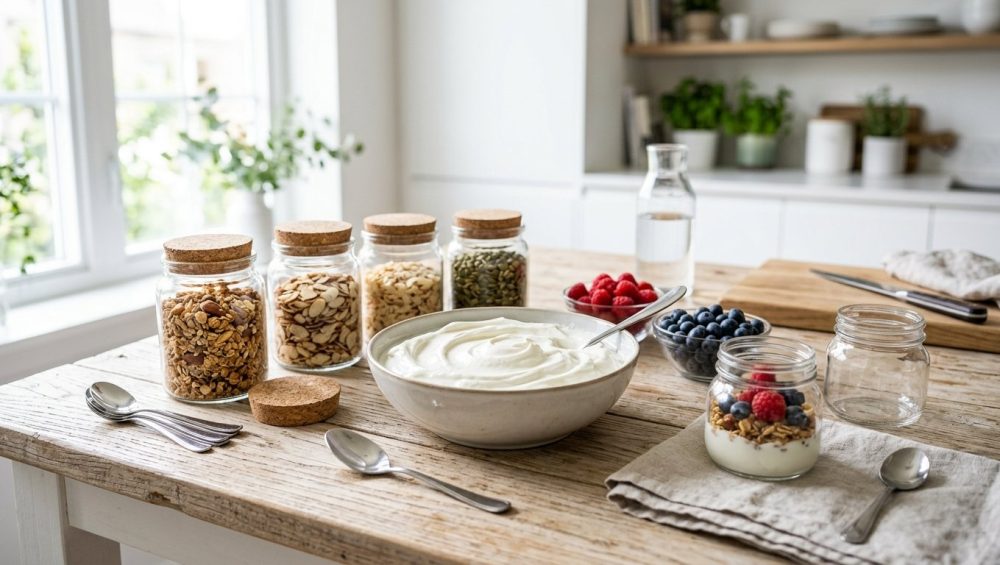
Picture this: It is a beautiful Sunday morning. You have invited a few friends over for a relaxed weekend gathering, and you have decided to set up a DIY yogurt parfait station. You spent your hard-earned money on artisanal honey, you painstakingly washed and dried organic berries, and you even bought that ridiculously expensive bag of small-batch granola. You set it all up in a massive, beautiful glass bowl, layering the yogurt, the fruit, and the oats like a culinary architect. It looks like a masterpiece ready for a magazine cover.
Then, your guests arrive twenty minutes late. By the time everyone finally grabs a spoon and digs in, the disaster is revealed. Your beautiful, crunchy granola has transformed into a sad, mealy paste. Your pristine white yogurt is bleeding a sickly grayish-purple hue from the berries. The entire bowl has the textural appeal of wet cement.
If this has happened to you, pour yourself a cup of coffee (or a mimosa—I will not judge), take a deep breath, and listen to me closely. You are not a bad cook, and you do not need a culinary degree to fix this. You just need to understand a tiny bit of basic food science and a few clever staging tricks. Weekday cooking is all about survival and shortcuts, but when we have the time to entertain on the weekend, we are going to do it right. We are going to cure cooking anxiety by understanding exactly why our food behaves the way it does. Today, we are mastering the definitive, scientifically-backed, absolutely foolproof mindful parfait bar.
The Weekend Brunch Renaissance: Why We Are Hosting at Home
Before we dive into the thermodynamics of oats, let us talk about why the home brunch is currently experiencing a massive cultural renaissance. If you have looked at a restaurant menu lately, you already know the punchline: dining out has become astronomically expensive.
Recent industry data from 2025 and 2026 shows that an astonishing 59% of consumers have actively cut back on dining out, specifically targeting luxury weekend meals like brunch. Let us be brutally honest with each other—paying twenty-two dollars for a bowl of yogurt and a handful of berries in a crowded, noisy cafe is an absolute scam. Furthermore, market researchers have noted a massive 22% jump in the amount of time people are spending outdoors and entertaining at home. We are trading crowded restaurant patios for our own dining rooms and backyards.
We are seeing a massive shift toward the “snackification” of morning meals, where people prefer flexible, grazing-style eating rather than sitting down to a heavy, formal plate of eggs and bacon. This is why the DIY parfait bar is the ultimate weekend hosting hack. It is interactive, it accommodates every conceivable dietary restriction (gluten-free, dairy-free, vegan—you name it), and it allows you to prep almost everything in advance. Mastering the art of effortless hosting means setting up systems that do the heavy lifting for you, so you can actually sit down and enjoy a conversation with your friends instead of sweating over a hot stove flipping individual pancakes.
The Food Science of Soggy Granola: Understanding Water Activity
To stop your granola from turning into a tragic, soggy mess, we have to talk about a concept called water activity. Do not let the terminology intimidate you; it is incredibly straightforward.
In the food science world, water activity (represented as $A_w$) is not just about how much moisture is in a food; it is a measurement of how much of that water is “free” or available to migrate, react, and cause chaos. The scale goes from 0.0 (bone dry) to 1.0 (pure water).
Here is the problem with your parfait: Standard yogurt has a massive water activity level of about 0.98. It is practically bursting with free, energetic water molecules looking for somewhere to go. On the other hand, properly baked granola has a water activity level hovering between 0.1 and 0.2. It is incredibly dry and highly hygroscopic, meaning it acts like a microscopic sponge.
Nature absolutely despises an imbalance. When you take a high-$A_w$ ingredient (yogurt) and directly layer it against a low-$A_w$ ingredient (granola), thermodynamics take the wheel. The moisture will aggressively migrate from the yogurt into the granola in a desperate attempt to reach thermodynamic equilibrium. The starches in the oats undergo retrogradation, the sugars dissolve, and within minutes, the structural integrity of your expensive granola collapses entirely. This is exactly granola won’t clump and hold its shape when it is suffocating under a blanket of wet dairy.
The secret to a perfect parfait bar is accepting that you cannot change the laws of physics. Instead, you must outsmart them through mindful staging and strategic barrier ingredients.
The Weeping Yogurt Dilemma: Decoding Syneresis
Have you ever opened a tub of yogurt, or looked at a bowl of it sitting on a buffet table, and noticed a gross, yellowish-clear liquid pooling on the surface? That phenomenon is called syneresis, and it is the enemy of a beautiful parfait bar.
Yogurt is essentially a protein gel. During the fermentation process, the drop in pH causes the casein proteins in the milk to coagulate and form a delicate, three-dimensional mesh network. This microscopic net traps the water and the whey, giving yogurt its thick, creamy texture.
However, this protein network is surprisingly fragile. When the gel is physically disturbed—like when you aggressively stir the yogurt, violently spoon it into a serving bowl, or allow it to experience rapid temperature fluctuations—the interstitial spaces in that protein network collapse. When the net breaks, the trapped liquid (the whey) is expelled and pools on top.
To prevent syneresis on your buffet line, you must treat your yogurt with respect. First, opt for high-protein varieties like authentic Greek yogurt or Skyr. These strained yogurts have a much higher concentration of casein protein, which creates a significantly stronger, tighter gel network that is far less prone to weeping. Second, when transferring the yogurt from its commercial container to your beautiful serving bowl, do not whisk it. Gently fold it or scoop it with a wide spatula. Finally, temperature control is paramount. Yogurt that sits at room temperature will break down faster, so keeping it chilled is non-negotiable.
The “No-Go” Rule: Toxic and Flimsy Kitchenware to Banish Immediately
If you have read any of my previous guides, you know I have absolutely zero patience for cheap, toxic, or poorly designed kitchenware. When you are hosting a mindful gathering, the vessels you use to serve your food are just as important as the food itself.
Do not ever serve yogurt or acidic fruit in cheap, mystery-metal bowls or flimsy, scratched plastic containers. Acidic ingredients (like yogurt, which has a low pH due to lactic acid) will react with reactive metals like raw aluminum, imparting a disgusting, metallic penny-taste to your food. Furthermore, cheap plastic bowls are notorious for harboring microscopic scratches that trap old food odors and leach chemicals into your pristine ingredients. This is exactly why your plastic containers stain orange after holding tomato sauce—they are porous and degrade over time. Throw them away. Banishing toxic kitchen gear is the first step to becoming a confident, serious home cook.
For a parfait bar, you need serving vessels with high thermal mass and absolute chemical neutrality. Heavy, high-fired ceramics, thick stoneware, and tempered glass are your best friends here. Because they have a high thermal mass, you can place these bowls in your refrigerator overnight. When you pull them out the next morning and fill them with yogurt, the bowl itself acts as a chilling vessel, keeping the yogurt safely out of the temperature danger zone and preventing syneresis for a much longer period on the buffet table.
If you prefer a modern aesthetic, high-quality, food-grade 304 or 316 stainless steel is also excellent and completely non-reactive. Just ensure you are using solid stainless serving spoons. If you want to know if your steel is truly high quality, you can usually feel the weight and density, or rely on culinary tricks like the water drop test when using them for stovetop cooking to gauge heat retention and surface integrity.
Structuring the Perfect DIY Parfait Station: A Lesson in Flow Psychology
Now that we have covered the science of the ingredients and the safety of the gear, we need to talk about the logistics of the gathering itself. There is nothing that ruins the vibe of a relaxed Sunday brunch faster than a massive, awkward bottleneck at the food station.
Buffet lines fail because hosts do not understand human psychology. When faced with an abundance of choices, the human brain experiences decision fatigue. If you put twenty different toppings in a single, clustered area against a wall, your guests will stand there, agonizing over whether they want chia seeds or flax seeds, while a line of hungry, increasingly annoyed people forms behind them. Furthermore, studies on catering flow show that a poorly arranged layout causes people to task-switch awkwardly, juggling plates, spoons, and napkins, which dramatically slows down the entire process.
To eliminate the bottleneck, you must design your parfait bar with intentional flow.
First, pull the serving table completely away from the wall. This is the single greatest catering hack you will ever learn. By floating the table in the center of the room or the patio, you create dual-sided access. Guests can flow down both sides of the table simultaneously, literally doubling your throughput instantly.
Second, separate the stations. Do not put the bowls, the yogurt, the fruit, and the granola all on the same two-foot footprint. Create physical space between the steps.
- Station 1: The Foundation. This is where the bowls, spoons, and napkins live, alongside the large chilled vessel of yogurt.
- Station 2: The Moisture Barriers. A foot or two down the table, place your fats and heavy spreads (nut butters, coconut flakes).
- Station 3: The Crunch. Further down the line, place your dry ingredients (granola, nuts, seeds).
- Station 4: The Finish. At the very end of the table, place your highly perishable, high-moisture items (fresh fruit, berries, honey, maple syrup).
By forcing a linear progression, you gently guide your guests through the line, preventing them from lingering in one spot and ensuring that the wet ingredients (fruit and syrup) go on the very top of the parfait, rather than sitting at the bottom turning everything to mush.
The Ultimate Ingredient Staging Strategy for Textural Integrity
Let us break down exactly how to prepare and stage each specific component of your parfait bar to ensure that every single bite is texturally perfect, from the first guest in line to the person going back for seconds an hour later.
The Base Layer: Prepping and Holding the Yogurt
As we established, keeping the yogurt cold is the key to preventing it from weeping. Even with a pre-chilled ceramic bowl, a warm dining room will eventually take its toll. If you are hosting a longer brunch, utilize a hidden ice bath. Find a decorative bowl that is slightly larger than your yogurt serving bowl. Fill the bottom of the larger bowl with crushed ice and a sprinkle of coarse salt (which lowers the freezing point of the ice), and nestle the yogurt bowl directly into it.
Do not offer six different flavors of commercially sweetened yogurt. They are packed with artificial stabilizers and excessive refined sugars. Instead, offer one large, beautiful bowl of high-quality, plain, full-fat Greek yogurt. By keeping the base unsweetened, you allow your guests to control their own sugar intake using the toppings further down the line. It is chic, it is mindful, and it saves you from buying unnecessary plastic tubs.
The Moisture Barriers: Fats Are Your Friends
If we want to stop the water in the yogurt from migrating into the granola, we need to build a wall. In food science, lipids (fats) are hydrophobic, meaning they actively repel water. By encouraging your guests to add a layer of fat between the yogurt and the dry ingredients, you create an edible moisture barrier.
Set out small, elegant bowls of high-fat ingredients. Almond butter, cashew butter, or tahini are phenomenal choices. You can thin them out with a tiny splash of warm water and a pinch of sea salt so they drizzle beautifully from a spoon. Cacao nibs, dark chocolate shavings, and toasted coconut flakes also possess high fat contents that resist moisture absorption. When a guest drizzles almond butter over their yogurt before adding their granola, that oil acts as a shield, keeping the oats incredibly crunchy.
The Crunch Factor: Baking and Storing Granola
If you truly want to impress your guests, you will make your own granola. It is absurdly easy, significantly cheaper than store-bought, and allows you to control the exact flavor profile. However, if you are going to bake it, you must respect the thermal process.
The biggest mistake home cooks make is baking granola at too high of a temperature. You are not searing a steak; you are gently dehydrating oats and encouraging a slow Maillard reaction. Toasting your oats first at a low, controlled temperature is the secret to deep flavor. Set your oven to exactly 300°F (149°C). If your oven runs hot, you will scorch the sugars before the oats dry out, so always rely on a simple oven thermometer rather than the digital dial on your appliance.
Spread the mixture evenly on a heavy-gauge, bare aluminum half-sheet pan. Flimsy, cheap pans will warp in the oven, causing the oil and honey to pool in the corners and burn, which is exactly why your baking sheets keep warping in the first place. Invest in commercial-grade aluminum.
Here is the most critical step, backed by rigorous food physics: When you remove the granola from the oven, do not touch it. Do not stir it. Do not transfer it to a bowl to cool. The starches in the oats are still pliable and releasing steam. If you dump it into a bowl while warm, the steam gets trapped, raising the humidity and ruining the crunch. Let it cool completely on the sheet pan at room temperature. As the sugars cool, they crystallize, binding the oats together into massive, satisfying clusters. Only break it apart once it is entirely cold to the touch.
Keep your granola in an airtight glass jar on the buffet table. Never leave it in an open bowl where ambient room humidity can soften it before the party even begins. Provide a dedicated scoop so guests can cleanly transfer it to their parfaits.
The Acidic Finish: Fresh Fruit and Syrups
Fruit is the crown jewel of the parfait bar, but it is also a textural liability. Fresh berries are delicate, highly perishable, and prone to weeping their juices everywhere if mishandled.
Never mix your fruit directly into the main bowl of yogurt. The acids in the fruit will immediately begin breaking down the dairy proteins, and the vibrant colors will bleed, making the entire bowl look like a bruised, unappetizing mess.
Instead, prep your fruit the morning of the gathering. Wash your berries, but make sure they are completely, bone-dry before putting them in serving bowls. Excess tap water is the primary reason why your berries mold so fast and turn to mush. If you are serving sliced strawberries or peaches, you can lightly macerate them with a tiny squeeze of fresh lemon juice and a pinch of sugar to draw out their natural syrups, but keep them in their own dedicated, slotted serving dish.
Place the fruit at the very end of the buffet line. This psychological cue ensures that guests put the wettest, heaviest ingredients on top of their parfaits, rather than burying their granola under a mountain of wet berries. Finally, flank the fruit with your liquid sweeteners—a small pitcher of high-quality, grade-A maple syrup and a jar of local honey with a proper wooden dipper.
Mindful Hosting: Enjoying Your Own Party
The entire philosophy of the weekend culinary hobbyist is that cooking and entertaining should bring you joy, not a stress-induced migraine. You work hard all week. When Sunday rolls around, you deserve to actually sit down, sip your coffee, and laugh with your friends.
By utilizing these scientific principles—understanding water activity, preventing syneresis, eliminating toxic gear, and optimizing your buffet flow—you are doing all of the hard work before the doorbell even rings. This is what the catering industry calls the “sprint test”. You sprint to get the mise en place (the setup and prep) absolutely perfect, so that when the event begins, the system runs itself effortlessly.
Your yogurt will stay thick and creamy in its chilled ceramic bowl. Your granola will remain shatteringly crisp in its airtight jar. Your guests will flow seamlessly around your intelligently placed table, building their own perfect, customized masterpieces without standing in a frustrating bottleneck.
You do not need to be a professional chef to pull off a flawless gathering. You just need to respect the ingredients, understand the basic physics of the kitchen, and refuse to settle for mediocre, soggy food. Now, go pre-chill your serving bowls, bake a fresh batch of oats, and get ready to host the most spectacular, stress-free brunch of your life. You have absolutely got this.