The Convenience Trap: Why We Settle for Bagged Cheese
Start with a familiar scenario. It is a Tuesday night. You are staring into the abyss of your refrigerator, desperate to throw together a quick stovetop mac and cheese or a bubbling skillet of queso. Your hand naturally gravitates toward that crinkly plastic bag of pre-shredded cheddar. I get it. I really do. Listen, I love a shortcut as much as the next exhausted human, and when it comes to surviving the weekday hustle, I am the first to advocate for absolute efficiency. But if there is one hill I am absolutely willing to die on, it is this: pre-shredded cheese is a culinary scam that is actively sabotaging your meals.
We have all been sold a lie by the commercial dairy industry. The United States cheese shreds market is a colossal juggernaut, projected to expand to a staggering $2.42 billion by 2035, growing at a compound annual growth rate of 3.9 percent. Retail pre-shredded packaging formats capture over 63 percent of this total market demand. Why? Because we are a society obsessed with convenience. We want dinner on the table in fifteen minutes, and we have convinced ourselves that spending sixty seconds dragging a block of cheddar across a box grater is somehow an insurmountable obstacle. But that perceived convenience comes at a steep, textural price.
When you are trying to master simple weeknight dinners, you might think that tossing a handful of bagged shreds into a hot pan is saving you precious time. In reality, you are setting yourself up for a culinary disaster that will take longer to fix than it would have taken to just prep the ingredients correctly in the first place. You are not just buying dairy when you buy those bags; you are buying a concoction of industrial additives designed for shelf stability, not for cooking. If you are serious about breaking your takeout habit and actually enjoying the food you cook at home, the very first thing you need to do is rethink your cheese drawer.
What Exactly Is in That Bag? The Anatomy of Pre-Shredded Cheese
Let us take a brutally honest look at the ingredient list on the back of your favorite bag of Mexican-blend shreds. You will see cheese, of course. But keep reading. You will also see a lineup of anti-caking agents and preservatives like powdered cellulose, potato starch, calcium sulfate, and natamycin. These ingredients are not there to enhance the flavor of your food. They are there to solve a logistical nightmare for the manufacturer.
When cheese is shredded in a factory, the freshly cut surfaces are highly prone to sticking together. If they just bagged it up as-is, the ambient moisture and fat would cause the shreds to fuse back into a solid, unyielding brick during transit. To prevent this, manufacturers toss the shreds in a fine dusting of anti-caking agents. The most infamous of these is cellulose.
The Truth About Powdered Cellulose
Cellulose is a plant fiber. In the commercial food industry, it is a food-grade additive derived primarily from wood pulp or cotton lint. Yes, you read that correctly. You are paying a premium price for cheese dusted with refined wood pulp. Now, before we panic, let us be scientifically accurate: the U.S. Food and Drug Administration (FDA) classifies cellulose as “generally recognized as safe” (GRAS) and permits up to 4 percent by weight in shredded cheese products. It is chemically identical to the cellulose found naturally in all plant matter, and it passes harmlessly through your digestive system as fiber.
However, just because it is safe to eat does not mean it belongs in your dinner. While industry studies project average cellulose levels around 1 to 2 percent in most commercial products, the reality can sometimes be much murkier. A few years ago, class-action lawsuits were filed against major brands, alleging independent testing revealed up to 8 to 10 percent cellulose in certain grated Parmesan products, wildly exceeding typical industry norms. You are quite literally paying for filler.
Natamycin and Potato Starch
Beyond wood pulp, you will frequently find potato starch and natamycin. Potato starch acts similarly to cellulose, absorbing ambient moisture to keep the shreds distinct and free-flowing. Natamycin is a natural antifungal agent used by the dairy industry to inhibit mold growth, extending the shelf life of the shredded cheese from a few days to several weeks. Again, these are FDA-approved, perfectly safe additives. But when you transition from storing the cheese to actually cooking with it, these highly effective moisture-absorbing agents turn into your absolute worst enemy.
The Science of Melting: How Cheese Actually Works
To understand why these additives ruin your food, we need to take a brief, no-nonsense detour into food science. I promise to keep the pretentious chef-speak to an absolute minimum, but you need to know what happens on a molecular level when cheese hits a hot pan.
Cheese is not a single, uniform substance. It is a complex emulsion—a delicate, tightly bound matrix of water, fat, and proteins (primarily casein). Think of the casein proteins as a microscopic sponge or a three-dimensional net. This net is held together by calcium bridges, and trapped inside the holes of this net are droplets of water and globules of milk fat.
When cheese is cold, the fat is solid, and the protein net is rigid. But when you apply heat, everything changes. At around 90°F (32°C), the dairy fat begins to liquefy. As the temperature continues to rise, the calcium bonds holding the casein proteins together start to weaken and loosen. The protein net relaxes, allowing the liquefied fat and the trapped moisture to flow more freely. If the structure is balanced correctly, the cheese transforms from a solid block into a smooth, stretchy, velvety liquid.
This delicate balance is the absolute secret to a flawless melt. The proteins need to relax just enough to let the cheese flow, but they still need to maintain enough structural integrity to keep the fat and water bound together in a stable emulsion. If the proteins tighten up too much, they will violently squeeze the fat out, leaving you with a rubbery clump of protein floating in a greasy puddle of oil. This is exactly what happens when you fail to utilize temperature control to prevent broken emulsions in your delicate modern pan sauces.
The Sabotage: How Anti-Caking Agents Destroy the Emulsion
Now, let us introduce our bagged, pre-shredded cheese into this delicate thermodynamic equation. You toss a handful of cellulose-coated cheddar into your hot skillet. The heat begins to rise, the fat begins to liquefy, and the protein net tries to relax. But there is a massive problem: the anti-caking agents.
Remember what cellulose and potato starch are designed to do? They are desiccants. They aggressively absorb moisture. As the cheese melts and releases its internal water, the starches and wood pulp immediately suck it up. This completely disrupts the moisture balance required to keep the emulsion stable. The proteins, suddenly deprived of the water they need to glide smoothly past one another, begin to panic. Instead of relaxing into a fluid sauce, the casein proteins clump together tightly.
Because the proteins have clumped up, they can no longer hold onto the liquefied fat. The emulsion shatters. The fat separates out, rising to the top of your sauce in an unappetizing, slick orange pool. Meanwhile, the cellulose and potato starch do not melt. Wood pulp does not melt at 150 degrees. Instead, these microscopic powders remain suspended in the liquid, creating a gritty, chalky texture.
This is precisely why your cheese sauce turns grainy when you use the bagged stuff. You are tasting the physical particles of the anti-caking agents, combined with the microscopic, rubbery clumps of denatured protein that failed to emulsify. It is a textural nightmare. You can whisk it until your arm falls off, but you cannot reverse the chemical damage. The starch has blocked the proteins from binding, and your sauce is permanently ruined. This is also the exact same scientific reason why your fondue breaks into a stringy, oily mess when you try to take a shortcut for your weekend dinner party.
The Great Grater Debate: Banishing Toxic Gear
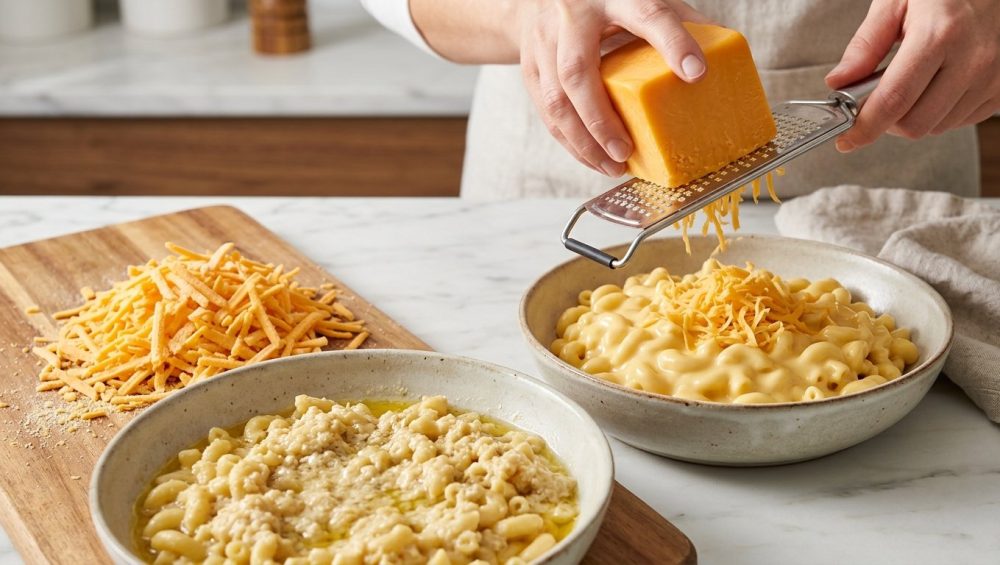
So, the scientific verdict is clear: if you want a velvety, restaurant-quality melt, you must grate your own block cheese. There are zero exceptions to this rule. But this brings us to another critical issue that I refuse to ignore. If you are going to commit to grating your own cheese, you need to use the right equipment.
I have absolutely zero patience for cheap, toxic kitchenware. We are not going to ruin our beautifully pure blocks of sharp cheddar by dragging them across a flimsy, dollar-store plastic grater. Cheap plastic graters are notorious for micro-abrasions. Every time you grate a hard cheese like Parmesan, microscopic shards of plastic are shaved off along with the dairy, ending up right in your dinner. Furthermore, cheap metals used in low-end box graters are prone to rusting, bending, and dulling after just a few runs through the dishwasher.
If you are serious about banishing toxic kitchen gear from your home, you need to invest in a high-quality, heavy-duty stainless steel box grater or a dedicated countertop rotary grater. A professional-grade stainless steel grater features chemically etched blades that are razor-sharp, allowing you to shred a one-pound block of Monterey Jack in under a minute with minimal physical effort. The metal is non-reactive, durable, and completely safe.
When you are curating your beginner kitchen tools, a heavy-duty box grater should be at the top of the list. It is not just for cheese; it is essential for grating cold butter into pastry dough, shredding zucchini for bread, and mincing garlic in a pinch. Do not buy the plastic junk. Buy a solid metal tool once, and it will serve you flawlessly for a decade. And please, wash it properly—do not let cheese residue sit in the crevices for days, which is the same lazy habit that makes your plastic containers stay greasy long after they have been “cleaned.”
The Financial Illusion: You Are Paying for Wood Pulp
Let us talk about the economics of the cheese drawer, because this is where the pre-shredded industry really pulls the wool over our eyes. The marketing departments want you to believe that buying bagged cheese is a smart, economical choice for the busy home cook. But if you actually look at the price per ounce, the illusion crumbles instantly.
When you buy a bag of pre-shredded cheese, you are paying a premium convenience markup. You are paying for the factory machinery that shredded it, the chemical additives that coat it, the heavy-duty plastic bag that holds it, and the nitrogen gas flushed into the bag to keep it fresh. On average, block cheese is significantly cheaper per ounce than its shredded counterpart.
But it gets worse. Remember the FDA allowance of up to 4 percent cellulose by weight? When you buy an 8-ounce bag of shredded cheese, you are not getting 8 ounces of pure dairy. You are getting roughly 7.7 ounces of cheese and 0.3 ounces of wood pulp and potato starch. You are literally paying cheese prices for sawdust.
When you buy a solid block of cheese, you are getting 100 percent unadulterated dairy. You are in complete control of the ingredient list. You are getting a product that contains naturally occurring aromatic compounds and volatile flavor oils that have not been exposed to the air and oxidized on a supermarket shelf for three weeks. Freshly grated cheese tastes sharper, smells richer, and melts infinitely better because it is pure.
Weekday Shortcuts That Don’t Ruin Your Food
I can already hear the protests. “But I work nine hours a day! I have kids! I don’t have time to stand around grating cheese on a Tuesday night!”
I hear you. I am a fierce advocate for the “Time is Money” philosophy during the workweek. But there is a massive difference between a smart culinary shortcut and a compromise that ruins your meal. You do not have to sacrifice texture for time if you plan intelligently.
If grating cheese by hand feels like an insurmountable chore, let technology do the heavy lifting. If you own a food processor, it likely came with a shredding disc that is currently gathering dust in the back of a cabinet. Dig it out. You can shred two pounds of block cheese in exactly fourteen seconds using a food processor. It is violently fast and incredibly efficient.
The smartest strategy is to do this on a Sunday afternoon. Buy your blocks of high-quality cheddar, Gruyère, and low-moisture mozzarella. Run them all through the food processor. Now, you have a massive stockpile of freshly shredded, pure cheese. How do you stop it from clumping without using industrial wood pulp? Simple: toss the freshly grated cheese lightly with just a tiny pinch of cornstarch (only if you are using it for baking or tossing in a salad), or better yet, just store it as-is in an airtight glass container in the fridge. Because you are not shipping it across the country in a hot truck, it will not fuse into a solid brick. If it clumps slightly in the fridge, just give the container a hard shake before you open it.
You now have the exact same grab-and-go convenience of the bagged stuff, but with zero toxic additives, zero textural sabotage, and a significantly lower price tag. It is a foolproof method to avoid the most common beginner cooking mistakes that lead to separated, oily dinners.
The Ultimate Masterclass: Building a Flawless Cheese Sauce
Now that we have successfully eradicated the bagged shreds from your kitchen, let us put this freshly grated block cheese to work. Making a velvety, mind-blowing cheese sauce—whether for macaroni, nachos, or a vegetable gratin—is a fundamental skill that every home cook must master. It does not require a culinary degree; it just requires a basic respect for the laws of thermodynamics.
Step 1: The Foundation (Roux vs. Sodium Citrate)
To melt cheese into a liquid without it separating, you need an emulsifier. The traditional French method is to build a roux (equal parts butter and flour cooked together) and whisk in cold milk to create a béchamel sauce. The starch in the flour swells and creates a thick matrix that will gently hold the cheese proteins and fat in suspension.
If you want an even more modern, foolproof, and aggressively gooey result—think stadium nacho cheese texture but with high-end sharp cheddar—you can skip the roux entirely and use sodium citrate. Sodium citrate is a magical, natural salt derived from citrus fruits. When dissolved in a splash of water or milk, it completely alters the calcium bridges in the cheese proteins, forcing them to melt into a perfectly smooth liquid without any flour at all. It is the secret weapon of professional kitchens.
Step 2: Grating the Right Blend
You must grate your cheese fresh from the block. For the best flavor and texture profile, you want a blend of moisture and age. A young, high-moisture cheese (like Monterey Jack, Fontina, or low-moisture mozzarella) provides the incredible stretch and structural stability. An aged, low-moisture cheese (like sharp cheddar, Gruyère, or Parmigiano-Reggiano) provides the deep, complex, savory flavor. A 50/50 ratio of a young melting cheese and an aged flavor cheese is the golden rule.
Step 3: Heat Management
This is where most people panic and ruin everything. Cheese is incredibly sensitive to thermal shock. If you take a bubbling, boiling pot of béchamel sauce and dump a mountain of cheese into it while the burner is still on high, the intense heat will instantly curdle the proteins. The casein will seize, the fat will break, and you will be left with a grainy, oily disaster.
The golden rule of melting cheese is: Remove the pan from the heat first.
Once your base liquid (béchamel or sodium citrate solution) is hot and thickened, turn off the stove. Move the pan to a cool burner. Wait thirty seconds. Then, add your freshly grated cheese in small handfuls, whisking gently and continuously until each handful is completely melted before adding the next. The residual heat of the liquid is more than enough to melt the cheese perfectly. By taking it off the direct flame, you are coaxing the proteins to relax gently rather than shocking them into submission.
The Final Verdict
Cooking at home should be a joyful, empowering experience, not an exercise in frustration. The food industry has spent decades trying to convince us that we need their hyper-processed, additive-laden shortcuts to survive the week. But the truth is, real cooking is often simpler, cheaper, and infinitely more delicious than the alternative.
By taking an extra sixty seconds to grate your own block cheese, you are not just improving the texture of your macaroni; you are taking back control of your ingredients. You are rejecting the anti-caking agents, the mysterious wood pulps, and the preservatives. You are ensuring that every single bite of food you serve to yourself and your family is pure, unadulterated, and engineered for maximum flavor.
So do yourself a massive favor. The next time you are at the grocery store, walk right past the wall of crinkly plastic bags. Head to the dairy case, pick up a solid block of sharp cheddar, and let your grater do the work. Your taste buds, your wallet, and your perfectly velvety cheese sauces will thank you. Now get out of here and go melt something spectacular.