The Tragic Tale of the Crisper Drawer
Picture this: It is a beautiful Saturday afternoon. You have just returned from the local farmers’ market or that upscale grocery store that plays classical music in the produce aisle. You are clutching a vibrant, fragrant bouquet of fresh sweet basil and a crisp, sprightly bunch of cilantro. You have grand weekend plans. You are going to make a mind-blowing, mortar-and-pestle pesto, or perhaps a vibrant, acidic chimichurri to drape over a perfectly seared flank steak. You proudly use a small handful of leaves for your culinary masterpiece, casually toss the rest of the bunch directly into your refrigerator’s crisper drawer, and confidently close the door.
Fast forward to Wednesday evening. You are exhausted from work, and you reach into that same drawer for a quick weeknight garnish, only to pull out a bag of dark green, putrefying sludge that smells faintly of a swamp. The beautiful basil has turned black, and the cilantro has liquefied into an unrecognizable biological hazard.
We have all been there. It is one of the most common rookie kitchen mistakes that plagues even the most enthusiastic weekend culinary hobbyists. You blame yourself, you blame the grocery store, and then you throw your hard-earned money straight into the compost bin. But as your resident sassy sous-chef and culinary truth-teller, I am here to tell you that it is not entirely your fault. You are simply fighting against the unforgiving laws of plant biology and thermodynamics.
Fresh herbs are not just ingredients; they are living, breathing, respiring organisms that have just suffered the trauma of being amputated from their root systems. To stop this cycle of waste, you do not need a culinary degree. You just need a masterclass in post-harvest degradation, cellular breakdown, and the specific moisture protocols required to keep your herbaceous friends alive. Let us dive deep into the science of why your fresh herbs turn to slime, and exactly how you can extend their shelf life by up to 14 days.
The Botanical Reality: Why Herbs Die in Your Fridge
To truly understand why your herbs are dying, we have to look at what happens the moment they are harvested. When you buy fresh herbs, you are essentially purchasing severed plant appendages. They have been permanently cut off from their root systems, meaning their primary source of water and nutrient uptake is entirely gone. Yet, against all odds, they are still biologically active. They are still respiring, still transpiring (losing water vapor through their pores), and still desperately fighting to survive.
If you want to stop throwing away sad veggies and slimy herbs, you have to understand the fundamental mechanics of moisture loss and cellular structure. Plant cells maintain their rigid, crisp structure through something called turgor pressure. This is the internal pressure of water inside the plant cell’s central vacuole pushing outward against the rigid cell wall. As long as the plant has a steady supply of water, turgor pressure remains high, and the herb stays crisp and upright.
However, the moment the herb is cut, it continues to lose water through tiny pores on its leaves called stomata. Because there are no roots to replace this lost moisture, the central vacuoles begin to shrink. The turgor pressure drops dramatically, the cell walls cave in, and the plant physically wilts. But wilting is just the first stage of death. If the environment is too dry, the plant desiccates and turns to dust. If the environment is too wet and cold, the cellular structure collapses entirely, leading to enzymatic browning, bacterial colonization, and the dreaded slime.
The Refrigerator: An Engineered Desert
Most home cooks assume that the refrigerator is the safest place for all fresh produce. Your refrigerator is indeed a marvel of modern engineering, designed to keep your milk cold and your leftover takeout safe from bacterial overgrowth. But from a botanical perspective, your fridge is an incredibly hostile, engineered desert.
The cooling cycle of a standard home refrigerator actively pulls moisture out of the air to prevent frost buildup on the internal coils. As a result, the average relative humidity inside a refrigerator drops to shockingly low levels, often hovering below 50%. The exact same thermodynamic principle that explains why your salad greens wilt is responsible for turning your beautiful basil into a tragic, blackened mess.
Fresh culinary herbs, depending on their species, generally require a relative humidity of 90% to 95% to maintain their cellular integrity and prevent rapid transpiration. When you toss an unprotected bunch of herbs into a 50% humidity environment, the dry air aggressively sucks the moisture right out of the leaves. The crisper drawer is supposed to mitigate this by trapping moisture, but without proper micro-climate management, it either remains too dry or traps standing water, which immediately rots the leaves.
The Invisible Enemy: Ethylene Gas Exposure
Moisture and temperature are not the only silent killers lurking in your kitchen. There is an invisible, odorless gas responsible for the rapid degradation of your fresh ingredients. Just as you should stop trusting your oven to maintain a precise temperature without verifying it with a secondary thermometer, you cannot trust your crisper drawer to magically protect your produce from chemical warfare.
Enter ethylene gas (C2H4). Ethylene is a naturally occurring plant hormone that regulates growth, senescence (aging), and ripening. Certain fruits and vegetables, known as climacteric producers, emit massive amounts of ethylene gas as they ripen. The worst offenders include apples, bananas, tomatoes, avocados, and melons. In nature, this gas dissipates into the wind. But inside the sealed, airtight plastic box of your refrigerator crisper drawer, ethylene accumulates to toxic levels.
This invisible gas is precisely why your fresh berries get moldy at an alarming rate when left next to a bunch of ripening bananas, and it is absolute poison to your fresh herbs.
How Ethylene Destroys Herbs
While some woody herbs (like rosemary and thyme) are relatively insensitive to ethylene, tender herbs—especially mint, parsley, marjoram, and cilantro—are highly susceptible to ethylene damage. When these sensitive herbs are exposed to ethylene gas, the hormone triggers a rapid acceleration of the plant’s aging process.
The first symptom of ethylene exposure is epinasty, which is the downward curling and drooping of the leaves. This is quickly followed by the breakdown of chlorophyll, the pigment that gives herbs their vibrant green color. As the chlorophyll degrades, the leaves turn a sickly, pale yellow. Finally, ethylene triggers leaf abscission, causing the leaves to physically detach from the stem and fall off.
The Golden Rule of Ethylene: Never, under any circumstances, store your fresh herbs in the same drawer as apples, tomatoes, or avocados. You must isolate your herbs from high ethylene producers to give them a fighting chance at survival.
Tender Herbaceous Plants: The Cold Shock Catastrophe
Now that we understand the general enemies of fresh produce, we must divide our herbs into two distinct botanical categories, because treating them all the same is a guaranteed recipe for failure. First, we have the divas of the culinary world: tender herbaceous plants. This category includes sweet basil (Ocimum basilicum), cilantro (Coriandrum sativum), parsley, and mint.
These plants have soft, fleshy, high-moisture stems and incredibly delicate leaves. But more importantly, we must look at their evolutionary origins. Basil, for example, is native to the tropical and subtropical regions of Central Africa and Southeast Asia. Its genetic makeup is entirely adapted to warm, humid environments. It possesses absolutely no biological defense mechanisms against the cold.
Just like you are secretly ruining your nonstick pans by blasting them with aerosol cooking sprays that bake into an impenetrable polymer, you are destroying your tender herbs by subjecting them to extreme cold shock.
The Science of Chilling Injury
When you place a tropical plant like basil into a 35°F (1.6°C) refrigerator, it suffers from a fatal physiological disorder known as chilling injury. At temperatures below 50°F (10°C), the lipid bilayer that makes up the plant’s cellular membranes undergoes a phase transition. In plain English, the fats in the cell walls go from a flexible, fluid state to a rigid, solid gel state.
Because the membranes are no longer flexible, they crack and rupture. The contents of the cells leak out, mixing enzymes that were previously kept strictly separated. Specifically, the enzyme polyphenol oxidase mixes with phenolic compounds and oxygen. This triggers a rapid chemical reaction called enzymatic browning—the exact same process that turns a bitten apple brown.
Within hours of being in the fridge, the basil leaves will develop interveinal brown spots. Shortly after, the entire leaf will turn black, wilt, lose its characteristic aromatic essential oils, and dissolve into a slimy puddle of cellular decay.
The Countertop Greenhouse Protocol
To keep tender herbaceous plants alive and vibrant for up to two weeks, you must treat them exactly like a bouquet of fresh-cut flowers, while managing their humidity.
- The Fresh Cut: The moment you bring basil or cilantro home, use a sharp pair of kitchen shears to snip about half an inch off the bottom of the stems. The old cuts have likely dried out and calloused over, preventing the plant from drinking water.
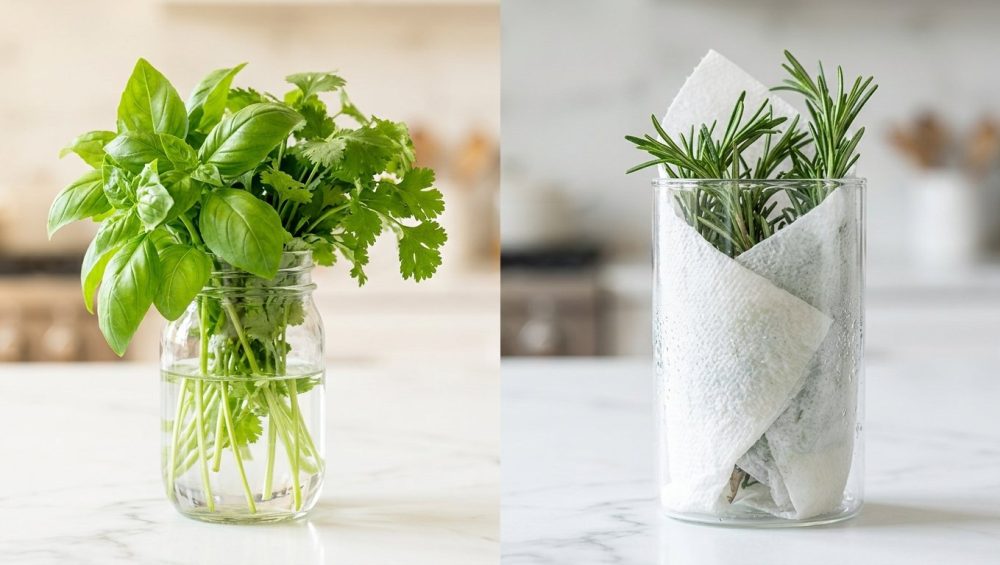
- The Water Submersion: Place the freshly cut stems into a heavy-bottomed glass jar (like a mason jar) filled with about one to two inches of room-temperature water. Ensure that only the stems are submerged. If any leaves are touching the water, they will rot instantly. Pluck off any low-hanging leaves.
- The Temperature Zone: Keep the jar on your kitchen countertop, out of direct, harsh sunlight. The ideal ambient temperature for these herbs is between 68°F and 72°F (20°C – 22°C).
- The Humidity Dome: Because your home’s ambient air is likely too dry, you need to create a micro-greenhouse. Take a loose, thin plastic produce bag and invert it over the top of the herbs, leaving the bottom slightly open for minimal air circulation. This traps the moisture transpiring from the leaves, maintaining that crucial 90% relative humidity without suffocating the plant.
- Maintenance: Change the water every two to three days. Stagnant water breeds bacteria, which will clog the stems and kill the plant.
Note on Cilantro: While cilantro is susceptible to cold shock, it is slightly more cold-tolerant than basil. If your kitchen is incredibly hot (above 75°F), you can place the jar of cilantro in the refrigerator, provided it has the plastic bag dome to protect it from the dry air. Basil, however, must absolutely never cross the threshold of your refrigerator door.
Woody Perennials: The Moisture Balancing Act
On the opposite end of the botanical spectrum, we have the tough, resilient woody perennials. This category includes rosemary (Rosmarinus officinalis), thyme, oregano, sage, and marjoram.
These plants are predominantly native to the Mediterranean. They evolved to survive in harsh, rocky, well-draining soils under the baking sun. To prevent fatal moisture loss in these arid climates, they developed tough, woody stems and thick, needle-like leaves with a reduced surface area.
Because they are so hardy in the ground, people assume they are invincible in the kitchen. But once harvested, their toughness becomes a liability. Because their stems are hard and woody, they cannot easily draw up water from a glass jar like basil can. If you try to store rosemary in a jar of water on the counter, it will simply dry out, turning into brittle, flavorless twigs that shatter when you touch them.
The Crisper Drawer Micro-Climate
Unlike tender herbs, woody perennials actually prefer the cold. Storing them at 35°F to 38°F (1.6°C – 3.3°C) significantly slows down their respiration rate, delaying senescence and preserving their pungent essential oils. However, they still desperately need high humidity (90-95%) to prevent desiccation in the fridge desert.
The goal here is a delicate moisture balancing act. You must provide enough ambient humidity to keep the leaves plump, but you must strictly avoid standing water, which will cause the woody stems to mold and rot.
I am a relentless advocate for banishing toxic kitchen gear, which means I absolutely forbid you from storing your gorgeous rosemary in cheap, single-use plastic grocery bags that leach mystery chemicals and endocrine disruptors into your food. We are going to build a safe, reusable, perfectly balanced micro-climate.
The Damp Towel Protocol
To extend the life of woody herbs for up to three weeks, follow this exact procedure:
- The Moisture Layer: Take a sheet of unbleached cellulose paper (a high-quality paper towel) or a clean, lint-free cotton flour sack towel. Run it under cold water, and then wring it out completely. It should be barely damp to the touch, not dripping wet. If you can squeeze a single drop of water out of it, it is too wet.
- The Wrap: Lay the woody herbs flat on the damp towel. Roll the towel up gently, creating a loose bundle. The damp towel acts as a localized humidifier, slowly releasing moisture into the air immediately surrounding the herbs.
- The Semi-Permeable Container: Place the bundle into a high-quality storage vessel. A glass container with a silicone lid is excellent. Alternatively, a platinum-grade reusable silicone bag works perfectly. Do not seal the container completely airtight. Leave a tiny corner cracked open. Herbs are still respiring; they take in oxygen and release carbon dioxide. If you seal them in an airtight tomb, the condensation will build up, the carbon dioxide will reach toxic levels, and the herbs will suffocate and rot.
- The Location: Place the container in the crisper drawer of your refrigerator. Ensure the drawer is set to the “high humidity” setting (which closes the vent, trapping moisture). Keep it far away from those ethylene-producing apples and tomatoes.
The Crucial Prep: Washing, Drying, and Trimming
We have covered the storage environments, but we must also discuss the critical preparation steps that happen between the grocery bag and the storage container. How you handle the herbs before you store them dictates their ultimate survival.
To Wash or Not to Wash?
There is a fierce debate in the culinary world about whether you should wash herbs before storing them. From a food safety and botanical perspective, the answer is yes, but with a massive caveat.
Fresh herbs carry field heat, agricultural dust, pesticide residue, and surface bacteria. All of these factors accelerate putrefaction. Washing them immediately removes these catalysts. However, storing wet leaves is a guaranteed death sentence. Moisture on the surface of an herb leaf acts as a breeding ground for bacteria and mold.
The rule is simple: Moisture at the stem provides life; moisture on the leaves breeds death.
If you are going to wash your herbs before storing them, you must dry them with absolute, ruthless perfection. This is exactly why your kitchen knives get dull so quickly when used on improper cutting boards, leading to bruised, oxidized herb leaves that decay twice as fast. Wait, let’s talk about the drying process first before we get to the cutting.
You do not need a culinary degree, but investing in a few essential beginner kitchen tools, like a high-quality salad spinner, is absolutely non-negotiable.
- The Plunge: Fill a large bowl with cold water. Submerge the herbs and agitate them gently with your hands to loosen dirt. Let them sit for a minute so the grit falls to the bottom of the bowl. Lift the herbs out of the water (do not dump the bowl, or you will pour the dirt right back onto the leaves).
- The Spin: Place the herbs into your salad spinner. Do not overcrowd the basket. Spin them gently. The centrifugal force will pull the heavy water droplets off the delicate leaves without crushing them.
- The Air Dry: Lay the spun herbs out in a single layer on a dry kitchen towel. Let them air dry at room temperature for 30 to 45 minutes until there is absolutely no visible surface moisture left on the leaves. Only then are they ready for the Countertop Greenhouse or the Damp Towel Protocol.
The Importance of a Sharp Blade
When it comes time to actually cook with your perfectly preserved herbs, your knife skills and equipment matter immensely. Herbs are delicate networks of cellular walls holding volatile essential oils.
If you use a dull chef’s knife to chop basil or cilantro, you are not slicing the plant; you are crushing it. The blunt force trauma ruptures a massive amount of cells simultaneously, releasing those essential oils onto your cutting board instead of into your food. Furthermore, the crushed, jagged edges of the leaves immediately oxidize, turning black and bitter.
Always use a razor-sharp knife to slice herbs cleanly. Use a gentle rocking motion, and never chop the same pile of herbs more than twice. The cleaner the cut, the more flavor stays intact, and the more professional your final dish will look and taste.
The End of Herb Anxiety
Cooking on the weekends should be a joy, a creative outlet, and a time to unwind with a glass of wine. It should not be a stressful race against rotting ingredients, nor should it end with you guiltily throwing away five dollars worth of black slime that used to be organic basil.
By understanding the basic botanical principles of post-harvest degradation, you take back control of your kitchen. You now know that the refrigerator is a dry desert, that ethylene gas is a silent killer, that tropical basil despises the cold, and that woody rosemary needs a perfectly balanced damp micro-climate.
Stop treating your herbs like an afterthought. Give them the precise temperature and humidity environments their cellular biology demands. By mastering these scientifically validated storage protocols, you are fundamentally unlocking kitchen creativity and buying yourself the time to cook like an absolute pro. Now go forth, buy that massive bunch of cilantro, and rest easy knowing it will still be vibrant, crisp, and ready for your tacos next Tuesday.