The Crime of the Century: The Soggy, Sad, Steamed Potato
Listen up, friends. We need to have a serious intervention about a culinary crime that is happening in kitchens across the globe every single night. You come home from work, you wash a beautiful, starchy Russet potato, and then—in a moment of sheer, misguided autopilot—you tear off a sheet of aluminum foil and swaddle that poor spud like a newborn baby before tossing it into the oven.
Put down the foil. Step away from the potato.
If you genuinely want to fix your food and stop serving sad, mediocre side dishes, you need to understand the basic science of moisture evaporation. Baking a potato in foil does not bake it at all. It steams it. You are trapping all of the potato’s natural moisture inside a shiny metal straightjacket, ruining what could have been a shatteringly crisp, perfectly seasoned skin, and turning the interior into a dense, gummy, waterlogged mess.
You might be thinking, “But my favorite steakhouse serves them in foil!” Yes, they do. And they do it for logistical reasons that have absolutely nothing to do with culinary perfection. They do it because they are serving hundreds of people a night and need to hold those potatoes at food-safe temperatures for hours. You are cooking for your family on a Tuesday. You do not need to hold a potato under a heat lamp for four hours. You want a steakhouse-quality side dish with zero extra effort, and the only way to achieve that is to let your potato bake naked.
In this definitive masterclass, we are going to dive deep into the thermodynamics of the potato, the chemistry of the Maillard reaction, and the foolproof, zero-fluff methodology to achieve the ultimate, fluffy-on-the-inside, crispy-on-the-outside baked potato. No culinary degree required. Just science, common sense, and a refusal to eat bad food.
The Anatomy of a Potato: Why Moisture is the Ultimate Enemy
To understand why foil is the enemy, we first have to understand what a potato actually is. It is easy to look at a dense, hard, raw potato and assume it is completely solid. But nature is deceptive.
The Water Weight Paradox
A standard Russet Burbank potato—the undisputed king of the baking potatoes—is actually composed of approximately 79% to 80% water. Let that sink in. When you are holding a raw potato, you are essentially holding a tightly packed water balloon held together by a rigid matrix of complex carbohydrates and cellular walls. The remaining 20% to 21% of the potato consists of dry matter, which is primarily starch (amylose and amylopectin), along with trace amounts of sugars, proteins, and minerals.
When you apply heat to this starchy water balloon, a fascinating chemical process called gelatinization occurs. As the internal temperature of the potato rises, the starch granules begin to absorb the surrounding water. They swell, expand, and eventually burst, forcing the potato’s cellular structure to separate into the dry, fluffy clumps we associate with a perfectly baked spud.
The Steaming Trap
However, for this texture to be light and cottony, the excess water must be allowed to evaporate and escape as steam. If you trap that moisture, the starches absorb too much water and become a cohesive, glue-like paste. We’ve all seen what happens when mashed potatoes turn gluey because of over-mixing or trapped moisture; well, trapped steam does the exact same thing to a baked potato.
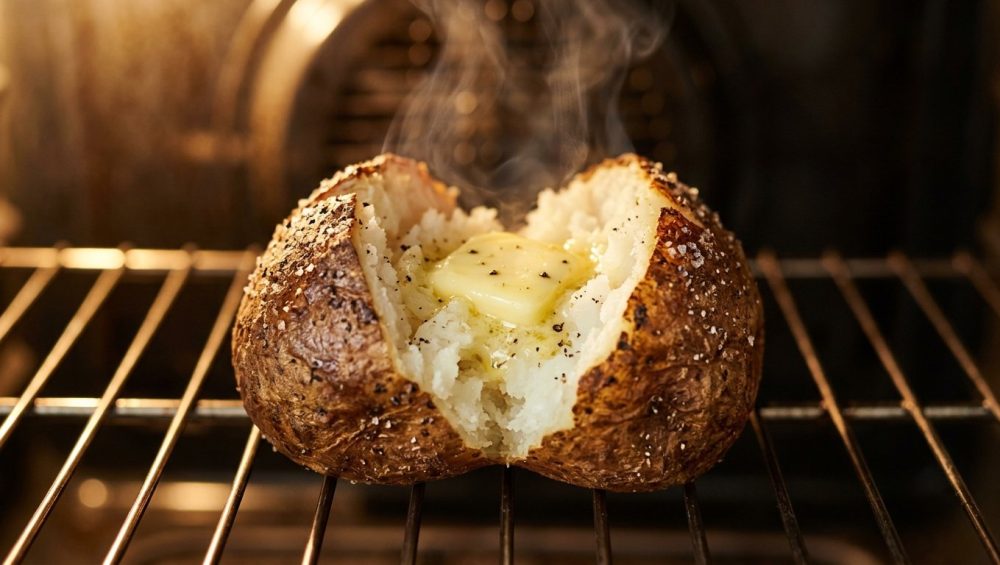
When you bake a potato naked in the dry, ambient heat of an oven, the moisture gradually escapes through the skin. The flesh becomes light and airy, while the skin itself dehydrates, concentrates its flavors, and crisps up beautifully.
The Foil Felony: Why Wrapping Ruins Everything
Let’s break down exactly what happens when you wrap a potato in aluminum foil and throw it in a 400°F (200°C) oven.
The Physics of the Shiny Wrapper
First, aluminum foil is shiny and highly reflective. When you wrap a potato in it, the foil actually reflects the oven’s radiant heat away from the potato, significantly slowing down the baking process. You aren’t speeding anything up; you are actively fighting your oven’s thermodynamics. In fact, wrapping a potato in foil can add up to 15 minutes to your total bake time. Time is money, and on a weeknight, nobody has an extra 15 minutes to waste on bad physics.
The Boiling Point Barrier
Second, and more importantly, foil creates an impermeable moisture barrier. As the potato heats up and its internal water turns to steam, that steam has nowhere to go. It condenses on the inside of the foil and drips right back down onto the potato skin. Because water cannot exceed 212°F (100°C) at sea level before turning into a gas, the surface of your potato is physically capped at the boiling point of water.
The Maillard Reaction Stalls
Why does that matter? Because of the Maillard reaction. This is the complex chemical reaction between amino acids and reducing sugars that gives browned food its distinctive flavor. It is the reason a seared steak tastes better than boiled beef, and why crusty bread tastes better than raw dough. The Maillard reaction generally requires temperatures of at least 285°F (140°C) to occur rapidly.
If your potato is wrapped in foil, sitting in a puddle of its own condensed steam, the skin will never exceed 212°F (100°C). The Maillard reaction cannot happen. You are left with a pale, soggy, leathery skin that lacks any depth of flavor. Just like the reason roasted veggies are mushy when you crowd the pan and trap steam, a foil-wrapped potato stews in its own juices instead of roasting.
The Toxicity Factor
Furthermore, I am a massive advocate for banishing toxic kitchen gear, and while wrapping a potato in foil won’t instantly poison you, it is far from ideal. Research has shown that cooking foods in aluminum foil at temperatures exceeding 400°F (200°C) can cause trace amounts of aluminum to leach into your food. This leaching is highly accelerated if the food is acidic or heavily salted. While the amounts are generally considered trace, why introduce unnecessary metallic exposure to your diet when the culinary result is inferior anyway? Ditch the foil.
The Blueprint for the Ultimate Naked Baked Potato
Now that we have established what not to do, let’s build the perfect baked potato from the ground up. This method is incredibly simple, requires virtually zero active prep time, and yields a restaurant-quality result every single time.
Step 1: Potato Selection and Preparation
Do not try to bake a waxy potato. Red potatoes, fingerlings, and even Yukon Golds have lower starch contents and higher moisture levels. They are fantastic for boiling, mashing, and roasting, but they will never give you that dry, cottony interior you want in a classic baked potato. You must use Russets (often labeled as Idaho potatoes).
When shopping, look for potatoes that are uniform in size. If you buy one massive potato and two tiny ones, they will finish cooking at completely different times, leaving you to play a frustrating game of oven-tetris.
Once you have your Russets, scrub them thoroughly under cold water. Potatoes grow in the dirt, and since we are going to be eating the crispy skin, you want it meticulously clean. After scrubbing, dry them completely with a clean kitchen towel. Remember, moisture is the enemy of crispiness. If you put a wet potato in the oven, it will steam before it roasts.
Step 2: The Crucial Steam Vents
To poke or not to poke? It is an age-old debate, but science gives us a definitive answer: you must pierce the potato.
As the internal temperature of the potato rises and the 79% water content turns into steam, pressure builds rapidly inside the rigid skin. If you do not provide an escape route for that pressure, the skin can rupture, resulting in a literal potato explosion in your oven. Take a standard dinner fork and stab the potato 6 to 8 times evenly around its circumference. You don’t need to go deep—just deep enough to puncture the skin and create a vent.
Step 3: The Brine and Oil Strategy
Here is where most home cooks make a critical error. They rub the potato with oil and salt before putting it in the oven.
If you oil a raw potato, the oil soaks into the skin, softening it and preventing it from crisping properly during the first half of the bake. Instead, we are going to bake the potato completely dry for the majority of the cooking time.
Place your dry, pierced potatoes directly on a wire rack in the center of an oven preheated to 400°F (200°C). Let them bake completely unbothered for about 45 to 50 minutes. During this time, the dry heat of the oven will dehydrate the skin, turning it papery and tight, while the inside begins to gelatinize.
At the 45-minute mark, carefully remove the potatoes using tongs. Now is the time to apply the fat and seasoning. Brush them generously with a high-smoke-point fat. Beef tallow, duck fat, or a high-quality avocado oil are phenomenal choices. And please, use a high-quality liquid fat—cheap aerosol cooking spray ruins nonstick pans and leaves a sticky, polymerized residue on your potatoes and baking sheets.
Once coated in fat, roll the potatoes in coarse kosher salt. The salt will stick to the oil, drawing out the very last bits of moisture from the skin through osmosis, and setting the stage for an intense Maillard reaction. Place the oiled, salted potatoes back in the oven for the final 10 to 15 minutes.
Step 4: The Temperature Sweet Spot
How do you know when a baked potato is done? Most people squeeze it. If you are guessing when it’s done by squeezing it, stop; this is exactly why your meat thermometer is lying in your drawer unused when it should be your best kitchen companion.
A perfectly baked potato is not determined by time or by a subjective “squeeze test.” It is determined by temperature. For peak fluffiness, the internal temperature of a baked potato must reach exactly 205°F to 210°F (96°C to 99°C).
At 205°F, the starch granules have fully swollen and burst, absorbing the internal moisture and creating that dry, cottony texture. If you pull the potato at 190°F, it will be dense and waxy. If you let it go to 215°F, the starches will begin to break down and turn into a hardened, dehydrated husk.
Insert a digital instant-read thermometer directly into the thickest center part of the potato. Once it hits that 205°F to 210°F sweet spot, pull it out immediately.
Essential Gear for the Perfect Bake
You do not need a kitchen full of expensive gadgets to cook like a pro, but having a few high-quality, non-toxic essentials makes the process infinitely easier. When building out the essential tools every beginner needs, a heavy-duty bare aluminum half-sheet pan is non-negotiable.
Do not use dark, cheap, non-stick baking sheets. Flimsy, cheap pans warp under high heat, which is why your baking sheets pop loudly in the oven and launch your potatoes across the rack. A heavy-gauge, bare aluminum pan conducts heat evenly and won’t warp at 400°F.
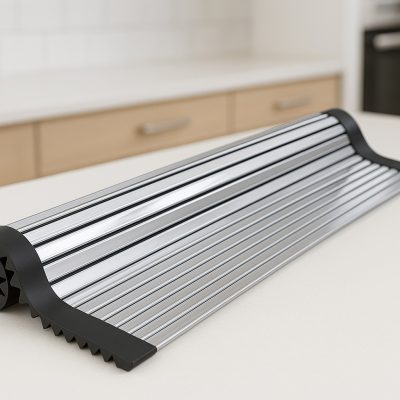
Furthermore, do not place the potato directly on the flat surface of the pan. If the potato rests flat against the metal, the bottom will burn and harden while the top remains pale. To achieve 360-degree heat circulation, you need to elevate the potato; this is the true magic of a wire rack. Place a stainless steel wire cooling rack inside your heavy-duty sheet pan, and place the potatoes on the rack. This allows the hot oven air to envelop the potato completely, ensuring an even, crispy skin on all sides.
Finally, as mentioned above, an instant-read digital thermometer is your best friend. Cooking is science, and science relies on accurate data. Stop guessing and start measuring.
The “I Need It Now” Weeknight Shortcut
I hear you. “This sounds amazing, but I get home at 6:00 PM on a Tuesday, and I am not waiting a full hour for a potato to bake.” I am a firm believer that time is money, and there are times when efficiency must take precedence.
If you are in a rush, you can absolutely hybridize this method. When you are crunched for time on a weeknight, the microwave is your best friend for jump-starting the cooking process.
The Hybrid Microwave-Oven Method
- Preheat your oven to 425°F (220°C). We are going hotter here to speed up the skin crisping.
- Wash, dry, and heavily pierce your Russet potatoes.
- Place them on a microwave-safe plate and microwave on high for 5 to 7 minutes, flipping them halfway through. The microwave works by vibrating water molecules, rapidly boiling the water inside the potato and effectively steaming it from the inside out.
- Carefully remove the partially cooked potatoes (they will be screaming hot).
- Immediately brush them with a high-smoke-point oil and roll them in coarse kosher salt.
- Transfer them to the wire rack in your preheated 425°F oven.
- Bake for 15 to 20 minutes, or until the skin is deeply browned, crispy, and the internal temperature hits that crucial 205°F to 210°F mark.
You cut your cooking time in half, but because you finished them in a dry, high-heat environment with oil and salt, you still trigger the Maillard reaction and achieve a beautifully crispy skin. It is the ultimate compromise between weeknight survival and culinary excellence.
The Art of the Serve: Don’t You Dare Slice It
You have spent an hour carefully monitoring the thermodynamics of your potato. You have achieved a perfectly dehydrated, crispy skin and a 210°F fluffy interior. Do not ruin it at the finish line by taking a knife and slicing it cleanly down the middle.
When you slice a baked potato with a knife, the flat blade compresses the delicate, gelatinized starches, mashing them together and ruining the fluffy texture you just worked so hard to create.
Instead, you must use the “Blossom” technique.
- As soon as the potato comes out of the oven, take a fork and pierce a dotted line straight down the center of the potato, from end to end.
- Grab the potato at both ends (use a kitchen towel to protect your hands from the 210°F heat).
- Push the two ends inward toward the center, and then squeeze slightly upward.
The potato will burst open along the dotted line, blossoming outward like a flower. The jagged edges of the tear maximize the surface area, exposing the delicate, fluffy interior without compressing it.
Immediately take a fork and gently fluff the interior flesh. This allows the last bit of trapped steam to escape rapidly. If you let a baked potato sit unopened for 10 minutes after it comes out of the oven, the residual steam trapped inside will condense, and the interior will turn gummy. Open it immediately.
Elevating the Toppings
Now that you have a perfect canvas, treat it with respect. Sure, a dollop of sour cream and some pre-shredded cheddar is fine for a Tuesday, but if you want to elevate this to weekend-dinner-party status, you need to think about compound butters.
Whip room-temperature high-quality butter with roasted garlic, finely chopped chives, a splash of lemon juice, and flaky sea salt. Drop a generous spoonful of this compound butter into the steaming hot, fluffed interior of the potato. The butter will melt instantly, coating every individual starch granule in rich, aromatic fat. Top it with freshly grated Gruyère or a sharp aged cheddar (grated from a block, never from a bag coated in anti-caking cellulose), and some crispy rendered pancetta.
Troubleshooting Rookie Potato Mistakes
Even with a foolproof method, things can go awry if you lose focus. Here is a quick diagnostic guide to fixing common baked potato disasters.
The Potato is Hard in the Center
You got impatient. A potato that is hard in the center has not reached the necessary 205°F for full starch gelatinization. The water has not been fully absorbed by the granules. Put it back in the oven. Do not try to force it by turning the oven up to 500°F; you will just burn the skin while the center remains raw. Patience is the only fix here.
The Skin is Leathery and Tough
This happens for two reasons. Either you wrapped it in foil (which we have thoroughly debunked), or you oiled the potato at the very beginning of the baking process. If you soak the raw skin in oil, it cannot dehydrate properly in the oven. The moisture gets trapped under the oil layer, leading to a tough, chewy skin rather than a delicate, crispy one. Always bake dry for the first 45 minutes.
The Interior is Dark and Discolored
This is usually a sourcing issue rather than a cooking issue. Potatoes that have been stored at temperatures that are too cold (like in a refrigerator) will convert their starches into sugars. When these sugars are exposed to high heat, they caramelize and burn prematurely, leading to dark, sweet, and unappetizing flesh. Always store your raw potatoes in a cool, dark, well-ventilated pantry—never in the fridge.
The Potato Wrinkles and Deflates After Baking
You waited too long to open it. As the potato cools, the steam inside condenses back into water. This creates a vacuum effect that pulls the skin inward, causing it to wrinkle and deflate. You must blossom and fluff the potato the minute it comes out of the oven to let that steam escape.
Final Thoughts from the Sassy Sous-Chef
Cooking is not magic. It is simply applied physics and chemistry, made delicious with a little bit of fat and salt. You do not need to go to culinary school to make a mind-blowing baked potato, and you certainly do not need to rely on the bad habits of high-volume chain restaurants.
Stop wrapping your food in toxic, heat-reflecting metal straightjackets. Respect the ingredients, understand the science of moisture evaporation, and let your oven do what it was designed to do. Bake the potato naked, hit it with oil and salt at the end, use a thermometer to guarantee perfection, and serve it immediately.
Your weeknight dinners are about to get a massive upgrade, and you will never look at a soggy, foil-wrapped diner potato the same way again. Now get out of here, go buy a bag of Russets, and start baking. You’ve got this.