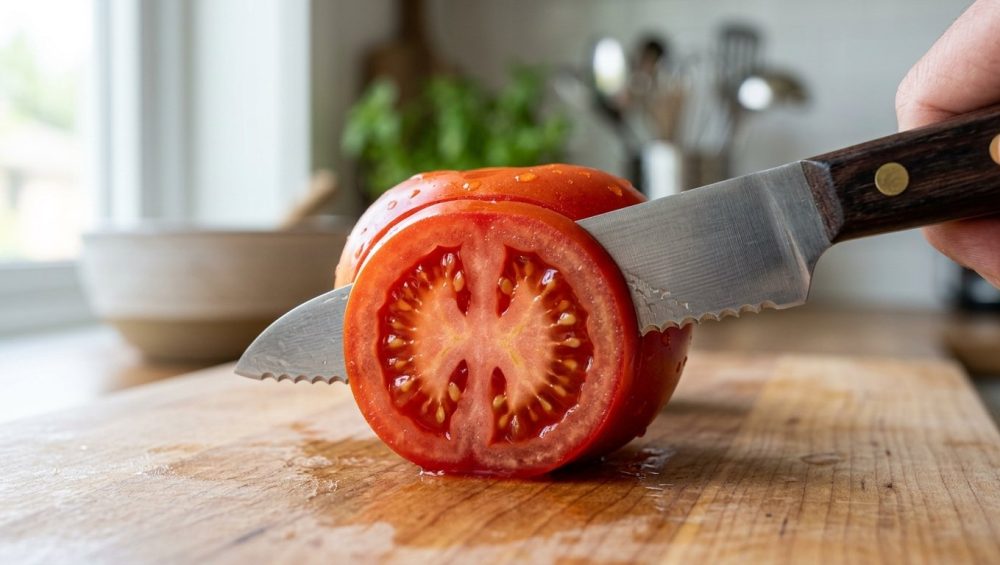
Look, I love you, but you are committing an absolute culinary felony on your cutting board right now. I can practically hear the screams of your produce from here. We have all been there: you buy a gorgeous, expensive, peak-season heirloom tomato from the farmer’s market. You bring it home, place it lovingly on your board, and pull out your standard eight-inch chef’s knife. You press down to make that first beautiful slice, and instead of a clean, surgical cut, the skin buckles. The knife slips. You push harder. Suddenly, the tomato collapses into a tragic, watery puddle of seeds and mangled flesh. It is a crime scene, and you are left standing there holding a dull knife, wondering where it all went wrong.
Home cooks are incredibly hard on themselves, constantly assuming that their lack of a formal culinary degree is the reason their weeknight dinners look like a chaotic mess. I am here to tell you: it is not your lack of skill, and it is certainly not a lack of effort. It is your gear. Specifically, it is your stubborn reliance on a straight-edged chef’s knife for a biological structure that practically begs for a serrated utility knife.
If you have ever wondered why you cry chopping onions, the answer is always a dull blade crushing the cell walls and releasing volatile gasses. The exact same microscopic violence is happening to your tomatoes, your bell peppers, and your stone fruit. Today, we are going to dive deep into the actual physics of slicing, the mechanics of cellular rupture, and why the scalloped micro-teeth of a proper, high-carbon steel serrated utility knife will change your weeknight meal prep forever. No pretentious chef-speak, no fluff—just the cold, hard, scientifically backed truth about why you are squishing your produce and exactly how to stop it.
The Anatomy of a Kitchen Disaster: Why Your Chef’s Knife is Failing You
To understand why your food is turning into a watery disaster, we first have to understand the biological architecture of the ingredients you are trying to cut. Nature is an incredible engineer. Fruits and vegetables like tomatoes, eggplants, plums, and bell peppers are designed to survive the harsh outdoors, ward off pests, and retain their internal moisture under the hot sun. They achieve this through a highly specialized structural design that happens to be the exact nemesis of a standard kitchen knife.
The Epidermis Problem: Tough Skin vs. Soft Flesh
Let us look closely at the anatomy of a tomato. The outermost layer is the exocarp (the skin), which is scientifically classified as a viscoelastic material composite. This means the skin possesses both fluid-like (viscous) and solid-like (elastic) properties. It is designed to stretch, resist tension, and bounce back. Beneath this tough, flexible armor lies the mesocarp (the fleshy wall) and the locular cavities, which are essentially fragile little chambers filled with seeds and high-moisture jelly.
When you take a standard straight-edged chef’s knife to a tomato, the blade encounters that viscoelastic exocarp. Unless your straight blade is literally razor-sharp—and let us be brutally honest, if you are a busy home cook, your knife is probably duller than a butter knife—it cannot immediately find a microscopic imperfection in the skin to catch onto. Instead of piercing the skin, the smooth edge of the blade simply glides, slips, or stretches the skin downward. The tough exterior resists the blade, while the incredibly soft, fragile interior waits helplessly beneath it.
Downward Force and Cellular Rupture (The Science of the Squish)
Because the straight blade refuses to bite into the slick skin, human instinct takes over. What do you do when a knife will not cut? You push down harder. In the realm of physics, this downward pressure is known as normal stress.
Here is where the disaster happens: as you apply heavy normal stress to the top of the tomato, the tough skin continues to stretch and resist, transferring all of that crushing downward force directly into the soft, fragile locular gel and mesocarp inside. You are essentially squeezing a water balloon. The internal pressure builds exponentially until the internal cell walls literally burst. In materials science, this sudden, catastrophic failure of the internal structure is referred to as a cohesive collapse.
By the time the blade finally breaks through the tough skin, the damage is already done. The soft tissue has been obliterated, the moisture has been forcefully ejected onto your cutting board, and your beautiful heirloom tomato is ruined. This cellular destruction is exactly why produce degrades so quickly in the fridge after being prepped; you can actually stop throwing away sad veggies if you stop violently crushing their cell walls during your initial prep.
Enter the Serrated Utility Knife: Your Kitchen’s Unsung Hero
So, how do we defeat the viscoelastic armor of high-moisture produce without triggering a cohesive collapse of the fragile interior? The answer is not pushing harder, and it is not spending three hundred dollars on a Japanese chef’s knife. The answer is a humble, inexpensive, wildly underappreciated tool: the serrated utility knife.
What Exactly is a Serrated Utility Knife?
When I say “serrated knife,” most people immediately picture a massive, ten-inch bread knife. While a bread knife is fantastic for hacking through a crusty sourdough boule, it is far too long, clumsy, and unwieldy for delicate vegetable prep. On the other end of the spectrum is the paring knife, which is too short and generally lacks the teeth required for the job.
The serrated utility knife is the ultimate Goldilocks tool. Typically measuring between five and six inches in length, it is long enough to span the diameter of a large beefsteak tomato or a grapefruit, yet short and nimble enough to give you absolute surgical control over the blade. It is lightweight, maneuverable, and designed specifically for the exact biological problem we just discussed.
Scalloped Micro-Teeth vs. Pointy Serrations (Blade Geometry)
Not all serrations are created equal, and understanding blade geometry is crucial if you want to cook like an expert. If you look at a hardware store saw, or a cheap survival knife, you will see pointed, aggressive teeth. Those pointed serrations are designed for ripping, tearing, and aggressively chewing through dense, fibrous materials like heavy rope or thick wood. If you use pointed serrations on a tomato, you will shred the flesh into a jagged, unappetizing mess.
A high-quality serrated utility knife, however, features scalloped micro-teeth. Instead of aggressive spikes, the edge is made up of gentle, semi-circular recesses (scallops) that terminate in incredibly sharp, fine points. This geometry is pure genius. The sharp points concentrate the applied force into microscopic areas, allowing the blade to instantly bite into slick, tough surfaces without slipping. Once those points breach the tough skin, the smooth, curved scallops glide effortlessly through the soft interior flesh, creating a clean, surgical slice without snagging, ripping, or tearing. Furthermore, because only the very tips of the teeth ever make contact with your cutting board, the recessed scallops are protected from friction. This means you can stop dulling your knives so rapidly, as the scalloped geometry inherently preserves the razor-sharp cutting edge for vastly longer periods.
The Physics of the Slice: Shear Stress and Friction
Understanding why this blade geometry works requires a quick lesson in the physics of cutting. We already established that normal stress (pushing straight down) causes cellular crushing. The serrated utility knife completely flips the script by utilizing shear stress.
Bypassing the Need for Downward Pressure
Shear stress is a mechanical force that is applied tangentially—meaning parallel to the surface of the object. When you use a serrated utility knife, you do not push down. Instead, you use a gentle, horizontal back-and-forth sawing motion.
Because the micro-teeth concentrate the force into such infinitely small points, they create immediate friction and grip the slippery skin the millisecond the blade moves horizontally. The teeth act like microscopic puncture points, instantly breaching the tough epidermis with practically zero downward pressure required. You are letting the geometry of the blade do the work, completely bypassing the need for normal stress. The knife glides through the tomato under its own weight, cleanly severing the skin and the flesh simultaneously.
Cellular Preservation: Keeping the Juice in the Produce
By eliminating downward pressure and relying entirely on shear stress, you preserve the structural integrity of the internal cell walls. The locular gel remains trapped inside its natural biological chambers. The moisture stays inside the slice of the tomato, exactly where it belongs, rather than bleeding out all over your cutting board.
This concept of cellular preservation is paramount to good cooking. When you cleanly slice a vegetable rather than crushing it, it retains its texture, its vibrant flavor, and its structural crunch. When cells are crushed and bruised, they immediately begin to leak water, which accelerates enzymatic browning and textural degradation. It is the exact same reason why your fresh herbs get slimy in the fridge when you aggressively chop them with a dull knife rather than cleanly slicing them. Furthermore, keeping the juice inside the produce prevents your final dishes from becoming waterlogged. Have you ever wondered why your salad greens wilt so incredibly fast? It is almost always because the acidic, watery juice from crushed, poorly sliced tomatoes has leaked out and completely drowned the delicate lettuce leaves. Clean slices equal dry, crisp, professional-quality salads.
High-Carbon Steel vs. Toxic Trash: Choosing the Right Blade
Now that you understand the science of the serrated utility knife, we need to have a very serious conversation about the actual material of the blade. I have zero patience for the pretentious chef-speak that tells you to spend five hundred dollars on a single knife, but I have even less patience for the garbage, novelty kitchenware sold at big-box stores.
The Non-Negotiable Rule on Blade Materials
If you want to achieve professional-level results in a home kitchen, you must invest in high-carbon steel. Standard, cheap stainless steel is too soft. It rolls, it bends, and it cannot hold a microscopic edge. High-carbon steel, on the other hand, contains a higher percentage of carbon in its metallurgical makeup. This allows the steel to be heat-treated to a much higher hardness on the Rockwell scale.
Why does this matter for a serrated knife? Because those tiny, sharp points that do all the piercing work need to be incredibly rigid and durable. If they are made of soft, cheap metal, they will quickly fold over and become useless. High-carbon steel ensures that the micro-teeth retain their aggressive bite for years of heavy weeknight use. I am deeply passionate about banishing toxic kitchen gear and useless novelty tools from your home, and upgrading to a bare, high-carbon steel utility knife is the single easiest aesthetic and functional upgrade you can make.
Why Cheap Coated Knives Belong in the Garbage
Walk into any supermarket and you will see them: brightly colored, pastel-painted, non-stick coated serrated knives packaged in cheap plastic clamshells. Do not buy them. Do not let them into your house. Throw them directly into the garbage where they belong.
These cheap knives are stamped from the lowest-grade mystery metals available and then coated in synthetic polymers or paints to make them look “fun” and “non-stick.” Here is the brutal reality: the friction of cutting acidic foods like tomatoes and citrus will inevitably cause that cheap coating to chip, peel, and flake. Where do you think those toxic paint flakes go? They go directly into your caprese salad, your sandwiches, and your family’s mouths. There is no excuse for using peeling, toxic gear when a high-quality, uncoated, high-carbon steel serrated utility knife can be purchased for twenty to forty dollars. It is an investment in your health, your sanity, and your food.
Beyond the Tomato: What Else This Knife Dominates
While the tomato is the poster child for the serrated utility knife, this tool is by no means a one-trick pony. Once you understand the physics of bypassing tough exteriors to protect soft interiors, you will find yourself reaching for this knife constantly.
Stone Fruit, Citrus, and Slippery Bell Peppers
Think about the waxy, incredibly slippery skin of a bell pepper. A dull chef’s knife will literally bounce off of it, putting your fingers at massive risk of slipping and getting sliced. The micro-teeth of the serrated utility knife grip that waxy skin instantly, allowing you to break down peppers with absolute safety and precision.
The same applies to citrus fruits. Lemons, limes, and oranges have tough, leathery rinds hiding highly pressurized, juice-filled vesicles inside. Slicing them with a straight edge often results in squeezing half the juice out onto the cutting board. The sawing shear stress of the utility knife cleanly breaches the rind and slices the citrus without squeezing out a single drop of precious juice. It is also the undisputed champion of stone fruits—slicing perfectly through the fuzzy, bruise-prone skin of peaches and plums without turning the delicate flesh to mush.
Sandwiches, Crusty Breads, and Delicate Pastries
Have you ever built a towering, magnificent BLT or a loaded turkey club, only to completely destroy it when you try to cut it in half? A straight blade requires you to push down, which compresses the bread and violently squishes all of your carefully layered ingredients out the sides. The serrated utility knife, utilizing that horizontal sawing motion, gently cuts through the toasted bread and the layers of meat and veg without applying any downward compression. Your sandwiches remain tall, beautiful, and intact. It is also the absolute best tool for slicing delicate, flaky pastries like croissants or pain au chocolat without shattering their laminated layers.
Cured Meats and Cheese Boards
If you are putting together a weekend charcuterie board, the serrated utility knife is your best friend. Salami, pepperoni, and hard cured sausages have tough, fibrous casings that can be difficult to pierce cleanly. The teeth make short work of them. Furthermore, when slicing blocks of semi-soft cheese, the scalloped recesses of the blade drastically reduce the surface area contact between the metal and the cheese. This prevents the cheese from creating a vacuum and sticking to the side of the blade, allowing for fast, uniform slices.
The Economics of Efficiency: Time is Money in the Kitchen
I firmly believe that anyone can cook mind-blowing food, but I also know that on a Tuesday night after a long day at work, time is your most valuable commodity. You do not have the luxury of spending forty-five minutes meticulously prepping vegetables. You need efficiency, shortcuts, and tools that work with you, not against you.
Speeding Up Weeknight Prep
The serrated utility knife is the ultimate weeknight time-saver. Because the recessed scallops protect the cutting edge from the board, this knife stays aggressively sharp for incredibly long periods of time without any maintenance. You do not have to pull out a whetstone or a honing rod before you start cooking. It is always ready to go.
When you are rushing to get dinner on the table, you want to stop adding garlic first (because it burns while you are frantically chopping the rest of your ingredients), and you want a tool that can seamlessly transition from slicing a slippery onion to dicing a delicate tomato without missing a beat. The utility knife allows you to fly through your prep work safely and cleanly, because the teeth grip the food securely, preventing the blade from slipping and slowing you down.
Why You Don’t Need a Culinary Degree to Slice Like a Pro
There is a pervasive myth that to be a good cook, you must master the rapid-fire “rock chop” technique used by professional chefs on television. That is absolute nonsense. Professional chefs use that technique because they have to prep fifty pounds of onions a day. You are cooking for yourself and your family.
You do not need elite knife skills; you just need to understand the biology of your ingredients and use the tool designed to conquer them. If you have ever been frustrated by roasted veggies are mushy and waterlogged, it is highly likely that you crushed and bruised them during the prep phase, causing them to leak their internal moisture and steam in the oven rather than roast. By switching to a tool that preserves the cellular structure of your produce, you instantly elevate the final texture and flavor of your dishes with zero extra effort or culinary training.
Knife Care 101: Keeping the Bite in Your Serrations
Even the greatest high-carbon steel in the world requires proper care. The good news is that caring for a serrated utility knife is incredibly easy, provided you follow a few strict, non-negotiable rules.
Honing vs. Sharpening Serrated Edges
There is a massive misconception that serrated knives cannot be sharpened and must be thrown away when they eventually dull. This is entirely false. It is true that you cannot run a scalloped blade over a flat whetstone, but they are actually quite easy to maintain.
Because the points of the teeth take all the friction and the scallops are recessed, it takes a very long time for the blade to lose its effectiveness. However, when you do notice that your kitchen knives get dull, you simply need a tapered ceramic honing rod. You take the ceramic rod and gently pass it through each individual scallop, pulling away from the blade. A few gentle passes through each recess will realign the micro-edge and bring the knife back to factory sharpness. It takes about two minutes, once a year.
The Dishwasher is the Enemy
I will say this as clearly as I possibly can: never, under any circumstances, put a high-carbon steel kitchen knife in the dishwasher. Just as you must stop ruining your nonstick pans by subjecting them to metal utensils and abrasive scrubbing, you must protect your high-carbon steel from the violent environment of the dishwasher.
Dishwasher detergents are highly abrasive and corrosive. Combined with the extreme heat and the prolonged exposure to moisture, a cycle in the dishwasher will actively eat away at the microscopic, razor-thin edge of your knife. It will cause high-carbon steel to pit and rust, and the heat will degrade and crack the handle over time. Your utility knife is a precision tool. Treat it with respect. Wash it by hand with warm soapy water, and dry it immediately with a clean towel before putting it away. It takes ten seconds and ensures your investment lasts a lifetime.
The Final Verdict: Upgrade Your Tool, Elevate Your Food
Cooking should not be a frustrating battle against your ingredients. It should be a joyful, empowering process. When you struggle to slice a tomato, when your bell peppers are bruised, and when your sandwiches are crushed, it is not a reflection of your ability as a cook. It is simply a failure of physics caused by using the wrong tool for the job.
By understanding the mechanics of shear stress, the brilliance of scalloped blade geometry, and the absolute necessity of cellular preservation, you can immediately eliminate one of the most annoying bottlenecks in the home kitchen. Stop squishing your produce. Stop letting cheap, toxic, dull knives dictate the quality of your weeknight meals.
Invest in a high-carbon steel serrated utility knife. Respect the biology of the food you are preparing. Let the micro-teeth do the hard work of piercing the tough epidermis, and watch as your prep time shrinks, your salads stay crisp, and your tomatoes remain perfectly intact, juicy, and beautiful. You do not need a culinary degree to cook like an expert; you just need the right gear, a little bit of science, and the confidence to slice without fear. Now get out of here, go buy a proper knife, and go make something amazing for dinner.