Listen up, weekend culinary warriors. If you have ever tried to bake a batch of peanut butter cookies, whip up a honey-sesame glaze, or portion out sticky molasses for a gingerbread cake, you already know the absolute nightmare I am about to describe. You grab your standard, hard-sided dry measuring cup. You pack it full of your highly viscous ingredient. You confidently invert it over your mixing bowl, expecting a clean drop. And then… nothing happens.
What follows is the dreaded spatula scraping dance. You dig, you scrape, you curse, and you inevitably end up using your index finger to dig out that last stubborn tablespoon of peanut butter, getting yourself completely covered in the process. You are left with a sticky counter, a messy measuring cup, and a sneaking suspicion that your recipe is now short on fat or sugar because 15 percent of your ingredient is still glued to the walls of the cup.
You do not need a culinary degree to bake like a professional, but you do need to stop fighting your own kitchen equipment. The brutal truth is that traditional measuring cups were never designed for sticky, stubborn ingredients. Today, we are going to dive deep into a highly functional, vastly under-appreciated kitchen tool that immediately solves this messy prep bottleneck: the adjustable plunger-style measuring cup.
The Sticky Situation: Why Traditional Measuring Cups Are Sabotaging Your Baking
Before we can appreciate the solution, we have to understand the science of the problem. Baking is not a dark art; it is just edible chemistry. And chemistry requires exact measurements, which is exactly what your standard measuring cups are failing to provide when things get sticky.
The Physics of Viscosity and Kitchen Frustration
To understand why traditional cups fail so spectacularly, we have to talk about the physics of viscosity. Viscosity is, in simple terms, a fluid’s resistance to flow. Water and milk have low viscosity; they flow freely and pour cleanly. Honey, molasses, corn syrup, tahini, and peanut butter have incredibly high viscosity. Furthermore, many of these ingredients exhibit non-Newtonian behavior, meaning their viscosity changes depending on the shear stress applied to them.
When you pack honey or peanut butter into a standard stainless steel or plastic measuring cup, you are battling two distinct physical forces: cohesion (the ingredient’s tendency to stick to itself) and adhesion (the ingredient’s tendency to stick to the surface of the container). In the case of highly viscous baking ingredients, the adhesion forces bonding the sticky liquid to the walls of your measuring cup are significantly stronger than the gravitational force trying to pull the ingredient down into your bowl.
We’ve already established that scooping your flour with a dry measuring cup is a cardinal sin of baking because it leads to compacted, inaccurate measurements. But trying to measure sticky, stubborn liquids in that exact same rigid cup is a special kind of culinary torture. Traditional cups rely entirely on gravity to empty their contents. When gravity is defeated by adhesion, you are forced to intervene manually with a spatula, which introduces a massive margin of error into your recipe.
The Hidden Cost of “Close Enough” Measurements
Now, I know what you might be thinking. “Why not just weigh everything?” It is true that while a digital kitchen scale is the undisputed champion for dry ingredients like flour and sugar, a massive number of beloved home recipes—especially vintage family heirlooms, quick weeknight marinades, and American-style baking formulas—are written strictly in volumetric measurements (cups and tablespoons). Furthermore, trying to weigh out a single tablespoon of sticky corn syrup directly into a bowl that already contains delicate, pre-weighed dry ingredients can be a risky game of roulette. If you accidentally over-pour, you cannot simply scoop the syrup back out without ruining the entire batch.
Beyond the frustration of inaccurate baking, there is a very real, very painful financial cost to this inefficiency. According to comprehensive 2025 data from ReFED and recent reports from the U.S. Environmental Protection Agency (EPA), the annual per capita cost of consumer food waste in the United States hovers around a staggering $728 to $780 per household. While we often think of food waste as throwing away a bag of rotten spinach, a massive portion of that financial loss comes from the invisible, incremental waste of leaving expensive ingredients behind in our cookware and prep tools.
Consider the price of premium baking ingredients. According to the National Honey Board’s 2024 market research, the average retail price of honey hit $7.85 per pound, with raw and organic varieties costing significantly more. Pure maple syrup, artisanal tahini, and high-quality vanilla bean paste are even pricier. When you leave 15 to 20 percent of your honey glued to the inside of a measuring cup every single time you bake, you are literally washing your hard-earned money down the sink. Over the course of a year, that adds up to entire jars of expensive ingredients wasted simply because you were using the wrong tool for the job.
Enter the Plunger Measuring Cup: Your New Kitchen Best Friend
If you are tired of wasting expensive ingredients and ruining your weeknight baking sessions with inaccurate ratios, it is time to upgrade your arsenal. The solution to this sticky madness is an ingenious, often-overlooked gadget that belongs in every serious home cook’s drawer.
What Exactly Is a Plunger Measuring Cup?
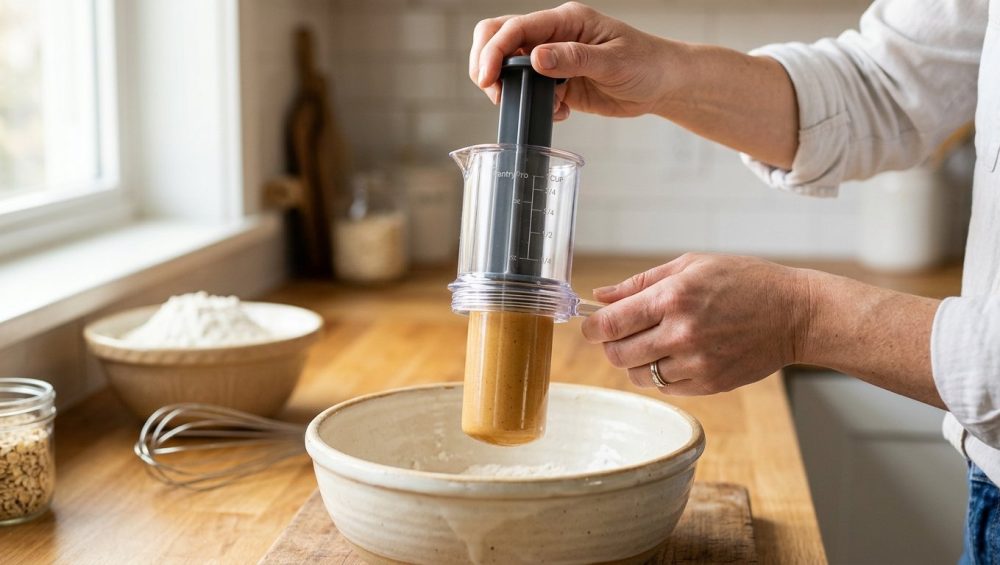
A plunger-style measuring cup (often referred to as an adjustable measuring cup) is a cylindrical, two-part gadget that looks somewhat like a giant medical syringe or a push-pop. It consists of a clear, rigid outer sleeve printed with various volumetric measurement markings—usually detailing cups, ounces, milliliters, and tablespoons. Inside this outer sleeve sits an inner tube that acts as a movable plunger, capped with a tight-fitting, flexible gasket.
Instead of having a whole drawer full of different sized cups, you simply twist or slide the inner tube to align the top of the plunger with your desired measurement mark on the outer sleeve. You fill the resulting cavity with your ingredient, invert the cup over your mixing bowl, and push the plunger down. Investing in a high-quality plunger measuring cup will fundamentally change your prep game, instantly eliminating the mess and frustration associated with viscous foods.
The Science of Mechanical Volume Displacement
The reason this tool is so revolutionary comes down to the science of mechanical volume displacement. As we discussed earlier, traditional cups rely on gravity to empty their contents, which fails when dealing with high-adhesion ingredients. The plunger cup does not care about gravity or adhesion.
When you push the inner tube forward, the flexible silicone gasket creates an airtight, squeegee-like seal against the walls of the outer sleeve. As the plunger moves, it forcibly displaces 100 percent of the volume inside the cavity. The gasket physically scrapes the walls perfectly clean as it travels, overcoming the adhesion forces of the honey, molasses, or peanut butter. The ingredient is extruded cleanly and completely into your bowl in one satisfying motion. No scraping, no digging, no sticky fingers, and absolutely zero waste.
The Death of the Spatula Scraping Dance: Why This Tool Changes Everything
I am a firm believer that anyone can make mind-blowing food in a standard home kitchen, provided they eliminate the unnecessary bottlenecks that cause stress and failure. Here is exactly why banishing the spatula scraping dance will elevate your cooking.
Unmatched Accuracy for Viscous Ingredients
Baking is an exact science that relies heavily on precise ratios of fat, liquid, flour, and leavening agents. When you are making a peanut butter cookie dough, the peanut butter acts as both a primary fat and a structural binder. If the recipe calls for exactly one cup of peanut butter, and you only manage to extract seven-eighths of a cup because the rest is stubbornly clinging to your measuring tool, you have just drastically altered the hydration and fat content of your dough.
If your ratio of fat to flour is off, your pie crust is always tough, your cookies turn into dry, crumbly pucks, and your cakes lose their tender crumb. The plunger cup guarantees that if you measure out exactly half a cup of tahini, exactly half a cup of tahini goes into your mixing bowl. This level of precision is the secret to achieving professional bakery results at home.
The Time-Saving Factor for the Weeknight Warrior
For the weeknight culinary hobbyist, time is money. When I am trying to throw together a quick weeknight dinner, I rigorously prioritize efficiency and shortcuts. I do not have the time or the patience to spend three minutes meticulously scraping molasses out of a tiny crevice with a miniature silicone spatula.
We all know that caramelized onions take forever, but measuring out a simple sticky ingredient should take seconds, not minutes. The plunger cup allows you to measure, dispense, and move on to the next step of your recipe in less than five seconds. It streamlines your prep work, keeps your workflow moving, and most importantly, keeps your hands clean so you don’t have to stop and wash them three times during the prep phase.
Zero Waste Means Saving Money
We have already touched on the depressing statistics of food waste, but it bears repeating: wasting ingredients is a culinary crime. When you use a plunger cup, the silicone gasket leaves the inside of the measuring tube practically spotless. Every single drop of that expensive organic maple syrup or artisanal almond butter ends up in your recipe, exactly where it belongs. Over the lifespan of the tool, it will easily pay for itself dozens of times over in saved ingredients alone.
Toxic Gear Warning: How to Choose a Safe and Durable Plunger Cup
You all know my strict “No-Go” rule. I absolutely despise cheap, toxic kitchenware, and I will actively warn you against buying it. The market is currently flooded with cheap, dropshipped kitchen gadgets made from mystery metals and highly questionable plastics. If you buy a low-quality plunger cup, you are going to regret it immediately. Here is what you need to know to protect your health and your wallet.
The “No-Go” Materials: What to Avoid at All Costs
Do not, under any circumstances, buy an adjustable measuring cup made from cheap polystyrene, acrylic, or unidentified brittle plastics. These low-grade materials contain harmful chemicals like BPAs and phthalates, which can leach into your food—especially if you are measuring warm liquids or acidic ingredients.
Furthermore, cheap plastics are highly susceptible to thermal shock and chemical degradation. If you run them through a hot dishwasher, they will warp, crack, and lose their shape. Once the outer tube warps even a fraction of a millimeter, the inner plunger will no longer form a tight seal, rendering the entire tool completely useless. When cheap plastic degrades, it also becomes highly porous. It’s the exact same reason your cheap plastic containers stay greasy no matter how much dish soap you use—the degraded plastic literally absorbs oils, fats, and pungent odors. You do not want a measuring cup that perpetually smells like last month’s garlic-miso paste.
The Gold Standard: Food-Grade Silicone and BPA-Free Polycarbonate
When shopping for this tool, you must look for reputable brands (like the KitchenArt Adjust-A-Cup or the OXO Good Grips adjustable measuring cup) that utilize high-quality, rigorously tested materials. The outer sleeve and inner tube should be constructed from heavy-duty, BPA-free polycarbonate or Tritan plastic. These high-end polymers are shatter-resistant, heat-resistant, and completely non-porous, meaning they will not absorb odors or warp under normal kitchen conditions.
Equally important is the gasket at the top of the plunger. It must be made from 100 percent food-grade silicone. If you buy a model with a low-grade synthetic rubber gasket, you’ll run into the same issue where silicone spatulas taste soapy and transfer a foul, chemical flavor to your food. High-quality silicone is heat-resistant, chemically inert, and maintains its flexibility over years of heavy use, ensuring a perfect squeegee seal every single time.
A Masterclass in Using Your Plunger Measuring Cup
Even the best tools in the world are useless if you do not know how to operate them correctly. While the plunger cup is incredibly intuitive, there is a specific technique to using it that guarantees zero mess and perfect accuracy. Consider this your definitive masterclass.
Prepping the Cup for Maximum Glide
The most common rookie mistake people make with an adjustable measuring cup is filling it incorrectly. You must set the measurement before you add the ingredient. Twist or pull the inner plunger down until the top of the silicone gasket perfectly aligns with your desired volume marking on the outer sleeve.
Do not, I repeat, do not pour honey into the fully closed cup and then attempt to pull the plunger down to draw the liquid in. This is not a syringe drawing medicine from a vial. If you try to pull the plunger down while the cup is full of a highly viscous liquid, you will create a massive vacuum seal, struggle against immense suction force, and likely end up pulling the gasket completely off, resulting in a catastrophic kitchen disaster. Set your measurement first, then fill the empty cavity from the top.
For 99 percent of ingredients, a high-quality silicone gasket provides more than enough glide. However, if you are working with something absurdly sticky—like pure commercial glucose syrup or melted marshmallows—you can rub a microscopic drop of neutral cooking oil along the inside of the upper sleeve to ensure an absolutely frictionless release.
The Push-and-Twist Technique for Perfect Release
Once your cup is set to the correct volume, spoon or pour your sticky ingredient into the cavity. If you are measuring a semi-solid like peanut butter or shortening, use the back of a spoon to pack it down firmly as you go. Air pockets are the ultimate enemy of volumetric measurement; if you have a giant air bubble trapped in the middle of your peanut butter, your measurement will be highly inaccurate.
Once the cup is filled and leveled off at the brim, hold it directly over your mixing bowl. Push the inner tube upward with a smooth, steady pressure. Watch in awe as the silicone gasket squeegees the walls completely clean. As the plunger reaches the very top and the ingredient begins to fall into your bowl, give the entire cup a quick, sharp twist of your wrist. This twisting motion allows the edge of the outer sleeve to cleanly shear off the ingredient from the top of the silicone gasket, ensuring a perfectly clean drop with no lingering strings of honey or syrup.
Cleaning and Maintenance for Lifelong Use
Proper maintenance is non-negotiable if you want your kitchen gear to last. When it is time to clean your plunger cup, you must completely disassemble it. Pull the inner tube all the way out of the outer sleeve so you have two separate pieces.
If you lazily throw the fully assembled unit into the sink or the dishwasher, water and food particles will become trapped in the microscopic gap between the two tubes. There is nothing worse than a kitchen tool that traps moisture—it’s the exact same reason a cheap whisk leaks dishwater all over your fresh batter the next time you use it.
While many high-end models claim to be top-rack dishwasher safe, I strongly advocate for hand washing this specific tool. The harsh detergents and extreme heat of a dishwasher can prematurely degrade the silicone gasket and slowly fade the printed measurement markings on the outer sleeve. Wash both pieces in warm, soapy water using a soft sponge. Keep your abrasive scouring pads and your chainmail scrubber far away from the polycarbonate tube, as they will cause micro-scratches that cloud the clear plastic and ruin the airtight seal of the squeegee. Let both pieces air dry completely before reassembling them and putting them back in your drawer.
Beyond Honey and Peanut Butter: Unexpected Uses for Your Plunger Cup
While the plunger measuring cup is universally praised for conquering honey, molasses, and peanut butter, its utility does not stop at the baker’s pantry. Once you get used to the convenience of mechanical volume displacement, you will find yourself reaching for this tool constantly for a wide variety of culinary tasks.
Conquering Mayonnaise, Sour Cream, and Shortening
Savory cooking relies just as heavily on messy, viscous ingredients. If you are whipping up a massive batch of potato salad for a summer barbecue, measuring out a cup of mayonnaise using a traditional measuring cup is a greasy, frustrating chore. The plunger cup makes quick work of mayonnaise, sour cream, Greek yogurt, and thick miso paste.
It is also the absolute best way to measure solid fats like vegetable shortening, lard, or room-temperature butter. Trying to pack shortening into a standard rigid cup, eliminate the air pockets, and then dig it all back out with a butter knife is an archaic, infuriating process. With the plunger cup, you pack the shortening in, push it out into your pie crust mixture, and you are done in seconds.
The Ultimate Tool for Thick Batters and Compound Butters
Because the plunger cup extrudes ingredients in a perfect, uniform cylinder, it is a brilliant tool for portioning and shaping. If you are making a large batch of garlic-herb compound butter to freeze for future steaks, you can pack the soft butter into the plunger cup, extrude it into a perfect log onto a sheet of parchment paper, roll it up, and freeze it.
This is incredibly useful for portioning out uniform logs of compound butter or thick, chunky cookie batter before chilling your dough in the fridge. You can set the plunger to exactly one-quarter cup, pack it with your heavy oatmeal raisin or chocolate chunk dough, and extrude perfectly uniform, identical portions directly onto your baking sheet. Uniform portions mean uniform baking times, which guarantees that every single cookie comes out perfectly baked.
The Final Verdict: Upgrading Your Culinary Arsenal
At the end of the day, transforming your daily cooking from a stressful chore into a joyful, creative outlet is all about working smarter, not harder. You do not need to suffer through the frustrating, messy, wasteful process of scraping sticky ingredients out of rigid cups.
The adjustable plunger measuring cup is a masterclass in intelligent kitchen design. It leverages simple mechanical physics to solve a universal cooking bottleneck, ensuring unparalleled recipe accuracy, saving you precious minutes during your weeknight prep, and preventing expensive ingredients from washing down your drain.
Do yourself a favor: ditch the cheap, toxic plastics, invest in a high-quality, BPA-free polycarbonate plunger cup, and banish the spatula scraping dance from your kitchen forever. Your sanity, your wallet, and your baked goods will thank you. Now get out of here, go measure some molasses with absolute precision, and make something delicious.