Picture this: It is 7:00 PM on a random Tuesday. You are exhausted, your feet ache from a long day, and you have ambitiously decided to whip up a batch of spicy peanut noodles to avoid the financial guilt of ordering takeout for the third time this week. The recipe calls for exactly one-half cup of peanut butter. You grab your standard, hard-plastic dry measuring cup, grab a spoon, and start aggressively spackling the peanut butter into the cup like you are patching drywall in a cheap apartment. You try to level it off, getting it all over your knuckles in the process.
Then comes the real nightmare: getting the peanut butter out of the cup and into the mixing bowl. You scrape, you scoop, you swear. Half of the thick paste stubbornly clings to the bottom corners of the cup. You eyeball the missing amount, toss another random glob into the bowl, and throw the sticky, ruined measuring cup into the sink, knowing full well it will haunt you during cleanup.
If this scenario raises your blood pressure, grab a glass of wine and pull up a stool. We need to have a serious, unfiltered talk about your kitchen tools.
As a home cook who has ruined more dinners than I care to admit simply because I lacked the right equipment, I am here to tell you that cooking does not have to be a messy, frustrating, soul-crushing chore. You do not need a culinary degree to make mind-blowing food, but you absolutely need to stop handicapping yourself with the wrong tools. And when it comes to measuring high-viscosity, sticky, gooey ingredients, standard measuring cups are not just the wrong tool—they are your worst enemy.
Enter the greatest unsung hero of the culinary world: the plunger measuring cup. Also known as an adjustable measuring cup, this brilliant piece of mechanical engineering is about to change your life, save your sanity, and rescue your baking ratios. Consider this a brutally honest guide to fixing one of the most annoying prep bottlenecks in your kitchen. We are going to dive incredibly deep into the science of sticky ingredients, the hidden costs of kitchen residue, and why upgrading to a plunger-style cup is the easiest way to elevate your weekend baking projects and streamline your weeknight meals.
The Sticky Situation: Why Traditional Measuring Cups Are Ruining Your Ratios
Before we can appreciate the genius of the solution, we have to thoroughly understand the depth of the problem. Traditional measuring tools are designed for two very specific types of matter: easily leveled dry solids (like flour and sugar) and free-flowing, low-viscosity liquids (like water and milk). Sticky ingredients exist in a frustrating culinary purgatory that defies both of these standard tools.
The Science of Viscosity vs. Volume
In fluid dynamics, viscosity is a measure of a fluid’s resistance to flow. Water has a low viscosity; it pours instantly and completely. Honey, molasses, and corn syrup have an incredibly high viscosity. When you pour them, they create a thick, slow-moving stream.
When you put a high-viscosity ingredient into a standard measuring cup, you run into the boundary layer problem. The molecules of the sticky ingredient adhere to the walls of the cup due to friction and surface tension. When you try to empty the cup, the center of the mass may fall out, but a thick layer remains permanently plastered to the sides and bottom. You are fighting basic physics when you try to scrape it out with a silicone spatula.
Furthermore, standard dry measuring cups are meant to be filled to the brim and leveled off with a straight edge. Try taking a straight-edged knife to a cup overflowing with marshmallow fluff. It doesn’t level; it just stretches, pulls, and creates a sticky, stringy disaster across your kitchen counter. Liquid measuring beakers are no better. You are supposed to read liquids at the meniscus (the curve of the liquid’s surface) at eye level. Good luck getting cold, thick molasses to settle into a readable, flat meniscus in a glass beaker.
The Hidden Cost of Leftover Residue
The frustration is only half of the issue; the real tragedy is the food waste and the ruined recipes. Let’s say you are measuring out a half-cup of expensive, artisanal local honey for a delicate cake. You pour it into a standard cup, and then you scrape it into your mixing bowl. Despite your best efforts, at least one to two tablespoons of honey remain stubbornly coated on the inside of the measuring cup.
That leftover residue represents a massive 12% to 25% loss of your required ingredient! In savory cooking, missing a little honey in a marinade might not be the end of the world. But in baking? Baking is an unforgiving science governed by strict chemical formulas. Have you ever wondered why your cookies spread into sad, flat, greasy puddles on the baking sheet? Or perhaps you have frantically Googled why your cakes are dense and heavy instead of light and fluffy?
More often than not, these baking disasters are the direct result of skewed ratios. When you leave two tablespoons of your wet ingredients (like honey, peanut butter, or oil) behind in the measuring cup, you drastically alter the hydration and fat ratios of your dough. Your flour-to-liquid ratio becomes unbalanced, leading to dry, crumbly, or overly dense baked goods. You are essentially setting your recipe up for failure before you even turn on the oven.
Enter the Plunger Measuring Cup: A Mechanical Masterpiece for the Home Kitchen
If you are looking for a no-nonsense guide to building a functional kitchen, you need to look beyond the basic wooden spoons and glass bowls. You need tools that actively solve mechanical problems. The plunger measuring cup is a triumph of utilitarian kitchen design, and it should absolutely be at the top of any list of essential kitchen tools for beginners and seasoned chefs alike.
What Exactly Is a Plunger-Style Measuring Cup?
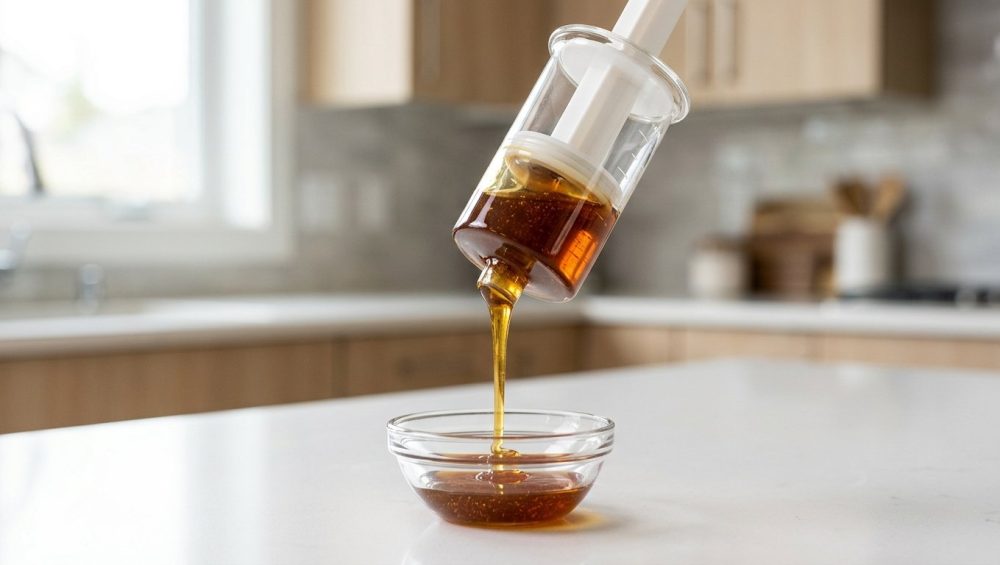
At first glance, a plunger measuring cup looks a bit like a large, clear plastic syringe. It consists of two primary components: an outer transparent sheath (or cylinder) marked with volume measurements, and an inner plunger piece that fits snugly inside the cylinder.
The inner plunger features a flat top platform and a flexible rim—usually made of high-quality food-grade silicone—that creates an airtight, watertight seal against the walls of the outer cylinder. By adjusting the position of the plunger within the cylinder, you create a customized cavity that holds exactly the volume of ingredients you need, ranging anywhere from a tiny 1/8 cup all the way up to a full 2 cups, depending on the model.
The Physics of Extrusion: How It Works
The magic of this tool lies in the physics of extrusion. To use it, you first pull or twist the plunger down so that the top platform aligns perfectly with your desired measurement marking on the outer cylinder. Let’s say you need exactly 1 cup of peanut butter. You set the platform to the 1-cup line.
Next, you pack your sticky ingredient into the cavity you just created, filling it all the way to the top rim of the outer cylinder. You can easily take a straight-edged knife and swipe it across the top, leveling the ingredient perfectly.
Now comes the transcendent culinary experience. You hold the cup over your mixing bowl and push the plunger upward. The flat platform forces the ingredient up and out of the cylinder in one perfect, satisfying, solid block. As the plunger moves upward, the flexible silicone rim acts as a squeegee, physically shearing the sticky boundary layer off the plastic walls. It wipes the inside of the cylinder completely clean. No scraping. No swearing. No leftover residue. You get exactly 100% of the ingredient you measured, directly into your bowl.
The Culprits: Ingredients That Demand a Plunger Cup
While you can technically use a plunger cup for dry ingredients like flour or liquids like water, its true purpose is to conquer the kitchen’s most notorious sticky offenders. If you frequently cook or bake with any of the following ingredients, a plunger cup is a mandatory upgrade.
Peanut Butter and Nut Butters
Peanut butter, almond butter, and tahini are the ultimate villains of the standard measuring cup. Not only are they sticky, but they are incredibly dense and prone to trapping hidden air pockets. When you scoop peanut butter into a traditional cup, you are inevitably leaving voids of empty space at the bottom. If you don’t pack it down vigorously, your “1 cup” of peanut butter might actually only contain 3/4 cup of actual food and 1/4 cup of trapped air.
With a plunger cup, you can actively pack the nut butter against the flat bottom of the plunger. Because the outer cylinder is made of clear plastic, you can visually inspect the sides for air bubbles and tap the cup on the counter to settle the ingredient, ensuring a perfectly dense, accurate volumetric measurement.
Honey, Molasses, and Syrups
Honey, dark molasses, maple syrup, and light corn syrup are a sticky, stringy nightmare. For decades, home economics teachers and beginner blogs have peddled a “clever” hack: spray your measuring cup with non-stick cooking spray before pouring in the honey, so it slides right out.
I despise this trick. Cooking spray adds unnecessary aerosol propellants and random oils to your delicate baking recipes. It alters the flavor profile and the fat content. Plus, it leaves a sticky, polymerized residue on your measuring cups that is virtually impossible to clean. The plunger cup requires absolutely zero lubrication. It uses mechanical force to eject the honey, keeping your recipe pure and your ratios flawless.
Shortening, Coconut Oil, and Butter
Measuring solid, room-temperature fats like vegetable shortening or coconut oil is a uniquely greasy form of torture. In the old days, bakers used the absurd “water displacement method.” If a recipe called for 1/2 cup of shortening, you would fill a large liquid measuring cup with 1/2 cup of cold water. Then, you would spoon globs of shortening into the water until the water line rose to exactly 1 cup. Finally, you had to fish the wet, slippery shortening out of the water, try to drain it, and add it to your dough.
It is 2026. We are not doing the water displacement method anymore. With an adjustable measuring cup, you simply set the plunger to 1/2 cup, pack the shortening in, level it off, and pop it out. Your hands stay clean, your counters stay grease-free, and your pie crusts turn out perfectly flaky.
Mayonnaise, Sour Cream, and Condiments
Do not think for a second that this tool is only for bakers. If you are making a massive batch of summer potato salad, macaroni salad, or a complex savory marinade, you are going to be dealing with mayonnaise, sour cream, Greek yogurt, and mustard. These emulsion-based condiments cling to standard plastic like their life depends on it. A plunger cup makes savory prep work incredibly fast, allowing you to measure and dispense thick sauces directly into your mixing bowls without dirtying a single spoon or spatula.
Time Is Money: The Weeknight Efficiency Factor
When you are trying to master simple weeknight dinners, every single minute counts. Weeknight cooking is about survival, efficiency, and minimizing friction.
Cutting Prep Time in Half
Think about the standard workflow for measuring sticky ingredients. You open the jar. You find a spoon. You scoop the ingredient into the measuring cup. You use a knife to level it. You grab a silicone spatula. You scrape the ingredient out of the measuring cup into the bowl. You spend three minutes trying to scrape the final remnants out of the bottom corners. You now have a dirty spoon, a dirty knife, a dirty spatula, and a incredibly sticky measuring cup.
With a plunger cup, the workflow is slashed in half. You set the cup. You pack the ingredient. You plunge it out. You are done. Sometimes, the best culinary upgrades are just simple kitchen fixes that eliminate unnecessary, frustrating steps from your daily routine.
The Dishwashing Rebellion: Easier Cleanup
Let’s talk about the aftermath. Hand washing a traditional measuring cup that is coated in a thick layer of shortening or peanut butter is a miserable experience. The fat ruins your sponge, the hot water just smears the grease around, and you end up using half a bottle of dish soap just to cut through the mess.
Because the plunger cup’s silicone squeegee wipes the inner walls completely clean during the extrusion process, there is virtually no residue left to wash. You are essentially just washing a piece of plastic that has lightly touched the ingredient. Most high-quality plunger cups are top-rack dishwasher safe, meaning you can just pop the two pieces apart, throw them in the machine, and walk away.
The Sassy Sous-Chef’s Non-Negotiable Gear Standards
Listen to me very carefully: I have absolutely zero patience for cheap, toxic kitchenware. Peeling non-stick coatings, mystery metals, and degrading plastics have no place in a home cook’s sanctuary. If you are going to invest in a plunger measuring cup, you must buy one that meets strict safety and durability standards.
Banish the Toxic Plastics: What to Look For
For years, the plastics industry relied heavily on BPA (Bisphenol A) to harden clear plastics. When the health risks of BPA became undeniable, many cheap manufacturers simply swapped it for chemical cousins like BPS (Bisphenol S) or BPAF, slapping a deceptive “BPA-Free” label on their products while still exposing consumers to endocrine-disrupting chemicals.
Thankfully, regulations are finally catching up to the science. In 2025, the European Union took a monumental step by officially banning BPA and its toxic analogs in all food contact materials under Regulation EU 2024/3190. Meanwhile, here in the United States, 2026 is a landmark year as a massive wave of strict state-level laws take effect, targeting forever chemicals (PFAS) and toxic additives in plastics, packaging, and cookware.
You cannot fix your food if your equipment is actively leaching harmful chemicals into your delicate marinades and doughs. When shopping for an adjustable measuring cup, demand transparency. Look for products made from high-quality, food-grade ABS or SAN plastics, or advanced Tritan co-polyesters that are rigorously tested and compliant with the new 2025/2026 safety standards. The squeegee seal must be made of 100% medical-grade or food-grade silicone, not cheap synthetic rubber that will degrade and flake into your food over time.
Durability and Seal Integrity
The market is largely dominated by two reputable heavy hitters: the OXO Good Grips Adjustable Measuring Cup and the KitchenArt Adjust-A-Cup.
The OXO model is a masterclass in ergonomic design. It features an internal threaded track and a comfortable rotating knob at the base. You twist the base to smoothly raise or lower the plunger along the track. This twisting mechanism is incredibly stable; because it is threaded, it physically prevents the plunger from slipping backward when you are packing down incredibly dense ingredients like cold butter.
On the other hand, the KitchenArt version utilizes a push-pull slider mechanism. While it is undeniably faster to adjust—you simply pull the plunger down to the desired line—it can sometimes require a firmer grip to keep the setting locked in place under heavy downward pressure. Both are excellent, safe choices made from durable materials. Do not be tempted by a three-dollar knockoff from a sketchy online marketplace; the measurement markings will wash off after three cycles in the dishwasher, and the cheap seal will leak liquid honey all over your countertops.
How to Master Your Plunger Measuring Cup Like a Pro
Owning the right tool is only half the battle; you have to know how to wield it. Using an adjustable measuring cup is highly intuitive, but there are a few pro tips that will ensure you get a lifetime of flawless performance out of your new favorite gadget.
Step-by-Step Extrusion Technique
- Set It First: Always adjust the plunger to your desired measurement before you put any ingredients into the cup. If you pour honey into the cup and then try to pull the plunger down to make room, you will break the vacuum seal and create a massive, leaking mess.
- Pack and Inspect: Spoon your sticky ingredient into the cavity. Press it down firmly with the back of a spoon to eliminate any hidden air pockets. Look through the clear outer cylinder to ensure the ingredient is packed solidly against the plunger platform.
- Level It Off: Fill the cup slightly past the top rim, then take the flat edge of a butter knife and scrape it cleanly across the top. This guarantees an exact, precise volumetric measurement.
- The Plunge: Hold the cup directly over your mixing bowl. Twist the knob (or push the slider) upward, extruding the ingredient cleanly into your batter.
Maintenance and Care for Longevity
While most high-quality plunger cups proudly advertise that they are top-rack dishwasher safe, I am going to give you a piece of controversial advice: hand wash the silicone plunger piece whenever possible.
Just like you need to stop dulling your knives by throwing them into the dishwasher where harsh detergents pit the steel, you should protect the delicate silicone squeegee edge of your measuring cup. The extreme heat and abrasive enzymes in modern dishwasher pods can eventually dry out and degrade silicone, causing it to lose its flexibility. If the silicone rim degrades, you lose the airtight seal, and your cup will start leaking liquids. Because the squeegee action leaves the cup practically clean anyway, a quick rinse with warm, soapy water in the sink takes literally ten seconds and will extend the life of your tool by years.
The Baking Science: Why Precision Matters More Than You Think
I will scream it from the rooftops until I lose my voice: stop scooping your flour directly from the bag with a measuring cup, and stop eyeballing your sticky ingredients.
Ratios, Hydration, and the Domino Effect of Guesswork
Baking is not cooking; baking is chemistry. In a savory stew, an extra splash of broth or a missing dollop of sour cream will just slightly alter the texture. In baking, ingredients rely on precise mathematical ratios to trigger chemical reactions.
When you bake a cake, the structure relies on the delicate balance between tougheners (flour, eggs) and tenderizers (sugar, fats, syrups). If a recipe calls for 3/4 cup of molasses for a gingerbread cake, and you leave two tablespoons stuck in your measuring cup, you have just robbed your batter of crucial moisture, sugar, and acidity. The acidity in molasses is required to react with the baking soda to create the carbon dioxide bubbles that make the cake rise. By shortchanging the molasses, you don’t just get a less flavorful cake; you get a dense, flat, dry brick that fails to rise properly.
By utilizing a plunger measuring cup, you eliminate the variable of human error and mechanical residue. You guarantee that 100% of the required fat, sugar, or syrup makes it into the bowl, ensuring that your chemical ratios remain perfectly balanced. It is the cheapest, easiest way to instantly upgrade the quality, consistency, and texture of your baked goods.
Conclusion: Reclaim Your Sanity and Your Ingredients
The modern kitchen is filled with useless, gimmicky unitaskers that do nothing but clutter your drawers and drain your wallet. The plunger measuring cup is the rare, glorious exception. It is a scientifically sound, mechanically brilliant tool that solves a universal, daily frustration.
Stop wrestling with jars of peanut butter. Stop wasting expensive local honey. Stop ruining your delicate baking ratios with inaccurate, air-filled measurements. Upgrade your gear, banish the toxic plastics from your home, and embrace the mechanical efficiency of extrusion. Your weeknight dinners will be faster, your weekend baking will be flawless, and you will never have to scrub a greasy, shortening-coated measuring cup ever again. Now get back in the kitchen, grab your gear, and start cooking like the expert you are capable of being.