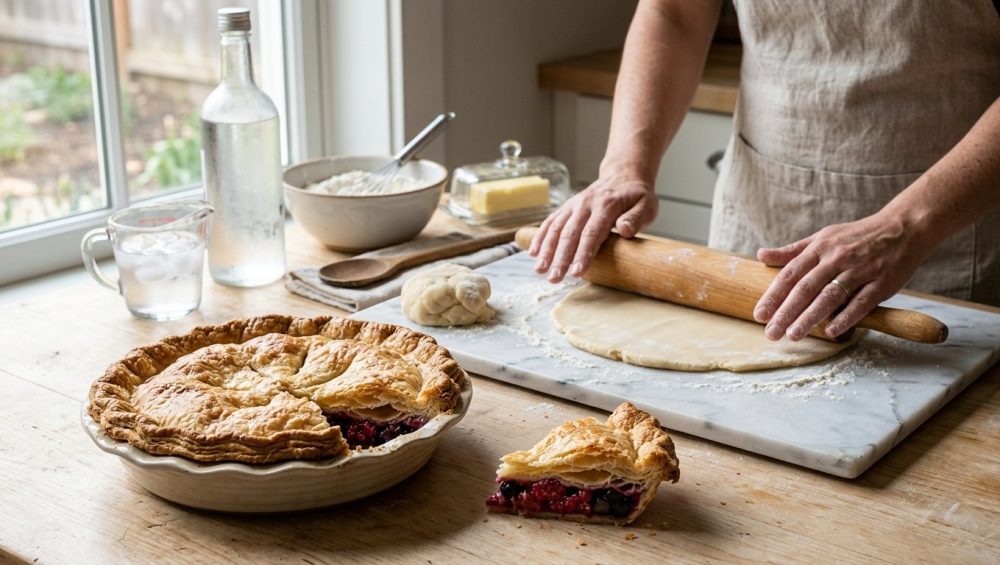
The Infuriating Reality of Pie Dough (And Why You’re Not to Blame)
Let us have a moment of brutal honesty: making pie crust from scratch is one of the most universally frustrating experiences in the home kitchen. If you have ever spent a perfectly good Saturday afternoon on the verge of tears because your dough crumbled into dry, sandy dust on the counter, or conversely, turned into a sticky, unmanageable paste that glued itself to your rolling pin, you are not alone. You are simply experiencing the maddening paradox of traditional pastry baking.
For generations, well-meaning grandmothers, pretentious culinary school instructors, and glossy food magazines have peddled the same incredibly vague advice: “Add ice water one tablespoon at a time until the dough just comes together,” and “Whatever you do, do not overwork the dough.” These instructions are practically designed to induce panic. They leave the everyday home cook guessing, second-guessing, and ultimately failing. When you are rushing to pull together a holiday dinner or just trying to treat yourself to a weekend baking project, you do not have the time or the patience for a recipe that requires a sixth sense to execute properly.
The reality is that traditional pie dough is a high-wire act of chemistry. You are constantly battling the competing needs of hydration and tenderness. If you do not add enough water, the dough will stubbornly refuse to bind, cracking and splitting the moment you attempt to roll it out. If you add even a fraction of a tablespoon too much water, the dough rolls out beautifully but bakes up into a tough, leathery, shrinking frisbee that requires a steak knife to cut through. It is a rigged game. But as a home cook who firmly believes that you do not need a Michelin star or a culinary degree to make mind-blowing food, I am here to tell you that you can cheat the system. You just need to look past your pantry and open your liquor cabinet.
The Science of the Struggle: Water, Flour, and the Gluten Monster
To truly conquer your fear of pie crust, we have to strip away the pretentious chef-speak and look at the cold, hard science of what is actually happening in your mixing bowl. The villain in our story is not your lack of skill; it is a microscopic protein network called gluten.
Gliadin and Glutenin: The Frenemies in Your Flour
Wheat flour contains two specific proteins: gliadin and glutenin. When flour is sitting dry in its bag, these proteins are completely dormant and harmless. However, the exact second that water is introduced to the flour, these two proteins wake up, seek each other out, and chemically bond to form a complex, elastic network known as gluten.
Gluten is an absolute miracle when you are baking a rustic loaf of sourdough bread. The gliadin provides extensibility (the ability of the dough to stretch), and the glutenin provides elasticity (the ability of the dough to snap back into place). When you knead bread dough, you are actively encouraging these proteins to form long, strong, cross-linked strands that will trap yeast gases and give the bread its satisfying, chewy structure.
But in a pie crust, gluten is the ultimate enemy. You do not want a chewy pie crust. You want a tender, delicate structure that shatters into flaky layers the moment your fork hits it. Therefore, the entire goal of making pie dough is to actively sabotage gluten development while still forming a cohesive mass. Before we even talk about liquids, you must stop scooping your flour with a measuring cup, which packs it down, adds excess protein to your bowl, and throws off your entire ratio. Instead, you need to use a digital kitchen scale to ensure you are starting with the exact right amount of dry ingredients.
The Hydration Paradox
Herein lies the baker’s ultimate dilemma. To prevent gluten from forming, you need to limit the amount of water you add to the flour. Standard pastry ratios generally follow a 3:2:1 rule—three parts flour, two parts fat, and one part liquid by weight. The fat (usually butter, shortening, or lard) coats the flour particles, creating a physical waterproof barrier that prevents the water from reaching the gliadin and glutenin.
However, you still need some liquid to bind the dry, fat-coated flour into a dough that can actually be rolled out with a rolling pin. If you strictly limit the water to prevent gluten, the dough remains a crumbly, infuriating mess. If you add enough water to make the dough smooth and pliable, the water bypasses the fat barriers, hydrates the proteins, and triggers a massive gluten network. This is exactly why your crust shrinks down the sides of your pie dish in the oven and turns out dense and chewy. You are trapped in the hydration paradox.
Enter the Liquor Cabinet: The Magic of Chilled Vodka
This brings us to one of the most brilliant, scientifically sound kitchen hacks of the modern culinary era. If water is the trigger for the gluten monster, what if we could add a liquid that provides the physical moisture needed to bind the dough, but doesn’t trigger gluten formation?
The 2007 Test Kitchen Revolution
In 2007, J. Kenji López-Alt, a culinary scientist and recipe developer working for Cook’s Illustrated, was tasked with solving this exact problem. The goal was to create a truly foolproof pie dough that an absolute beginner could roll out with ease, without the risk of overworking it into a tough, leathery state. He realized that the answer lay in manipulating the chemical properties of the hydrating liquid.
Why Vodka? The 40/60 Rule
The secret ingredient is 80-proof vodka. By definition, an 80-proof spirit is composed of exactly 40% pure ethanol (alcohol) and 60% water.
Here is where the magic happens: gliadin and glutenin are highly reactive to water, but they do not react to alcohol in the same way. Ethanol does not hydrate these proteins effectively, meaning it cannot force them to link up and form gluten.
When you substitute half of the ice water in your pie dough recipe with chilled vodka, you are adding the total volume of liquid your dough desperately needs to become sticky, pliable, and incredibly easy to roll out. However, because 40% of that vodka is alcohol, you are significantly reducing the amount of actual water that hits the flour. The dough behaves exactly like a highly hydrated, easy-to-work dough on your counter, but chemically, it acts like a low-hydration, low-gluten dough. It is the ultimate culinary loophole.
The Thermodynamics of a Flaky Bake
Now, I know what you are thinking. “I am serving this pie to my children, my sober mother-in-law, and my boss. I cannot serve them a pastry that tastes like a college frat party.” This is where the physics of baking steps in to save the day.
Evaporation Rates: 173°F vs. 212°F
When you place your pie into a screaming hot oven (usually around 400°F to 425°F for the initial bake), the liquids trapped inside the dough begin to heat up and vaporize. Standard water boils and turns into steam at 212°F (100°C). Ethanol, however, has a significantly lower boiling point. It vaporizes at just 173°F (78°C).
Because the alcohol vaporizes at a lower temperature and much more rapidly than water, it aggressively pushes up against the layers of cold fat and flour as it turns into gas. This rapid expansion creates larger, more distinct steam pockets within the dough. When the fat finally melts and the structure sets, those steam pockets are locked into place, resulting in an extraordinarily flaky, shatteringly crisp crust.
Does It Actually Bake Off? The Sober Truth
There is a pervasive myth in the culinary world that “all alcohol completely burns off during cooking.” Science tells us this is not entirely true for all dishes. According to the USDA Table of Nutrient Retention Factors (Release 6), if you stir alcohol into a thick stew or a deep casserole and bake it for a full hour, roughly 25% of the original alcohol content can remain trapped in the dish.
However, pie crust is a completely different thermodynamic environment. You are rolling the dough out to an incredibly thin 1/8-inch layer, maximizing its surface area, and blasting it with intense, direct, dry heat. Under these specific conditions, the evaporation rate of the ethanol in the crust is highly efficient. The vast majority of the alcohol vaporizes into the oven, leaving behind absolutely zero lingering boozy flavor. The vodka does its structural job on the counter and then politely exits the stage in the oven.
The Sassy Sous-Chef’s Foolproof Vodka Pie Crust Masterclass
Alright, enough theory. Let’s get our hands dirty. As someone who survives weekdays on 30-minute meals just to buy the time to be a perfectionist on the weekends, I demand efficiency and reliability from my baking projects. Here is exactly how to execute the vodka pie crust technique flawlessly.
Step 1: Chill Everything (And I Mean Everything)
The golden rule of pastry is temperature control. If your fat melts before the pie hits the oven, you lose your flaky layers, and you end up with a greasy, dense cookie.
Measure out 1/4 cup of water and 1/4 cup of 80-proof vodka, mix them together in a small measuring cup, and put it in the freezer. Cut your butter (1.5 sticks) and your secondary fat (1/2 cup of shortening or lard) into small cubes and put them in the freezer for at least 15 minutes. Even your flour can benefit from a brief stint in the fridge.
Step 2: The Food Processor Technique
While I love the romantic idea of cutting fat into flour by hand with a pastry blender, time is money, and warm hands melt butter. A food processor is your best friend here.
Add 1.5 cups of your flour, 1 tablespoon of sugar, and 1 teaspoon of kosher salt to the food processor. Pulse it twice to combine. Next, add your frozen butter and shortening cubes. Process this mixture continuously for about 15 seconds.
Yes, 15 seconds. Ignore the archaic advice to leave the butter in “pea-sized” chunks. You actually want this initial mixture to look like coarse, wet sand. By fully coating this first batch of flour in fat, you are completely waterproofing it, ensuring zero gluten can form.
Step 3: The Second Flour Addition
Once you have your wet sand, add the remaining 1 cup of flour. Pulse the machine 4 to 6 times, just until the new flour is distributed. This secondary flour remains uncoated by the fat, which means it will interact with the liquid to form just enough gluten to hold the crust together. Empty this entire mixture into a large mixing bowl.
Step 4: The Booze and The Bind
Take your freezing cold vodka-water mixture out of the freezer and sprinkle it evenly over the flour mixture in your bowl. Use a stiff rubber spatula to fold the liquid into the dry ingredients. Press down firmly with the spatula to help the dough clump together. If you are mixing by hand, a Danish dough whisk is the perfect tool to gently fold the liquid in without overworking the mixture.
The dough will look slightly wetter and tackier than you are used to. Do not panic. This is the vodka doing its job, providing moisture without triggering gluten.
Step 5: The Chill Phase
Divide the dough in half, form each half into a 4-inch disc, and wrap them tightly in plastic wrap. The secret power of chilling dough applies just as much to pie crust as it does to baking; it allows the fat to firm back up and gives the minimal gluten you did form time to relax. Skipping this step is a massive rookie mistake; the importance of resting your dough for at least one hour in the refrigerator cannot be overstated.
Upgrading Your Gear: A Brutally Honest Intervention
You can follow the science perfectly, use the best ingredients, and still ruin your pie if you are baking it in garbage equipment. If you have read my column before, you know I am militant about banishing toxic kitchen gear from my home, and pie pans are absolutely no exception.
Ditch the Toxic and Flimsy Pie Pans
I have zero patience for cheap, lightweight aluminum pie tins coated in mystery non-stick chemicals. These dark, toxic coatings (often containing PTFE or PFAS derivatives) are prone to scratching the moment you slice into your pie, leaching forever chemicals into your beautiful homemade dessert. Furthermore, thin metal pans conduct heat erratically, burning the edges of your crust while leaving the bottom soggy and raw. And just as cheap baking sheets keep warping under high heat, flimsy tin pie pans will buckle and distribute heat unevenly.
Instead, invest in high-quality, non-toxic materials.
- Aluminized Steel (Uncoated or Ceramic-Coated): A heavy-gauge aluminized steel pan without toxic coatings provides rapid, even heat transfer, practically guaranteeing a crisp, golden bottom crust.
- Ceramic and Stoneware: These materials take longer to heat up, but they hold heat incredibly steadily, resulting in a beautifully even, gentle bake.
- Tempered Glass: Glass is excellent because it allows you to physically look at the bottom of the crust to check for browning. However, if your glass baking dish shattered in the past, it was likely due to thermal shock from taking it straight from the freezer to a screaming hot oven. Always use caution with temperature swings when using glass.
Essential Dough-Handling Tools
When you are rolling out this beautifully hydrated vodka dough, you need the right tools to handle it. A heavy, French-style tapered wooden rolling pin gives you the tactile feedback necessary to roll the dough evenly without crushing the fat layers.
Furthermore, when it comes to lifting your delicate dough off the floured counter and transferring it to the pie pan, you absolutely need a bench scraper to gently loosen it from the work surface without tearing it.
Customizing the Booze: Can You Use Bourbon or Rum?
One of the most common questions I get from home cooks is: “Do I have to use vodka?” The answer is absolutely not. Vodka is the standard recommendation because it is a neutral spirit; it is completely colorless and flavorless, meaning it will not alter the taste of a delicate fruit filling or a subtle custard.
However, you can absolutely use this technique to introduce complementary flavor profiles into your crust. As long as the spirit you choose is at least 80-proof (40% alcohol by volume), the chemistry of the gluten inhibition will work exactly the same.
- Bourbon: Substituting the vodka for an 80-proof Kentucky bourbon adds incredible depth, vanilla notes, and a subtle smokiness that pairs flawlessly with a rich pecan pie or a brown-butter apple pie.
- Spiced Rum: A dark spiced rum works wonders in the crust of an autumnal pumpkin or sweet potato pie.
- Amaretto or Frangelico: Be careful with liqueurs. While they offer great flavor, they are often much lower in proof (around 40-proof or 20% ABV) and contain high amounts of added sugar, which will cause your crust to brown too quickly and burn in the oven. Stick to the hard stuff.
Troubleshooting Your Dough Like a Pro
Even with the magic of vodka on your side, pastry can still sense fear. If you run into issues, here is how to troubleshoot them without throwing your rolling pin across the kitchen.
Why is My Dough Still Cracking?
If your vodka dough cracks significantly when you try to roll it out, it is likely too cold. While we want the fat to be solid, butter becomes brittle when it is freezing hard. Let the wrapped dough disc sit at room temperature for about 5 to 10 minutes to take the hard chill off before you start rolling. If it cracks slightly at the edges, do not panic. Simply press the cracks back together with your warm fingers. The dough is forgiving.
Why is My Crust Shrinking in the Pan?
If your crust pulls away from the edges of the pie dish and shrinks down the sides during baking, you have committed the cardinal sin of stretching the dough. When you transfer the rolled dough into the pie pan, you must gently lift the edges and let the dough naturally slump down into the corners of the dish. If you push or stretch the dough to make it fit, the minimal gluten network you formed will act like a rubber band. When it hits the heat of the oven, it will snap back to its original size. Just like kitchen knives get dull when you abuse them on glass cutting boards, your pie dough will fight back and shrink if you manhandle it.
Always ensure you let the fully formed, crimped pie crust rest in the refrigerator (or even the freezer) for at least 20 minutes before baking to relax the gluten one final time.
Conclusion: Reclaiming the Weekend Pie
Baking a pie from scratch should be a joyful, rewarding weekend project, not a stressful chore that ends in a tough, inedible crust and a sink full of dirty dishes. By understanding the fundamental science of hydration, respecting the destructive nature of the gluten monster, and utilizing the brilliant chemical loophole of chilled vodka, you can completely eliminate the guesswork from your pastry making.
You do not need to rely on vague advice from outdated cookbooks, and you certainly do not need to settle for mediocre, store-bought crusts rolled up in cardboard boxes. Equip your kitchen with safe, high-quality gear, keep your ingredients ice-cold, and let the science of ethanol do the heavy lifting. Pour yourself a glass of wine, pour a splash of vodka into your mixing bowl, and go bake a pie that will make you look like an absolute culinary genius.