Let’s get one thing straight right out of the gate: there are few culinary disappointments more universally heartbreaking than a bad hash brown. It’s Sunday morning. You’ve got a cup of coffee in one hand, a spatula in the other, and a vision of golden, diner-style perfection in your mind. You just want a plate of crispy, savory comfort food without ordering takeout. But instead of achieving that glorious crunch, you flip your shredded potatoes only to discover a pale, gray, gelatinous clump of despair. It’s soggy. It’s steamed. It’s practically mashed potatoes with an identity crisis.
If this sounds like your weekend breakfast reality, put down the spatula and listen to me. You do not need a culinary degree to fix this. You do not need a three-hundred-dollar appliance. You just need to understand basic physics, respect the ingredients, and utilize the most unsung hero in your entire culinary arsenal: a clean cotton kitchen towel.
The secret to mind-blowing, shatteringly crisp hash browns isn’t a magical seasoning blend or a secret flipping technique. It is aggressive, unapologetic moisture control. Today, we are going to dive deep into the science of the spud, the thermodynamics of your frying pan, and the sheer, brute-force magic of wringing the absolute life out of your potatoes.
The Science of the Spud: Why Moisture Ruins Everything
To conquer the hash brown, you must first understand your enemy. And in this scenario, your enemy is water. A raw potato might feel dense and solid, but from a botanical and chemical standpoint, it is essentially a starchy water balloon.
The Thermodynamics of Steamed Potatoes
On average, a standard potato is composed of roughly 79% water [1]. When you take freshly shredded, raw potatoes and immediately toss them into a hot frying pan, you are setting yourself up for thermodynamic failure. Here is exactly what happens: the intense heat of the pan rapidly forces the water inside the potato cells to evaporate, turning it into steam [1].
Because steam caps out at 212°F (100°C) at sea level, this escaping moisture creates a localized temperature barrier around your food [1]. It acts as a thermal shield, preventing the surface of the potato from ever getting hotter than the boiling point of water. Why is this a catastrophic problem? Because of the Maillard reaction.
The Maillard reaction, first described by French chemist Louis Camille Maillard in 1912, is the complex chemical process between amino acids and reducing sugars that gives browned food its distinctive, rich flavor and golden crust [1]. This beautiful reaction doesn’t even begin to kick off until surface temperatures reach around 285°F (140°C), and it proceeds rapidly at temperatures north of 350°F (176°C) [1].
If your potatoes are sweating out a massive puddle of internal moisture, they are literally locked in a steam bath [1]. The surface temperature cannot rise high enough to trigger the Maillard reaction. Instead of frying, your potatoes are gently steaming themselves into a mushy, flavorless paste. Moisture is the ultimate saboteur of crispiness.
Starch Content and Potato Varieties
Not all potatoes are created equal, and choosing the wrong tuber will doom your breakfast before you even turn on the stove. Potatoes generally fall into three categories: waxy, starchy, and all-purpose [1].
Waxy potatoes, such as Red Bliss or delicate Fingerlings, have a low starch content and a very high moisture content [1]. They hold their shape beautifully when boiled, making them the undisputed champions of potato salad. However, if you try to make hash browns out of waxy potatoes, their high water content and lack of expansive starch cells will result in a gummy, wet disaster.
For hash browns, you need the heavy hitter: the starchy potato [1]. In the United States, this almost exclusively means the Russet (or Idaho) potato. Russets have a thick, coarse skin and a dry, floury, high-starch interior [1]. Because they naturally contain less moisture, they are much easier to dry out. Furthermore, when exposed to high heat, those abundant starch cells expand, separate, and toast, creating a light, fluffy interior and a deeply crunchy exterior [1]. It is the exact same cellular architecture that allows you to whip up perfectly fluffy mashed potatoes. If your grocery store is out of Russets, a medium-starch Yukon Gold can work in a pinch, but Russets will always reign supreme for frying [1].
The Kitchen Towel Technique: A Masterclass in Wringing
Now that we understand the science of why moisture ruins our breakfast, we can deploy the ultimate countermeasure. This is where the kitchen towel steps into the spotlight. You are going to use it to manually extract the water from the potato before it ever has a chance to hit the pan.
Choosing the Right Towel
Before you grab the nearest rag hanging off your oven handle, we need to talk about textiles. The material of your towel is critical.
Do not use a terry cloth towel. Terry cloth is woven with thousands of tiny, looped piles designed to absorb water after a shower. In the kitchen, those loops shed lint, trap stubborn bacteria, and will leave your shredded potatoes looking like they grew a layer of fuzz. Do not use synthetic microfiber towels. Not only do they shed microplastics, but many cheap microfibers can actually melt or degrade if they come into contact with residual heat [1]. And please, do not even think about using paper towels. Paper towels lack the structural integrity required for this job; they will instantly disintegrate into a soggy, pulpy mess, leaving you picking wet confetti out of your raw potatoes.
You need a 100% cotton flour sack towel [1]. Historically made from salvaged cotton bags used to transport bulk flour and grains, these towels are tightly woven, exceptionally thin, highly absorbent, and entirely lint-free [1]. They are practically indestructible and can withstand an immense amount of torque. A stack of high-quality flour sack towels belongs in any essential kitchen survival guide. They are the workhorses of a functional kitchen.
The Step-by-Step Wringing Process
Once you have the right towel, it’s time for some manual labor. Lay your flour sack towel flat on the counter and pile your freshly shredded, rinsed potatoes directly into the center.
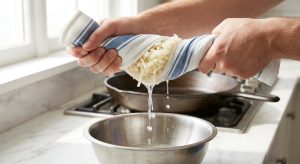
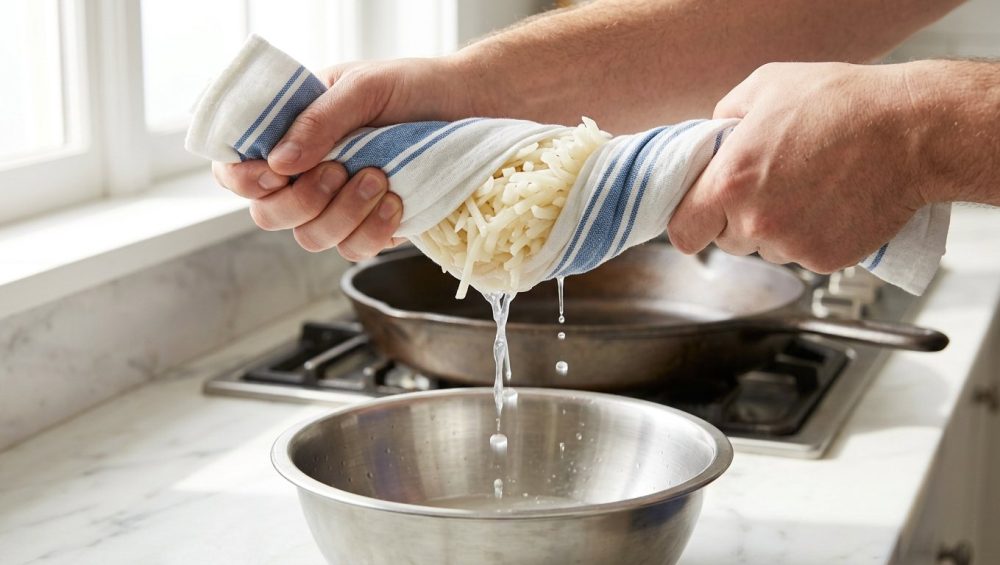
Gather the four corners of the towel together, creating a tight bundle. Lift it over your sink. Now, twist the top of the bundle to close it, and start squeezing. Squeeze hard. As you apply pressure, you will see a steady stream of murky, starchy liquid pour out of the bottom of the towel.
When your forearms start to burn and you think you have extracted every possible drop of water, twist the towel one more rotation and squeeze again. You will be absolutely astounded by the sheer volume of water that a single Russet potato can hide. You can spend thousands of dollars on the most beautiful aesthetic kitchen upgrades, but if you skip this gritty, hands-on step, your hash browns will never achieve diner-level greatness. The potatoes should feel remarkably dry, almost like slightly damp straw, when you finally unwrap the towel.
Beyond the Squeeze: Perfecting the Pan and the Fat
You’ve successfully dehydrated your potatoes. You’ve won the first battle. But if you drop those perfectly prepped shreds into the wrong pan with the wrong fat, you will snatch defeat from the jaws of victory.
Banishing Toxic Non-Stick Cookware
I have absolutely zero patience for cheap, lightweight, toxic non-stick cookware, and neither should you. I am a relentless, vocal advocate for banishing toxic kitchen gear from the home.
Flimsy aluminum pans coated in Teflon (PTFE) or other “mystery metal” non-stick coatings are a culinary liability. First, they cannot safely handle the high heat required to get a serious, aggressive sear on a hash brown. When heated past 500°F (260°C), these chemical coatings begin to break down, releasing toxic fumes and shedding little black flakes of synthetic polymer into your food. Second, they lack thermal mass. When you take a mound of room-temperature potatoes and drop them into a thin aluminum pan, the temperature of the metal plummets instantly. The pan cannot recover its heat fast enough, meaning your potatoes will sit in lukewarm oil and gently steam instead of violently frying.
Furthermore, if you are relying on aerosol cooking sprays to lubricate these cheap pans, you are actively ruining your nonstick pans. The soy lecithin and chemical propellants in those sprays burn and polymerize onto the surface at relatively low temperatures, creating a sticky, invisible lacquer that destroys whatever non-stick properties the pan originally had. Throw them in the trash.
The Glory of Heavy Metal
To make perfect hash browns, you need heavy metal: specifically, cast iron or carbon steel. These materials are essentially giant thermal batteries. They take a few minutes to properly preheat, but once they are hot, they stay hot. When you add your potatoes, the thick iron retains its kinetic energy, transferring that heat directly into the food to instantly kickstart the Maillard reaction [1].
Yes, they require a tiny bit of maintenance. But they are naturally non-stick when properly seasoned and preheated. If you are terrified to use traditional cookware because your cast iron leaves black specks on your food, that simply means you have built up a layer of burnt, un-polymerized carbon that needs to be scrubbed off and re-seasoned. It does not mean you should revert to toxic chemical pans. Treat your heavy metal right, and it will outlive you.
Choosing the Right Cooking Fat
The fat you choose serves two purposes: it acts as a heat transfer medium, conducting the thermal energy from the pan into the uneven nooks and crannies of the shredded potato, and it provides rich flavor.
Do not use standard whole butter. Whole butter contains milk solids and water. Those milk solids will scorch and burn at around 350°F (176°C) [1], turning bitter and black long before your potatoes have had time to cook through to the center.
If you want that classic, rich, buttery diner flavor, you must use clarified butter or ghee. By slowly melting butter and skimming off the milk solids and water, you are left with pure butterfat, which boasts a massive smoke point of 450°F (232°C). Alternatively, beef tallow is an old-school diner secret that adds an incredible, savory depth of flavor. If you prefer to use oil, reach for a high-heat, neutral option like avocado oil, which can withstand temperatures up to 520°F (271°C) without breaking down into acrid smoke.
The Perfect Shred: Tools of the Trade
Before we hit the stove, let’s briefly discuss the mechanics of breaking down the potato. The size and cleanliness of your shred matter immensely.
Box Grater vs. Food Processor
You have two main options here: a food processor with a shredding disc, or a traditional manual box grater. A food processor is undeniably fast, especially if you are cooking for a crowd. However, pulling out a heavy appliance, assembling it, and then having to wash five different plastic components is often more hassle than it’s worth for a standard weekend breakfast.
A traditional stainless steel box grater is inexpensive, compact, and highly effective. But there is one crucial caveat: it must be sharp. Over time, the stamped metal teeth of a cheap box grater will dull. When you drag a potato across dull teeth, you aren’t cleanly slicing the flesh; you are violently mashing and bruising the cell walls. This premature cellular destruction forces the potato to weep excess starch and water before you even get it to the towel. Using a dull box grater is just as counterproductive as ruining your knives by aggressively chopping on a glass or stone cutting board. Keep your tools sharp.
The Great Rinsing Debate
There is a fierce debate in the culinary world about whether you should rinse your shredded potatoes before wringing them out. The answer is an unequivocal yes.
When you shred a potato, you rupture millions of starch cells, coating the exterior of the shreds in a sticky, milky liquid [1]. If you leave this surface starch intact, two things will happen. First, the starch will rapidly oxidize when exposed to the air, turning your beautiful potatoes an unappetizing, bruised gray color. Second, when that excess surface starch hits the hot pan, it will instantly gelatinize and act like a high-strength culinary glue, fusing your hash browns into a dense, impenetrable brick.
To prevent this, immediately transfer your raw shreds to a fine-mesh strainer and run them under cold water until the water runs completely clear. Then, transfer them to your flour sack towel and wring them dry. You are washing away the sticky surface starch while retaining the internal starch that provides the fluffy texture.
The Cooking Process: From Raw to Diner-Level Crispy
You have wrung your rinsed potatoes completely dry. You have a heavy pan. You have the right fat. It is time to cook.
Heat Management and the Sizzle
Place your cast iron or carbon steel skillet on the burner and preheat it over medium heat. Do not rush this step. If you drop your potatoes into cold fat, they will act like a sponge, soaking up the oil and becoming heavy, greasy, and flabby. You want the pan hot enough that the potatoes immediately sizzle and begin frying the second they make contact.
If you are opting to use a heavy-bottomed, multi-clad stainless steel skillet instead of cast iron, heat management is even more critical. You must allow the stainless steel to thoroughly preheat before adding your fat. Use the water drop test to check the surface temperature. Flick a few drops of water into the dry pan; if they instantly vaporize, it’s not hot enough. If they bead up and glide across the surface like liquid mercury (the Leidenfrost effect), the pan is perfectly preheated. Add your oil, wait ten seconds for it to shimmer, and add your potatoes.
The Art of the Flip
Add your dry, shredded potatoes to the hot fat. Using a wide spatula, gently spread them out into an even layer, roughly half an inch to three-quarters of an inch thick. Press down firmly—but not aggressively—to ensure that the maximum amount of potato surface area is in direct contact with the hot metal.
Now comes the hardest part of the entire recipe: walk away.
Do not poke them. Do not stir them around like you’re sautéing onions. Do not continuously lift the edges to check the underside. Every time you agitate the potatoes, you interrupt the heat transfer and disrupt the crust formation. The Maillard reaction takes time [1]. Let the pan do the work.
Allow the potatoes to fry undisturbed for at least 5 to 7 minutes. You are waiting for the edges to turn a deep, golden, caramelized brown. You will actually hear the sound of the sizzle change; as the last bits of surface moisture evaporate, the aggressive popping will subside into a steady, rhythmic crackle.
Once the bottom is beautifully crusted and structurally sound, slide a wide spatula underneath and confidently flip the entire patty in one fluid motion. Add a tiny bit more fat to the edges of the pan if it looks dry, and let the second side fry for another 4 to 5 minutes.
Troubleshooting Your Breakfast Tragedies
Even with the towel trick, things can occasionally go sideways if your heat management or prep technique is sloppy. If your hash browns aren’t perfect, diagnose the problem so you can fix it next time.
Gummy, Undercooked Centers
If the outside of your hash brown is crispy but the inside is a gummy, raw, translucent mess, you made the patty too thick. Heat can only penetrate so far into a dense layer of starch. If you pile the shreds two inches high, the exterior will burn long before the ambient heat can cook the center. Keep your layers thin and even.
Burnt Edges, Raw Middles
If your hash browns are rapidly turning black and tasting acrid, your pan is entirely too hot. The Maillard reaction is a beautiful thing, but if the temperature gets too high, it quickly crosses the threshold into pyrolysis—the chemical breakdown that leads to burning and bitter, carbonized flavors [1]. If your fat is smoking aggressively, turn the burner down. Medium heat is the sweet spot; it provides enough energy to crisp the exterior while allowing time for the internal heat to gently cook the inside.
Uneven Texture and Stringy Bits
If your hash browns have an awful, uneven texture—some pieces burnt, some pieces raw—your shredding technique is flawed. You probably hacked at the potato with a dull blade or forced it through a cheap grater, resulting in wildly different sizes of potato shreds. Different sizes cook at different rates. If you ever wonder why your knives get dull so fast, you are likely abusing them on hard surfaces or running them through the dishwasher, which translates directly to poorly prepped ingredients that cook unevenly. Treat your blades with respect, and your food will cook uniformly.
Bland, Cardboard Flavor
Potatoes are a blank culinary canvas. They are desperate for seasoning. If your hash browns look beautiful but taste like crispy cardboard, you failed to season them properly. Do not salt your potatoes while they are sitting in the towel, as salt draws out moisture through osmosis, which will make them endlessly wet. Instead, season them generously with kosher salt the absolute second they hit the hot pan. When you flip them, season the cooked side. And finally, hit them with a finishing pinch of flaky sea salt as soon as you slide them onto your plate, while the residual fat is still hot enough to absorb the flavor.
Conclusion: Reclaiming Your Weekend Breakfast
Cooking incredible food at home isn’t about magic, and it certainly isn’t about pretentious chef-speak or overly complicated techniques. It is about understanding the fundamental properties of your ingredients and applying a little bit of common sense and elbow grease.
The humble kitchen towel is the ultimate equalizer in the war against soggy breakfasts. By taking three extra minutes to aggressively wring the water out of your shredded potatoes, you eliminate the steam barrier, unlock the full potential of the Maillard reaction, and guarantee a shatteringly crisp crust every single time.
So this weekend, skip the crowded diner lines. Grab a Russet potato, heat up your cast iron skillet, and show that starch exactly who is boss. You have the knowledge, you have the tools, and you have the technique. Now go make some mind-blowing hash browns.