Listen, we need to have a serious talk about the state of your side dishes. I know you are a busy person trying to get a decent dinner on the table between a chaotic workday and whatever evening disaster is currently unfolding in your living room. But that is absolutely no excuse for serving mashed potatoes that have the structural integrity of industrial wallpaper paste. You know exactly what I am talking about: that sticky, gummy, heavy spackle that clings aggressively to the roof of your mouth, sits in your stomach like a lead weight, and makes everyone at the dinner table quietly reconsider their life choices.
You do not need a culinary degree from Le Cordon Bleu to make mind-blowing, cloud-like, perfectly fluffy mashed potatoes. You do not need a brigade of sous-chefs, and you certainly do not need to rely on those terrifying dehydrated potato flakes that come in a cardboard box. You just need to understand a tiny bit of food science and stop treating your ingredients like they owe you money.
So, pour yourself a generous glass of wine, take a deep breath, and let’s fix this once and for all. We are going to dive incredibly deep into the cellular anatomy of the potato, the thermodynamics of boiling, and the mechanical physics of mashing. By the time we are done, you will have a foolproof, stress-free method for weeknight dinners, and you will never have to apologize for a gluey side dish ever again.
The Botany of the Spud: Understanding Your Ingredients
To understand why your potatoes are turning into glue, we have to travel down to the microscopic level. According to legendary food scientists like Harold McGee, the potato is essentially a dense, swollen underground stem—a tuber—designed by nature to store energy for the plant. This energy is stored in the form of starch, and those starches are packed into microscopic biological packets called amyloplasts.
When a potato is raw, these starch granules are tightly packed, crystalline, and completely indigestible to humans. However, when we apply heat and water through the cooking process, a magical transformation called gelatinization occurs. Right around 140 to 150 degrees Fahrenheit, the starch granules begin to absorb surrounding water. They swell up like tiny water balloons, and eventually, their rigid crystalline structure melts away, leaving them fragile and swollen.
Inside these swollen cellular water balloons are two very specific types of starch molecules: amylose and amylopectin. Amylopectin is a highly branched molecule that is relatively stable. Amylose, on the other hand, is a long, straight-chain molecule, and it is the exact culprit behind your culinary nightmares. When you violently rupture the swollen potato cells, the amylose spills out into the surrounding environment and tangles up with other amylose molecules. This creates a highly cohesive, sticky, gummy network. In fact, this exact chemical principle has been used historically to manufacture actual glue for bookbinding and wallpapering. If your mashed potatoes are sticky, it is because you have quite literally manufactured edible adhesive.
The Potato Matrix: Choosing Your Fighter
Not all potatoes are created equal, and choosing the wrong variety is the first rookie mistake that will doom your side dish before you even turn on the stove. Grocery stores generally do not sort potatoes by their chemical composition, but you need to view them on a spectrum from high-starch to low-starch.
The High-Starch Heroes: Russets
Russet potatoes, often labeled as Idaho baking potatoes, are the undisputed kings of the fluffy mash. They boast an incredibly high starch content—averaging around 21 percent solids to 79 percent water—and a very high proportion of amylose. Because of this unique ratio, when Russets are cooked, their cells swell and separate from one another very easily with minimal mechanical force. They fall apart into a dry, mealy texture that is practically begging to act as a sponge for butter and cream. If you want the lightest, airiest, most classic mashed potatoes possible, Russets are your holy grail.
The Buttery Compromise: Yukon Golds
Bred in Canada in the 1960s, Yukon Golds sit right in the middle of the potato spectrum. They are a medium-starch, medium-moisture hybrid that offers a naturally rich, buttery flavor and a gorgeous golden hue. Because they have slightly less starch and more moisture than a Russet, they will never achieve that same cloud-like fluffiness. Instead, they produce a denser, creamier, more velvety mash. They are an incredibly acceptable choice for a weeknight dinner, especially if you prioritize robust flavor over a purely airy texture.
The Enemies of Fluff: Red and Waxy Potatoes
Red Bliss, New Potatoes, and Fingerlings are waxy potatoes. They have a very low starch content and a very high moisture content. Their cellular structure is designed to stay tightly bonded together even after prolonged boiling, which makes them absolutely brilliant for potato salads, soups, and roasting. However, this same quality makes them a nightmare for mashing. Because their cells refuse to separate easily, you have to apply a massive amount of mechanical force to mash them smooth. By the time you finally crush away all the lumps, you will have inevitably ruptured millions of cells, released a flood of amylose, and created a dense, gluey paste. Keep waxy potatoes far away from your mashing tools.
Prep Work: Setting the Stage for Success
Now that you have selected the correct high-starch potato, it is time to prep. Do not rush this phase. Weeknight cooking requires efficiency, but cutting corners here will ruin the final texture.
First, you must peel your potatoes. I know the rustic, skin-on mashed potato trend is popular in certain hipster gastropubs, but the skin introduces an entirely different, chewy texture and traps excess moisture. For a definitive, masterclass-level fluffy mash, the skins must go.
Next, grab your favorite heavy-duty wooden cutting board and a sharp chef’s knife. You need to break the potatoes down into perfectly uniform cubes, roughly one to one-and-a-half inches in size. Uniformity is strictly non-negotiable. If you have tiny pieces mixed with giant chunks, the small pieces will overcook, absorb too much water, and disintegrate into mush, while the large pieces will remain raw and crunchy in the center. If you happen to need a bench scraper to efficiently scoop up all your perfectly uniform potato cubes and transfer them to your cooking pot, make sure you are using a high-quality stainless steel one rather than a flimsy piece of plastic.
Once your potatoes are diced, throw them into a colander and rinse them thoroughly under cold running water. Your knife just sliced through thousands of potato cells, spilling raw starch all over the surface of the cubes. If you do not wash that surface starch away, it will instantly turn into a gummy gel the second it hits the hot water.
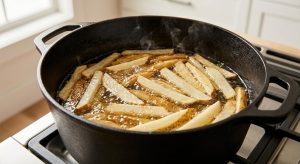
Finally, place your rinsed potato cubes into a large, heavy-bottomed pot and cover them with cold water. I cannot stress this enough: always begin the cooking process with cold water. If you drop raw potatoes into boiling water, the exterior of the potato cooks instantaneously. The starches on the outside gelatinize and form a hard, impenetrable barrier, preventing the heat from reaching the center. By starting in cold water, the temperature of the potato rises evenly alongside the water, ensuring that the inside and the outside cook at the exact same rate.
The Crucible: Boiling Thermodynamics
With your potatoes submerged in cold water, it is time to season. This is your one and only opportunity to flavor the actual cellular interior of the potato. Once the starch gelatinizes, it locks up, and any salt you add later will merely sit on the surface. Treat your potato water exactly like pasta water; it should be aggressively salted.
Place the pot over medium-high heat. As soon as the water reaches a boil, you must immediately reduce the heat. You are looking for a gentle simmer, not a violent, rolling boil. A rolling boil creates intense turbulence in the water. That aggressive agitation will violently smash the softening potato cubes against each other and against the hard metal sides of the pot. This premature physical trauma will break down the cell walls before you even start mashing, turning your cooking water into a cloudy, starchy slurry and waterlogging your potatoes.
Cook the potatoes until they offer absolutely no resistance when pierced with a paring knife. They should be completely tender all the way through, but they should not be actively falling apart or disintegrating into the water.
Once they are perfectly tender, drain them thoroughly in a colander. But we are not done yet. You must execute the crucial “drying” phase. Return the drained potatoes immediately to the hot, empty pot, and place it back on the stove over low heat for about one to two minutes. Gently shake the pot. You will see steam rising from the potatoes as the residual surface moisture evaporates. Water is the mortal enemy of a fluffy mash; if your potatoes are waterlogged, the fat will not be able to coat the starch cells properly, resulting in a soggy, heavy mess.
Weapons of Mass Destruction: The Physics of Over-Mashing
We have reached the most critical juncture of the entire process. Your potatoes are perfectly cooked, dry, and fragile. How you handle them in the next three minutes dictates whether you end up with a culinary masterpiece or a bowl of glue.
Remember our food science lesson: you want to separate the swollen potato cells from one another without bursting them open. This means you must apply the absolute minimum amount of mechanical shear force necessary.
This brings us to the appliances that have single-handedly ruined millions of Thanksgiving dinners. If you want to avoid the catastrophic danger of the blender, you must leave it unplugged and far away from your potatoes. A blender or a food processor operates using high-speed rotary blades. These blades act like microscopic lawnmowers, violently slicing and shearing open almost every single starch granule in the bowl. Within ten seconds of turning on a food processor, you will have released so much amylose that your potatoes will literally stretch like melted mozzarella cheese.
Similarly, you must ditch the hand mixer immediately. While it may seem like a great shortcut for a busy weeknight, the high-speed whipping action of the beaters relies on aggressive shear force. It will invariably overwork the starch and leave you with a sticky, dense paste.
This is also the perfect time to address the absolute garbage tools sold in most big-box stores. I am a fierce advocate for permanently banishing toxic kitchen gear from your home. Do not use cheap, flimsy nylon or plastic potato mashers. Not only do they bend and warp, requiring you to apply twice as much downward force (which ruptures more cells), but they also degrade under high heat and can leach microplastics or shed peeling coatings directly into your hot food. You deserve better. Your food deserves better.
The Arsenal: Proper Mashing Tools
To achieve professional-level fluffiness in a standard home kitchen, you need tools designed to separate cells gently.
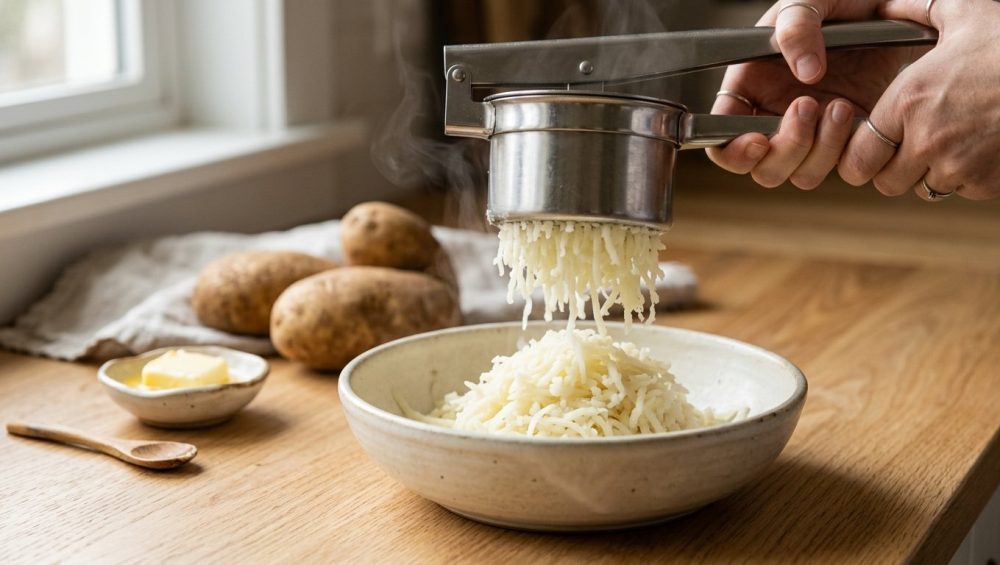
The absolute undisputed champion of the kitchen is the stainless steel potato ricer. If you have ever eaten mashed potatoes in a high-end restaurant and wondered how they achieved that impossibly light, cloud-like texture, this tool is the answer, and that is exactly why you need a ricer in your culinary arsenal. A ricer operates like a giant garlic press. You place the cooked potatoes into the hopper and squeeze the handles. The potato is gently extruded through dozens of tiny holes just one single time. There is no repetitive smashing, no high-speed shearing, and no violent friction. The potato emerges in delicate, uniform strings, completely lump-free, with its cellular structure remarkably intact.
If you do not have a ricer, a food mill fitted with a medium disc is an excellent secondary option. It uses a rotating blade to gently press the potatoes through a perforated plate, achieving a very similar extrusion effect with minimal cell damage.
If you absolutely must use a traditional hand masher, ensure it is a heavy-gauge, solid stainless steel grid masher rather than a squiggly wire one. A grid masher cuts through the potato cleaner and faster. Press straight down and lift straight up. Do not twist, do not stir vigorously, and stop the very second the big lumps are gone.
The Chemistry of Creaminess: The Emulsion Phase
Mashing the potatoes is only half the battle; now we must turn them into a rich, creamy masterpiece. Mashed potatoes are essentially a delicate culinary emulsion of starch, water, and fat. How you introduce your dairy dictates the final texture.
The golden rule of the emulsion phase is: Fat goes in first. Always.
When you fold melted butter into your freshly riced potatoes before adding any liquid, the fat molecules coat the exterior of the intact starch cells. This luxurious coating of milk fat acts as a biological lubricant. It physically prevents the starch cells from linking up and bonding with one another, which stops the gummy network of amylose from forming.
Conversely, if you add milk or cream first, the thirsty starch cells will immediately absorb the water content from the dairy. They will swell even further, become waterlogged, and turn sticky. Only after the potatoes have absorbed all the butter should you introduce your liquid.
Furthermore, temperature is wildly important. Never, under any circumstances, add cold butter or cold milk to hot potatoes. Introducing cold ingredients rapidly drops the temperature of the starch. This causes a chemical reaction known as retrogradation, where the starches lock up, firm up, and take on a waxy, unpleasant texture.
Take three minutes on your weeknight to gently heat your butter and your whole milk (or heavy cream) in a small saucepan on the stove, or even in the microwave, until the butter is completely melted and the milk is steaming.
When it is time to combine, do not stir aggressively. Pour the hot melted butter over the riced potatoes and use a silicone spatula to gently fold it in, using broad, sweeping motions. Once the butter is absorbed, gradually fold in the hot milk until you reach your desired consistency. Taste for seasoning, add a final pinch of salt or white pepper if needed, and stop touching them.
Troubleshooting and Serving: When Good Potatoes Go Bad
Even with the best intentions, mistakes happen. However, it is vital to manage your expectations regarding what can and cannot be salvaged in the kitchen.
If you overworked the starch and your potatoes turn gluey, I must be brutally honest with you: you cannot fix them. There is no secret ingredient, no splash of vinegar, and no amount of extra butter that will magically stuff the spilled amylose back inside the ruptured cell walls. The chemical reaction has already occurred. If you find yourself with a pot of sticky paste, your best option is to pivot. Add a massive handful of shredded Gruyère and mozzarella to lean into the stretchy texture and call it Pommes Aligot, or chill the mixture, form them into patties, coat them in breadcrumbs, and fry them into potato croquettes.
Similarly, if you notice your side dish feels incredibly heavy on the palate, just like when your baked potatoes are dense, the issue usually stems from trapped moisture or choosing the wrong potato variety from the start. Waterlogged waxy potatoes will never become light and airy, no matter how perfectly you rice them.
If you are preparing these for a dinner party or a holiday gathering and need to hold them before serving, do not leave them sitting on a cold counter, and do not keep them over direct heat on the stove, which will dry them out and scorch the bottom. Instead, construct a simple double boiler. Place your perfect mashed potatoes in a heat-proof glass or stainless steel bowl, and set that bowl over a pot of barely simmering water. Drape a clean kitchen towel over the top of the bowl before placing the lid on; the towel will catch any condensation and prevent water droplets from falling back into your beautiful, fluffy potatoes.
Cooking incredible food at home does not require magic, and it does not require a stressful, chaotic environment. It simply requires respecting the science of your ingredients and using the right techniques. Treat your potatoes with a little bit of gentle respect, throw away your cheap plastic mashers, and you will be rewarded with a side dish so spectacularly fluffy, it might just steal the spotlight from the main course. Now get into the kitchen and show those spuds who is boss.