Picture this: It is a beautiful Saturday afternoon. You have spent the last two hours meticulously measuring flour, creaming butter, and separating eggs to bake what is supposed to be a transcendent, bakery-level lemon ricotta cake. You pull it out of the oven, let it cool, and take that highly anticipated first bite. But instead of a bright, sunshiny burst of citrus, your mouth is flooded with a harsh, soapy, medicinal bitterness that lingers on your palate like a bad decision.
You did not burn the cake. Your ingredients were fresh. You followed the recipe to the letter. So, what went wrong?
The culprit is not your lack of culinary prowess. The culprit is sitting in your kitchen drawer right now, masquerading as a helpful prep tool. It is your dull, stamped-metal box grater, and it has been sabotaging your food for years.
As a home cook, you do not need a Michelin star or a fancy culinary degree to make mind-blowing food. You simply need to understand the basic science of your ingredients and use the right equipment to manipulate them. I firmly believe that mastering the art of the kitchen is about working smarter, not harder. Today, we are going to dive deep into the anatomy of a citrus fruit, expose the mechanical flaws of traditional zesting tools, and explore the absolute genius of the photo-etched rasp grater. By the end of this masterclass, you will understand exactly why a simple, specialized tool upgrade can instantly eliminate harsh, bitter flavors from your favorite recipes.
The Anatomy of a Citrus Fruit: A Tale of Two Layers
To understand why your lemon zest tastes bitter, we first have to take a microscopic look at the fruit itself. Citrus fruits—whether they are lemons, limes, oranges, or grapefruits—are technically a type of modified berry known in botany as a hesperidium. The outer shell of this berry is divided into two highly distinct layers, and treating them as if they are the same thing is one of the most common beginner cooking mistakes that will ruin a dish.
The Flavedo: The Culinary Goldmine
The outermost layer of a citrus fruit is called the flavedo. This is the brightly colored skin—the yellow of the lemon, the green of the lime, the vibrant orange of the tangerine. If you look closely at the flavedo, you will notice that it has a pebbled, textured surface. Those tiny bumps are actually microscopic, balloon-like sacs filled with highly concentrated essential oils.
The flavedo is where the magic happens. It contains a complex mixture of hundreds of volatile aromatic compounds, the most prominent being a terpene called limonene. In sweet oranges and lemons, limonene can make up anywhere from 75% to 95% of the essential oil profile. This compound is responsible for that bright, floral, intoxicatingly fresh citrus aroma that we all love. When a recipe calls for “zest,” this millimeter-thick layer of fragrant oil is exactly—and exclusively—what the recipe writer is asking for.
The Albedo: The Bitter Villain
Immediately beneath the colorful flavedo lies the albedo, commonly known as the pith. This is the thick, white, spongy layer that acts as a protective shock absorber for the delicate fruit segments inside.
While the albedo is packed with healthy dietary fiber and pectin, it is an absolute nightmare for your tastebuds. The albedo is heavily laden with flavonoid compounds, specifically naringin and limonin. In nature, these intensely bitter compounds serve an evolutionary purpose: they act as a chemical defense mechanism to deter insects and animals from eating the fruit before the seeds are fully mature.
When you accidentally include the albedo in your cooking, you are essentially seasoning your food with the plant’s natural pest repellent. It does not matter how much sugar you add to your lemon tart or how much butter you mount into your lemon-caper pan sauce; if you introduce naringin and limonin into the mix, the bitterness will overpower the delicate terpenes and ruin the dish.
The goal of zesting, therefore, is an exercise in microscopic precision. You must extract the oil-rich flavedo while leaving the bitter albedo completely untouched. And this is exactly where your traditional box grater fails you.
The Box Grater: A Kitchen Crime Scene
Let me be perfectly clear: when you are trying to cure cooking anxiety, the last thing you need is a tool that actively fights against you. The traditional four-sided box grater is a staple in many home kitchens, and while it is perfectly fine for shredding a block of cheddar cheese or a zucchini, it is a weapon of mass destruction when applied to a delicate lemon.
The Problem with Stamped Metal
To understand why the box grater ruins citrus, you have to look at how it is manufactured. The vast majority of standard box graters are made using a process called metal stamping. A manufacturer takes a flat sheet of cheap stainless steel and runs it through a massive, high-pressure mechanical press. The press punches holes into the metal, forcing the edges of the holes to protrude outward.
Because the metal is violently punched rather than sharpened, the resulting cutting edges are incredibly blunt and jagged on a microscopic level. They are not blades; they are blunt-force trauma instruments.
Mashing, Tearing, and Bruising
When you drag a lemon across the small holes of a stamped-metal box grater, the blunt teeth do not slice through the skin. Instead, they mash and tear at the fruit.
First, the blunt impact crushes the delicate oil sacs in the flavedo. Instead of capturing those precious volatile oils in your zest, the oils are sprayed into the air (which is why your kitchen smells great, but your food tastes bland) or left smeared across the metal surface of the grater.
Second, because the blunt teeth require you to apply significant downward pressure to get any results, the grater inevitably digs too deeply into the fruit. It blows right past the millimeter-thin flavedo and gouges deep into the white albedo. By the time you are done, you are left with a sad, bruised lemon and a pile of zest that is at least fifty percent bitter white pith.
The Knuckle-Busting Cleanup Nightmare
As if ruining your food wasn’t enough, the stamped box grater is a physical hazard. Because you have to press so hard, one slip of the hand results in grated knuckles. Furthermore, the jagged, punched holes trap the torn citrus fibers, making the grater an absolute nightmare to clean. You end up shredding your kitchen sponge trying to scrub the dried, sticky citrus oils out of the crevices.
It is inefficient, it is dangerous, and it ruins your food. It is time to upgrade.
The Rasp Grater: A Masterpiece of Photo-Etched Perfection
Enter the hero of our story: the rasp-style grater. If you want to cook like a pro, this is one of those essential kitchen tools that will outlast almost everything else in your drawer. But the culinary rasp grater didn’t actually start in the kitchen at all. It started in a woodshop.
From the Workshop to the Kitchen
The modern culinary rasp grater was born in 1990, invented by brothers Richard and Jeff Grace in Russellville, Arkansas. Their company, Grace Manufacturing, specialized in making precision thin-metal parts for high-tech printers using a chemical process. Looking to expand their product line, they used their specialized manufacturing technique to create a highly efficient woodworking rasp for smoothing and shaping lumber.
The tool was a hit among carpenters, but its true destiny was realized in 1994 by a Canadian homemaker named Lorraine Lee. Lorraine was attempting to bake an Armenian orange cake, but her traditional stamped-metal grater was tearing the fruit to shreds and producing a bitter mess. Out of pure frustration, she marched into her husband’s workshop, grabbed his brand-new woodworking rasp, and dragged an orange across it.
To her absolute astonishment, the tool did not tear the fruit. Instead, delicate, lacy shards of pure orange flavedo fell from the blade like snowflakes, leaving the bitter white pith perfectly intact on the fruit. The culinary Microplane was born, and it revolutionized the professional and home kitchen forever.
The Science of Photo-Etching
What makes the rasp grater so vastly superior to the box grater? The secret lies entirely in the manufacturing process. The Grace brothers did not use a mechanical press to punch holes in their metal. They used a process called photo-etching (or photochemical machining).
In photo-etching, a sheet of high-quality stainless steel is coated with a photo-sensitive chemical resist. A pattern of tiny teeth is projected onto the metal, and the unexposed areas are washed away. The sheet is then submerged in a bath of highly corrosive acid. The acid chemically dissolves the metal in the exact shape of the teeth.
Because the metal is dissolved chemically rather than punched mechanically, the resulting edges are not jagged or blunt. They are microscopic, razor-sharp scalpels.
Shearing vs. Tearing
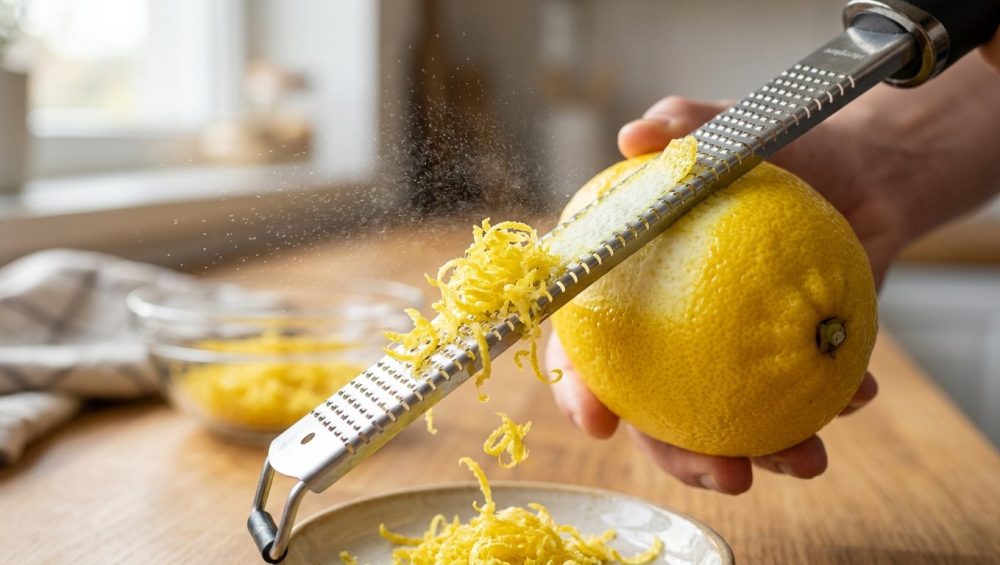
When you run a lemon across a photo-etched rasp grater, the razor-sharp teeth perform a clean surgical shear. Because the blades are so sharp, you do not need to apply any downward pressure. The teeth effortlessly slice off the oil-rich flavedo in perfect, feathery ribbons.
Because it is a clean cut, the oil sacs are not crushed against the metal; the essential oils remain trapped inside the ribbons of zest, ready to be released into your food. And because you are not pressing down hard, the teeth do not dig into the fruit, ensuring that the bitter white albedo stays exactly where it belongs: in the compost bin.
The “No-Go” Rule: Why I Despise Toxic, Cheap Kitchen Gear
We need to take a brief, highly necessary detour, because if you are serious about upgrading your cooking skills, you have to look closely at how your tools are manufactured and what materials they are made from.
As your Sassy Sous-Chef, I have a strict, zero-tolerance policy for cheap, toxic kitchenware. I am talking about frying pans with peeling non-stick coatings, spatulas that melt into your eggs, and bargain-bin gadgets made from mystery metals.
When the rasp grater became a global phenomenon, the market was immediately flooded with cheap, poorly manufactured knock-offs. Do not be tempted by the $4 grater at the discount store. Here is why material quality is non-negotiable for this specific tool:
The Danger of Mystery Metals and Rust
Citrus fruits are highly acidic. Lemon juice has a pH of around 2.0 to 2.5. When you drag acidic fruit across low-grade steel, the metal reacts. Cheap knock-off graters are often made with 400-series stainless steel or unverified carbon steel alloys that have a very low chromium and nickel content.
When these low-grade metals are exposed to citric acid and then washed in a humid kitchen environment, they oxidize and rust. Grating your food over a rusty blade is not just a great way to ruin the flavor of your dish with a harsh, metallic tang; it is a fundamental food safety hazard. Furthermore, cheap alloys can leach trace heavy metals into highly acidic foods.
Surgical-Grade Stainless Steel: Buy Once, Cry Once
When you purchase a rasp grater, you must ensure that the blade is constructed from premium, surgical-grade stainless steel. You want to look for 304-grade (often labeled as 18/8 or 18/10) stainless steel. The “18/10” designation means the alloy contains 18% chromium and 10% nickel.
Chromium is the element that gives stainless steel its rust resistance by forming a passive layer of chromium oxide on the surface. Nickel enhances that corrosion resistance and provides structural durability. A photo-etched blade made from 18/10 stainless steel will withstand decades of highly acidic lemon juice, salty parmesan cheese, and hot water without ever developing a single speck of rust.
Yes, a high-quality, authentic photo-etched rasp grater will cost you $15 to $20 instead of $4. But it will last you a decade, it will never leach mystery chemicals into your food, and it will never ruin your dinner. Buy once, cry once.
Mastering the Rasp Grater: Pro Techniques for the Home Cook
Having the right tool is only half the battle; knowing how to wield it is what separates the amateurs from the experts. If you have ever watched a home cook try to zest a lemon, you have likely seen them holding the grater vertically against the cutting board, furiously rubbing the lemon up and down the blade like they are trying to start a fire.
This is highly inefficient. When you hold the grater stationary and move the fruit, you cannot see the surface of the lemon you are zesting. As a result, you end up grating the same spot three or four times, which guarantees you are digging into the bitter albedo.
If you want to extract maximum flavor, this simple technique will completely transform your daily meals from flat to vibrant:
The “Upside-Down” Method
- Hold the Fruit, Not the Grater: Hold the lemon (or lime, or orange) securely in your non-dominant hand.
- Invert the Tool: Hold the handle of the rasp grater in your dominant hand. Flip the grater upside down so that the metal edges of the teeth are facing the ceiling.
- Pull Across: Rest the blade on top of the fruit. Gently pull the grater horizontally across the top of the lemon, pulling it toward your body.
- Watch the Magic: Because the grater is on top, you can see exactly how much skin you are removing. The incredibly fine, aromatic zest will collect neatly in the U-shaped channel on the back of the blade.
- Rotate and Repeat: Swipe exactly one time over a section of the fruit. As soon as you see the white albedo exposed, rotate the fruit to a fresh, colorful section. Never grate the same spot twice.
- Tap to Release: Once you have collected enough zest in the channel of the grater, flip it over and gently tap the metal frame against the edge of your mixing bowl or cutting board. The zest will fall out in a perfect, fluffy mound, leaving all the bitter pith behind.
Proper Maintenance and Care
Because the teeth of a photo-etched grater are microscopic, they can easily trap food particles if left to sit. Never toss a dirty rasp grater into the sink to deal with later. The moment you are done using it, run it under warm water.
If you need to scrub it, never wipe a sponge against the grain of the teeth—you will shred your sponge and dull the blades. Wipe carefully in the direction the teeth are pointing. While high-quality stainless steel models are technically dishwasher safe, I highly recommend hand-washing them. The harsh, abrasive detergents in a dishwasher can prematurely dull those microscopic razor edges over time.
Beyond Citrus: The Weekday Versatility of the Rasp Grater
While the rasp grater is the undisputed king of citrus zesting, its genius does not stop there. I am a massive advocate for weekend culinary perfection, but when it comes to Monday through Friday, my philosophy is “Time is Money.” I have zero patience for tedious prep work when I am trying to get dinner on the table.
The rasp grater is the ultimate multitasker, perfect for executing the latest modern recipe trend without breaking a sweat. Here is how this single tool will save your sanity during the week:
The Ultimate Garlic and Ginger Hack
Mincing garlic with a chef’s knife requires time, patience, and decent knife skills. Pushing it through a garlic press results in a crushed, bitter mess (and a nightmare of a cleanup). Instead, take a peeled clove of garlic and run it across your rasp grater.
The razor-sharp teeth will instantly shear the garlic into a perfectly smooth, fine paste. From a scientific perspective, this fine grating ruptures a massive amount of the garlic’s cell walls, triggering the enzymatic reaction that creates allicin—the compound responsible for garlic’s pungent, savory flavor. You get maximum flavor distribution in your vinaigrettes, marinades, and pan sauces in a fraction of the time.
The same applies to fresh ginger root. Ginger is notoriously fibrous and stringy. When you chop it, you often end up biting into tough, woody threads. When you run a piece of peeled ginger across a rasp grater, the photo-etched teeth shear away the tender, flavorful flesh and leave the tough, fibrous strings attached to the root in your hand. You get a perfect, smooth ginger puree with zero fibrous texture. When you are finally ditching takeout for good, efficiency is everything, and this hack saves you precious minutes of prep.
The Parmesan Cloud
If you are still buying pre-shredded parmesan cheese in a plastic tub, we need to have a serious talk. Pre-shredded cheeses are coated in anti-caking agents like cellulose (wood pulp) to prevent them from clumping in the bag. These powders prevent the cheese from melting smoothly, resulting in grainy, broken pasta sauces.
Instead, buy a wedge of real Parmigiano-Reggiano. When you grate a hard cheese on a rasp grater, the microscopic blades shave off impossibly thin, airy ribbons. This dramatically increases the surface area of the cheese. A tiny, one-ounce block of parmesan will yield a massive, fluffy mountain of cheese that melts instantaneously into your hot pasta water, creating a silky, emulsified sauce. You actually end up using less cheese to get more flavor, saving you money in the long run.
Elevating Spices and Chocolate
Pre-ground spices lose their volatile aromatic oils rapidly as they sit in your pantry. A jar of pre-ground nutmeg that has been sitting on your shelf for two years tastes like sawdust.
Instead, buy whole nutmeg seeds. A few quick swipes of a whole nutmeg over a rasp grater will release a burst of intense, warm, highly aromatic oils that will fundamentally elevate your béchamel sauces, mashed potatoes, and baked goods.
The same goes for finishing a dessert. A block of high-quality dark chocolate run across a rasp grater produces delicate, curling chocolate dust that looks like it came out of a high-end patisserie kitchen.
The Bottom Line: Gear That Works for You
Cooking should not be a struggle, and it certainly shouldn’t result in bitter, soapy-tasting food. The difference between a dish that tastes muddy and a dish that sings with bright, vibrant flavor often comes down to the mechanics of how you treat your ingredients.
By understanding the anatomy of citrus and recognizing that the bitter albedo is the enemy, you have already won half the battle. By throwing away that dull, knuckle-busting, stamped-metal box grater and investing in a photo-etched, surgical-steel rasp grater, you win the rest.
These are the exact tools every beginner needs to build a functional workspace that empowers rather than frustrates. Whether you are cooking a quick Tuesday supper or hosting mindful gatherings on the weekend, your kitchen gear should do the heavy lifting for you.
So go buy a proper rasp grater. Treat your ingredients with the surgical precision they deserve. Leave the bitter pith behind, and let the bright, beautiful essential oils shine through. Your lemon ricotta cake will thank you.