Picture this: It is a beautiful Sunday afternoon. You have successfully navigated the chaotic weekday dinner gauntlet, relying on your clever shortcuts and efficiency hacks to survive the week. Now, it is your time. You have carved out a few precious hours to be an absolute perfectionist with an elaborate weekend baking project. You are whipping up a delicate, cloud-like lemon Swiss meringue buttercream. It looks flawless. You dip your finger in for a taste, expecting a burst of bright citrus and sweet vanilla.
Instead, you are assaulted by the distinct, gag-inducing flavor of synthetic lavender dish soap.
Or perhaps you are on the savory side of the spectrum. You are gently folding a classic French omelet on a Saturday morning, only to take a bite and realize your delicate eggs taste exactly like the aggressive, spicy garlic stir-fry you made three nights ago.
If you are nodding your head in frustrated solidarity right now, welcome to the club. You have just fallen victim to one of the most infuriating phenomenons in the modern home kitchen: the cursed, odor-absorbing silicone spatula. It is enough to make you want to throw your entire utensil crock out the window and go back to ordering delivery, but breaking your takeout habit requires reliable gear that doesn’t actively sabotage your food.
Listen up, buttercup. I have zero patience for pretentious chef-speak, and I have even less patience for ruined food. You do not need a culinary degree to understand why your expensive kitchen utensils are betraying you, and you certainly do not need to accept soapy frosting as a fact of life. Today, we are going to dive deep into the actual, hardcore chemistry of why your silicone tools hold onto weird smells and flavors. More importantly, I am going to give you the definitive, science-backed, masterclass protocol to fix it permanently.
The “No-Go” Rule: Not All Silicone is Created Equal
Before we can cure the disease, we have to talk about the patient. If you have spent more than five minutes reading my kitchen rants, you know I have a very strict, non-negotiable philosophy when it comes to kitchen equipment: the “No-Go” rule. I absolutely despise cheap, toxic kitchenware. I am talking about peeling Teflon pans, mystery metal baking sheets that warp the second they hit the oven, and yes, cheap, counterfeit silicone.
When you are banishing toxic kitchen gear from your life, you have to understand what you are actually buying. True food-grade silicone is a synthetic polymer made of siloxane. Unlike traditional plastics, which are built on a carbon backbone and heavily rely on endocrine-disrupting plasticizers (like BPA and phthalates) to stay flexible, silicone is built on an alternating chain of silicon and oxygen atoms. This silicon-oxygen backbone is incredibly stable, highly heat-resistant, and completely inert. It does not react with food, it does not leach toxic chemicals into your soup, and it can comfortably withstand temperatures up to 450°F (232°C) without melting.
However, because pure silicone is relatively expensive to manufacture, shady offshore companies love to cut corners. They pump their silicone full of cheap plastic fillers, chemical curatives, and low-grade impurities to bulk up the product and lower their manufacturing costs. These fillers completely compromise the integrity of the tool. They lower the heat resistance, they degrade over time, and they are notorious for leaching weird, chemical tastes into your food.
So, how do you know if your spatula is the real deal or a cheap imposter? You perform the Pinch Test.
Take your silicone spatula, baking mat, or muffin liner and tightly pinch or twist a section of the material. If the silicone remains a solid, uniform color, congratulations! You have high-quality, pure silicone. But if the pinched area turns stark white, you have a problem. That white color indicates that the material has been stretched past the limits of its cheap plastic fillers. If your gear fails the pinch test, throw it in the trash immediately. I firmly advocate for the everyday home cook, and part of that advocacy is ensuring you are only using safe, durable beginner kitchen tools that offer real, long-lasting value. We do not cook with toxic garbage in this house.
The Science of the Stink: Why Silicone Absorbs Odors
Now that we have established you are using high-quality, pure food-grade silicone, we have to address the elephant in the room. Why does this supposedly inert, premium material hold onto smells so aggressively? Why is it that no matter how many times you scrub it, your baking spatula still smells like garlic from last week’s pasta night?
To understand this, we have to look at the microscopic structure of siloxane polymers. While silicone feels perfectly smooth and solid to the naked eye, at a molecular level, it is actually quite porous and highly permeable. The polymer chains are spaced out in a flexible, three-dimensional matrix.
This matrix is incredibly susceptible to a specific type of molecule: Volatile Organic Compounds (VOCs). More specifically, it is a magnet for fat-soluble VOCs.
Think about the most pungent ingredients in your kitchen. Garlic, onions, curry powder, cumin, and hot chilies. The flavor and aroma compounds in these ingredients (like allicin in garlic or capsaicin in chilies) are heavily oil-based and fat-soluble. Silicone itself is highly lipophilic, which is a fancy scientific term that means “fat-loving.”
When you are standing over a hot stove, sautéing a massive pan of garlic and onions, two things happen simultaneously. First, the heat of the pan causes the molecular matrix of your silicone spatula to physically expand, opening up those microscopic pores. Second, the hot, fat-soluble garlic oils are released into the pan. Because the silicone is lipophilic, it acts like a sponge, eagerly soaking those volatile oil molecules right into its expanded pores.
When you finish cooking and remove the spatula from the heat, the silicone cools down. The polymer matrix contracts, the pores close, and those fat-soluble garlic molecules are locked inside the spatula like a vault. You can scrub the surface with soap all you want, but the odor isn’t on the surface. It is trapped deep inside the molecular structure of the tool itself.
The Dishwasher Dilemma: Why Your Spatula Tastes Like Synthetic Soap
If the garlic and onion phenomenon makes sense, the soapy flavor phenomenon is going to blow your mind. One of the most common complaints I hear from frustrated home cooks is that their silicone gear makes their food taste like soap. It is a disgusting, palate-ruining experience, and ironically, it happens because you are trying to keep your kitchen clean.
I am a massive proponent of efficiency. Time is money, especially on a Tuesday night when you have a million other things to do besides stand over a sink. The dishwasher is a modern miracle of time-saving engineering. However, when it comes to silicone, the dishwasher is a double-edged sword. Throwing your silicone gear in with your heavily soiled plates is one of those classic rookie kitchen mistakes that will quietly ruin your weekend baking projects.
Here is the breakdown of the dishwasher disaster:
Modern dishwasher detergents are incredibly aggressive chemical cocktails. They are packed with heavy-duty alkaline surfactants, protein-destroying enzymes, and, crucially, synthetic fragrance oils. Brands load their pods and powders with artificial scents like “Citrus Breeze” or “Lavender Meadow” (using chemical compounds like limonene and linalool) so that your kitchen smells nice when you open the dishwasher door.
These fragrance compounds are, you guessed it, heavily oil-based and fat-soluble.
When you run a dishwasher cycle, the machine blasts your dishes with scalding hot water, often exceeding 140°F (60°C). Just like in the frying pan, this intense heat causes the silicone matrix of your spatula to expand and open its pores. The detergent dissolves, releasing a massive wave of fat-soluble synthetic fragrance oils into the hot, steamy environment.
Your expanded, lipophilic silicone spatula happily absorbs these fragrance oils deep into its core. Then comes the heated dry cycle. The dishwasher cranks up the heat even higher to evaporate the water, essentially baking the synthetic soap oils directly into the silicone matrix. The machine turns off, the spatula cools, the pores close, and the soap is permanently trapped.
Fast forward to Sunday. You are using that exact same spatula to fold warm, melted butter into a delicate cake batter. The heat of the warm butter causes the silicone pores to slightly expand, and the lipophilic nature of the butter pulls those trapped synthetic fragrance oils right out of the spatula and into your dessert. Congratulations, your cake now tastes like a laundry room.
Failed Remedies: What NOT to Do
When faced with a stinky, soapy spatula, most people turn to the internet for quick fixes. Unfortunately, the internet is full of terrible advice that completely ignores the laws of chemistry. Let’s brutally debunk the most common failed remedies, so you stop wasting your precious time.
1. The Baking Soda Paste
Every mommy-blogger on the internet will tell you to make a paste of baking soda and water and scrub the silicone. Baking soda is a fantastic, mild abrasive and a great alkaline odor neutralizer for surface-level stains. However, as we have already established, the odor molecules are not on the surface; they are trapped deep inside the polymer matrix. A surface scrub will do absolutely nothing to extract trapped oils. It is just as futile as scrubbing with dish soap when your plastic containers stay greasy after a spaghetti dinner.
2. The White Vinegar Soak
Vinegar (acetic acid) is a miracle worker in the kitchen for cutting through hard water stains, dissolving mineral buildup, and killing certain surface bacteria. But vinegar is mostly water. It is not a solvent for heavy, fat-soluble volatile organic compounds. Soaking your silicone in a bowl of vinegar might make the outside smell like a salad dressing for a few hours, but the second that spatula hits a hot pan, the underlying soap or garlic smell will come roaring back.
3. Boiling the Silicone
This is a step in the right direction, but it ultimately falls short. Some people recommend boiling the silicone utensils in a pot of water for twenty minutes. The theory is that the heat will open the pores and release the oils. The problem here is basic thermodynamics. Liquid water caps out at a maximum temperature of 212°F (100°C) at sea level. This temperature is simply not high enough to reach the vaporization point of heavy synthetic fragrance oils or dense garlic compounds. You will open the pores slightly, but you won’t generate enough thermal energy to force the oils out.
4. Bleach or Harsh Chemicals
Absolutely, unequivocally, no. Do not ever soak your silicone in bleach or harsh chemical solvents. Not only will this degrade the siloxane polymer structure and ruin the flexibility of your tool, but it will also introduce highly toxic chemicals into a porous material that touches your food.
The Masterclass Fix: How to Bake the Stink Out of Silicone
If you want to solve a chemistry problem, you have to use science. Since we know that the offending odor molecules are fat-soluble volatile organic compounds trapped inside a heat-sensitive polymer matrix, the only way to remove them is through a process called Thermal Volatilization.
We need to apply a sustained, dry heat that is high enough to turn those trapped liquid and solid oils into a gas. When they convert to a gaseous state, their vapor pressure exceeds the atmospheric pressure, forcing them to evaporate and physically escape the silicone matrix.
The magic numbers for this scientific exorcism? 250°F (121°C) for 20 to 30 minutes.
Why 250°F? This specific temperature is the culinary sweet spot. It is well above the boiling point of water, and it is high enough to reach the flash point and vaporization threshold of almost all synthetic fragrance oils and food-based volatile compounds. However, it is safely below the degradation threshold of high-quality, food-grade silicone, which can easily withstand sustained oven temperatures of 400°F to 450°F.
By baking the silicone, you are forcing the matrix wide open and giving the trapped molecules enough thermal energy to turn into vapor and flee the scene. Mastering this trick is a game-changer, and the results are just as satisfying as learning the secret to making your skillet actually non-stick.
The Step-by-Step Baking Protocol
Do not just throw your dirty spatulas into a hot oven and hope for the best. Follow this exact protocol to ensure you do not ruin your gear or smoke out your kitchen.
Step 1: The Deep Clean Pre-Wash
Before you apply high heat, you must ensure the exterior of the silicone is completely stripped of any surface grease, food particles, or debris. If you bake a spatula that has a smear of butter on the handle, you are just going to polymerize that fat onto the surface, creating a permanent, sticky mess. Hand wash the items vigorously in the sink using hot water and a grease-cutting, unscented dish soap. Dry them completely with a clean microfiber cloth.
Step 2: The Preheat
Preheat your oven to exactly 250°F (121°C). Do not use the convection setting if you can avoid it, as we want a steady, even, radiant heat. Absolutely do not use the broiler setting. Ensure your oven racks are positioned in the center of the oven.
Step 3: The Bake
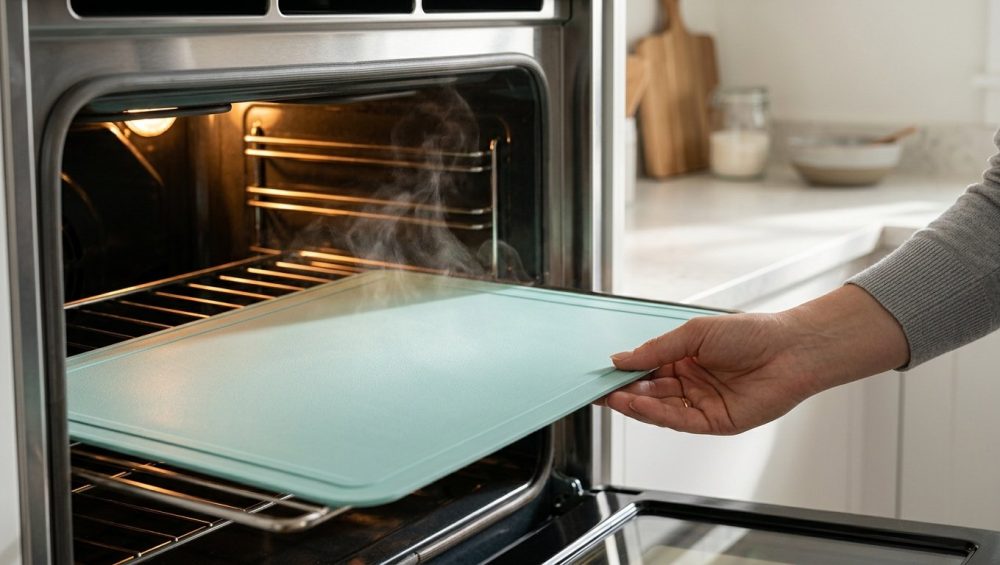
Place your clean, dry silicone spatulas, baking mats, muffin liners, or ice cube trays directly onto a bare, ungreased aluminum baking sheet. Do not line the sheet with parchment paper or aluminum foil; you want maximum airflow and even heat distribution. Place the baking sheet into the center of the preheated oven. Set a timer for 20 minutes.
Step 4: The Sniff Test
As the silicone bakes, the trapped volatile compounds will turn into gas and release into your oven. Do not be alarmed if your kitchen suddenly smells intensely of synthetic lavender, old garlic, or stale curry. This is the smell of victory; it means the volatilization process is working perfectly.
After 20 minutes, open the oven (carefully, do not put your face directly in the vapor cloud) and use a pair of tongs to pull the baking sheet out. Let the silicone cool for just a few seconds so you don’t burn your nose, and give the spatulas a careful sniff. If they smell completely neutral, you are done. If you can still detect a faint lingering odor of soap or food, put them back in the oven for another 10 minutes. Stubborn, deeply embedded oils may take up to 30 or even 40 minutes to fully vaporize.
Step 5: The Cool Down and Final Wash
Once the silicone passes the sniff test, remove the baking sheet from the oven and let the utensils cool completely to room temperature on the counter. Do not shock them by throwing them in cold water. Once they are fully cooled and the polymer matrix has contracted back to its normal state, give them one final hand wash with unscented soap and warm water to wash away any residual oils that may have settled on the surface during the baking process.
Congratulations. You have successfully reset your silicone to factory settings.
Prevention: How to Keep Your Silicone Smelling Fresh
Now that you know how to rescue your gear, let’s talk about how to prevent this from happening again. I am all about efficiency, and baking your spatulas every weekend is a colossal waste of your precious time. Implement these strict kitchen rules to keep your silicone pristine.
1. Ditch the Scented Dishwasher Pods
This is the single biggest change you can make. Stop buying dishwasher detergents loaded with artificial fragrances. You do not need your plates to smell like a mountain spring; you just need them to be clean. Switch to a high-quality, unscented, “free and clear” powder or gel detergent. Not only will this save your silicone from tasting like soap, but it is also generally better for your dishwasher’s internal components.
2. The 30-Second Hand Wash Rule
I know I said I love the dishwasher, but when it comes to silicone, hand washing is the ultimate preventative measure. Silicone is naturally non-stick and incredibly easy to clean. It takes exactly thirty seconds to run a soapy sponge over a spatula and rinse it under hot water. If you use a silicone tool in a highly pungent dish (like a garlic stir-fry or a rich curry), do not let it sit in the sink overnight, and do not put it in the dishwasher. Wash it immediately by hand so the oils do not have time to deeply penetrate the matrix.
3. The “Sweet vs. Savory” Segregation System
If you are a weekend baking warrior, you need to treat your pastry tools with respect. You should never, ever use the same spatula to scrape down a bowl of vanilla buttercream that you use to sauté onions. Implement a strict segregation system in your kitchen crock. Buy two different colors of silicone spatulas. For example, use red spatulas exclusively for savory cooking (meats, garlic, onions, spices) and blue spatulas exclusively for sweet baking (frostings, batters, chocolate). This guarantees cross-contamination never ruins a dessert.
4. Ban Aerosol Cooking Sprays
Just like ruining your nonstick pans, aerosol cooking sprays are the enemy of silicone bakeware. These sprays contain chemical propellants and emulsifiers (like soy lecithin) that burn at low temperatures and create a sticky, polymerized film on the surface of your silicone baking mats and muffin liners. This sticky film acts as a glue, trapping food odors and making the silicone impossible to clean. Use pure, liquid oils applied with a paper towel or a pastry brush instead.
5. Invest in Platinum-Cured Silicone
Stop buying cheap, mystery-brand utensil sets from discount websites. When building your culinary arsenal, high-quality, 100% platinum-cured silicone spatulas are essential tools that every home cook needs. Platinum-cured silicone uses a higher-quality manufacturing process that results in a tighter polymer matrix, greater heat resistance, and significantly fewer impurities. It is slightly more expensive upfront, but it is much more resistant to odor absorption and will outlast cheap alternatives by a decade.
Cooking should be a joy, not a stressful battle against your own equipment. You do not need to accept soapy frosting or garlic-tainted eggs as a normal part of the culinary experience. By understanding the science of siloxane polymers, avoiding cheap toxic fillers, and utilizing the 250°F baking protocol, you can permanently eliminate weird odors from your kitchenware. Now get out of here, go bake the stink out of your spatulas, and get back to making mind-blowing food.