We’ve all been there. You’re standing in your kitchen on a Tuesday night. You’re exhausted. You’ve somehow managed to master simple weeknight dinners well enough to keep yourself alive, and tonight you decided to treat yourself. You bought that ridiculously overpriced, tiny plastic clamshell of fresh sweet basil. You envision a vibrant, aromatic garnish cascading over your pasta. You grab your trusty chef’s knife—the one you bought on sale five years ago and haven’t sharpened since—and you start hacking away.
But instead of delicate, fragrant green ribbons, you are left with a bruised, weeping, blackened pile of mush that smells vaguely of lawn clippings.
Welcome to my world of culinary pet peeves. I am your Sassy Sous-Chef, and I am here to tell you that you are committing a botanical homicide. The culprit? It’s not the basil. It’s not the humidity. It is your atrociously dull kitchen knife.
I am a firm believer that anyone can cook like an expert. You do not need a culinary degree to make mind-blowing food. What you do need is an understanding of the basic science happening on your cutting board, and a strict adherence to using tools that actually do their job. We are going to dive deep—and I mean cellular-level deep—into the science of why your delicate greens turn black, why they lose their flavor, and how a sharp edge is the ultimate secret weapon for the home cook.
The Anatomy of an Herb: A Microscopic View
To understand why your herbs are turning into a tragic, dark puddle, we need to zoom in. Way, way in.
Imagine looking at a fresh basil leaf under a powerful microscope. You wouldn’t just see a flat sheet of green; you would see a complex, highly organized metropolis of plant cells. Each of these cells is encased in a rigid structure known as the plant cell wall. Think of the cell wall as the brick mortar of a tiny house. Inside this house, there are various rooms and compartments called organelles.
One of the most important compartments is the vacuole. The vacuole is essentially the plant cell’s storage unit. It holds water, nutrients, and a variety of chemical compounds that the plant uses for defense, growth, and flavor. Among these stored chemicals are phenolic compounds (polyphenols).
Now, in a completely different part of the cell—usually the cytoplasm or the chloroplasts—lives an enzyme called Polyphenol Oxidase (PPO).
In a healthy, intact plant, the phenolic compounds and the PPO enzyme live in perfect harmony because they are physically separated by cellular membranes. They are the two volatile roommates who are perfectly fine as long as they stay in their own bedrooms. But the moment those walls come down, all hell breaks loose.
When plant cell walls are compromised, the structural integrity of the leaf fails. The liquid inside leaks out. If you’ve ever wondered why your fresh herbs turn to slime in the back of your crisper drawer, it is because cellular degradation is happening on a mass scale. But when you are actively chopping on a cutting board, you are accelerating this process through blunt-force trauma.
The Chemistry of Enzymatic Browning (The Science of the Black Mush)
So, what happens when those cellular walls are breached? Enter the phenomenon known as enzymatic browning.
If you have ever bitten into an apple and watched it turn brown five minutes later, you have witnessed enzymatic browning. The exact same chemical reaction happens in your delicate herbs like basil, mint, and cilantro—it just happens much faster and turns them an incredibly unappetizing blackish-brown.
Here is the exact chemical sequence of your culinary disaster:
The Breach
Your dull knife crushes the plant tissue, tearing open the cell walls and membranes.
The Mixing
The phenolic compounds spill out of their vacuoles and mingle with the Polyphenol Oxidase (PPO) enzyme.
The Catalyst
PPO acts as a catalyst. When it comes into contact with the phenolic compounds and oxygen from the air, it triggers a rapid oxidation reaction.
The Transformation
The phenols are rapidly oxidized into new compounds called quinones.
The Darkening
Quinones are highly reactive. They quickly link together (polymerize) to form large, complex molecules called melanin. Yes, the exact same dark pigment that gives human skin and hair its color is what turns your basil into a black, swampy mess.
The speed of this reaction in herbs like basil is staggering. Basil is notoriously high in both phenolic compounds and PPO activity. It is a ticking time bomb of enzymatic browning just waiting for a dull blade to set it off. This is precisely pesto turns bitter and brown when you over-process it in a hot blender instead of gently crushing it or using sharp blades. You are oxidizing the living daylights out of it.
The Crime Scene: Crushing vs. Slicing
Let us talk about the weapon of choice: the dull knife.
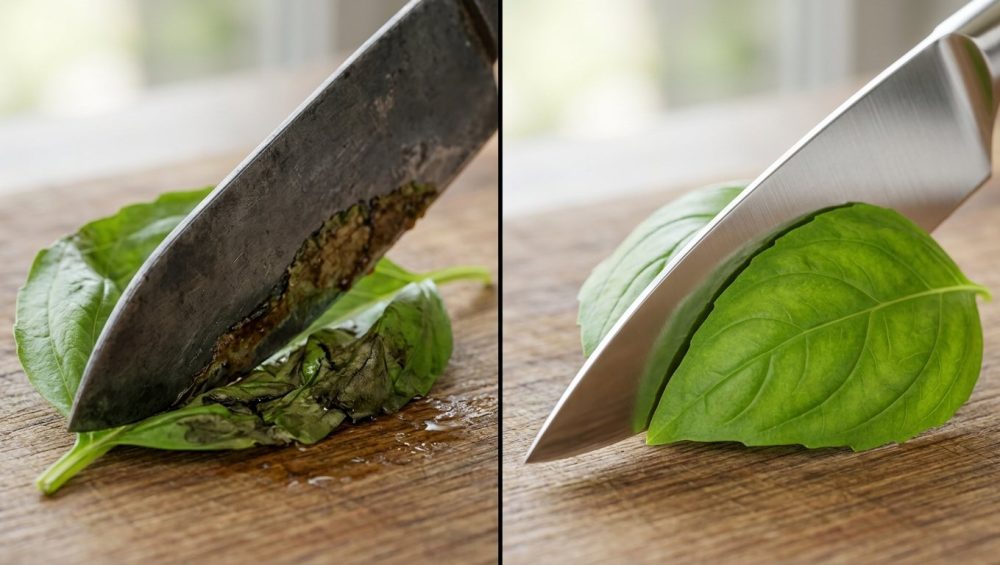
A knife blade, at a microscopic level, is a wedge. A properly sharpened, well-maintained chef’s knife tapers down to an infinitesimally thin edge. When a sharp edge meets a basil leaf, it acts like a laser. It cleanly severs the cell walls directly in its path. The cells immediately adjacent to the cut remain perfectly intact. Because only a microscopic fraction of the cells are actually ruptured, only a minuscule amount of PPO and phenols are released. The cut edges stay bright, vibrant green.
Now, let us look at the dull knife. A dull edge is rounded. It is blunt. When you press a dull knife into a pile of herbs, it does not cut; it crushes. It acts like a blunt-force battering ram, smashing its way through the plant tissue.
Instead of cleanly severing a single line of cells, the dull knife compresses and obliterates thousands of surrounding cells. The cell walls explode. The membranes are shredded. A massive amount of PPO and phenolic compounds are violently mixed together and exposed to the oxygen in your kitchen.
Furthermore, because a dull knife requires you to use significantly more downward force to get through the food, you end up bruising the herbs against the cutting board itself. You are essentially juicing your herbs on the board.
If you look at your cutting board after chopping herbs and see a wet, green, smeared puddle, you have failed. That green puddle is the literal lifeblood of your ingredients. It is the exact same mechanical failure that explains why you cry chopping onions. A dull blade crushes the onion cells, releasing a massive aerosolized cloud of sulfur compounds into your eyes, whereas a sharp blade cleanly slices them, leaving the irritants trapped inside the intact cells.
The Collateral Damage: Where Did the Flavor Go?
The tragedy of the dull knife does not stop at the visual horror of black basil. The real crime is the theft of flavor.
Why do we use fresh herbs in the first place? We use them for their vibrant, volatile aromatic compounds. In basil, these compounds include linalool (which gives it that floral, sweet scent), eugenol (the clove-like warmth), and estragole (the anise/licorice kick). In mint, it is menthol and pulegone.
These aromatic compounds are highly volatile, meaning they evaporate into the air extremely quickly. They are stored in fragile microscopic sacs and glandular trichomes on the surface and within the leaves.
When you cleanly slice an herb with a razor-sharp knife, you preserve the vast majority of these essential oils within the intact pieces of the leaf. The flavor is retained, waiting to burst over your palate when you actually chew the food.
When you crush and bruise the herbs with a dull knife, you rupture all of those oil sacs prematurely. The volatile compounds immediately evaporate into the air (which is why your kitchen suddenly smells amazing) or bleed out onto your cutting board (which is why your board is stained green).
By the time you scrape that blackened, bruised pile of mush into your pasta, all the essential oils are gone. What is left? The structural cellulose and the bitter chlorophyll. Your expensive fresh herbs now taste like literal grass. If you want to transform your daily meals from mediocre to restaurant-quality, you must stop leaving your flavor on the cutting board.
The “No-Go” Rule on Toxic and Terrible Gear
As your Sassy Sous-Chef, I have zero patience for pretentious chef-speak, but I have even less patience for garbage kitchen equipment. I firmly believe in banishing toxic kitchen gear and useless gimmicks that actively sabotage your cooking.
If your knife is dull, it is likely because of one of three cardinal sins:
The Glass Cutting Board
If you own a glass cutting board, throw it in the recycling bin immediately. I am not joking. Glass is harder than the steel of your knife. Every time the blade strikes the glass, the microscopic edge rolls, chips, and flattens. You are actively destroying your tools.
The Bamboo Cutting Board
Bamboo is trendy and eco-friendly, but it is terrible for your knives. Bamboo is technically a grass, and it contains high levels of silica—the exact same mineral that makes up sand and glass. Chopping on bamboo is like chopping on sandpaper. This is exactly why ruining your knives is so easy if you use the wrong board. Stick to soft woods like maple, walnut, or hinoki, or use high-quality rubber or plastic boards.
The Cheap Mystery Metal Knife
If you bought a knife set for $29.99 at a big-box store, it is likely stamped from low-carbon steel. It cannot hold a sharp edge, no matter how much you hone it. Invest in one single, high-quality chef’s knife made of high-carbon stainless steel (or pure carbon steel, if you are willing to maintain it).
The Pull-Through Sharpener
Those cheap, V-shaped carbide pull-through sharpeners do not sharpen your knife; they violently tear away strips of metal, leaving a jagged, microscopic saw-tooth edge that will crush herbs just as badly as a dull blade.
How to Actually Chop Delicate Herbs (Without Ruining Them)
Alright, you have a sharp knife and a proper wood cutting board. How do we actually cut the herbs?
There is a massive difference between robust herbs (like rosemary, thyme, and sage) and delicate herbs (like basil, mint, cilantro, and parsley). Robust herbs have woody stems and hardy, thick leaves. They can handle a bit of a beating. Delicate herbs are fragile, water-dense, and highly prone to enzymatic browning.
For delicate herbs, you must abandon the “rock chop” method. You know the one: where you put your hand on the spine of the knife and rapidly rock the blade up and down over the pile of herbs until it is minced into a fine dust.
Do not do this. Every time the blade passes through the herbs, you are inflicting more cellular damage. Re-chopping the pile is a guaranteed way to bruise them, release the PPO enzyme, and turn them black.
Instead, use the Chiffonade technique.
Step 1: Stack
Take your clean, dry basil or mint leaves and stack them neatly on top of one another, with the largest leaf on the bottom.
Step 2: Roll
Tightly roll the stack into a compact cylinder, like a little green cigar.
Step 3: Slice
Using a razor-sharp chef’s knife, use a smooth, gliding motion (pushing forward and down, or pulling backward and down) to slice off thin ribbons. Let the sharpness of the blade do the work; do not press down forcefully.
Step 4: Stop
Once you have sliced the roll into ribbons, you are done. Do not run your knife back through the pile.
The result? Beautiful, vibrant green ribbons that hold their shape, retain their essential oils, and elevate the art of food plating to a professional level.
Knife Maintenance 101: Keep Your Edge
A sharp knife is a safe knife, and it is a fast knife. When we talk about weekday meals, time is money. Struggling with a dull blade slows down your prep time exponentially.
But you must understand the difference between honing and sharpening, which is the number one reason knives go dull so fast.
Honing is what you do with that steel rod that came with your knife block. It does not sharpen. As you use a sharp knife, the microscopic edge bends and folds slightly out of alignment. Honing simply pushes that microscopic edge back into the center. You should hone your knife every few times you use it.
Sharpening, on the other hand, actually removes metal to create a brand new edge. This should be done with a whetstone (water stone) every 6 to 12 months, depending on how often you cook. If you do not want to learn how to use a whetstone, pay a local professional $10 to sharpen it for you. It is the best culinary investment you will ever make.
Herb Preservation: Before the Knife Even Hits
You can have the sharpest Japanese steel in the world, but if you mistreat your herbs before they hit the cutting board, they are doomed.
Water is the enemy of chopped herbs. If you try to chop wet basil, the blade will slip, the leaves will stick to the knife, and the moisture will accelerate the degradation process.
Always wash your herbs gently in cold water, and then dry them ruthlessly. A salad spinner is your best friend here. If you don’t have one, lay them out on a paper towel and gently pat them completely dry.
Furthermore, keep your cutting board clean and dry. When you are prepping multiple ingredients, do not scrape the board clean with the sharp edge of your knife. Scraping the blade sideways across a hard board instantly rolls the edge and dulls it. This is exactly why you need a bench scraper. Use a cheap stainless steel bench scraper to move ingredients and clean the board, saving your knife’s edge for the actual cutting.
The Bottom Line
Professional-level results in a standard home kitchen are not achieved through magic, and they certainly aren’t achieved by spending thousands of dollars on culinary school. They are achieved by respecting the ingredients and understanding the basic science of cooking.
Your fresh herbs are delicate, complex structures packed with volatile flavor compounds and mischievous enzymes just waiting to ruin your dinner. By maintaining a razor-sharp knife and using a clean, slicing motion, you bypass the catastrophic cellular crushing that leads to enzymatic browning. You keep the flavor in the leaf, not on the cutting board.
So, the next time you bring home a gorgeous bunch of fresh basil, do it a favor. Put down the dull, mystery-metal wedge you call a knife, grab a properly sharpened blade, and slice with confidence. Your palate—and your dinner guests—will thank you. Stay sassy, and keep cooking.