Look, we have all been there. You are hosting a dinner party, or maybe you are just trying to pull together a comforting weekend roast. You have spent hours meticulously tending to a beautiful cut of meat, your gravy is simmering away, and you are feeling like an absolute culinary deity. Then, you glance at the clock. Panic sets in. You need to mash the potatoes, and you need to do it five minutes ago.
In a moment of pure, time-saving desperation, you look at your food processor or that shiny immersion blender sitting on the counter. “It purees soup into silk,” you rationalize. “It makes flawless hummus. Surely, it will make quick work of these boiled spuds.”
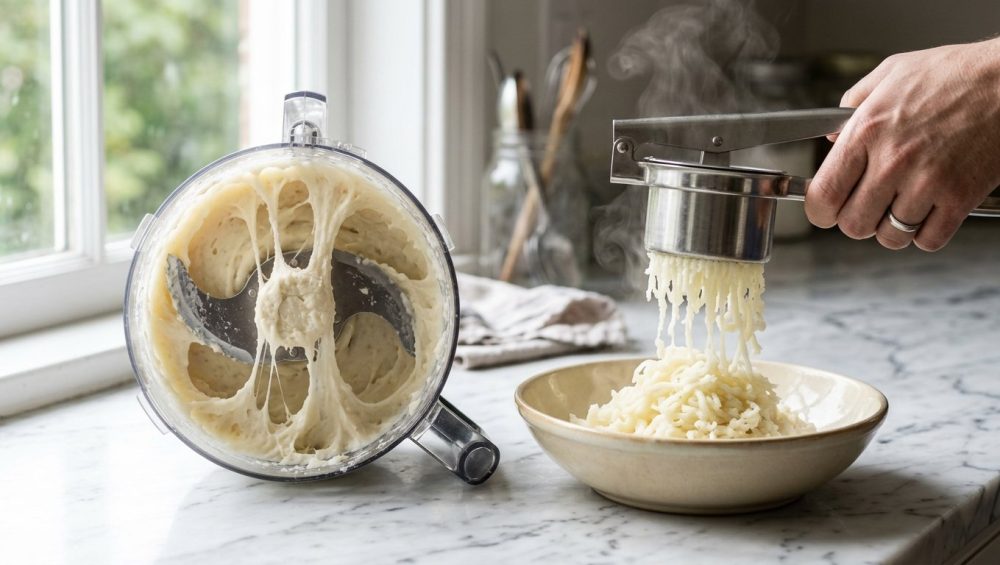
You toss the hot potatoes into the bowl, lock the lid, and hit the pulse button. The machine roars to life. Ten seconds later, you lift the lid, expecting a bowl of ethereal, cloud-like potato perfection. Instead, you are staring into a vortex of shiny, elastic, impenetrable spackle. You dip a spoon into the bowl, and the entire mass lifts out in one terrifying, cohesive glob. Congratulations. You haven’t made a side dish; you have manufactured industrial-grade wallpaper paste.
If this sounds like a personal attack, take a deep breath and pour yourself a glass of wine. You are not a bad cook. You simply fell victim to a fundamental misunderstanding of plant botany and thermodynamics. Today, we are going to unpack exactly why mashed potatoes turn to glue when you try to take a high-speed shortcut. We are going to dive deep into the starch chemistry that governs your kitchen, and I am going to show you how to achieve mind-blowing, restaurant-quality results in your own home—without a culinary degree, and absolutely without a blender.
The Anatomy of a Potato: What You Are Actually Cooking
To understand why your food processor just ruined your dinner, we have to zoom in on what a potato actually is. A potato is not just a uniform block of carbohydrates waiting to be crushed. It is a highly structured, complex biological organism.
At a microscopic level, a potato is made up of millions of tiny plant cells. Inside each of these cells are even tinier packets called starch granules. When a potato is raw, these granules are hard, compact, and completely unbothered by their surroundings. But when you introduce heat and water—say, by boiling them on your stovetop—everything changes.
As the temperature of the water rises, the starch granules inside the potato cells begin to absorb moisture. They drink in the water, swelling to many times their original size in a process known to food scientists as gelatinization. By the time your potatoes are fork-tender, those microscopic cells are essentially functioning as highly pressurized, incredibly fragile water balloons. They are swollen to their absolute limit, packed with fully hydrated starch, and waiting for the slightest provocation to burst.
Meet the Culprits: Amylose and Amylopectin
Not all starch is created equal. The starch inside those fragile potato cells is primarily composed of two different types of carbohydrate molecules: amylopectin and amylose.
Amylopectin is a highly branched, tree-like molecule. It is relatively well-behaved. It provides a creamy texture and plays nicely with other ingredients.
Amylose, on the other hand, is a long, linear, single-chain molecule. When amylose is safely contained inside the intact walls of a cooked potato cell, it is harmless. But when a potato cell ruptures and amylose is released into the wild, it acts like a microscopic net. Because of its long, straight structure, amylose molecules love to tangle up and bond with one another, trapping water and forming a tight, sticky, elastic gel.
When you make mashed potatoes, your entire goal is to separate the swollen potato cells from one another without breaking them open. You want a bowl of intact, fluffy little starch balloons. You want to keep the amylose locked safely inside.
The Crime Scene: What Happens When You Blend a Potato
Now, let’s bring the food processor back into the equation.
A food processor, a standard blender, or an immersion blender does not mash food. It shreds it. These appliances operate via high-speed mechanical shearing. Their metal blades spin at thousands of revolutions per minute, creating a violent vortex of physical destruction.
When you drop your perfectly boiled, fragile, swollen potato cells into a food processor, those blades act like microscopic lawnmowers. They do not gently separate the cells; they violently slice them to ribbons. In a matter of seconds, millions of potato cells are simultaneously ruptured.
The Violent Shearing Effect
The moment those cell walls are shredded, a microscopic flood occurs. All of that long-chain amylose is instantly dumped into the bowl. Because the blender is still spinning, it rapidly whips those amylose molecules together, allowing them to cross-link and form a massive, continuous starch network.
The physical friction and heat generated by the spinning blades only accelerate this process. Within ten to fifteen seconds, the fluffy texture is completely annihilated. The amylose has bound the water, the dairy, and the remaining potato solids into a tight, gummy matrix. You have effectively created a non-Newtonian fluid.
This is why you must ditch the hand mixer, the blender, and the food processor when dealing with starchy tubers. Even a standard electric hand mixer, if used too aggressively or for too long, will eventually batter enough cells to release a critical mass of amylose.
Choosing Your Victim: Not All Potatoes Are Created Equal
If you want to master the art of the mash, you have to start at the grocery store. The botanical makeup of the potato you choose will dictate how much mechanical force it can withstand before turning into a sticky disaster.
The Champions: Russets and Yukon Golds
For consistently light, airy, and fluffy results, the Russet potato is the undisputed king. Russets are high-starch, low-moisture potatoes. They contain roughly 20% to 24% starch by dry weight. Because their moisture content is naturally low, their cells tend to separate from one another very easily when cooked. You barely have to look at a boiled Russet for it to fall apart into a powdery, fluffy pile. This means they require the absolute minimum amount of mechanical force to mash, drastically reducing the risk of cell rupture.
If you prefer a denser, creamier, more buttery mash, Yukon Golds are your best friend. Yukon Golds are medium-starch potatoes. They contain slightly more water and slightly less starch than a Russet. They hold their shape a bit better when boiled, but they still break down beautifully with gentle pressure. Many professional chefs use a 50/50 blend of Russets and Yukon Golds to get the perfect balance of fluffy texture and rich, golden flavor.
The Traitors: Waxy Potatoes
Do not ever try to make traditional fluffy mashed potatoes with waxy varieties like Red Bliss, New Potatoes, or Fingerlings. Waxy potatoes are low-starch and high-moisture. They are biologically designed to hold their cellular structure together even after prolonged boiling. This makes them fantastic for potato salads or roasting, but terrible for mashing.
Because waxy potatoes resist breaking down, you have to apply an immense amount of physical force to mash them. By the time you have finally crushed a red potato into a smooth paste, you have undoubtedly ruptured thousands of cells. This is exactly baked potatoes turn gummy if you try to scoop out and aggressively whip the flesh of the wrong varietal. Always match the potato to the purpose.
The Masterclass: How to Make Perfect, Cloud-Like Mashed Potatoes
Alright, we have covered the science, the starch, and the botanical warfare. Now, let’s get into the kitchen. As a weekend culinary perfectionist, I am telling you that making the ultimate side dish is entirely about respecting the ingredients and using the right technique. Follow these steps, and you will never serve glue to your dinner guests again.
Step 1: The Prep and the Cold Water Start
Peel your Russets or Yukon Golds and cut them into uniform, two-inch chunks. Uniformity is critical here. If you have massive chunks mixed with tiny pieces, the small pieces will overcook and disintegrate into mush before the large pieces are even tender.
Once your potatoes are cut, rinse them under cold water to wash away the surface starch you just released by slicing them. Now, place them in a large, heavy-bottomed pot.
Here is a non-negotiable rule: you must cover them with cold water. Never drop raw potatoes into boiling water. If you do, the rapid heat transfer will instantly overcook the exterior of the potato, causing it to slough off and turn to mush while the center remains raw and crunchy. By starting in cold water, you bring the temperature of the entire potato up gradually, ensuring perfectly even gelatinization from edge to edge.
Add a generous handful of kosher salt to the cold water. The potatoes need to absorb the seasoning as they cook and swell. If you try to add all your salt at the very end, your mash will taste flat.
Step 2: The Boil and the Steam-Dry
Bring the pot to a boil over medium-high heat, then immediately reduce it to a gentle simmer. Do not aggressively rapid-boil your potatoes. A violent, rolling boil will physically batter the potato chunks against each other and the sides of the pot, causing them to break apart and absorb excess water.
Simmer them until they offer absolutely no resistance when pierced with a paring knife—usually about 15 to 20 minutes.
Once they are tender, drain them thoroughly in a colander. But we are not done. Water is the enemy of fluffy mashed potatoes. If you mash them while they are waterlogged, they will be dense and heavy. Return the drained potatoes to the hot, empty pot and set it over low heat for about two to three minutes. Gently shake the pot. You will see steam rising from the potatoes. This “steam-dry” step evaporates the residual surface moisture, leaving you with dry, chalky exteriors that are primed and ready to absorb butter and cream like a sponge.
Step 3: The Proper Tools (Put the Blender Away)
This is where we talk about gear, and if you know me, you know I have a strict “No-Go” rule when it comes to toxic, flimsy kitchen equipment. I have zero patience for cheap plastic tools that bend under pressure, harbor bacteria in their scratches, or worse, leach endocrine-disrupting chemicals and microplastics into your hot, steaming food.
If you are using a peeling, non-stick coated masher or a flimsy plastic tool from a discount bin, throw it in the trash right now. I am entirely serious about banishing toxic kitchen gear from your home. You deserve better, and your food deserves better.
To achieve the ultimate, lump-free, cloud-like texture without rupturing the starch cells, you need a high-quality, heavy-duty stainless steel potato ricer. A ricer looks like a giant garlic press. You place the hot chunks of potato into the hopper and squeeze the handles together. The cooked potato is gently forced through small perforated holes, extruding into delicate, uniform, rice-like strings.
Because the potato only passes through the holes once, there is virtually zero shearing force. The cells are separated cleanly and gently, leaving the amylose safely locked inside. This is exactly why you need a ricer in your arsenal. It is one of the most essential kitchen tools for beginners and experts alike because it completely removes human error from the equation.
If you do not have a ricer, a stainless steel food mill is a fantastic secondary option. If you prefer a slightly chunkier, more rustic texture, a rigid, stainless steel traditional hand masher works beautifully—just press straight down and lift. Do not stir, whip, or twist the masher aggressively.
Step 4: The Fat and the Liquid
You have successfully riced your potatoes into a warm bowl. They are light, fluffy, and perfectly intact. Now, you must add the enrichments, and the order in which you add them is a matter of strict scientific protocol.
Always add your fat first.
Cut high-quality, unsalted butter into cubes and gently fold it into the hot, riced potatoes using a silicone spatula. Why the fat first? Because melted butter coats the exterior of the starch cells. It acts as a biological lubricant. By coating the cells in fat, you create a protective barrier that prevents them from linking together, drastically reducing the risk of a gummy texture.
Only after the butter is fully incorporated should you add your liquid. And please, for the love of all things culinary, do not pour cold milk straight from the fridge into your hot potatoes. Cold dairy will shock the hot starch, causing it to seize up and turn grainy.
Gently warm your whole milk, heavy cream, or half-and-half in a small saucepan (steeping it with a smashed garlic clove and a sprig of thyme if you want to be fancy). Fold the warm liquid into the butter-coated potatoes gradually. Stop mixing the very second the liquid is absorbed. The less you agitate the mixture, the fluffier it will remain. Taste for seasoning, add more salt if necessary, and serve immediately.
Damage Control: Can You Fix Gluey Potatoes?
Let’s say you are reading this article a little too late. You already used the food processor. You are currently staring into a bowl of translucent, sticky potato glue. Can you fix it? Can you add a splash of vinegar, or fold in some baking soda, or pray to the culinary gods to reverse the damage?
I am going to give it to you straight: No.
You cannot un-rupture a plant cell. You cannot force the spilled amylose back inside the starch granule. Once the mechanical shearing has occurred, the chemical transformation is permanent. Trying to fix gummy mashed potatoes is one of the seven disastrous beginner cooking mistakes that usually ends in tears and wasted ingredients. Adding more cream will just give you a thinner paste. Adding more butter will just make it a greasy paste.
However, you do not have to throw the batch away. A resourceful home cook knows how to pivot.
While you cannot serve them as a fluffy side dish, gummy mashed potatoes are actually structurally perfect for binding. Because the starches are already cross-linked and sticky, they make an incredible base for potato croquettes. Let the gluey mash cool in the fridge until it is firm. Roll it into small balls, stuff a cube of mozzarella in the center, coat them in flour, egg wash, and panko breadcrumbs, and deep fry them until golden brown. The sticky texture will hold the croquette together perfectly in the hot oil.
Alternatively, you can lean into the gluey texture and make a faux Pommes Aligot. Aligot is a traditional French dish where mashed potatoes are aggressively beaten with massive amounts of melted Tomme de Laguiole or Gruyère cheese until the mixture becomes fondue-like and incredibly stretchy. Put your gummy potatoes in a pot over low heat, fold in a terrifying amount of shredded, high-quality melting cheese, and whip it until it stretches three feet in the air. Tell your guests it is a rustic French delicacy. They will never know you messed up.
If you are dealing with baked potatoes that turned gummy because you scooped them out and whipped them too hard, remember to stop wrapping them in foil in the oven next time—foil traps the steam and waterlogs the potato, making it highly susceptible to turning into paste the moment a fork hits it.
Final Thoughts from Your Sous-Chef
Cooking is not magic; it is applied physics and chemistry. Once you understand the rules of the game, you can manipulate the ingredients to do exactly what you want them to do. You do not need to spend thousands of dollars on culinary school tuition to make a flawless Sunday dinner. You just need to know when to leverage modern technology, and when to step back and do things the old-fashioned way.
The food processor is a brilliant invention. It saves us hours of chopping, pureeing, and emulsifying on busy weeknights. But it has absolutely no business being anywhere near a boiled potato.
Respect the starch. Invest in a solid stainless steel ricer. Take the extra three minutes to process your potatoes gently by hand. Stop making gluey mashed potatoes by trying to shave sixty seconds off your prep time. When you finally sit down at the table and take a bite of that rich, buttery, impossibly airy mash, you will realize that the slight bit of extra elbow grease wasn’t a chore at all. It was the secret ingredient to perfection.
Now, go pour yourself another glass of wine, get that water boiling, and show those tubers who is boss. You’ve got this.