Picture this: It is 8:00 PM on a Friday. You have survived another grueling workweek, you have finally put your kitchen to bed, and you want nothing more than a bowl of that ridiculously expensive, ultra-premium vanilla bean dessert you hid in the back of the freezer. You pull out the pint, grab a standard tablespoon from the drawer, and dig in.
Clink.
The spoon stops dead. You push harder. The handle of the spoon bends at a horrifying 45-degree angle, and you are left staring at a mangled piece of flatware and a completely unbothered, rock-solid pint of frozen dairy. When it comes to surviving kitchen disasters, battling a stubbornly frozen dessert usually ranks pretty high on the annoyance scale. I have zero patience for pretentious chef-speak, but I have even less patience for a bent tablespoon and sore wrists.
If you are tired of wrestling with your weekend treats, it is time to put down the bent silverware and step into the light. We are going to talk about a true marvel of culinary thermodynamics: the liquid-filled, heat-conductive aluminum scoop.
The Universal Struggle: Why We Are All Bending Our Spoons
To understand why we need a specialized tool, we first need to understand the physics of modern freezers and the chemistry of ice cream. Your home freezer is designed to maintain a temperature of 0°F (-18°C) to ensure food safety and prevent bacterial growth. At this temperature, premium ice cream is structurally closer to a block of concrete than a dairy product.
Ice cream is a complex emulsion of water, butterfat, sugar, and air. The amount of air whipped into the base during the freezing process is called “overrun.” Cheaper, mass-produced brands have a very high overrun—sometimes up to 100%, meaning the carton is literally half air. Because they are so airy, they are relatively easy to scoop straight out of the freezer. However, if you are buying the good stuff—the dense, artisanal, high-butterfat pints—the overrun is incredibly low. Less air and more fat chilled to sub-zero temperatures equals a dense, impenetrable brick.
So, what do most home cooks do? They reach for a mechanical scoop with a thumb trigger. You know the one: the cheap plastic or metal contraption with a sweeping gear inside the bowl. These are designed for soft, commercial parlors holding their dipping cabinets at a balmy 10°F. When you use a mechanical trigger scoop on a 0°F premium pint, the gears strip, the spring pops out, and the tool is destroyed in a matter of seconds. If you want to stop bending your spoons and breaking flimsy mechanical triggers, you need to rely on science, not brute force.
The Microwave Mistake: A Culinary Crime Against Dairy
Faced with a rock-hard pint, the modern weekend cook often resorts to the ultimate culinary sin: putting the carton in the microwave for ten seconds to “soften it up.” Let me be crystal clear—you should never, under any circumstances, microwave your ice cream.
True steps to culinary artistry require respecting the science of your ingredients. Microwaves heat food by exciting water molecules, but they do so incredibly unevenly. When you microwave a pint, the radio waves blast the outer perimeter of the carton. The edges rapidly melt into a warm, soupy puddle of liquid dairy, while the core remains a frozen glacier.
Worse yet, you are destroying the delicate emulsion that the manufacturer worked so hard to create. When that melted outer layer goes back into the freezer, it does not magically turn back into smooth ice cream. Because the air structure (overrun) has collapsed, the water separates from the fat. When it refreezes, it forms massive, crunchy, unappetizing ice crystals. You have effectively ruined a ten-dollar pint of dessert just to save three minutes of thawing time. Weeknights are for efficiency, yes, but ruining your food is not a shortcut; it is a tragedy.
Enter the Hero: The Liquid-Filled, Bare Aluminum Scoop
The solution to this madness is not a stronger wrist or a microwave; it is a deceptively simple, single-piece tool made of bare aluminum. To the untrained eye, it looks like a solid chunk of metal. But inside its handle lies a brilliant feat of thermodynamic engineering that has remained largely unchanged for nearly a century.
The History Lesson You Didn’t Know You Needed
Consider this your ultimate kitchen survival guide for conquering frozen desserts: the Zeroll scoop. In 1932, a man named Sherman Kelly was vacationing in West Palm Beach, Florida. While watching a young woman working at an ice cream parlor, he noticed her hands were covered in painful blisters from the repetitive strain of forcing a mechanical disher through rock-hard frozen cream. Kelly knew there had to be a better, more ergonomic way.
By 1933, Kelly had patented a revolutionary new design: a non-mechanical dipper made of cast aluminum with a hollow handle containing a heat-conductive fluid. In 1935, his company, Zeroll, began manufacturing these scoops in collaboration with ALCOA (The Aluminum Company of America). The design was so brilliantly effective and aesthetically timeless that it was later featured in the Museum of Modern Art (MoMA). It even went to the moon with astronaut Buzz Aldrin on the Apollo 11 mission. It is one of those curated kitchen essentials that you will buy once, use for a lifetime, and eventually pass down to your children.
The Thermodynamics of Dessert: How It Actually Works
You do not need a culinary degree to make mind-blowing food, but a basic understanding of kitchen physics will save you a massive amount of time and frustration. If you want to eliminate kitchen chaos, you need tools that work with physics, rather than fighting against it.
Aluminum vs. Stainless Steel: A Battle of Thermal Conductivity
When shopping for kitchenware, you will often see scoops made of stainless steel or zinc alloys. While stainless steel is incredibly durable and dishwasher-safe, it is a remarkably poor conductor of heat. The thermal conductivity of standard stainless steel hovers around 15 to 30 W/m·K (Watts per meter-Kelvin).
Aluminum, on the other hand, is a thermal beast. Pure aluminum boasts a thermal conductivity of roughly 235 to 237 W/m·K. This means aluminum transfers heat approximately ten to fifteen times faster than stainless steel. When you grab a bare aluminum handle, the metal instantly begins pulling the 98.6°F (37°C) ambient heat from your skin. It acts as a thermal highway, rapidly shuttling the warmth of your palm directly down the shaft and into the bowl of the scoop.
The Secret Sauce: The Fluid Core (And No, It’s Not Antifreeze)
The aluminum alone is highly conductive, but the real genius lies inside the handle. The handle is hollowed out and partially filled with a heat-conductive fluid. For decades, a persistent urban legend claimed that this fluid was toxic automotive antifreeze. Let me debunk that right now: it is not.
According to the manufacturers of the original fluid-filled scoops, the liquid inside is a completely non-toxic, safe, water-soluble oil or a proprietary food-grade conductive fluid. When you tilt the scoop downward to dig into your dessert, this fluid rushes to the base of the bowl. It acts as a thermal battery, capturing your body heat and continuously delivering it directly to the razor-thin edge of the metal.
As the warmed edge makes contact with the 0°F ice cream, it creates a microscopic layer of melted dairy—a “micro-melt.” This incredibly thin layer of liquid fat and water acts as a lubricant. Instead of relying on brute force to crack and chisel the frozen block, the metal simply glides through the micro-melt, shearing away perfect ribbons of dessert with zero resistance.
The Anatomy of a Perfect Scoop
A proper heat-conductive dipper is absolutely one of the essential tools every beginner needs in their drawer, but you have to know what to look for when buying one.
The Razor-Thin Edge
Look closely at a high-quality aluminum scoop. The leading edge is not blunt or rounded like a standard spoon. It is machined to a razor-thin taper. This geometry is crucial. The thinner the edge, the less surface area is required to displace the frozen cream. Combined with the rapid heat transfer from the fluid core, this tapered lip acts like a hot knife gliding through butter.
Zero Moving Parts
Efficiency is the name of the game in my kitchen. Tools with springs, gears, and thumb triggers are destined to fail. They trap food particles, harbor bacteria, and inevitably snap under pressure. A single-piece, cast aluminum scoop has zero moving parts. There is nothing to break, nothing to unscrew, and nothing to jam. It is the epitome of functional minimalism.
The “No-Go” Rule: A Warning Against Cheap, Toxic Kitchenware
If you have read my articles before, you know I have a strict, uncompromising policy on banishing toxic kitchen gear from my home. I absolutely despise cheap, peeling non-stick coatings and mystery metals.
The market is flooded with cheap knock-offs of the classic aluminum scoop. These counterfeits are often made of low-grade zinc or pot metal, and because they lack the natural thermal conductivity of aluminum, the manufacturers coat them in cheap Teflon or painted non-stick finishes to help the ice cream slide off.
Do not buy these. When you scrape a frozen, hard surface repeatedly, cheap non-stick coatings will inevitably scratch, flake, and peel. You do not want microscopic chips of toxic polymer ending up in your family’s mint chocolate chip. Stick to bare, high-quality, uncoated spun or cast aluminum. It is naturally food-safe, incredibly durable, and relies on the laws of physics—not toxic chemical coatings—to release the food.
How to Actually Use a Heat-Conductive Scoop: Technique Matters
Having the right tool is only half the battle; knowing how to use it is where the magic happens. Most people treat their scoops like a shovel. They point the tip straight down into the exact center of the pint and try to excavate a deep hole. This is mechanically inefficient and completely negates the science of the tool.
The center of a frozen pint is the coldest, hardest, and most insulated part of the block. The edges—where the dairy meets the cardboard container—are slightly warmer due to ambient heat transfer from the room.
The Perimeter Curl
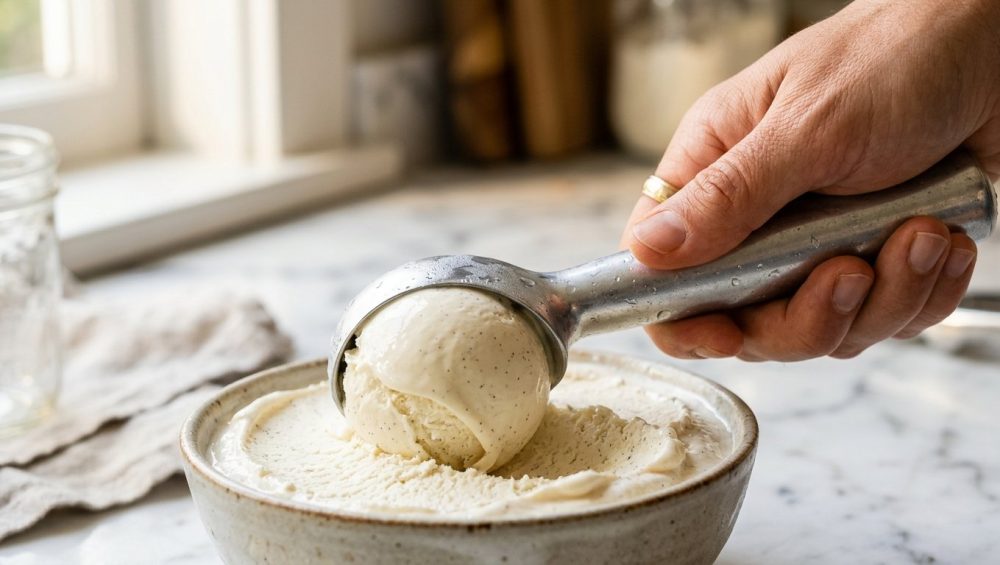
Instead of stabbing the center, start at the outer edge. Hold the scoop firmly in your palm for about five to ten seconds before you begin. This primes the internal fluid, charging it with your body heat. Press the razor-thin edge against the perimeter of the carton.
The ‘S’ Curve Scrape
Do not dig down; pull across. Drag the tool across the surface of the ice cream in an ‘S’ pattern or a wide circular motion. Because the edge is warm, it will instantly melt a one-millimeter layer of the cream. As you pull, the curved geometry of the bowl forces that thin ribbon of dairy to roll back onto itself. Keep dragging, and the ribbon will naturally form a picture-perfect, tightly coiled sphere.
Because you are only shaving the top layer where the micro-melt occurs, you encounter almost zero physical resistance. Your wrists are spared, your spoons remain unbent, and the resulting scoop looks like it belongs in a high-end parlor window.
The Golden Rule of Maintenance: Never, Ever Use the Dishwasher
We have reached the most critical part of this masterclass. If you ignore everything else I have said, remember this: NEVER put a bare aluminum, liquid-filled scoop in the dishwasher. Period.
If you have ever pulled your favorite dessert tool out of the wash cycle and wondered why your scoop turned gray, this is the exact chemical reaction to blame.
The Science of Aluminum Oxidation
Dishwasher detergents are not like standard liquid dish soap. They are highly alkaline, caustic chemical cocktails designed to aggressively break down baked-on food proteins. Aluminum is a highly reactive metal. In its natural state, bare aluminum forms a microscopic, transparent layer of aluminum oxide when exposed to air. This invisible layer acts as a shield, protecting the metal from further corrosion.
When you subject aluminum to the caustic environment of a modern dishwasher, the highly alkaline detergent completely strips away that protective oxide layer. The exposed, bare aluminum then violently reacts with the extreme heat, moisture, and chemicals in the machine. This accelerated oxidation process transforms the surface of the metal, creating a thick, porous, dark grey or black layer of aluminum oxide soot.
This soot is highly abrasive. It looks terrible, it feels chalky, and it will aggressively rub off onto your hands, your dish towels, and your food. Once a scoop has been “dishwashered,” it is incredibly difficult to restore. You have to manually scrub away the oxidized layer with an acidic cleaner (like lemon juice or Bar Keepers Friend) and a heavy abrasive pad, and even then, it rarely regains its original luster.
Furthermore, dishwashers use extreme heat during their drying cycles. This intense, sustained ambient heat can cause the conductive fluid inside the sealed handle to expand rapidly. This expansion can blow out the vacuum seal at the base of the handle, causing the fluid to leak out and rendering the tool completely useless.
Much like the frustrating mystery of why your plastic containers stay greasy no matter how hard you scrub them, understanding the materials in your kitchen changes everything. Aluminum requires respect. Wash your scoop by hand in warm, soapy water immediately after use. It takes exactly fifteen seconds. Rinse it, dry it with a towel, and put it back in the drawer.
The Bigger Picture: Upgrading Your Kitchen Intelligence
I am usually the first person to tell you to avoid single-purpose kitchen gadgets. You do not need a strawberry huller, you do not need an avocado slicer, and you certainly do not need a banana hanger. But a liquid-filled, heat-conductive aluminum ice cream scoop is the rare exception to the rule.
It is a masterclass in functional design. It solves a universal, highly annoying problem using the elegant, invisible laws of thermodynamics rather than cheap plastic gears or toxic coatings. It saves your time, it protects your wrists, it spares your flatware, and it treats your expensive ingredients with the respect they deserve.
Cooking—and serving—should never be a wrestling match. By investing in a high-quality, science-backed tool and learning exactly how to maintain it, you are proving that you do not need a culinary degree to operate like a professional in your own home. So, throw away that flimsy trigger-scoop, step away from the microwave, and let the physics of thermal conductivity do the heavy lifting for your weekend dessert.