Picture this: It is 6:30 PM on a Tuesday. You are exhausted from a long day of pretending to care about spreadsheets, and you have responsibly decided to make a healthy, vibrant salad for dinner instead of ordering your body weight in takeout. You chop the crisp lettuce, slice the heirloom tomatoes, and throw together a quick dressing. You pour some expensive olive oil and fancy balsamic vinegar into a mason jar, give it a vigorous shake, and pour it over your beautiful greens.
For exactly thirty seconds, you feel like a culinary genius. But by the time you carry your bowl to the dining table, disaster has struck. The dressing has completely separated. Your delicate greens are now suffocating under a heavy, greasy oil slick, while a harsh, acidic puddle of pure vinegar pools at the bottom of the bowl. Every bite is a game of Russian roulette—will you get a mouthful of slick, unflavored fat, or a throat-burning hit of straight acid?
If your vinaigrette always separates before you can even take your first bite, you are not alone. It is a universal frustration, and frankly, it is one of those classic rookie kitchen mistakes that can easily ruin an otherwise perfect meal.
As a fiercely pragmatic home cook, I believe that your time is money. During the week, we need maximum efficiency. We do not have the luxury of spending forty-five minutes coaxing a sauce together, nor do we have the patience to re-shake a mason jar every time we want to take a forkful of lettuce. You need a dressing that stays together, coats the leaves perfectly, and delivers a balanced punch of flavor in every single bite. Because let’s be honest, nobody wants to eat a salad where the fresh herbs get slimy under a suffocating blanket of separated olive oil.
The secret to solving this maddening problem does not require a culinary degree, a pretentious chef’s vocabulary, or a laboratory full of equipment. It requires a basic understanding of high school chemistry and a humble jar of Dijon mustard. Today, we are going to master the science of emulsification. We are going to learn exactly why oil and vinegar hate each other, how to force them to get along, and how to create a bulletproof, restaurant-quality vinaigrette that will elevate your weeknight dinners and your elaborate weekend feasts alike.
The Science of Stubborn Liquids: Why Oil and Water Hate Each Other
Before we can fix the problem, we need to understand why the problem exists in the first place. Why is it so incredibly difficult to get oil and vinegar to stay mixed? The answer lies at the microscopic level, in the fundamental laws of molecular polarity.
Polarity 101: A Tale of Two Molecules
Vinegar is essentially a solution of acetic acid and water. Water molecules are what chemists call “polar.” Because of the electronegative properties of the oxygen atom, a water molecule has a slight positive charge on one end and a slight negative charge on the other. Much like the north and south poles of a magnet, these charged ends are fiercely attracted to other polar molecules. They love each other. They want to stick together. In scientific terms, they are hydrophilic, which literally translates to “water-loving”.
Oil, on the other hand, is a fat. Fat molecules are “non-polar.” They do not have charged ends. They are completely indifferent to the magnetic charm of water molecules. In fact, because water molecules are so aggressively attracted to each other, they actively squeeze the oil molecules out of the way so they can bond with one another. Oil is hydrophobic, meaning “water-fearing”.
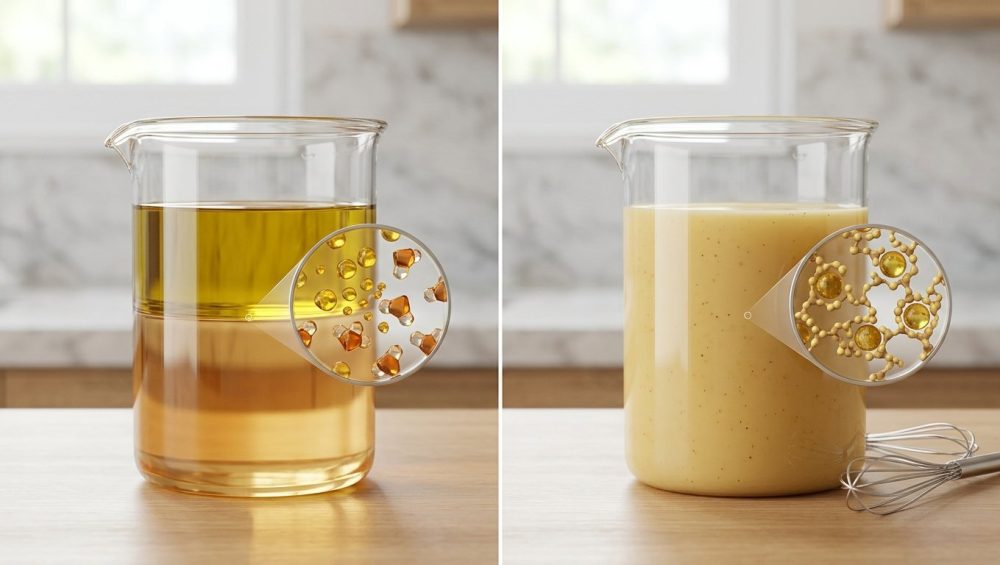
When you pour oil and vinegar into the same container, they physically refuse to mix. It is not a matter of technique; it is a matter of physics. The water molecules link arms and sink to the bottom (because water is denser than oil), while the oil molecules are pushed to the top, forming two distinct, stubborn layers.
The Temporary Fix: Mechanical Shear
“But wait!” you say. “When I shake the jar really hard, they mix!”
Yes, temporarily. When you vigorously shake a jar or aggressively attack a bowl with a whisk, you are applying what is known as “mechanical shear”. You are using brute physical force to smash the oil layer into millions of microscopic droplets, dispersing them throughout the vinegar. For a brief, fleeting moment, the mixture looks cloudy, thick, and cohesive.
But the moment you stop shaking, thermodynamics takes over. The oil droplets, desperate to escape the water and minimize their surface area, begin bumping into each other. When two small oil droplets collide, they merge into a larger droplet. This process, called coalescence, happens rapidly. Within minutes, all those microscopic droplets have merged back into a single, greasy slick floating on top of your vinegar.
Shaking is not a solution; it is a temporary delay of the inevitable. To create a dressing that actually stays together, you need a molecular peacekeeper. You need an emulsifier.
Enter the Hero: What is an Emulsifier, Anyway?
An emulsion is a stable mixture of two liquids that normally refuse to combine—in our case, oil and water. To create a stable emulsion, you need a third ingredient that can act as a bridge between the two hostile parties. This magical ingredient is called an emulsifier (or a surfactant).
The Molecular Matchmaker
Emulsifiers are the diplomats of the culinary world. At a molecular level, an emulsifier has a split personality. One end of the molecule is hydrophilic (water-loving), and the other end is lipophilic or hydrophobic (oil-loving).
When you introduce an emulsifier into your dressing and apply mechanical shear (whisking or shaking), the emulsifier leaps into action. The oil-loving tail buries itself into the microscopic droplets of oil, while the water-loving head points outward, grabbing onto the surrounding vinegar. The emulsifier effectively coats every single oil droplet in a protective molecular armor.
Because the water-loving heads are now facing outward, the oil droplets can comfortably float suspended in the vinegar without being pushed away. Furthermore, this protective coating prevents the oil droplets from bumping into each other and coalescing. The result? A perfectly smooth, thick, creamy, and permanently stable dressing that will cling beautifully to your lettuce leaves.
Once you understand this science, you will realize the true magic of a salad spinner. If your lettuce is wet, that excess water will dilute your carefully constructed emulsion and cause the dressing to slide right off. Dry greens and a properly emulsified vinaigrette are the two non-negotiable pillars of a restaurant-quality salad.
The Secret Power of Dijon Mustard
So, where do we find these magical emulsifying molecules? The culinary world is full of them. Egg yolks contain lecithin, which is why mayonnaise and hollandaise sauce stay together. Honey and garlic have mild emulsifying properties. But for a classic vinaigrette, the undisputed king of the kitchen is Dijon mustard.
Not All Mustards Are Created Equal
Why Dijon? Why not the bright yellow mustard you squirt on a hot dog? While yellow mustard does contain some emulsifying properties, Dijon is the superior choice for several reasons. First, the flavor profile of Dijon is sharp, complex, and sophisticated, perfectly complementing the acidity of vinegar and the fruitiness of olive oil without overpowering them. Second, Dijon mustard is finely ground into a smooth paste, which helps it integrate seamlessly into a liquid dressing without leaving a gritty texture.
Mucilage: The Unsung Hero of the Mustard Seed
The real secret power of Dijon mustard lies in a substance called mucilage. Mucilage is a complex carbohydrate (a polysaccharide gum) found primarily in the outer hull of the mustard seed.
During the manufacturing process of high-quality Dijon mustard, the seeds are crushed, and this mucilage is released. Mucilage is a highly effective natural hydrocolloid. It acts as a powerful emulsifying agent because its molecular structure features both hydrophilic and hydrophobic properties.
When you whisk Dijon mustard into your vinegar, the mucilage dissolves. As you slowly drizzle in your oil, the mucilage molecules wrap around the newly formed oil droplets, dropping the interfacial tension between the oil and the water. It essentially acts as a highly effective glue, pulling the two opposing liquids into a harmonious, stable suspension.
Just a single teaspoon of Dijon mustard contains enough mucilage to stabilize an entire cup of vinaigrette. It is a cheap, accessible, and entirely natural food science miracle sitting right in your refrigerator door.
The Masterclass: Building a Bulletproof Vinaigrette
Now that we understand the chemistry, it is time to put it into practice. Making a stable vinaigrette is incredibly simple, but the order of operations is absolutely critical. You cannot just dump everything into a bowl at once and hope for the best.
Step 1: The Acid Base
Always start with your water-based ingredients. In a mixing bowl, combine your acid (such as white wine vinegar, apple cider vinegar, or fresh lemon juice). This is also the time to add any other water-soluble flavorings, such as a splash of maple syrup or a finely minced shallot.
Step 2: The Dijon Anchor
Next, add your emulsifier. For a standard batch of dressing (about one cup total), you need roughly one to two teaspoons of Dijon mustard. Whisk the mustard thoroughly into the vinegar until it is completely dissolved and the liquid is opaque.
This is also the exact moment you must add your salt. Salt dissolves beautifully in water (vinegar), but it absolutely refuses to dissolve in oil. If you wait until after you have added the oil to season your dressing, the salt crystals will just sink to the bottom, leaving your dressing tasting flat and under-seasoned. Whisk the salt into the vinegar/mustard mixture until it vanishes.
Step 3: The Drip-Drop Oil Method
This is where the magic happens, and it is where most home cooks fail. You must add the oil incredibly slowly.
If you dump all the oil in at once, the mustard mucilage will be overwhelmed. It will not have enough time to coat the oil droplets, and the emulsion will fail before it even begins.
Take your whisk in your dominant hand and your measuring cup of oil in the other. Begin whisking the vinegar mixture vigorously. While maintaining a rapid whisking motion, add the oil a few drops at a time. Once the first few drops have been completely absorbed and the mixture starts to look slightly thicker, you can begin pouring the oil in a very slow, thin, steady stream.
Do not stop whisking. The mechanical shear of the whisk is breaking the oil down into microscopic droplets, while the Dijon mustard is immediately wrapping those droplets in mucilage to lock them in place. By the time you have incorporated all the oil, your dressing should be thick, glossy, and completely unified. It should look more like a loose mayonnaise than a watery liquid.
Step 4: Mastering the Ratio
The classic French culinary ratio for a vinaigrette is 3 parts oil to 1 part vinegar. However, as a sassy sous-chef who prefers a brighter, punchier salad, I find the 3:1 ratio to be a bit too heavy and greasy for modern palates. I highly recommend starting with a 2:1 ratio (two parts oil to one part vinegar). If you are using a very mild acid, like a sweet balsamic or a mellow rice vinegar, you can even push it to a 1:1 ratio. The beauty of knowing the science is that you have the power to adjust the variables to suit your exact taste.
Troubleshooting the Broken Dressing
Even the best of us occasionally mess up. Maybe the phone rang, maybe you poured the oil too fast, or maybe your ingredients were too cold. Whatever the reason, you are suddenly staring at a broken, separated mess. Do not panic, and do not throw it away. You can rescue a broken emulsion.
Why Did My Dressing Break?
Emulsions are delicate systems, and they usually break due to a failure in one of three physical constraints: temperature, emulsifier concentration, or mechanical energy.
- You rushed the oil: If you add the oil faster than the whisk can break it down, the oil droplets coalesce, and the sauce breaks.
- Temperature shock: Cold oil straight from the fridge is highly viscous and resists breaking into small droplets. Always try to make your dressings with room-temperature ingredients.
- Not enough emulsifier: If you tried to make a massive batch of dressing with only a microscopic dab of mustard, there simply wasn’t enough mucilage to coat the volume of oil.
How to Rescue a Broken Emulsion
The instinct of most beginners is to just whisk the broken dressing harder. This will not work. Once the oil droplets have coalesced and the emulsion has collapsed, brute force alone cannot rebuild the interfacial tension. You need to re-establish the colloidal dispersion from scratch.
Here is the foolproof, food-science-approved rescue method:
- Grab a clean mixing bowl.
- Add one teaspoon of room-temperature water, or a fresh half-teaspoon of Dijon mustard (or mayonnaise) into the clean bowl.
- Take your broken, separated dressing and slowly—drop by drop—whisk it into the new bowl.
By starting fresh, you are giving the emulsifier a chance to properly coat the oil droplets all over again. Within sixty seconds, your broken, greasy mess will transform back into a luscious, stable, creamy vinaigrette. It feels like absolute magic, but it is just physics.
The Sassy Sous-Chef’s Gear Check: Tools for the Perfect Emulsion
You cannot do good work with bad tools. While I firmly believe that anyone can cook like an expert without a culinary degree, I am fiercely committed to banishing toxic kitchen gear from your home. The equipment you use to make your dressings matters immensely.
The Bowl Matters (No Peeling Non-Stick!)
When making an emulsion, you need a heavy bowl that will sit flat on the counter while you whisk with one hand and pour oil with the other. I highly recommend a heavy-duty glass bowl or a thick, high-quality stainless steel mixing bowl with a silicone non-slip base.
Do not, under any circumstances, use cheap plastic mixing bowls or flimsy, scratched non-stick cookware. Plastic is inherently lipophilic (it loves oil), which is exactly why your plastic containers stay greasy no matter how hard you scrub them. Trying to build a delicate oil-in-water emulsion in a bowl that actively clings to oil is a fool’s errand. Furthermore, using a metal whisk in a cheap non-stick bowl will scratch the toxic coating right into your food, just like you are ruining your nonstick pans with cheap aerosol sprays. Stick to glass or stainless steel.
The Whisk Situation
You need mechanical shear to break up the oil, which means you need a proper whisk. A balloon whisk (the one with the wide, bulbous bottom) is great for aerating egg whites, but it is clumsy for making a small batch of vinaigrette. Instead, invest in a French whisk. A French whisk has thicker, stiffer wires that are clustered closer together in a narrower profile. It provides vastly superior shearing force, ripping the oil into microscopic droplets with minimal effort.
Also, please invest in a whisk with a completely sealed handle. Because there is nothing worse than when your whisk leaks dishwater into your pristine dressing from a poorly constructed seam.
Immersion Blenders for the Weekend Perfectionist
If you are making a large batch of dressing for a dinner party, or if you simply despise whisking, an immersion blender (stick blender) is your best friend. The spinning blades of an immersion blender operate at thousands of revolutions per minute, providing a level of mechanical shear that a human arm simply cannot match.
To use an immersion blender, place your vinegar, mustard, and seasonings into a tall, narrow vessel (like a wide-mouth mason jar). Plunge the blender to the bottom and turn it on. Slowly pour the oil in from the top. The vortex created by the blender will pull the oil down, violently smashing it into the mustard mucilage and creating an emulsion so thick and stable it could practically hold up a spoon.
If you decide to use a silicone spatula to scrape every last drop of that liquid gold out of the blender jar, make sure you are using high-quality platinum silicone. Using cheap filler-silicone is exactly why you end up ruining the flavor profile of your food or wondering why your spatula smells like garlic three weeks later.
Beyond the Salad: Other Culinary Miracles of Emulsification
Once you master the science of emulsification, a whole new world of culinary artistry opens up to you. The exact same principles that keep your salad dressing from separating are the foundation of countless other restaurant-quality techniques. After all, the foundation of a beautifully organized dream kitchen starts with mastering the basics.
Pan Sauces That Cling
Have you ever tried to make a pan sauce after searing a steak, only to end up with a watery, broken mess of beef broth and separated butter? That is a broken emulsion. Butter is essentially an emulsion of water suspended in butterfat. When you melt it into a hot liquid, it breaks. To fix it, you need an emulsifier and mechanical shear. By vigorously whisking a small dab of Dijon mustard into your simmering pan juices before slowly whisking in cold cubes of butter, you create a rich, glossy, stable pan sauce that coats the back of a spoon and clings beautifully to your meat.
Marinades That Actually Penetrate
If you throw chicken breasts into a ziplock bag with a separated mixture of oil and vinegar, the oil will coat the outside of the meat, preventing the acidic vinegar and the water-soluble flavors (like salt and garlic) from penetrating the flesh. By emulsifying your marinade first using a spoonful of Dijon mustard, you ensure that the fat, the acid, and the salt are delivered evenly to the surface of the meat, resulting in a vastly superior flavor and texture.
Frequently Asked Questions About Salad Dressings
Because I know you have questions, let’s address the most common roadblocks home cooks face when diving into the world of homemade vinaigrettes.
How long will a Dijon-emulsified vinaigrette stay together?
If properly emulsified using the slow-drip method and a sufficient amount of Dijon mustard, the emulsion can hold at room temperature for several hours, and sometimes up to a few days in the refrigerator. Unlike mayonnaise, which is a permanent emulsion stabilized by egg yolks, a standard vinaigrette is considered a temporary or semi-permanent emulsion. Eventually, gravity and thermodynamics will win, and it will begin to separate. However, because the mucilage is still present, a quick shake of the jar will instantly restore the emulsion.
Does homemade vinaigrette need to be refrigerated?
If your dressing consists strictly of oil, vinegar, Dijon mustard, salt, and dried spices, it is highly acidic and generally safe to sit on the counter for a few days. However, if you add fresh ingredients like minced garlic, shallots, fresh herbs, or lemon juice, it must be stored in the refrigerator to prevent bacterial growth. Note that high-quality olive oil will solidify in the fridge. Simply let the jar sit at room temperature for 15 minutes before serving, give it a shake, and you are good to go.
Can I use dry mustard powder instead of Dijon?
Yes, you can. Dry mustard powder also contains the mucilage necessary to act as an emulsifier. However, dry mustard powder requires time to hydrate and activate. If you use dry powder, whisk it into the vinegar and let it sit for about ten minutes before streaming in your oil. Be aware that dry mustard packs a significantly hotter, more pungent punch than prepared Dijon, so adjust your quantities accordingly.
Can I use mayonnaise to fix a broken dressing?
Absolutely. Mayonnaise is essentially an oil-in-water emulsion that is heavily stabilized by the lecithin in egg yolks. Adding a tiny dollop (about a half teaspoon) of mayonnaise to a broken vinaigrette introduces a massive dose of powerful emulsifiers. Whisking the broken dressing into that small amount of mayo will instantly bind the oil and vinegar back together without significantly altering the flavor profile.
Final Thoughts: You Are the Master of Your Salad
Cooking is not magic. It is not an elite skill reserved for people who spent fifty thousand dollars at a culinary institute in France. Cooking is simply applied physics and chemistry, made delicious.
When you understand that oil and water are locked in a microscopic battle of polarity, you stop blaming yourself when your dressing separates. When you realize that the humble mustard seed contains a complex carbohydrate designed by nature to bridge the gap between fat and water, you unlock the power to control your ingredients.
You no longer have to settle for the overpriced, preservative-laden bottles of dressing from the grocery store. You no longer have to endure the heartbreak of an oily, wilted weekday salad. Armed with a glass bowl, a sturdy whisk, and a spoonful of Dijon mustard, you are now the undisputed master of the emulsion.
Go forth, whisk with confidence, and never eat a sad, separated salad ever again.