Let’s get one thing straight right out of the gate: you do not need a culinary degree to make mind-blowing, restaurant-quality food in your standard home kitchen. You just need to understand a little bit of basic physics, respect your ingredients, and equip yourself with the right tools. If you are reading this, you have likely experienced the profound disappointment of cooking a batch of tofu that turned out pale, squishy, and entirely devoid of flavor. You wanted a shatteringly crisp, golden-brown crust, but instead, you ended up with something that visually and texturally resembled a damp kitchen sponge.
Do not blame yourself, and more importantly, do not blame the tofu. It’s one of the most frustrating rookie kitchen mistakes that plagues weekend culinary hobbyists, but the culprit is almost always excess internal moisture. We are going to take a brutally honest, highly analytical deep dive into the cellular structure of this beautiful plant-based protein, explain the thermodynamic nightmare of pan-frying wet ingredients, and introduce you to the absolute genius of a dedicated tofu press. Grab a glass of wine, sharpen your favorite knife, and let’s fix your weeknight stir-fry once and for all.
The Cellular Anatomy of Tofu (Or: Why It’s Basically a Water Balloon)
To understand why your tofu refuses to crisp up in a hot pan, you have to understand what tofu actually is on a microscopic level. Tofu is not a solid block of protein; it is a highly complex, delicate matrix that is holding onto a massive amount of liquid.
Soybean Curds and Coagulants: A Brief Chemistry Lesson
Tofu is made through a process that is remarkably similar to making cheese. Dried soybeans are soaked, crushed, and boiled to produce fresh soy milk. To turn that liquid milk into a solid block, tofu artisans introduce a coagulant—typically a salt like calcium sulfate or magnesium chloride, or an acid. These coagulants cause the proteins and suspended fats in the soy milk to denature and bond together, forming delicate curds.
When these curds are pressed into blocks, they form a three-dimensional protein-water gel. The soy proteins create a structural lattice, and trapped within the microscopic pockets of that lattice is water. Lots of water. Even when you purchase a block labeled “extra-firm,” that block is still composed of roughly 85% water.
The Sponge Effect: How Tofu Traps Moisture
Because tofu is a gel network, it behaves exactly like a sponge. The water isn’t just sitting on the surface; it is locked deep inside the cellular structure. As long as that water remains trapped inside the matrix, the tofu will remain soft, heavy, and structurally fragile.
When you slice a block of unpressed tofu and immediately throw it into a hot pan, the heat causes the protein network to rapidly contract. As the proteins tighten, they squeeze the trapped water out of the cellular pockets, flooding your frying pan with liquid. You are no longer pan-frying your dinner; you are accidentally boiling it in its own juices.
The Thermodynamics of Pan-Frying: Why Water is the Enemy of Crispiness
Cooking is just applied thermodynamics, and pan-frying is a battle for temperature supremacy. If you want a crispy, flavorful exterior on any protein, you are entirely reliant on a specific chemical reaction, and that reaction has a strict set of environmental demands.
The Maillard Reaction Explained (Without the Chef-Speak)
The golden-brown crust you crave on a perfectly seared piece of tofu is the result of the Maillard reaction. Coined in 1912 by French chemist Louis-Camille Maillard, this is a complex, non-enzymatic chemical reaction between amino acids and reducing sugars that occurs when food is subjected to high heat.
The Maillard reaction does not just change the color of the food; it creates hundreds of brand-new flavor and aroma compounds that make food taste incredibly savory and complex. However, the Maillard reaction is notoriously picky. It typically requires temperatures between 140°C and 165°C (280°F to 330°F) to proceed rapidly.
The Leidenfrost Effect and Steam Barriers
Here is where the physics of water ruins your dinner. Liquid water cannot exceed 100°C (212°F) under normal atmospheric pressure. When the water inside your tofu hits the hot oil in your pan, it absorbs the thermal energy and undergoes a phase change, turning into steam. As long as there is liquid water present on the surface of your tofu, the temperature of that surface is mathematically capped at 100°C.
Understanding how to prevent food sticking is half the battle in a home kitchen, and excess moisture is the primary villain. If the surface of the tofu cannot exceed 100°C, the Maillard reaction (which demands 140°C) simply cannot occur. The tofu will sit in the pan, sputtering and spitting violently, creating a layer of steam that acts as a thermal barrier between the protein and the hot oil.
Why Wet Tofu Steams Instead of Sears
This is the exact reason your tofu turns out pale and soggy. You are waiting for a golden crust to form, but the thermal energy from your stove is entirely occupied with boiling away the continuous flood of water weeping from the tofu’s cellular matrix. By the time enough water has finally evaporated for the surface temperature to rise, the interior of the tofu is hopelessly overcooked, rubbery, and dry. To achieve a rapid, aggressive sear, the surface of the protein must be completely devoid of moisture before it ever touches the pan.
The “Heavy Books and Paper Towels” Method: A Recipe for Disaster
For decades, home cooks have been told to drain their tofu by wrapping it in half a roll of paper towels, placing a cutting board on top, and balancing a precarious stack of heavy cookbooks or a cast-iron skillet over the whole assembly. As your sassy sous-chef, I am officially begging you to stop doing this. We are weekend culinary hobbyists, not amateur jugglers.
The Structural Integrity Problem
The “heavy books” method is fundamentally flawed because it relies on unbalanced, uncalibrated weight. When you stack a heavy skillet on top of a cutting board, the weight is rarely distributed evenly. One side of the tofu gets crushed under immense pressure, while the other side barely drains.
Worse, sudden, aggressive weight fractures the delicate soy protein matrix. Instead of gently coaxing the water out of the cellular pockets, you are violently crushing the walls of the lattice. When you go to slice that fractured block, it will crumble into a mess of ragged, uneven pieces that will disintegrate as soon as you try to flip them in the pan.
The Hygiene and Waste Nightmare
Beyond the structural damage to your food, the textbook method is an absolute mess. You are burning through expensive, wasteful paper towels that instantly become saturated and useless. Furthermore, balancing dusty college textbooks or the bottom of a well-used skillet near your raw ingredients is a hygiene disaster waiting to happen. You need a dedicated, sanitary tool designed specifically for the physics of water displacement.
Enter the Tofu Press: The Unsung Hero of Plant-Based Cooking
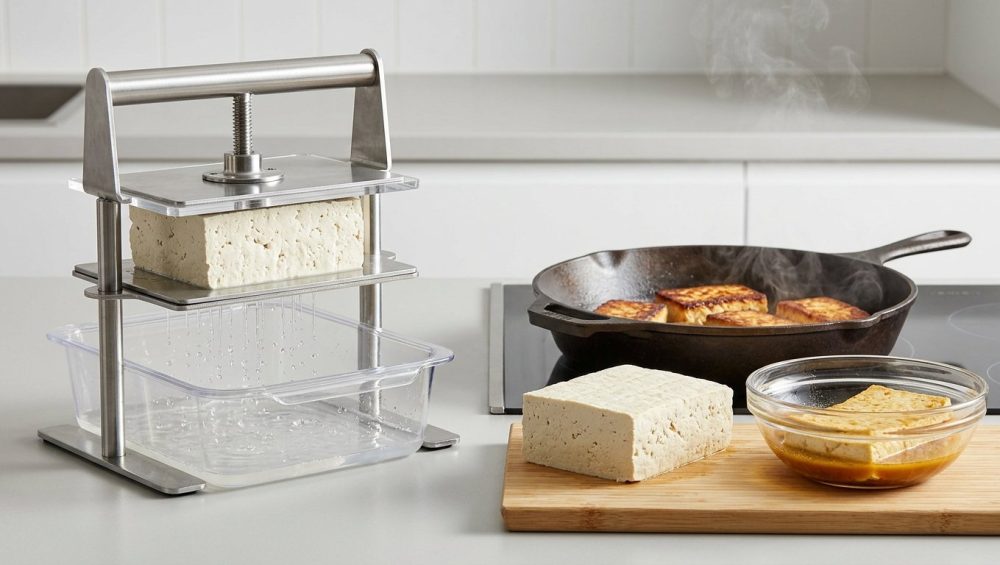
A dedicated tofu press is not a single-use kitchen gimmick; it is a precision tool engineered to solve a specific thermodynamic problem. By replacing chaotic, unbalanced weight with calibrated mechanical tension, a tofu press transforms a soggy block of soy curds into a dense, meaty, flavor-absorbing powerhouse.
The Physics of Consistent, Gentle Pressure
The genius of a high-quality tofu press lies in its ability to apply consistent, even, and gradual pressure across the entire surface area of the block. Whether utilizing tension springs, threaded screws, or heavy stainless steel plates, a press gently compresses the protein matrix without fracturing it.
As the press slowly tightens, the internal pockets of the gel network are smoothly collapsed, forcing the trapped water out through the sides. Because the pressure is applied evenly, the structural integrity of the block remains perfectly intact. The result is a block of tofu that is significantly denser, firmer, and completely dry to the touch.
Capillary Action: How Pressing Unlocks Flavor Absorption
Pressing your tofu does not just guarantee a crispy exterior; it is the absolute secret to deep, penetrating flavor. Remember those microscopic pockets in the protein lattice that used to hold water? When you press the tofu, you empty those pockets.
When you subsequently submerge that pressed, dry tofu into a flavorful liquid, capillary action takes over. The empty cellular voids act like a vacuum, physically sucking the soy sauce, ginger, and sesame oil deep into the center of the block. If you do not press your tofu, those pockets remain full of water. Your expensive marinade will simply wash over the surface and burn in the pan. Burnt garlic powder instantly makes food bitter, ruining the entire dish. A tofu press ensures your flavors penetrate all the way to the core.
How to Choose a Tofu Press (And Which Toxic Trash to Avoid)
Not all tofu presses are created equal. The market is currently flooded with cheap, poorly manufactured gadgets that will break after three uses. If you are going to invest in a tool to elevate your weeknight dinners, you need to buy something that actually works.
The “No-Go” Rule: Flimsy Plastics and Mystery Metals
I am a relentless advocate for banishing toxic kitchen gear from your home, and cheap plastic tofu presses are public enemy number one. When you apply mechanical tension to brittle, low-grade plastic, it is only a matter of time before the plastic snaps under pressure.
Furthermore, you are often pressing tofu that has been exposed to acidic marinades. Squeezing wet, acidic food against cheap, unverified plastics that may leach endocrine disruptors or microplastics is a massive no-go. If you are buying a press, demand food-grade stainless steel, sustainable bamboo, or high-quality, BPA-free materials from reputable manufacturers.
Spring-Loaded vs. Plate-Style Presses
There are generally two main styles of presses available to the home cook:
- Box-Style (Spring-Loaded): These presses feature a plastic or metal box with a spring-loaded top plate. You drop the tofu in, clamp the lid down, and the spring applies continuous pressure. These are incredibly convenient because they are self-contained, catch their own water, and can be placed directly in the fridge while pressing.
- Plate-Style (Screws or Weights): These presses consist of two flat plates connected by threaded screws. You manually tighten the screws to increase the pressure. Plate presses offer much more precise control over the exact level of density you want to achieve.
Material Matters: Stainless Steel and Sustainable Bamboo
If you want a buy-it-for-life tool, material is everything. Just as cheap bamboo cutting boards can splinter and ruin your knives if not properly maintained, a poorly made bamboo press will warp from the constant exposure to water. However, high-quality, sustainably sourced bamboo presses with heavy-duty stainless steel hardware are beautiful, eco-friendly, and highly effective.
For the absolute purists, heavy-duty stainless steel presses are the gold standard. Brands like Raw Rutes manufacture solid stainless steel presses right here in the USA. Instead of springs or screws, they use a solid five-pound stainless steel weight to apply gravity-based pressure. It is virtually indestructible, completely free of plastics, and will outlast every other tool in your kitchen.
The Masterclass: How to Achieve Restaurant-Quality Crispy Tofu
Now that you understand the science and have secured the proper equipment, it is time to put the theory into practice. Follow these steps meticulously, and you will achieve a golden, shatteringly crisp crust every single time.
Step 1: The Drain and Press
Start with a block of extra-firm or super-firm tofu. Drain the liquid from the packaging and place the block into your tofu press. Apply gentle tension. Do not crank the screws down as hard as you can immediately, or you will blow out the sides of the block. Let the press do its work for at least 15 to 30 minutes. As the water weeps out, gradually increase the tension.
Once pressed, remove the block and pat the exterior completely dry with a clean kitchen towel. Next, decide on your shape. You can slice it into pristine, uniform cubes, but if you want maximum crispiness, try tearing the tofu into rugged chunks with your hands. Tearing creates craggy, uneven edges, which drastically increases the surface area exposed to the hot oil, resulting in a much crunchier final texture.
Step 2: The Cornstarch Coating (The Secret Weapon)
Even after pressing, there will be a microscopic amount of residual moisture on the surface of the tofu. To combat this and guarantee a crust, we rely on the magic of starch gelatinization.
Toss your dry, pressed tofu chunks in a bowl with a few tablespoons of cornstarch (or potato starch), a pinch of kosher salt, and some freshly cracked black pepper. The cornstarch absorbs any remaining surface moisture. When that starch hits the hot oil in your pan, the starch granules rapidly swell, absorb water, and burst, forming a rigid, glass-like crust that perfectly encapsulates the tender protein inside.
Step 3: The Pan, The Heat, and The Oil
You need a pan that can hold onto thermal energy. This is where understanding carbon steel skillet thermodynamics becomes your secret weapon. A heavy carbon steel or cast-iron skillet retains heat beautifully, ensuring that the temperature of the pan does not plummet the second you add your room-temperature tofu.
Place your skillet over medium-high heat and let it get properly hot. Add a generous glug of a high-smoke-point cooking oil, such as avocado oil, grapeseed oil, or peanut oil. You need enough oil to completely coat the bottom of the pan—do not skimp here. Relying on cheap aerosol cooking sprays is a guaranteed method for ruining your nonstick pans and will leave your food sticking to the metal.
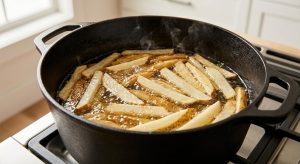
Carefully lay your cornstarch-coated tofu pieces into the hot oil, ensuring they are in a single layer with plenty of space between them. If you crowd the pan, the temperature will drop, and the tofu will steam. Now, for the most difficult step: walk away. Do not touch the tofu. Do not shake the pan. Do not peek underneath. Let the Maillard reaction do its job. After 4 to 5 minutes, when a deep golden-brown crust has formed, the tofu will naturally release from the pan, allowing you to easily flip it and crisp the remaining sides.
Beyond the Press: Advanced Tofu Hacks for the Weekend Warrior
Once you have mastered the basic press-and-sear technique, you can start experimenting with advanced preparation methods that alter the molecular structure of the tofu even further.
The Freeze-and-Thaw Method
If you want an incredibly meaty, chewy texture, freezing it first changes everything. Take the entire block of tofu—still sealed in its original plastic packaging—and throw it directly into the freezer overnight.
Because tofu is mostly water, the liquid inside the cellular matrix expands as it turns into ice crystals. This aggressive expansion forces the protein lattice to stretch and bloat. When you eventually thaw the block, the ice melts, leaving behind massive, porous honeycomb holes. The resulting texture is dramatically more elastic and chewy. Once thawed, you simply run it through your tofu press to expel the melted water, and you are left with a sponge that will absorb marinades faster and deeper than fresh tofu ever could.
Boiling Tofu Before Pressing (Yes, Really)
It sounds entirely counterintuitive to introduce a water-logged ingredient to a pot of boiling water, but science proves otherwise. Much like the counterintuitive trick where you should actually boil them first to get perfectly seared mushrooms, boiling tofu is a game-changer.
If you drop your block of tofu into a pot of heavily salted boiling water for just 5 minutes before pressing, two incredible things happen. First, the intense heat causes the protein network on the surface of the tofu to rapidly contract and tighten. Second, the high salinity of the boiling water triggers osmosis, actively drawing the excess internal moisture out of the tofu and into the pot. When you pull the tofu out, it is significantly firmer, cleaner tasting, and structurally prepped to crisp up beautifully in the pan.
By combining these advanced preparation techniques with the mechanical efficiency of a high-quality tofu press, you are no longer just cooking a weeknight dinner; you are mastering the physical properties of your ingredients.
When your meal feels heavy and flat, it is usually because your dinner actually needs acid to cut through the fat. Once your tofu is perfectly crispy, pull it from the heat and toss it in a vibrant sauce featuring fresh lime juice, rice vinegar, or a splash of black vinegar. The sharp acidity will balance the rich, fried exterior, elevating the entire dish to professional standards.
You do not need to settle for sad, soggy, flavorless plant-based meals. Ditch the stack of heavy books, invest in a proper tofu press, respect the thermodynamics of your skillet, and start cooking with the confidence of an absolute expert. Your weeknight stir-fries will never be the same.