Look, I get it. You dropped forty dollars on a tiny, beautifully branded tin of ceremonial-grade matcha because some wellness influencer promised it would bring you inner peace and glowing skin. You scooped that precious green dust into your favorite coffee mug, poured boiling water over it, stirred it aggressively with a soup spoon, and took a hopeful sip.
And what did you get? Hot, bitter, grassy sludge with a massive clump of dry powder exploding in the back of your throat. Delicious.
I am the Sassy Sous-Chef, and I am here to tell you that the problem isn’t the tea. The problem is your physics. As a home cook who has set off the smoke detector more times than I care to admit, I learned the hard way that you cannot brute-force delicate ingredients. You cannot treat a 900-year-old culinary tradition the same way you treat a packet of instant hot cocoa. If you want to survive the kitchen without relying on expensive, eight-dollar coffee shop runs every morning, you need to understand the mechanics of what you are actually doing.
We are going to dismantle the “green sludge” phenomenon once and for all. We are going to talk about fluid dynamics, the absolute necessity of a traditional bamboo chasen, and exactly why whisking in circles is a fundamental failure of hydrodynamic shear. More importantly, we are going to explore how mastering this simple, precise process can transform your chaotic weekends into intentional, shared sensory experiences.
The Social Shift: Why Matcha Gatherings Are the New Happy Hour
Before we get into the microscopic science of tea particles, we need to talk about why you should even care about making a proper bowl of matcha in the first place. The landscape of weekend socializing has completely shifted. If you look at the latest 2026 data from beverage industry analysts at Datassential and IWSR, the writing is on the wall: the alcohol-free gathering is no longer a niche trend; it is a global cultural reset [1, 2].
The global non-alcoholic beverage market has exploded into a $1.55 trillion industry in 2026, driven largely by Gen Z and Millennials who are actively rejecting the hangover-inducing, chaotic dinner parties of the past [2, 4]. We are seeing a massive behavioral shift toward what industry insiders call “function stacking.” People don’t just want a drink that tastes good; they want a drink that does something [6]. They want beverages that offer functional benefits, like the calm, focused energy provided by the L-theanine found in high-quality matcha [4, 6].
This is where the mindful matcha gathering comes into play. You don’t need a massive dining room to host a meaningful dinner party; a simple, beautifully curated tea setup on your kitchen island is more than enough. A matcha gathering is the ultimate intentional social ritual. It is quiet, it is visually stunning, and it forces everyone to slow down and actually engage with the process.
Instead of shouting over loud music while mixing complicated cocktails, you and your guests are gathered around a beautiful ceramic bowl, watching the vibrant green powder transform into a silky, frothy masterpiece. It is an alcohol-free, anxiety-free way to connect with the people you care about. But to pull this off, you have to actually know how to make the tea palatable. Serving your guests a gritty, bitter bowl of hot swamp water is not exactly the vibe we are going for.
The Physics of the Powder: Why Your Matcha Is Clumping
To fix your matcha, you have to understand what matcha actually is. When you make standard green tea, you are steeping intact leaves in hot water to extract their water-soluble compounds, and then you throw the leaves away. Matcha is entirely different. Matcha is shade-grown Camellia sinensis tea leaves that have been de-veined, de-stemmed, and stone-ground into an ultra-fine powder [4]. When you drink matcha, you are consuming the entire leaf.
Here is the most critical scientific fact you need to internalize: matcha does not dissolve. It is not sugar. It is not salt. It is a stabilized aqueous suspension of micronized organic matter [4].
Ceremonial-grade matcha is ground to an incredibly fine particle size, averaging between 3 and 7 microns in diameter [4]. At this microscopic scale, the laws of physics start playing tricks on you. Because the particles are so small, they carry a high electrostatic charge [1]. This charge causes the particles to aggressively stick together in what physicists call agglomeration. The van der Waals forces dominating these tiny particles mean that the moment they touch moisture, they form stubborn, dry-centered clumps that act like waterproof armor [4].
This is why your soup spoon is failing you. The true secret to conquering the kitchen is understanding the science behind the ingredients, and the science here demands violence.
When you stir matcha with a spoon, or when you lazily whisk it in a circle, you are creating laminar flow. Laminar flow is a smooth, continuous movement of fluid. By stirring in a circle, you are essentially creating a single, lazy vortex. Centrifugal force takes over, and all those dry, electrostatic clumps of matcha are simply pushed to the outer edges of your bowl [1, 4]. You aren’t breaking them apart; you are just taking them on a very fast merry-go-round ride.
To break the van der Waals forces and shatter those clumps, you need turbulent flow. You need hydrodynamic shear force [4]. You need to physically pulverize the powder against the water molecules to force the particles into an even suspension [1]. And you cannot achieve that level of shear force with a standard kitchen utensil.
The Geometry of the Whisk: Entering the ‘W’ and ‘M’ Dimensions
If you want to stop drinking clumps, you have to stop whisking in circles. You need the right tool, and you need the right kinetic motion.
Let’s talk about the chasen, the traditional Japanese bamboo whisk. A traditional bamboo whisk is one of those essential tools every beginner needs if they are serious about this process. It looks like a delicate, rustic antique, but do not be fooled—it is a piece of high-precision fluid engineering [1]. A standard chasen is carved from a single piece of bamboo and features anywhere from 80 to 120 individual, flexible tines [1].
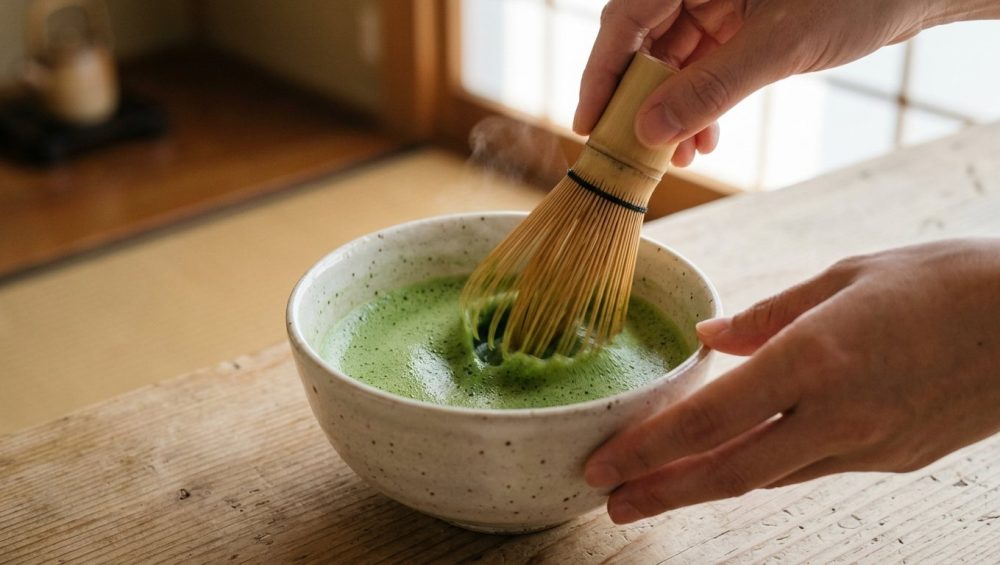
When you use a chasen correctly, those 100+ tines act as a massive shear force multiplier. But the magic only happens if you use the correct motion. You must whisk in a rapid, sharp “W” or “M” pattern [1].
When you vigorously snap your wrist back and forth in a straight, zigzag line, you are forcing the water to constantly crash into itself. Instead of one large, lazy circular vortex, the “W” motion forces the 100 tines of the bamboo whisk to create hundreds of microscopic, colliding mini-vortices [1]. This violent, chaotic turbulence generates the exact shear rate necessary (around 120–180 s⁻¹) to shatter the electrostatic clumps of powder and force the 5-micron particles into a uniform suspension [4].
But the “W” motion does something else equally important: it aerates the liquid to create a micro-foam.
If you have ever had a truly great bowl of matcha at a high-end café, you know it has a thick, creamy, almost sweet layer of foam on top. This is not just for aesthetics. A stable micro-foam consists of bubbles that are smaller than 100 microns in diameter [9]. This dense network of microscopic bubbles physically traps the suspended tea particles, preventing them from sinking to the bottom of the bowl [9]. It completely alters the mouthfeel of the tea, transforming it from a thin, watery broth into a rich, velvety emulsion.
If you whisk in circles, you introduce air too slowly and unevenly, resulting in large, fragile macro-bubbles that look like dish soap and pop within seconds, leaving you with a flat, gritty beverage [9]. The rapid “W” or “M” motion is the only manual way to achieve the cavitation required for a stable micro-foam.
The Sassy Sous-Chef’s No-Go List: Toxic Gear and Cheap Gadgets
Since we are on the topic of equipment, we need to have a very serious conversation about the absolute garbage being sold to home cooks under the guise of “modern convenience.” As your resident culinary truth-teller, I am fiercely passionate about banishing toxic kitchen gear from your home, and the matcha accessory market is currently flooded with absolute nonsense.
First on my hit list: the motorized, handheld milk frother. I see people using these cheap, battery-operated wands to mix their matcha, and it makes my eye twitch. Yes, a frother spins at 12,000 RPM and creates a massive vortex [9]. But remember what we just learned about fluid dynamics? A single, high-speed vortex creates macro-foam [1]. It whips huge amounts of air into the water, creating giant, unstable bubbles that collapse almost immediately [9]. Worse, the harsh metal coils of a motorized frother will violently scratch the bottom of your ceramic matcha bowl, ruining the glaze and potentially leaching whatever mystery metals the bowl was made of into your drink. Do not use a metal frother in a ceramic bowl. Ever.
Second on the list: cheap, painted ceramic bowls from discount home goods stores. A proper matcha bowl, or chawan, is designed with a specific wide, flat bottom to give your bamboo whisk the surface area it needs to execute the “W” motion effectively. Cheap bowls are often narrow, steeply sloped, and coated in toxic, low-fired decorative glazes that can contain heavy metals. When you are aggressively scraping a whisk against the bottom of a bowl filled with hot water, you need to know that the glaze is food-safe and fired at high temperatures. Investing in a beautiful, handcrafted ceramic chawan is one of those aesthetic kitchen upgrades that actually impacts your health and the quality of your food. Buy a real, high-quality stoneware or porcelain chawan from a reputable ceramics dealer.
Lastly, do not buy a metal kitchen whisk to make matcha. A standard metal balloon whisk has maybe 8 to 12 thick loops of wire [5]. It is physically impossible for 12 loops of thick metal to generate the micro-turbulence required to suspend 5-micron tea particles [1]. You will just end up with green water and clumps. Respect the bamboo.
The 175°F Rule: Stop Burning Your Tea
Now that we have the physics and the gear sorted out, we have to tackle the chemistry. If your matcha tastes incredibly bitter, astringent, or like burnt lawn clippings, your water is too hot. Period.
Having a precise temperature protocol is the fastest way to cure cooking anxiety when dealing with expensive ingredients. Matcha is an incredibly delicate biological compound. Because the leaves are shade-grown for weeks before harvest, they overproduce chlorophyll and a specific amino acid called L-theanine [10]. L-theanine is the holy grail of tea compounds; it is responsible for the deep, savory umami flavor, the subtle natural sweetness, and the calming, jitter-free energy that matcha is famous for [10, 14].
However, tea leaves also contain catechins (specifically epigallocatechin gallate, or EGCG) and tannins [10]. These are the defensive compounds of the plant, and they are aggressively bitter and highly astringent [10, 14].
Here is the biochemical reality: L-theanine is highly water-soluble and extracts beautifully at lower temperatures [14]. Catechins and tannins, on the other hand, require much higher thermal energy to break down and dissolve into the water [14].
If you use boiling water (212°F / 100°C) straight from the kettle, you are dropping a thermal sledgehammer onto your delicate matcha powder. At 212°F, you instantly scorch the vibrant green chlorophyll, turning it a dull, swampy yellow-brown. Worse, the extreme heat acts as a skeleton key, instantly unlocking and extracting all of the bitter catechins and tannins, completely overpowering the delicate sweetness of the L-theanine [10, 14].
The absolute ceiling for matcha water temperature is 175°F (80°C) [10, 14].
For the absolute best balance of sweet umami, rich foam, and minimal bitterness, your sweet spot is between 160°F and 175°F (71°C – 80°C) [10]. At this precise temperature window, the water has enough kinetic energy to help the bamboo whisk create a stable micro-foam, but it is cool enough to leave the bitter catechins locked away inside the plant cells while gently coaxing out the sweet L-theanine [14].
If you don’t have a fancy electric kettle with variable temperature control, don’t panic. You can achieve 175°F through a simple thermal transfer method. Boil your water, then pour it into an empty ceramic mug or a glass measuring cup. Let it sit for about three to four minutes. The thermal mass of the cold cup and the ambient air will rapidly draw the heat out of the water, dropping it down to the safe 170°F-175°F range.
The Step-by-Step Masterclass for a Perfect Bowl
We have covered the physics, the gear, and the chemistry. Now, we execute. Consider this your essential kitchen survival guide for navigating the tricky waters of traditional tea preparation. If you follow these steps exactly, you will produce a flawless, café-quality bowl of matcha every single time, without fail.
Step 1: The Sift (Non-Negotiable)
I cannot stress this enough: if you skip the sifting stage, you deserve the clumps. Remember those electrostatic van der Waals forces we talked about? The only way to break the initial macro-clumps in the dry powder is mechanically. Place a fine-mesh stainless steel strainer over your dry chawan (matcha bowl). Scoop 1.5 to 2 grams of ceremonial-grade matcha (about half a teaspoon, or two traditional bamboo chashaku scoops) into the strainer. Use the back of your scoop or a small spoon to gently push the powder through the mesh. It will fall into the bowl like a fine, vibrant green snowfall.
Step 2: The Pre-Wetting Slurry
Do not dump all of your water in at once. This is a rookie mistake that leads to splashing and dry pockets. Pour just a tiny splash—about 10 to 15 milliliters—of your 175°F water into the sifted powder [19]. Take your bamboo chasen and gently massage the powder and water together in a slow, circular motion. Yes, I know I said no circles, but this is the only exception, because we are not trying to foam the tea yet; we are just creating a smooth, dark green paste. By creating this slurry, you are ensuring that every single particle of matcha is fully hydrated before you apply the shear force.
Step 3: The Pour
Once your slurry is perfectly smooth and looks like melted dark chocolate, pour in the rest of your 175°F water. For a traditional usucha (thin tea) preparation, you want about 60 to 70 milliliters of water total [19]. Do not over-dilute it. Matcha is meant to be a concentrated, rich beverage, not a giant 16-ounce mug of watery green broth.
Step 4: The Violent ‘W’
This is the main event. Hold the edge of the chawan with your non-dominant hand to stabilize it. Grip the handle of the bamboo chasen with your dominant hand. Keep your shoulder and elbow relaxed; all the movement must come from your wrist. Submerge the tines of the whisk into the liquid, keeping them just barely above the bottom of the bowl so you don’t aggressively scrape the ceramic.
Now, whisk in a sharp, fast “W” or “M” motion [19]. Back and forth, back and forth, as fast as your wrist can manage. You are aiming for maximum turbulence. Do this vigorously for about 15 to 20 seconds. You will see the dark liquid suddenly transform as millions of micro-bubbles form, rising to the surface and creating a thick, pale green crema.
Step 5: The Surface Sweep
Once you have a thick layer of foam, slow your whisking down significantly. Raise the whisk so that only the very tips of the tines are interacting with the top layer of foam. Gently sweep the whisk across the surface in a slow, relaxed figure-eight motion. This final step breaks up any remaining large macro-bubbles, leaving behind a perfectly uniform, silky micro-foam. Draw a gentle circle around the edge of the bowl and lift the whisk straight up from the center.
Congratulations. You have just defeated physics and brewed a perfect bowl of matcha.
Hosting the Mindful Matcha Gathering
Now that you possess this incredibly specific culinary superpower, it is time to use it. When you are hosting mindful gatherings, the focus shifts from mindless consumption to intentional appreciation. You are not just handing someone a drink; you are crafting an experience.
Invite a few close friends over on a Sunday afternoon. Clear off your kitchen counter or set a low coffee table. Lay out your tools: the bamboo whisk, the fine mesh sifter, the ceramic bowls, and a high-quality tin of ceremonial-grade powder. Boil the water and let it rest, explaining the 175°F rule to your guests so they understand the care you are putting into the process.
Let them hear the crisp, rhythmic sound of the bamboo whisk rapidly striking the water. Let them see the vibrant, almost neon-green color of the freshly sifted powder. Hand them a warm, heavy ceramic bowl and let them experience the rich, sweet, umami-dense flavor of a properly suspended tea.
If you want to master the art of effortless hosting, you have to embrace simplicity. You don’t need to spend three days prepping a five-course meal to impress people. A plate of simple, high-quality shortbread cookies or traditional Japanese wagashi (sweets) paired with a perfectly executed bowl of matcha is infinitely more memorable than a stressed-out host serving a complicated, mediocre dinner.
The Sassy Sous-Chef’s Final Thoughts
Cooking and preparing food at home does not require a culinary degree. It does not require a pretentious attitude or a kitchen outfitted with ten thousand dollars worth of commercial equipment. What it requires is a willingness to understand the “why” behind the instructions.
You now know why boiling water ruins your tea. You know why a spoon cannot break van der Waals forces. You know why the bamboo whisk is an engineering marvel, and why the “W” motion is the only path to micro-foam glory.
Stop cutting corners, stop whisking in circles, and start giving your ingredients the respect they deserve. Your weekends—and your tastebuds—will thank you. Now go sift your tea, mind your temperature, and host a gathering that actually leaves you feeling refreshed instead of exhausted. You’ve got this.