Listen to me very carefully. If you are currently seasoning your beautifully seared, expensive cuts of meat or your carefully simmered weekend sauces with a disposable plastic pepper grinder from the grocery store spice aisle, we need to have a serious intervention. I have zero patience for pretentious, gatekept chef-speak, but I also have absolutely zero patience for home cooks sabotaging their own meals with terrible equipment. You do not need a culinary degree to make mind-blowing food in a standard home kitchen, but you do need to respect your ingredients. If you constantly find yourself wondering why your dinner tastes boring despite following the recipe to the letter, the culprit might be sitting right in the middle of your dining table.
Pre-ground pepper is just sad, oxidized sawdust. But even worse is a cheap, flimsy grinder that violently smashes your spices into uneven boulders while secretly shedding microplastics into your food. It is an insult to your cooking and your health. Today, we are going to dive deep into the mechanical, chemical, and culinary reasons why you need to immediately stop crushing your spices and invest in a true, precision-machined carbon steel burr pepper grinder.
The Anatomy of a Peppercorn (And Why We Care)
To understand why your grinder matters, we first need to understand what you are actually grinding. Black, white, and green peppercorns all come from the fruit of the Piper nigrum vine. When these berries are harvested and dried, they develop a complex, highly concentrated chemical profile that is responsible for both the pungent heat and the aromatic flavor we associate with good pepper.
The Science of Piperine and Volatile Oils
A peppercorn is essentially a tiny, flavor-packed vault. Inside this vault, there are two primary components that we care about as cooks. First is piperine, an alkaloid compound that makes up roughly 5% to 10% of the peppercorn. Piperine is responsible for the sharp, biting pungency—the actual “heat” of the pepper. It is relatively stable, meaning even stale pepper will still have a bit of a spicy kick to it.
The second, and far more delicate, component is the essential oil profile. The outer layers of the peppercorn contain a complex matrix of volatile essential oils, including monoterpenes and sesquiterpenes like 3-carene, D-limonene, beta-pinene, and beta-caryophyllene. These are the compounds that give fresh pepper its incredible floral, citrusy, piney, and woody aromas.
Here is the catch: these essential oils are incredibly sensitive to heat and oxidation. The moment a peppercorn is broken open, these volatile compounds begin to evaporate into the air. This is why pre-ground pepper smells like dusty cardboard; all the essential oils evaporated months ago in a warehouse. Furthermore, the friction generated by a bad grinder creates localized heat. Just as you would carefully control the temperature when blooming them in oil to extract their fat-soluble flavors without burning them, you must control the friction when grinding spices. If your grinder violently crushes the peppercorn, the resulting heat destroys the monoterpenes before they ever hit your plate.
The Grocery Store Grinder Epidemic: Crushing vs. Shearing
Walk into any supermarket, and you will see shelves lined with disposable glass or plastic bottles featuring built-in acrylic or cheap ceramic grinding mechanisms. These are not grinders. They are crushers. And there is a massive mechanical difference between crushing a spice and shearing it.
The Mechanics of Smashing
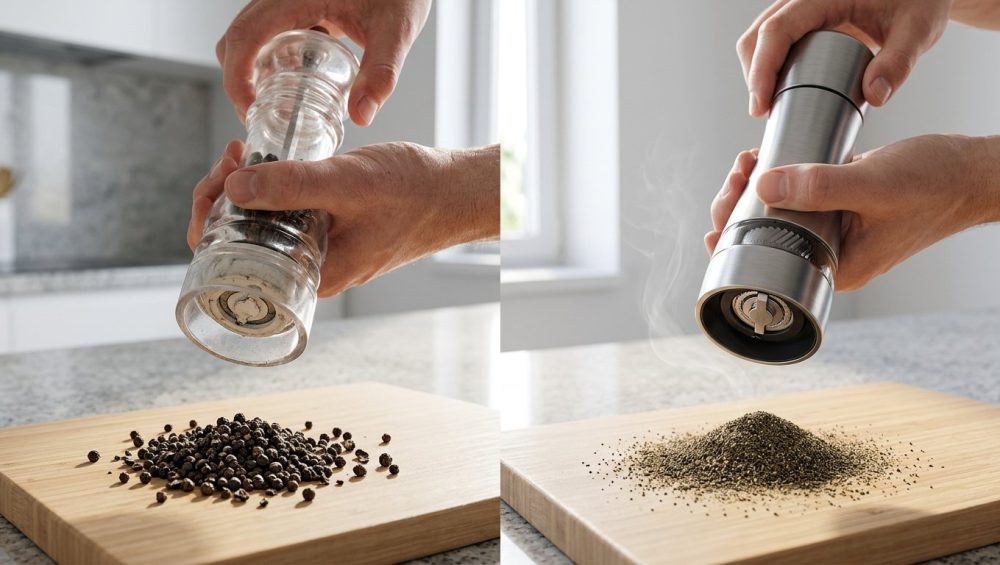
Cheap acrylic and low-grade ceramic mechanisms do not have sharp edges. They rely on blunt force trauma. When you twist the top of a disposable grocery store mill, the dull nubs inside grab the peppercorn and smash it against the outer wall until it shatters under the pressure.
This shattering effect creates two massive problems for your food. First, it generates an enormous amount of friction, which, as we just learned, vaporizes the delicate essential oils. Second, it produces a wildly inconsistent particle size. You end up with a mixture of ultra-fine, oxidized dust and massive, un-cracked half-peppercorns. Serving a guest a giant, rock-hard peppercorn boulder that threatens to shatter their dental work is one of those classic rookie kitchen mistakes that we are going to fix today. You want uniform seasoning that melts into the dish, not a minefield of spice shrapnel.
What is a True Burr Grinder? (A Brief History of Perfection)
If crushing is the enemy, what is the solution? Slicing. Or, more accurately in the mechanical world, shearing. To achieve this, you need a true burr mechanism.
The Stator and the Rotor
A proper burr grinder consists of two main metal components: the stator (a stationary outer ring with teeth) and the rotor (a spinning inner cone, also lined with teeth). As you twist the mill, the peppercorns are fed down into the gap between the stator and the rotor.
In a high-quality burr mill, this mechanism operates in two distinct stages. The larger, upper grooves first crack the whole peppercorn in half to stabilize it. Then, the smaller, razor-sharp teeth at the bottom shear the cracked peppercorn layer by layer. It acts like a microscopic mandoline slicer, peeling away the layers of the spice rather than pulverizing it. This clean slicing action releases the volatile essential oils perfectly without generating destructive frictional heat. Using a dull, blunt instrument to process a delicate ingredient is exactly like using a glass cutting board and ruining your knives in the process. You need a sharp tool for a clean cut.
The Peugeot Legacy of 1842
We cannot talk about burr grinders without talking about the undisputed king of the category: Peugeot. Yes, the French car company. Long before they were manufacturing automobiles, the Peugeot brothers, Jean-Pierre and Jean-Frederic, converted their family’s flour mill into a steel foundry in 1810. They became famous across Europe for manufacturing incredibly durable steel saw blades.
In 1842, Peugeot applied their proprietary case-hardened steel technology to culinary tools, creating the world’s first modern pepper grinder. They designed a patented mechanism featuring precision-engineered burrs arranged in a helical (spiral) pattern. This helix design actively pulls the peppercorns down into the teeth, preventing the grinder from jamming. The design was so flawless that it remains fundamentally unchanged nearly two centuries later. When professional chefs demand a pepper mill, they are almost exclusively reaching for a carbon steel burr mechanism based on this exact 1842 design.
The Material Masterclass: Carbon Steel vs. The Impostors
As a home cook who values time and efficiency, you need gear that works every single time you pick it up. I have a strict “no-go” rule when it comes to toxic, cheap, or gimmicky kitchenware. The material of your grinder’s internal mechanism dictates whether you are elevating your food or poisoning it.
The Plastic and Acrylic Nightmare
Let’s address the most horrifying issue first: microplastics. If you are using a disposable grocery store grinder with a plastic mechanism, you are actively grinding plastic into your dinner.
A terrifying 2025 pilot study published in the European Research Studies Journal analyzed the microplastic contamination resulting from the use of pepper mills with plastic grinding mechanisms. The researchers utilized advanced FTIR qualitative analysis and nanomagnetic sorbents to test the output of disposable mills made from polyoxymethylene (POM). The findings were staggering. The mechanical abrasion of hard peppercorns against the plastic burrs caused the mechanism to rapidly degrade, releasing several thousand microplastic particles per 100 grams of ground spice directly into the food.
Let that sink in. Every time you twist that plastic grinder over your pasta, you are garnishing it with thousands of microscopic shards of industrial plastic. As your resident advocate for banishing toxic kitchen gear, I am begging you to throw these away immediately. They are not a convenience; they are a health hazard.
The Cheap Ceramic Illusion
Many mid-tier brands tout their “ceramic grinding mechanisms” as a premium feature. Ceramic does have one distinct advantage: it is completely non-reactive and corrosion-proof. This makes ceramic the absolute mandatory choice for grinding salt, which will rapidly rust any steel mechanism.
However, for pepper, cheap ceramic is an illusion of quality. Ceramic is incredibly hard, but it is also highly brittle. Because it is cast in a mold rather than precision-machined like metal, the teeth on a ceramic burr are relatively thick and dull. They cannot achieve the razor-sharp edge required to shear a peppercorn. Consequently, ceramic mechanisms revert back to crushing and smashing the spice. Furthermore, if you accidentally drop a ceramic mill on your tile kitchen floor, the internal burrs can easily chip or shatter, rendering the tool completely useless.
The High-Carbon Steel Gold Standard
For grinding pepper, high-carbon steel is the undisputed gold standard. Carbon steel is an alloy that is significantly harder and sharper than standard stainless steel. During the manufacturing process, the steel is often case-hardened, meaning the outer surface is treated to become exceptionally tough while the inner core remains slightly malleable to absorb shock without snapping.
Because carbon steel is machined rather than cast, the teeth of the burr can be cut to microscopic, razor-sharp precision. This is what allows the mechanism to cleanly slice the peppercorn and release those volatile essential oils. A high-quality carbon steel burr will easily outlive you, providing decades of flawless, jam-free seasoning.
The Science of Grind Size and Flavor Release
A true burr grinder does more than just cut cleanly; it gives you total control over the grind size. The distance between the stator and the rotor can be adjusted, allowing you to dictate exactly how coarse or fine your pepper will be. This is not just a visual preference; grind size fundamentally alters how the flavor is perceived on the palate.
Fine Grind for Integration
When you tighten the burrs to produce an ultra-fine powder, you are maximizing the surface area of the pepper. This is ideal for smooth applications like a delicate béchamel sauce, a creamy potato purée, or a velvety butternut squash soup. In these dishes, you want the sharp heat of the piperine to integrate seamlessly into the background without interrupting the smooth texture of the food.
Coarse Grind for Textural Contrast
Conversely, opening the burrs for a coarse, cracked grind minimizes the surface area but preserves the structural integrity of the peppercorn’s outer layers. This is mandatory for a heavy, pan-seared steak, a classic steak au poivre, or a vibrant Caesar salad. The coarse chunks provide a sudden, explosive burst of floral aroma and a satisfying crunch when you bite into them. If you want to stop eating mushy veggies, a coarse, crunchy crack of fresh pepper provides a desperately needed textural contrast to your roasted sides.
Uniformity is the key here. A cheap crusher will give you a mix of dust and boulders regardless of the setting. A precision carbon steel burr will give you exactly the uniform size you dial in, allowing you to control the flavor release with absolute scientific precision.
The “No-Go” Rule: Identifying Toxic and Trashy Grinders
I am incredibly strict about what makes it into my kitchen, and you should be too. The market is flooded with aesthetically pleasing but mechanically garbage pepper mills. Do not be fooled by a pretty bamboo exterior or a sleek acrylic window. You must look under the hood.
Avoid any grinder that uses a plastic central drive shaft. The drive shaft is the rod that connects the top knob to the bottom burr. When you encounter a particularly hard peppercorn, a plastic drive shaft will simply twist, warp, and eventually snap under the torque. Much like cheap non-stick cookware losing their slip after a few months of heavy use, these flimsy grinders degrade rapidly and end up in the landfill.
Furthermore, beware of “mystery metals.” Cheap imported grinders often use low-grade zinc alloys coated in a faux-chrome finish. Over time, the acidic oils from the spices and the friction of grinding will cause this cheap plating to flake off directly into your food. It’s the same reason why cheap silicone spatulas taste like soap—inferior materials break down and leach into your meals. Stick to solid, uncoated, high-carbon steel or pure hardened stainless steel for your grinding mechanisms.
How to Choose the Ultimate Burr Pepper Grinder
When you are ready to graduate from the grocery store aisle and buy a real tool, here is your definitive checklist for choosing a lifelong pepper grinder:
1. The Burr Material
As we have exhaustively covered, look for case-hardened carbon steel. If the manufacturer does not proudly state that the mechanism is machined steel, assume it is cheap plastic or cast ceramic and walk away.
2. The Adjustment Mechanism
The biggest frustration with traditional grinders is the top knob loosening as you grind, causing your fine powder to slowly turn into coarse chunks mid-seasoning. Look for mills with a stepped adjustment system at the base of the grinder. Peugeot’s U’Select system is the industry gold standard here, offering six distinct, locked-in grind sizes that will never slip while you are twisting.
3. The Body Material and Ergonomics
You are going to be picking this tool up with wet, greasy, or sticky hands while cooking. You need grip and leverage. Solid, sustainably sourced beechwood or heavy-duty stainless steel bodies are ideal. They provide the necessary heft and stability. Avoid full-glass bodies; they become incredibly slippery when your hands are covered in olive oil, and dropping them is a disaster waiting to happen.
4. Dedicated Functionality
Never buy a “two-in-one” salt and pepper grinder. The mechanical needs of the two spices are entirely opposed. Pepper requires the sharp shearing force of carbon steel. Salt requires the corrosion resistance of ceramic. Combining them into one housing is a gimmick that compromises the performance of both.
Care and Maintenance of Your Carbon Steel Grinder
Once you invest in a proper carbon steel burr grinder, it will last you a lifetime—provided you do not commit the ultimate sin of kitchen maintenance.
The Golden Rule: Keep It Dry
Never, under any circumstances, wash your pepper mill with water. Do not submerge it in the sink, do not put it in the dishwasher, and do not wipe the internal burrs with a damp cloth. Carbon steel is incredibly strong, but it is highly susceptible to rust. The moment moisture hits that raw steel, it will oxidize, the razor-sharp teeth will dull, and the mechanism will seize up.
Dealing with Clogs and Oils
Over time, the volatile essential oils from the peppercorns can build up on the steel teeth, causing a slight gummy residue that might trap paper-thin pepper flakes. If your grinder feels sluggish, do not reach for soap. Instead, empty out the peppercorns and run a tablespoon of dry, uncooked white rice through the grinder. The hard, dry rice acts as a natural abrasive, scrubbing the essential oils off the steel teeth and absorbing the residue without introducing any moisture.
Keep Salt Far Away
I will say it one more time for the people in the back: never put salt in a carbon steel pepper grinder. Salt is a desiccant and a highly corrosive mineral. It will eat through the carbon steel in a matter of weeks, leaving you with a seized, rusty paperweight. Buy a dedicated ceramic mill for your coarse sea salt.
Sometimes you might think your dinner actually needs acid, but what it really lacks is the complex, aromatic punch of properly sheared, fresh black pepper.
The Final Word
Cooking is not about complicated techniques or expensive ingredients; it is about extracting the maximum amount of flavor from the food you have. Smashing your spices with a disposable plastic toy from the supermarket actively destroys the delicate chemical compounds that make food taste vibrant and alive, while secretly seasoning your meals with toxic microplastics.
Upgrading to a precision-machined, carbon steel burr grinder is one of the most immediate, impactful changes you can make to your daily cooking routine. It buys you efficiency on a busy Tuesday night, and it buys you perfection on a leisurely Sunday afternoon. Throw away the plastic trash, invest in a tool that respects your food, and truly embrace the art of the kitchen. Your steaks, your soups, and your sanity will thank you.