Listen, we need to have a serious talk about what you are doing to your potatoes. I know you mean well. You buy a bag of russets, you give them a half-hearted rinse, you swaddle them tightly in a layer of shiny aluminum foil like they are fragile little infants, and you throw them into a lukewarm oven while you go watch television. An hour later, you unwrap your silver packages of disappointment, slice them open, and try to mask the dense, gummy, waterlogged texture beneath an absolute mountain of sour cream and shredded cheddar.
Stop it. You are better than this, and frankly, the potato deserves better.
As your resident sassy sous-chef, I am officially staging an intervention. I have zero patience for pretentious culinary jargon, but I have even less patience for the widespread mistreatment of the humble spud. You do not need a culinary degree to make a mind-blowing, restaurant-quality baked potato. You just need to understand a tiny bit of basic kitchen science and respect the process.
Today, we are going to completely deconstruct the baked potato. We are going to look at the cellular structure of starch, the thermodynamics of your oven, and the exact temperature markers that separate a sad, soggy side dish from a fluffy, cloud-like masterpiece. Once you master this incredibly simple technique, you will have unlocked the ultimate weekend hosting hack: the cozy, endlessly customizable baked potato bar. It is cheap, it is stress-free, and it will make your guests think you are a culinary genius.
Grab a glass of wine, preheat your oven, and let’s fix this mess.
The Crime Against Carbohydrates: Why Your Baked Potatoes Are Sad and Soggy
Let’s start by addressing the shiny, silver elephant in the room. If you take only one piece of advice from me today, let it be this: step away from the aluminum foil.
The Aluminum Foil Fallacy
Somewhere along the line, a rumor started that wrapping a potato in aluminum foil helps it bake faster and results in a better texture. This is a lie perpetrated by high-volume commercial kitchens and perpetuated by well-meaning but fundamentally misguided home cooks.
When a restaurant wraps a potato in foil, they are not doing it to achieve a culinary triumph. They are doing it because foil acts as a protective barrier that keeps the potato warm during a busy dinner service, makes it easier for the kitchen staff to handle without burning their fingers, and conveniently hides any unsightly bruises or blemishes on the skin. It is a logistical shortcut, not a flavor enhancer.
Here is the brutal, scientific truth: when you wrap a potato in foil, you are not baking it. You are steaming it.
A raw potato is composed of roughly 80% water. When you place that potato in a hot oven, the water inside begins to heat up and convert into steam. If the potato is sitting bare on an oven rack, that steam slowly and gently escapes through the skin, allowing the interior flesh to dry out and become light and fluffy.
However, when you entomb the potato in a sealed foil packet, that steam has absolutely nowhere to go. It hits the impenetrable wall of aluminum, condenses, and rains right back down onto the potato. You have essentially created a custom-fit, miniature sauna. The potato sits in its own trapped moisture, boiling in its jacket. The result? The interior flesh becomes dense, waterlogged, and gummy, while the skin turns into a pale, rubbery, soggy disaster.
Furthermore, let’s talk about food safety for a brief second. Leaving a foil-wrapped baked potato sitting out at room temperature creates the perfect warm, moist, anaerobic (oxygen-free) environment for Clostridium botulinum—the bacteria responsible for botulism—to thrive. So not only is the foil ruining your dinner, but it is also a massive food safety hazard if you don’t store your leftovers correctly. Ditch the foil. Your tastebuds and your immune system will thank you.
The Anatomy of a Russet Potato
Not all potatoes are created equal, and if you are trying to bake a red waxy potato, you are setting yourself up for failure before you even turn on the oven.
Potatoes are generally categorized by their starch content. Waxy potatoes, like Red Bliss or fingerlings, have a lower starch content and a higher moisture content. Their cellular structure allows them to hold their shape beautifully when boiled, making them perfect for potato salads or hearty stews. But if you try to bake them, they will turn out dense and creamy rather than light and fluffy.
For the ultimate baked potato, you need the gold standard: the Russet (often called an Idaho potato). Russets are high-starch, low-moisture potatoes. A high-quality Russet potato averages about 21% solid matter (starch) to 79% water. Because they have a higher ratio of a specific type of starch called amylose, their cells behave very differently under high heat. We will get into the nerdy details of that in a moment, but for now, just remember: if you want a fluffy interior and a thick, sturdy skin that crisps up beautifully in the oven, you must buy Russets.
The Science of the Fluff: What Actually Happens Inside a Baking Potato
I promised you we wouldn’t use pretentious chef-speak, but we do need to talk about some basic chemistry. Understanding what is physically happening inside your oven is the key to breaking bad habits and learning how to survive without ordering takeout every time a recipe goes wrong.
Gelatinization: The Magic Word for Fluffy Spuds
The secret to a perfect baked potato boils down to one highly scientific word: gelatinization.
Inside the cells of a raw Russet potato are thousands of tightly packed, microscopic starch granules. When the potato is cold or at room temperature, these granules are hard and unyielding. But as the potato heats up in the oven, a magical transformation occurs.
Starting at around 135°F to 150°F, those starch granules begin to act like tiny sponges, absorbing the water that is naturally present inside the potato. As the temperature continues to climb, the granules swell to many times their original size. Eventually, the heat and the absorbed moisture cause the amylose and amylopectin molecules within the starch to gel and expand so much that the granules physically separate from one another.
This separation is what creates that signature “mealy” or fluffy texture. It is a fascinating paradox: a perfectly baked, fluffy potato actually contains almost the exact same amount of moisture as a raw potato. The difference is that in a raw potato, the water is free-floating. In a baked potato, the water has been completely captured and bound within the gelatinized starch matrix.
If you trap the steam with foil, the excess free water prevents the cells from separating properly, leaving you with a gluey mess. But if you allow the dry ambient heat of the oven to work its magic, the moisture is perfectly managed, and the interior becomes as light as a cloud.
The Maillard Reaction on Potato Skins
While the inside of the potato is busy gelatinizing, the outside is undergoing its own transformation: the Maillard reaction. This is the chemical reaction between amino acids and reducing sugars that gives browned food its distinctive flavor. It is the same reaction that gives a seared steak its crust and a loaf of bread its golden exterior.
For the Maillard reaction to occur, you need high, dry heat. Moisture is the enemy of browning. If your potato is wrapped in foil, the skin will never exceed the boiling point of water (212°F), which means it will never brown, and it will never crisp. By baking the potato completely naked in a hot oven, the surface moisture evaporates, allowing the skin’s temperature to rise high enough to trigger the Maillard reaction. This transforms the skin from a tough, earthy wrapper into a crackly, salty, deeply savory delicacy that is arguably the best part of the entire dish.
The 205°F Rule: Stop Guessing and Start Measuring
One of the most beginner cooking mistakes I see is relying on vague, subjective sensory cues to determine when food is done. Recipes have been lying to you for decades with phrases like “bake until golden brown” or “cook until fork tender.”
The “Fork Tender” Lie
Let’s dismantle the “fork tender” myth right now. Piercing a potato with a fork to check for doneness is a terribly inaccurate method. Yes, a potato will feel relatively soft and yield to a fork when its internal temperature reaches about 185°F. However, at 185°F, the starch granules have not fully gelatinized. If you pull the potato out of the oven at this point, the center will still be dense, waxy, and disappointing.
Why Thermometers Aren’t Just for Meat
If you want professional results, you need to use professional tools. This means you need an instant-read digital thermometer. If you don’t have one, or if you are wondering meat thermometer is lying to you because it takes thirty seconds to register a temperature, it is time to upgrade.
Science has given us an exact, non-negotiable target for the perfect baked potato: 205°F.
At exactly 205°F, the starch gelatinization process is perfectly optimized. The interior is fully cooked, the granules have swelled and separated, and the texture is flawlessly fluffy. Not 195°F. Not 215°F (which is overcooked and structurally collapsed). Exactly 205°F. Stop guessing, stop poking your food with forks, and start temping your potatoes.
The Ultimate Sassy Sous-Chef Method for Perfect Baked Potatoes
Alright, we have covered the theory. Now it is time for the practical application. This is my definitive, foolproof method for achieving potato perfection. It requires very little active prep time, making it ideal for a lazy weekend, but you absolutely cannot rush the bake.
Step 1: The Wash, The Scrub, and The Ruthless Dry
Start with similarly sized Russet potatoes so they all finish baking at the same time. Give them a vigorous scrub under cold water to remove any residual dirt.
Now, pay attention: you must dry them ruthlessly. Use a clean kitchen towel or paper towels and dry them until there is not a single drop of surface moisture left. Remember, moisture is the enemy of crispy skin. If they go into the oven wet, they will steam before they bake.
Once they are bone dry, take a fork and pierce each potato six to eight times, going about a quarter-inch deep. These holes act as essential steam vents. If you skip this step, the steam pressure will build up inside the potato until it literally explodes in your oven, leaving you with a horrific burnt mess to scrape off the heating elements.
Step 2: The Brine (Or The Oil and Salt Massage)
There are two schools of thought for seasoning the skin, and both yield excellent results.
The first is the traditional oil and salt massage. Take a neutral oil with a high smoke point (like avocado oil, canola oil, or vegetable oil—do not use extra virgin olive oil, as it will burn and turn bitter in a 400°F+ oven) and rub a very light coating over the entire potato. Then, generously coat the skin with coarse kosher salt. The oil conducts heat to crisp the skin, and the salt draws out surface moisture while providing incredible flavor.
The second method, favored by many test kitchens, is the brine dip. Dissolve two tablespoons of kosher salt into a half-cup of water. Toss the dry, pierced potatoes in this heavy brine until coated, then place them on your rack. The water evaporates in the oven, leaving behind a perfectly even, micro-thin crust of salt. If you use this method, you wait until the potato reaches 205°F, pull it out, brush it lightly with oil, and throw it back in for a final 10 minutes to fry and crisp the skin. It is slightly more work, but the results are staggering.
Step 3: The Wire Rack Elevation
Do not place your potatoes directly on a flat baking sheet. If the bottom of the potato is sitting flush against a solid metal pan, it will not receive proper air circulation, and the bottom will steam, flatten, and turn into a leathery, burnt disc.
You need to elevate your spuds. Place them directly on the middle wire rack of your oven, or place them on a stainless steel wire cooling rack set inside a rimmed baking sheet. This allows the hot, dry air of the oven to circulate 360 degrees around the potato, ensuring an even bake and uniformly crispy skin.
And please, for the love of all things holy, make sure your baking sheets are high quality. If you are constantly wondering why your baking sheets keep warping in a hot oven, sounding like a gunshot going off in your kitchen, it is because you are using cheap, thin, toxic metal pans. Invest in heavy-gauge aluminized steel or thick stainless steel.
Step 4: The Bake, The Temp Check, and The Smash
Preheat your oven to a blazing 400°F to 450°F. A high temperature is crucial to prevent a leathery “pellicle” (a tough skin layer) from forming just beneath the surface.
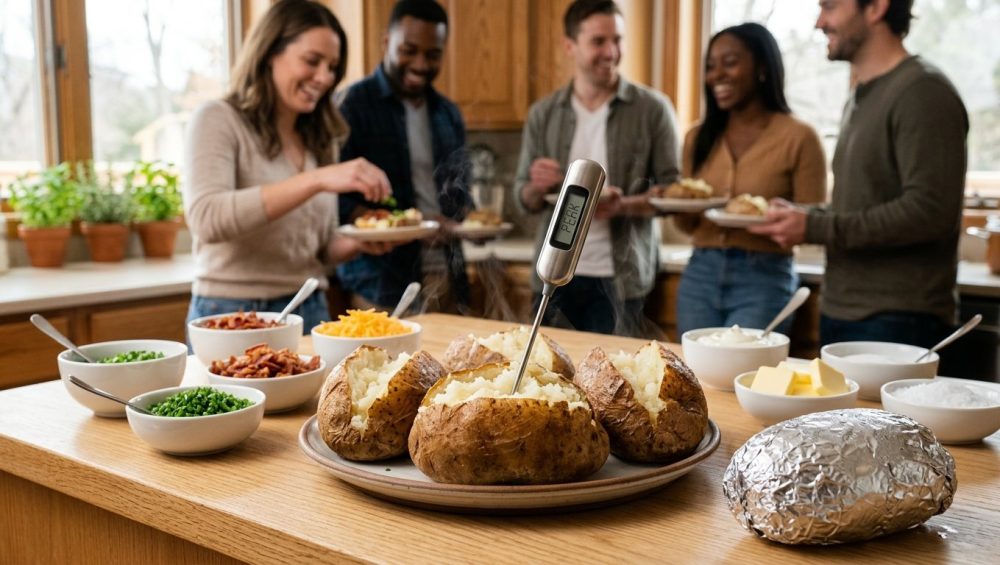
Bake the potatoes undisturbed for about 45 to 60 minutes, depending on their size. At the 45-minute mark, take your digital thermometer and insert the probe directly into the thickest, dead-center part of the largest potato. You are looking for that magic number: 205°F.
Once they hit 205°F, pull them out. Now, you must act quickly. Do not let them sit around intact, or the trapped steam will immediately begin condensing and ruining the fluffy texture you just spent an hour building.
Take a serrated knife and slice a shallow slit down the length of the potato. Then, place your thumbs and index fingers on the ends of the potato and push inward and upward—a technique affectionately known as “the smash.” The potato will blossom open, releasing a massive plume of steam. Congratulations. You have just baked the perfect potato.
The Cozy Baked Potato Bar: Stress-Free Weekend Entertaining
Now that you have mastered the technique, let’s talk about how to weaponize this knowledge for your social life. If you want to know host a relaxed dinner party without spending three days stressing over a complicated menu, the baked potato bar is your ultimate salvation.
Why a Potato Bar is the Ultimate Hosting Hack
Hosting friends and family should be fun, but it usually devolves into the host sweating over a hot stove while everyone else enjoys the party. A baked potato bar completely eliminates this dynamic.
First, it is incredibly budget-friendly. Potatoes cost pennies, which means you can allocate your grocery budget toward high-quality toppings and good wine. Second, it is the great equalizer for dietary restrictions. Whether your guests are gluten-free, vegetarian, vegan, or carnivorous, a potato bar allows everyone to customize their own plate safely and happily without you having to cook four separate meals.
Prepping the Toppings
The beauty of the potato bar is that 90% of the work is done before your guests even arrive. While the potatoes are spending their hour in the oven, you can prepare an absolute feast of toppings.
Do not just set out a tub of sad, cold sour cream and call it a day. We are elevating this. Here is how you build a legendary topping spread:
The Foundation:
You need high-quality fats to melt into the hot, fluffy starch. Set out room-temperature cultured butter, full-fat sour cream or thick Greek yogurt, and a variety of freshly grated cheeses. Please grate your own cheese from a block; pre-shredded cheese is coated in anti-caking agents that prevent it from melting smoothly. If you’ve ever wondered why your cheese sauce turns grainy, pre-shredded cellulose-coated cheese is usually the culprit.
The Proteins:
This is where the potato goes from a side dish to a hearty main course.
- Crispy Bacon: Bake it in the oven on a wire rack until shattered and crisp, then chop it finely.
- Chili: A rich, thick, homemade beef or black bean chili is a classic.
- Pulled Pork or Brisket: Slow-cooked meats with a tangy barbecue sauce are phenomenal over a starchy potato.
- Shredded Buffalo Chicken: Toss rotisserie chicken in a high-quality buffalo sauce for a spicy, tangy kick.
The Veggies and Acids:
A heavy, rich potato needs freshness and acidity to balance the palate. If you don’t understand why your dinner actually needs acid, just try eating a pound of starch and dairy without a squeeze of lemon or a pickled onion. It is exhausting.
- Steamed Broccoli: Cut into tiny, bite-sized florets.
- Sautéed Mushrooms and Onions: Caramelized in butter with a splash of soy sauce for umami.
- Fresh Scallions and Chives: Essential for that sharp, oniony bite.
- Pickled Jalapeños or Red Onions: The acidity cuts right through the heavy cheese and butter.
Temperature Control for the Buffet Line
The only logistical challenge of a potato bar is keeping the hot things hot and the cold things cold.
For the hot toppings like chili, cheese sauce, or pulled pork, utilize your slow cookers or Instant Pots on the “Keep Warm” setting.
For the potatoes themselves, timing is everything. Ideally, you want to pull them out of the oven, immediately smash them open to vent the steam, and serve them within 15 minutes. However, if you need to hold them longer, do not leave them in a low oven, as the dry heat will aggressively dehydrate them. Instead, you can place the vented potatoes in a dedicated warming drawer. If you are serving a massive crowd, you can line a cooler with clean towels, place the hot potatoes inside, and shut the lid. The thermal mass of the potatoes will keep them piping hot for over an hour without drying them out.
Essential Gear for Potato Perfection (And What to Throw Away)
I cannot write a masterclass without addressing the tools you are using. You can have the best technique in the world, but if your kitchen is stocked with garbage, your food will suffer. If you want to dive deeper into banishing toxic kitchen gear, you know I have plenty to say on the subject.
Ditch the Peeling Non-Stick and Flimsy Foil
We have already established that aluminum foil is banned from the potato-baking process. But I also need you to throw away those cheap, scratched, peeling non-stick baking mats and flimsy, dark-coated baking sheets. Dark pans absorb heat too aggressively and will scorch the bottom of your food. Scratched non-stick coatings leach mystery chemicals into your meals. You do not need them.
The Holy Trinity: Stainless Steel Rack, Good Thermometer, Safe Baking Sheet
To execute this method flawlessly, you only need three basic, durable items. These are the essential tools every beginner needs for a functional kitchen:
- A Heavy-Duty Rimmed Baking Sheet: Look for uncoated aluminized steel or pure stainless steel. It will not warp, it will not peel, and it will outlive you.
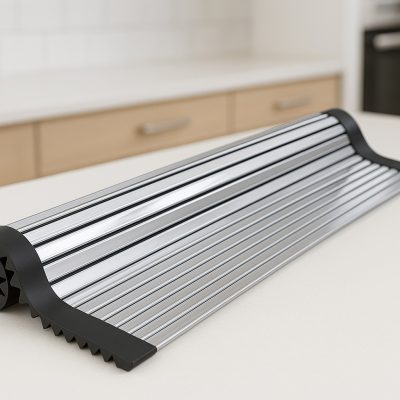
- A Stainless Steel Wire Cooling Rack: Make sure it fits snugly inside your baking sheet. This is what elevates your potato, allowing that crucial 360-degree air circulation to crisp the skin. Ensure it is 100% stainless steel and not chrome-plated, as chrome can flake off in high heat.
- An Instant-Read Digital Thermometer: This is the most important tool in your kitchen. Stop relying on guesswork and start cooking to exact temperatures.
If you follow the science, respect the 205°F rule, and banish the foil, you will never eat a sad, soggy potato again. You will become the undisputed master of the weekend potato bar, and you will stop ruining your dinner parties with overly complicated, stressful menus.
Now, go wash some Russets, dry them ruthlessly, and let the oven do the heavy lifting. You’ve got this.