Listen up, weekend warriors. Put down the spatula, take a deep breath, and step away from the stove. We need to have a serious talk about what you did to that beautiful, expensive piece of salmon last night. You know exactly what I’m talking about. You bought a gorgeous, ruby-red fillet of king salmon. You imagined plating up a restaurant-quality dinner. But instead, you ended up aggressively scraping a mangled, shredded pile of fish flakes off your skillet while the smoke alarm sang the song of its people.
If this sounds like your typical Tuesday night, you are not alone. Searing fish is universally terrifying for the everyday home cook. But I firmly believe that anyone can cook like a seasoned expert without a culinary degree—you just need to understand the science of what is actually happening in your skillet. We are going to permanently cure cooking anxiety by throwing out the most pervasive, destructive culinary myth of all time: the “screaming hot pan.”
For decades, pretentious chefs and outdated cookbooks have screamed at you to preheat your pan until it’s practically glowing red before adding your fish. They claimed this was the only way to get crispy skin and “seal in the juices” (a myth so completely debunked by food science that it makes my eye twitch). But here is the brutal truth: that screaming hot pan is exactly why your fish is tearing in half.
Today, we are doing a deep analytical breakdown of the “Cold Pan Method.” This modern technique defies all traditional preheating rules, and it is going to change your life. By starting your salmon in a completely cold skillet, you slowly render the subcutaneous fat, preventing the proteins from violently seizing and bonding to your cookware. It guarantees perfectly crispy skin, perfectly cooked flesh, and absolutely zero sticking. And the best part? It requires less effort, less panic, and zero chef-y posturing.
The Physics of the Fish: Why Hot Pans Betray You
To understand why the cold pan trick is nothing short of a culinary miracle, we first need to understand the physics of failure. Why does fish stick to pans in the first place? It comes down to chemistry, specifically the bonding of proteins to metal.
When you take a cold, protein-rich piece of salmon and drop it into a blistering hot stainless steel skillet, you are initiating a violent chemical reaction. At a microscopic level, your shiny, smooth pan is not smooth at all. It is a rugged landscape of microscopic hills, valleys, and pores. When heat is applied, these pores expand.
Now, let’s talk about the fish. Salmon is packed with proteins. When these proteins are suddenly exposed to high heat, they denature—their intricate, three-dimensional structures unfold and unravel. These newly exposed protein strands, specifically the polyester and carboxylate groups, are highly reactive. When they hit the hot metal surface, they actively seek out metal atoms (like the iron present in your stainless steel or cast iron pans) and form actual chemical bonds. We are talking about van der Waals forces and even strong covalent bonds. The fish isn’t just resting on the pan; it is chemically welding itself to the metal.
Traditional methods try to combat this by relying on the Leidenfrost effect—the phenomenon where a liquid, in near contact with a mass significantly hotter than the liquid’s boiling point, produces an insulating vapor layer that keeps the liquid from boiling rapidly. In theory, if the pan is hot enough, the moisture in the fish instantly vaporizes, creating a microscopic cushion of steam that lifts the food above the metal, helping to prevent protein adhesion.
But here is the problem: salmon is delicate. The skin is thin, and the fat content is highly variable. If your pan is even slightly too cold, the steam cushion fails, and the proteins weld to the metal. If the pan is too hot, the skin instantly scorches and burns before the heat can penetrate the flesh. You are walking an impossible tightrope, and frankly, nobody has time for that kind of stress on a weeknight.
The Toxicity Trap: Why We Are Trashing Your “Non-Stick” Pan Right Now
Before we go any further into the technique, we need to address the elephant in the kitchen. I know what some of you are thinking: “I don’t have to worry about proteins bonding to metal because I use a non-stick pan!”
Stop. Just stop. If you are using a cheap, scratched, peeling Teflon pan that you bought at a big-box store five years ago, we are throwing it in the garbage immediately. I have a strict “no-go” rule on toxic gear, and I will not let you poison yourself in the name of convenience.
Let’s look at the hard data. Traditional non-stick pans are coated with Polytetrafluoroethylene (PTFE), a synthetic polymer that belongs to the broader family of PFAS (per- and polyfluoroalkyl substances)—often referred to as “forever chemicals” because they simply do not break down in the environment or in the human body.
While manufacturers claim that modern PTFE is safe under normal cooking conditions, the reality of the home kitchen is far different. When a PTFE pan is heated above 500°F (260°C)—a temperature an empty pan can reach in just two to three minutes on a gas stove—the coating begins to thermally degrade. It releases invisible, odorless, PFAS-containing fumes that cause a condition known as “polymer fume fever” or “Teflon flu”. If these fumes are lethal to pet birds in the house, what do you think they are doing to your lungs?
Furthermore, once that coating is scratched, it begins to shed millions of microplastics and nanoparticles directly into your food. A recent environmental health analysis showed that even minor surface scratches can release thousands of plastic particles in just 30 seconds of cooking, while broken patches can release up to 2.3 million micro- and nanoparticles. When your non-stick pans keep losing their slick surface, it’s not because the magic wore off; it’s because you have literally eaten the chemical coating over the past few years.
In December 2023, the International Agency for Research on Cancer (IARC) classified PFOA—a legacy chemical historically used in manufacturing these coatings—as a Group 1 carcinogen, putting it in the same risk category as asbestos and tobacco. While PFOA has been largely phased out, the replacement “GenX” chemicals are showing similarly alarming toxicological profiles.
You do not need toxic chemicals to cook fish. You need good technique. By mastering the cold pan method, you can achieve a flawless, non-stick release on safe, durable cookware like stainless steel or carbon steel. So, consider this your official mandate for banishing toxic kitchen gear from your home once and for all.
Enter the Cold Pan Method: A Thermal Dynamics Breakdown
Now that we have removed the hazardous waste from your kitchen, let’s talk about the solution. The cold pan trick—popularized by the meticulous food scientists at America’s Test Kitchen—is an absolute game-changer. It is one of those foolproof cooking secrets that feels like cheating, but is entirely rooted in thermodynamics.
Here is how it works: Instead of preheating the skillet, you place your completely dry, seasoned salmon fillet (skin-side down) into a cold, dry pan (or a pan with a very light film of cold oil). Only then do you turn the burner onto medium or medium-low heat.
Why does this work? It’s all about the temperature gradient and the rendering of subcutaneous fat.
When you start cold, the temperature of the pan and the temperature of the fish rise together gradually. Because the heat is increasing slowly, the proteins in the fish skin do not experience thermal shock. They do not instantly seize, unfold, and weld themselves to the metal. Instead, the gentle heat allows the proteins to denature slowly and contract gently.
More importantly, this gradual heating process targets the fat layer located just beneath the salmon’s skin. As the pan warms up, this subcutaneous fat begins to melt—or “render”—turning from a solid into a liquid oil. By the time the pan reaches the temperature where sticking would normally occur, the salmon has already produced its own protective barrier of hot, liquid fat. The fish is literally frying in its own natural oils.
As the temperature continues to climb, the Maillard reaction begins. This is the complex chemical process where amino acids and reducing sugars react under heat to create that deeply browned, savory, crispy crust. Because the pan wasn’t screaming hot from the start, the skin has time to fully render its fat and crisp up beautifully before the delicate flesh above it overcooks. The result? A perfectly golden, shatteringly crisp skin that releases from the pan with zero resistance.
The Anatomy of Salmon Skin and Fat Rendering
To truly appreciate this method, we need to geek out on the anatomy of the salmon for a minute. I know, I know, you just want to eat dinner, but understanding your ingredients is how you stop ruining them.
Salmon are cold-water fish. To survive in freezing oceanic temperatures, they have evolved a thick layer of subcutaneous fat directly beneath their skin, which acts as a thermal insulator. This fat is incredibly rich in omega-3 fatty acids, which are not only phenomenally healthy for your brain and cardiovascular system but are also culinary gold.
Fat rendering is a function of time and temperature. If you blast the skin with high heat immediately, the exterior of the skin sears and crisps before the fat underneath has a chance to melt. This traps the unrendered, gummy fat beneath a scorched exterior, resulting in a flabby, chewy, unappetizing texture that most people end up peeling off and throwing away.
Think about how you cook bacon. If you throw cold bacon into a blazing hot pan, the meat burns while the fat stays rubbery. But if you start bacon in a cold pan and let the heat rise slowly, the fat melts out beautifully, leaving you with perfectly crisp strips. The exact same principle applies here.
By utilizing the cold pan method, you give that subcutaneous fat the time it needs to reach its rendering temperature. The fat liquefies and pools under the fish. The skin, now depleted of its insulating fat layer, becomes paper-thin and fries perfectly in the rendered oil. This is how a stopped burning dinner transformation happens—by working with the ingredient’s natural composition rather than fighting against it.
Step-by-Step Masterclass: The Cold Pan Technique
Alright, enough theory. It is time for the practical application. Tie your apron, pour yourself a glass of wine, and let’s walk through this step-by-step.
Step 1: Moisture is the Ultimate Enemy
If there is one rule you take away from me today, let it be this: wet food will never, ever brown. Water is the enemy of the Maillard reaction. If you take a damp piece of salmon out of its packaging and put it in a pan, the heat energy will be entirely consumed by boiling off that surface water. The fish will steam, turn grey, and stick.
You must thoroughly pat your salmon fillets dry with paper towels. I mean really dry. Do not just dab it; press the paper towel into the skin to absorb as much surface moisture as possible. For the absolute best results, leave the salmon uncovered in the fridge for a few hours before cooking. The circulating air will dry out the skin beautifully, harnessing the magic of dry brining to guarantee an extra-crispy result. Season the fish generously with kosher salt just before it goes into the pan.
Step 2: The Pan Selection
As established, we are not using toxic non-stick garbage. For the cold pan method, your best friends are a heavy-bottomed, multi-clad stainless steel skillet or a well-seasoned carbon steel pan. These materials offer superior thermal conductivity, meaning the heat will distribute evenly across the bottom of the pan, preventing hot spots that could cause uneven rendering.
Step 3: The Cold Start
Place your dry, seasoned salmon fillets skin-side down directly into the cold, dry skillet. You do not need to add oil, though if your pan is notoriously finicky, you can rub a microscopic drop of high-heat oil (like avocado oil) onto the skin just for insurance.
Once the fish is perfectly positioned, turn your burner to medium heat. Not high. Not medium-high. Medium. We want a steady, controlled climb in temperature.
Step 4: The Waiting Game (Do Not Touch It)
This is where you need to exercise restraint. As the pan heats up, you will hear a gentle sizzling start to develop. This is the sound of the fat rendering and the residual moisture evaporating.
You will notice the flesh of the salmon slowly changing color from bottom to top, turning from translucent ruby to opaque pale pink. You will also likely see white stuff oozing out of the sides of the fish. Do not panic. This is albumin, a liquid protein in the muscle fibers that coagulates and turns white when heated. While a massive amount of albumin can indicate overcooking, a little bit is perfectly normal.
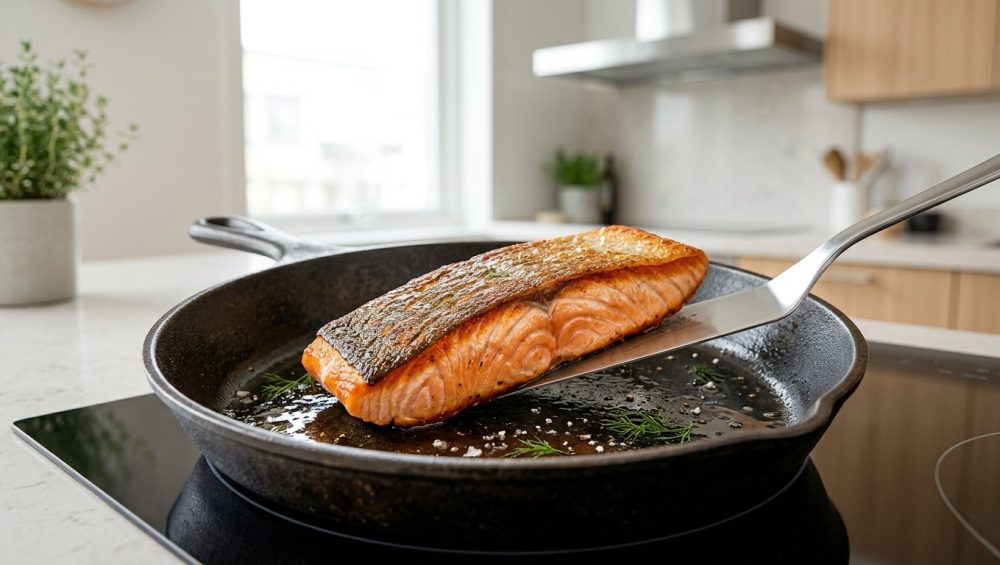
Let the fish cook undisturbed for about 6 to 8 minutes, depending on the thickness of the fillet and the power of your stove. Watch the edges of the skin—you will see them turn golden brown and crispy.
Step 5: The Flip
How do you know when it’s time to flip? The fish will tell you. When the skin has fully rendered its fat and the Maillard reaction has created a sufficient crust, the chemical bonds between the proteins and the metal will naturally release.
Take a thin, flexible fish spatula (an absolute necessity in any kitchen) and gently slide it under the fillet. If you feel resistance, stop. It is not ready. Give it another 60 seconds. When it is ready, the spatula will glide underneath effortlessly.
Flip the salmon over. At this point, the fish is about 80% cooked. Turn the heat off completely. The residual heat in the heavy skillet is more than enough to gently kiss the flesh side and finish cooking the center to a perfect medium-rare (around 125°F on an instant-read thermometer). This takes maybe one to two minutes. Remove the fish from the pan immediately to prevent overcooking.
Busting Culinary Myths: Stop Making These Rookie Errors
I need to address some of the nonsense you’ve been told by television chefs who care more about dramatic camera angles than actual culinary science.
First, the concept of “searing meat to seal in the juices” is a blatant lie. Searing does not create a waterproof barrier. Moisture evaporates from meat based on internal temperature, not the presence of a crust. We sear for flavor and texture (the Maillard reaction), not for moisture retention. Starting your salmon cold will not result in a dry piece of fish; in fact, the gentle heat curve prevents the muscle fibers from violently contracting and squeezing out their moisture, resulting in a juicier fillet.
Second, stop poking, prodding, and aggressively sliding your food around the pan. One of the most common rookie kitchen mistakes is the inability to leave food alone. When you constantly lift the fish to “check on it,” you interrupt the temperature building on the surface, ruining the crust formation and increasing the likelihood of tearing. Put it in the pan and step back. Drink your wine. Let the heat do the work.
Troubleshooting: When Good Fish Goes Bad
Okay, so you tried the method, and things still went sideways. Let’s diagnose the problem so you can fix it next time.
-
Problem: The fish still stuck to the pan.
- Diagnosis 1: You didn’t dry the fish enough. Any surface moisture caused the pan temperature to stall, creating steam instead of a sear.
- Diagnosis 2: Your pan wasn’t clean. If your stainless steel pan has polymerized oil residue or microscopic burnt food particles from previous meals, those act as anchor points for the fish proteins to grab onto. Clean your pans thoroughly with Bar Keepers Friend.
- Diagnosis 3: You got impatient and tried to flip it before it naturally released.
-
Problem: The skin burned before the fish was cooked.
- Diagnosis: Your heat was too high. “Medium” on a high-BTU gas range is very different from “medium” on an electric coil. If the pan gets too hot too fast, you bypass the slow rendering phase. Next time, lower the heat.
-
Problem: The fish is dry and chalky.
- Diagnosis: You overcooked it. Salmon cooks incredibly fast. Once the internal temperature creeps past 140°F, it dries out exponentially. Invest in a high-quality instant-read thermometer. It is a non-negotiable tool in my essential kitchen survival guide. Pull the fish at 125°F; carryover cooking will bring it up to a perfect 130°F as it rests.
The Sassy Sous-Chef’s Gear Guide for Safe Searing
Since we threw your toxic non-stick pan in the trash (you did throw it away, right?), you might be wondering what to use instead. You have three excellent, lifetime-durable options for the cold pan method.
- Fully Clad Stainless Steel: The workhorse of the professional kitchen. Look for pans with an aluminum core sandwiched between layers of stainless steel. The aluminum conducts heat rapidly and evenly, while the stainless steel provides a durable, non-reactive cooking surface.
- Carbon Steel: This is the secret weapon of French bistros. It is lighter than cast iron, heats up quickly, and when properly seasoned (polymerized with multiple layers of baked-on oil), it becomes incredibly slick and naturally non-stick. It is perfect for searing fish.
- Cast Iron: While you can use cast iron for the cold pan method, its massive thermal mass means it heats up very slowly and holds heat forever. This can make the “turn off the heat and let the residual heat finish the fish” step a bit tricky, as the pan will stay aggressively hot for 20 minutes, potentially overcooking the delicate flesh. If you use cast iron, pull the fish out immediately after flipping.
Time is Money: Integrating the Cold Pan Method into Your Tuesday Night
I am a firm believer that weekday meals need to be ruthlessly efficient. Time is money, and after a long day of work, you do not have the bandwidth for a culinary science experiment.
The beauty of the cold pan method is its inherent laziness. Because you aren’t standing over a smoking hot pan dodging grease splatters, your hands are completely free during that initial 6 to 8 minute rendering phase.
Use this time. While the salmon is slowly rendering its fat, you can toss a quick arugula salad with lemon and olive oil. You can whisk together a fast yogurt-dill sauce. You can microwave some pre-cooked quinoa. By the time the salmon is ready to flip, your side dishes are plated. It transforms a chaotic, high-stress cooking process into a calm, synchronized routine. You are letting the physics of the pan do the heavy lifting while you manage the rest of the meal.
Conclusion: Reclaiming the Kitchen
Cooking seafood at home does not have to be an exercise in frustration, and you do not need to rely on chemical-laden, disposable cookware to get a clean release. By understanding the thermal dynamics of your ingredients—how proteins react to heat, how subcutaneous fat renders, and how temperature gradients affect texture—you take back control of your kitchen.
The cold pan trick is more than just a recipe hack; it is a fundamental shift in how we approach stovetop cooking. It respects the delicate nature of the fish, maximizes flavor and texture, and practically guarantees success for even the most intimidated beginner.
So the next time you bring home a beautiful cut of salmon, don’t crank the burner to high. Don’t reach for the peeling Teflon. Dry the fish, grab your stainless steel skillet, start cold, and trust the science. You’ve got this. Now go cook something amazing.