The Tragic Reality of Gummy Homemade Fried Rice
Put down the spatula and step away from that gummy, gluey block of starch currently cementing itself to the bottom of your skillet. We need to have a serious talk.
You followed the recipe. You bought the expensive toasted sesame oil, you meticulously chopped your scallions on a bias, and you even splurged on the good soy sauce. Yet, when it came time to actually fry the rice, everything went catastrophically wrong. Instead of the distinct, fluffy, slightly chewy, and beautifully seared grains you get from your favorite local takeout joint, you ended up with a sad, steaming mound of soy-sauce-flavored risotto. It is mushy. It is heavy. It is a culinary tragedy.
But do not throw your wok out the window just yet. You do not need a culinary degree, a commercial kitchen, or a jet-engine wok burner that sounds like a Boeing 747 taking off in your living room to achieve perfect, restaurant-quality results. If you are serious about ditching takeout, you simply have to respect the underlying science of the ingredients.
Fried rice is not just a haphazard way to clear out your refrigerator’s vegetable crisper. It is an exercise in thermodynamics, moisture control, and carbohydrate chemistry. When your homemade fried rice turns into a sticky mess, it is not because you are a bad cook; it is because you are fighting against the fundamental molecular biology of the rice grain itself.
In this definitive masterclass, we are going to tear down the myths, banish the bad habits, and rebuild your wok technique from the ground up. We will explore the rigorous science of starch retrogradation, the unforgiving laws of moisture evaporation, and the absolute necessity of ditching toxic, peeling kitchenware that is quietly ruining your food and your health. By the time you finish reading, you will possess the knowledge to execute flawless, distinct, perfectly seared fried rice every single time.
The Science of the Mush: Starch Retrogradation Explained
To understand why your fried rice is failing, we have to shrink down and look at what is actually happening inside a single grain of rice when you apply heat, water, and time. Cooking is just edible chemistry, and rice is one of the most temperamental chemical compounds in your pantry.
Amylose vs. Amylopectin: The Starch Battle
Rice is composed primarily of carbohydrates, specifically two different types of starch molecules: amylose and amylopectin. The ratio of these two starches dictates exactly how the rice will behave in your pan.
Amylose is a linear, helical molecule. Because of its straight, rigid structure, amylose molecules pack tightly together. They do not dissolve easily in water, and they resist gelatinization. Grains with a high percentage of amylose will cook up firm, dry, and distinctly separate.
Amylopectin, on the other hand, is a highly branched, bushy molecule. Those sprawling branches love to grab onto water and onto each other. When heated in water, amylopectin breaks down quickly, becoming incredibly gelatinous, sticky, and glue-like.
When you attempt to make fried rice with a high-amylopectin variety (like short-grain sushi rice or Arborio), you are setting yourself up for failure before you even turn on the stove. Those branched molecules will rapidly fuse together in the pan, creating a dense, impenetrable brick of carbohydrates.
The Magic of Starch Retrogradation
Here is the secret that every professional chef knows, validated by rigorous food science: you cannot fry freshly cooked rice. When rice is fresh out of the cooker, its starches are fully swollen, gelatinized, and incredibly fragile.
To make the grains resilient enough to withstand the aggressive tossing and high heat of a wok, the rice must undergo a molecular transformation known as starch retrogradation. As cooked rice cools, the chaotic, gelatinized starch molecules begin to reorganize and recrystallize into a highly ordered, rigid structure.
A comprehensive 2026 physicochemical study from Jiangsu University analyzed the exact structural changes in overnight cooked rice. The researchers utilized X-ray diffraction and scanning electron microscopy to prove that a 12-hour storage period at 4°C significantly increases the relative crystallinity of the starch. The cooling process caused the moisture content to decrease while the physical hardness and chewiness of the grains dramatically increased, simultaneously dropping the adhesiveness (stickiness) to near zero. This short-term retrogradation is the literal, scientifically proven foundation for perfect fried rice.
Beyond texture, this cooling process triggers a massive health benefit. As the starches recrystallize, a significant portion of the digestible carbohydrate converts into “resistant starch”. Resistant starch bypasses digestion in the small intestine and travels to your colon, where it acts like a prebiotic fiber, feeding beneficial gut bacteria. Clinical studies demonstrate that cooling and reheating rice can lower its glycemic index by up to 10-15%, drastically reducing the post-meal blood sugar spike. You get better texture and better metabolic health in one simple step.
Why Fresh, Hot Rice is the Ultimate Enemy
Using fresh, steaming hot rice is one of the most common rookie kitchen mistakes that home cooks make. Fresh rice is essentially a saturated sponge. It contains massive amounts of both internal and surface moisture.
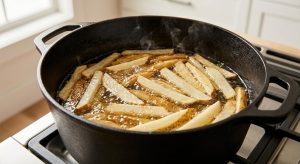
When you dump a mountain of hot, wet rice into a skillet, the surface moisture immediately hits the hot oil and violently vaporizes. This rapid evaporation sucks an enormous amount of thermal energy out of your pan, instantly plummeting the cooking temperature. Because your standard home stove does not have the raw horsepower to recover that heat quickly, the oil stops frying and starts boiling. You are no longer making fried rice; you are aggressively steaming wet rice in a puddle of lukewarm oil. The fragile, non-retrograded grains burst open, releasing their sticky amylopectin directly into the pan, cementing everything into a tragic paste.
The Foundation: Choosing and Prepping Your Grains
Great fried rice is not made at the stove; it is made during the prep work. If you fail to lay the proper foundation, no amount of frantic stirring will save your dinner.
Choosing the Right Rice Variety
As we established with our starch biology, you must choose a rice variety that is naturally high in amylose.
Long-grain varieties are the undisputed champions of the wok. Authentic Jasmine rice and Basmati rice typically contain between 22% and 25% amylose. This high amylose content ensures that the grains will remain distinct, fluffy, and resistant to turning into mush when subjected to high-heat frying. Jasmine rice, with its subtle floral aroma, is the traditional gold standard for Southeast Asian and Chinese-style fried rice.
Medium-grain rice can work in a pinch, but it requires masterful moisture control because its amylopectin levels are noticeably higher. Short-grain, glutinous, or “sticky” rice (which ironically contains almost zero amylose and nearly 100% amylopectin) should be strictly avoided unless you are intentionally trying to make a solid rice cake.
The Rinsing Mandate (Wash Your Rice!)
If you take nothing else away from this masterclass, remember this: you must wash your rice before cooking it.
When rice is milled and transported, the grains rub against each other, creating a fine exterior coating of pure starch dust. If you do not wash this dust away, it will instantly gelatinize in the cooking water, acting like a powerful adhesive that glues the grains together before they even make it to the fridge.
Place your raw rice in a fine-mesh strainer or a bowl, submerge it in cold water, and gently agitate the grains with your hands. The water will immediately turn milky white. Drain and repeat this process three to five times until the water runs almost completely clear. This non-negotiable step strips away the excess surface starch, virtually guaranteeing distinct grains.
The Golden Rule of Cooking the Rice (Less Water is More)
When you are boiling or steaming rice specifically with the intention of frying it later, you must alter your standard water-to-rice ratios.
Standard package directions usually recommend a 1:1.5 or even 1:2 ratio of rice to water. This is fine if you want soft, tender rice to eat alongside a curry. But for fried rice, you want the grains to be slightly al dente. They need a firm structural integrity to survive the wok. Reduce your total cooking water by 10% to 15%. If your rice cooker normally calls for 1.5 cups of water for every cup of rice, drop it down to 1.25 cups. The resulting rice will be slightly drier and firmer, which is exactly what you want before the retrogradation process begins.
Moisture Control: The Unforgiving Law of the Wok
Once your rice is cooked, you enter the most critical phase of the operation: moisture management. The wok is an unforgiving environment that punishes excess water with extreme prejudice.
Surface Moisture vs. Internal Moisture
It is vital to distinguish between the moisture inside the grain and the moisture on the outside of the grain.
You actually want the rice to retain a decent amount of internal moisture; otherwise, the final dish will be unpleasantly hard, crunchy, and stale. What you must ruthlessly eliminate is the surface moisture. It is the microscopic layer of water clinging to the exterior of the grain that causes the catastrophic temperature drops and steam explosions in the pan.
The Steam Factor and Overcrowding
Even if you have perfectly dried, day-old rice, you can still ruin the dish by overcrowding the pan. A commercial restaurant wok burner blasts out over 100,000 BTUs of heat energy. Your standard residential gas or electric stove struggles to output 15,000 BTUs.
If you want to survive the kitchen without serving up a soggy disaster, you must respect the thermal limits of your equipment. When you add four cups of cold rice to a home skillet all at once, you instantly kill the heat. The pan cannot recover fast enough, and the rice begins to steam in its own trapped moisture.
The solution? Cook in batches. Fry two cups of rice at a time, get that beautiful, slightly charred sear on the grains, transfer them to a holding bowl, and repeat. It takes an extra five minutes, but it is the only way to mimic professional wok hei (the smoky “breath of the wok”) on a residential stove.
How to Cool Rice Properly (and Weeknight Cheats)
We know that starch retrogradation and surface dehydration are mandatory. But how do we actually achieve them efficiently?
The Traditional Overnight Refrigerator Method
The absolute best, chef-approved method is to plan ahead. Cook your rice the night before. While it is still hot, spread it out in a thin, even layer on a large baking sheet. Let it stop steaming on the counter for about ten minutes, then place the entire uncovered tray directly into the refrigerator for 12 to 24 hours.
A modern refrigerator is essentially a giant, highly efficient dehumidifier. The cold, circulating air rapidly evaporates the surface moisture from the spread-out grains while the drop in temperature forces the amylose starches into their rigid, crystalline retrograded state. By the next day, you will have the ultimate, premium raw material for fried rice.
The Fan Hack and the Freezer Cheat
But let us be realistic. You are a busy person. Sometimes you crave fried rice at 5:00 PM, and you do not have a time machine to go back to yesterday to prep your grains. When you are trying to throw together simple weeknight dinners on a tight schedule, you need a scientific shortcut.
The Box Fan Hack: Food science legend Kenji López-Alt proved that you can force rapid evaporation without the overnight wait. Spread your freshly cooked, steaming hot rice in a very thin layer on a large metal sheet pan. Place the pan directly in front of a powerful box fan turned up to its highest setting. The intense, continuous airflow blows away the boundary layer of steam, causing massive evaporation and rapidly dropping the surface temperature of the rice. In just 25 to 60 minutes, the surface moisture is eradicated, and the grains are dry enough to fry beautifully.
The Freezer Hack: If you do not have a fan, the freezer is your best friend. Spread the freshly cooked rice thinly on a parchment-lined baking sheet and place it in the freezer for exactly 15 to 20 minutes. The extreme cold halts the gelatinization process and rapidly forces short-term retrogradation, while the dry freezer air wicks away the surface steam. Do not leave it in long enough to freeze solid—just long enough to chill the grains and dry the exterior.
The Hardware: Stop Poisoning Your Rice with Toxic Pans
You can have the most perfectly retrograded, precisely hydrated Jasmine rice in the world, but if you are cooking it in a degraded, toxic piece of garbage pan, you are ruining your food and endangering your health.
The Non-Stick Nightmare (Ditch the Peeling Teflon)
I have absolutely zero patience for cheap, lightweight, synthetic non-stick pans. The vast majority of standard non-stick cookware is coated in PTFE (polytetrafluoroethylene), which belongs to a family of synthetic “forever chemicals” known as PFAS.
These pans are a culinary and biological nightmare. When you use metal utensils, or simply when the pan ages, the PTFE coating inevitably scratches and flakes. A recent scientific analysis revealed that a single broken patch or scratch on a PTFE coating can release up to 2.3 million microplastics and nanoplastics directly into your food in just 30 seconds of cooking. Let that sink in. You are garnishing your fried rice with millions of toxic, microscopic plastic shards.
Furthermore, fried rice requires high heat. When PTFE is heated past 500°F (a temperature easily reached during a stir-fry), the coating begins to break down at a molecular level, releasing invisible, toxic fumes. Inhaling these fumes causes a documented medical condition known as polymer fume fever, or “Teflon Flu,” which results in severe chills, fever, and headaches. It is so toxic that these fumes are famously known to be instantly fatal to pet birds kept in the same house.
The regulatory hammer is finally coming down on this toxic industry. As of January 1, 2025, the state of Minnesota enacted Amara’s Law, becoming the first state in the nation to completely ban the sale of cookware containing intentionally added PFAS. Colorado and Maine followed suit with their own sweeping bans starting in January 2026, and Connecticut and Vermont have strict legislation taking effect by 2028.
The era of toxic Teflon is ending. Stop buying cheap non-stick pans that peel toxic flakes into your food. Throw them in the garbage where they belong.
Carbon Steel and Stainless Steel: Your Forever Pans
If you want to cook like an expert, you need to use the tools the experts use.
Instead, invest in high-quality carbon steel pans or a traditional carbon steel wok. Carbon steel is relatively lightweight, incredibly durable, and boasts phenomenal thermal conductivity, meaning it responds instantly to changes in heat. Best of all, the beautiful alchemy of carbon steel wok seasoning creates a naturally slick surface. By baking micro-layers of cooking oil into the microscopic pores of the metal, the fat polymerizes into a hard, safe, naturally non-stick patina that gets better every time you cook.
Alternatively, heavy-bottomed stainless steel skillets are virtually indestructible and completely non-toxic. While they have a reputation for sticking, this is entirely user error. If you properly preheat a stainless steel pan until a drop of water beads up and dances across the surface like a mercury marble (the Leidenfrost effect), you create a microscopic vapor barrier that prevents the rice proteins and starches from adhering to the metal.
The Execution: Frying Like a Weekend Warrior
You have the right rice, the perfect moisture content, and a safe, high-performance pan. Now it is time to face the fire.
The Mise en Place (Don’t Chop While You Fry)
Fried rice moves fast. Once the oil is smoking, you have mere minutes before things start burning. You cannot be frantically chopping garlic or searching your pantry for the white pepper while the wok is at 500 degrees.
You must practice strict mise en place. Every single ingredient—your diced onions, minced ginger, beaten eggs, thawed peas, and measured soy sauce—must be prepped, portioned, and sitting in little bowls right next to your stove before you even think about turning on the burner.
The Fat (Oil Choices and Why Butter is a Secret Weapon)
You need an oil with a high smoke point that can withstand the intense heat without breaking down into acrid, bitter compounds. Peanut oil, avocado oil, and refined canola oil are excellent choices. Do not use extra virgin olive oil; it will burn instantly and ruin the flavor profile.
The Sassy Sous-Chef Secret: While you should do the primary frying in a high smoke point neutral oil, finishing the dish with a tiny, one-tablespoon knob of cold, unsalted butter right at the very end is a game-changer. The milk solids in the butter brown instantly in the residual heat, wrapping the grains in a rich, nutty, luxurious gloss that elevates the dish from “good homemade” to “how much did you pay for this?”
The Toss and The Sear (Don’t Just Stir, Fry!)
When you add the cold, dry rice to the screaming hot, oiled pan, do not immediately start stirring it like a maniac.
Spread the rice out into an even layer, pressing it gently against the hot metal, and leave it alone for 30 to 45 seconds. By allowing the grains to maintain undisturbed contact with the searing heat, you are actively accelerating the maillard reaction. This complex chemical reaction between amino acids and reducing sugars creates those deeply savory, toasted, caramelized flavor compounds that define authentic fried rice.
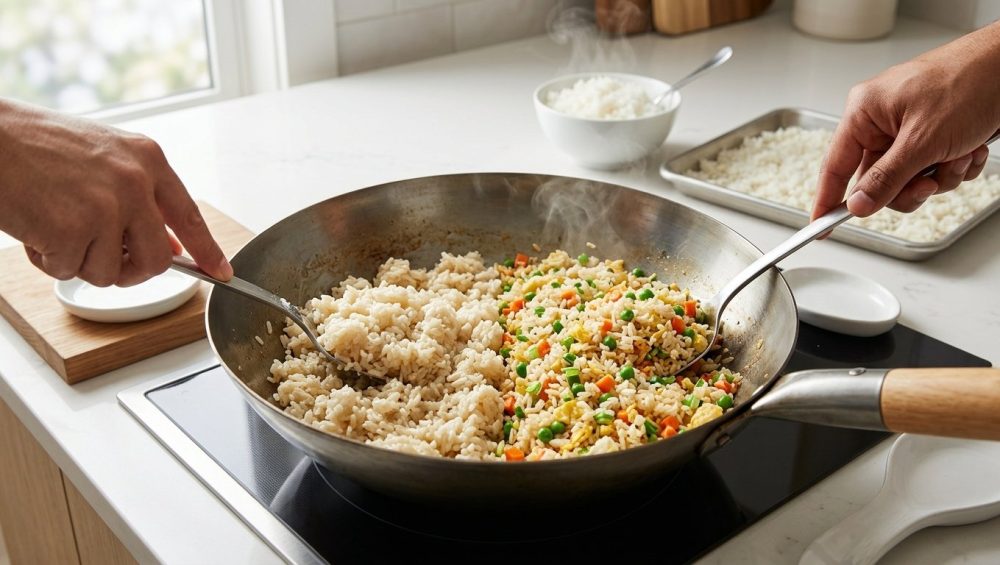
Once the bottom layer has developed a slightly crispy, golden-brown crust, use a thin metal spatula to slice under the rice and flip it. Toss the grains using a scooping, lifting motion. Never smash or press the rice down aggressively with the flat of your spatula—you will crush the grains, releasing the internal starches and creating the exact mush you have worked so hard to avoid.
Troubleshooting Common Fried Rice Disasters
Even with the best intentions, things can go sideways. Here is how to navigate the most common pitfalls.
What to Do if the Rice is Already Too Wet
If you miscalculated and your rice is visibly clumping and steaming heavily in the pan, do not panic, but do act quickly. Immediately turn your burner to its absolute maximum heat setting. Spread the rice out as thinly as possible and stop stirring. You need to maximize the surface area exposed to the heat to force rapid evaporation. Do not add any liquid seasonings (no soy sauce, no Shaoxing wine) until the visible steam subsides and the grains begin to separate and crisp.
Why Your Add-Ins Are Making It Soggy
Vegetables are essentially little water balloons. Zucchini, mushrooms, bell peppers, and onions contain massive amounts of internal hydration. If you throw raw vegetables into the pan at the same time as your rice, the vegetables will dump all their water directly into the starch, ruining the texture.
You must cook your proteins and water-heavy vegetables first. Sauté your chicken, shrimp, and mushrooms until they are fully cooked and their exterior moisture has evaporated. Then, remove them from the pan entirely and set them aside on a plate. Fry your rice in the empty, hot pan. Only reintroduce the cooked proteins and vegetables at the very end, tossing them through the hot rice just long enough to warm them up.
The Soy Sauce Mistake
Never pour soy sauce directly onto the center of the rice pile. The liquid will soak instantly into the nearest grains, making them soggy and aggressively salty while leaving the rest of the pan bland.
Instead, push the rice slightly away from the edges of the pan, and drizzle the soy sauce directly onto the exposed, smoking hot metal perimeter. The intense heat will instantly sear and caramelize the soy sauce, boiling off the excess water content before it even touches the rice, leaving behind only the concentrated, savory umami flavor.
Egg Integration Techniques
There are two acceptable ways to handle the egg.
The first is the “Push and Scramble.” Push your beautifully fried rice to one side of the pan. Add a drop of oil to the empty side, pour in your beaten eggs, and scramble them quickly. Once they are 80% set, fold them into the rice. This creates distinct, fluffy curds of egg throughout the dish.
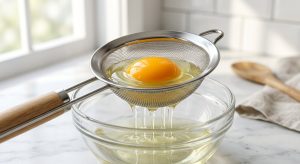
The second is the “Golden Coating” method, favored by many traditional chefs. While your day-old rice is still cold in the bowl, crack raw egg yolks directly into it and mix vigorously with your hands until every single grain is coated in a thin film of yellow yolk. When this hits the hot wok, the egg cooks instantly around each grain, creating a physical barrier that prevents sticking and results in a stunning, uniformly golden dish.
The Ultimate Fried Rice Master Formula
To ensure you never eat a bowl of gummy starch paste again, let us synthesize everything into a rigorous, unbreakable checklist. Mastering these foolproof cooking secrets will elevate your culinary game permanently.
- Use Long-Grain Rice: Jasmine or Basmati only. High amylose is mandatory.
- Wash the Grains: Rinse until the water is crystal clear to remove surface starch.
- Reduce Cooking Water: Drop the water ratio by 10-15% for a firmer, al dente structure.
- Force Retrogradation: Cool the rice completely. Use the overnight fridge method, the 25-minute box fan hack, or the 15-minute freezer cheat to eliminate surface moisture and recrystallize the starches.
- Ditch the Teflon: Use a safe, high-heat carbon steel wok or a pre-heated stainless steel skillet. Absolutely no peeling, toxic PTFE pans.
- Mise En Place: Have all ingredients chopped and ready before the heat goes on.
- Cook in Batches: Do not overcrowd the pan. Respect your stove’s limited BTUs.
- Sear, Then Toss: Let the rice sit undisturbed to develop a Maillard crust before tossing. Do not smash the grains.
- Manage the Moisture: Cook wet vegetables separately. Sear soy sauce on the edges of the pan.
Cooking is not magic; it is applied physics and chemistry. By understanding how starch molecules react to heat, cold, and water, you have successfully hacked the system. You are no longer at the mercy of a takeout menu or a poorly written internet recipe. You are in total control of your wok. Now, get into the kitchen, turn on the exhaust fan, and show those grains of rice exactly who is boss.