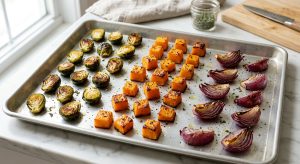
Picture this: It is a random Tuesday night. You are exhausted. You have finally managed to chop up some broccoli, toss it in olive oil, and slide it into a 425-degree oven. You pour yourself a well-deserved glass of wine, lean against the counter, and close your eyes for a brief moment of peace.
And then—BANG.
It sounds like a small explosive just detonated inside your oven. Your heart leaps into your throat, your dog starts barking frantically, and your wine nearly ends up on the ceiling. You yank open the oven door, fully expecting to see a scene of fiery devastation, only to find… your broccoli. Sitting there. Innocent. But the baking sheet? It is violently twisted, propped up on two corners like a metallic potato chip, with all your carefully distributed olive oil now pooling into one sad, greasy corner.
If this sounds familiar, welcome to the club. You have just experienced the infamous baking sheet “pop.”
Let me be perfectly clear: you are not going crazy, and you are not necessarily doing anything wrong. You certainly do not need a culinary degree to figure out why your kitchenware is suddenly doubling as a percussion instrument. As a home cook who has set off her fair share of smoke detectors and ruined more than a few weeknight dinners in the name of “trial and error,” I am here to tell you that this jarring pop is one of the most common, universally despised phenomena in the modern kitchen.
But just because it is common does not mean you have to tolerate it. I have absolutely zero patience for kitchen gear that fights back. Cooking is supposed to be your time to unwind, to create something delicious, and to feed yourself without having a stress-induced meltdown. When your tools literally buckle under the pressure, it is time to intervene.
We are going to break down exactly what happens inside that dark, hot box of an oven. We are going to translate the physics of thermal expansion into plain English, dissect the anatomy of cheap cookware, and outline exactly how to stop your pans from permanently warping. Because your time is money, your ingredients are expensive, and you deserve a peaceful, quiet kitchen.
The Physics of the Pop: What Actually Happens Inside the Oven
To understand the pop, we have to talk about science. Do not roll your eyes at me—I promise to keep the pretentious chef-speak to an absolute minimum. But we need to address what is happening on a molecular level when you expose metal to high heat.
The Science of Thermal Expansion
Everything comes down to a concept called thermal expansion. When you place a room-temperature metal baking sheet into a hot oven, the heat transfers energy to the metal atoms. Imagine these metal molecules as miniature springs. At room temperature, they are relatively calm and closely packed. But as they heat up, they get energized. They start vibrating, moving faster, and demanding more personal space. As these “springs” stretch, the metal itself physically expands.
If the entire baking sheet were to heat up at the exact same rate, it would expand uniformly in all directions, and it would remain perfectly flat. But in the real world—and especially in a standard home oven—uniform heating is a myth.
The Battle of the Temperature Gradients
Your oven is full of hot spots and cool spots. Furthermore, your baking sheet is not a single, flat, infinite plane. It has a large, flat bottom and, usually, four raised, rolled edges.
When you put the pan in the oven, the large, flat surface area of the bottom absorbs heat much faster than the thicker, structurally reinforced rimmed sides. The bottom of the pan wants to expand immediately. It is pushing outward in all directions. However, the cooler, stiffer rims are not expanding at the same rate. They act like a rigid frame, trapping the expanding bottom.
This creates an immense amount of mechanical stress right at the crease where the flat base meets the raised lip. The bottom is effectively trapped. It needs somewhere to go, but the edges are holding it hostage.
The Breaking Point
Eventually, the tension becomes too much. The metal cannot contain the stress anymore, and it violently buckles to relieve the pressure. It snaps out of its flat, two-dimensional plane and adopts a three-dimensional curved shape—often popping up in the center or twisting diagonally so that it rests on only two corners.
That loud, reverberating BANG you hear? That is the sound of the pan suddenly giving in to the stress of the expansion. It is a rapid release of mechanical energy.
Interestingly, once the pan reaches a uniform temperature—meaning the rims finally catch up to the bottom—the stress equalizes, and the pan will often flatten back out on its own. But the damage to your nerves (and your evenly spaced cookies) is already done. And over time, this repeated stress will permanently deform the metal.
The Usual Suspects: Why Your Specific Pan is Failing
If your pans are popping every single time you roast a vegetable, the problem is likely the pan itself. Let’s talk about the specific design flaws that turn bakeware into a liability.
The Gauge Problem: Thin is Not In
When it comes to baking sheets, thickness matters. In the manufacturing world, the thickness of a metal sheet is measured in “gauge”. Here is the confusing part: the gauge scale is regressive. That means the higher the number, the thinner the metal.
Most of the flimsy, entry-level baking sheets you buy at the grocery store or big-box retailer are made of 18-gauge aluminum (which is roughly 0.0403 inches thick) or even thinner. Manufacturers love 18-gauge metal because it is incredibly cheap to produce, lightweight to ship, and easy to stamp into shape.
But 18-gauge metal is a nightmare for the home cook. Because it is so thin, it has very little structural integrity. It heats up almost instantly, making it highly susceptible to extreme temperature gradients. It simply lacks the mass to absorb and distribute heat evenly, meaning it will buckle and twist at the slightest provocation.
If you want a pan that behaves, you need a lower gauge. Commercial kitchens—the places that roast hundreds of pounds of food a day without their pans sounding like a drumline—use 10-gauge (about 0.102 inches thick) or 13-gauge pans. A 10-gauge pan is a heavy, thick, absolute unit of a tool. It has the thermal mass required to heat up slowly, distribute that heat evenly across its entire surface, and resist the mechanical stress that causes warping.
The “Mystery Metal” and Toxic Coatings
As your resident Sassy Sous-Chef, I have a strict “no-go” rule when it comes to cheap, toxic kitchenware. I absolutely despise mystery metals coated in low-grade, peeling non-stick chemicals.
Many budget baking sheets are made of thin carbon steel coated in a dark non-stick finish. First of all, dark surfaces absorb heat faster and more aggressively than light, shiny surfaces, which immediately exacerbates the temperature gradient problem and leads to burnt bottoms. Second, when these cheap pans inevitably warp and twist, the mechanical flexing causes that brittle non-stick coating to crack, flake, and peel right into your food.
If you are currently cooking on a warped, scratched pan that sheds black flakes onto your roasted potatoes, throw it in the trash immediately. You should be actively banishing toxic kitchen gear from your home. High heat and cheap chemical coatings do not mix. Furthermore, the constant flexing from the “pop” is losing their slip and destroying whatever non-stick properties the pan originally had.
The Rolled Edge Dilemma
Look closely at your baking sheet. Does it have a rim that is tightly rolled over, perhaps with a galvanized steel wire hidden inside it?
Rolled edges are designed to give thin metal a bit of rigidity and prevent the pan from bending when you pick it up with heavy oven mitts. However, they are a double-edged sword. Because the rolled edge is significantly thicker than the flat base, it heats up much slower. This exacerbates the exact temperature difference that causes the pan to warp in the first place.
Heavy-duty 10-gauge commercial pans often have open rims or are so thick that they don’t rely entirely on the rim for structural integrity. The metal itself is strong enough to resist the tension.
Human Error: How You Are Accidentally Torturing Your Bakeware
Okay, tough love time. Yes, your flimsy 18-gauge pan is mostly to blame. But you might also be committing some egregious kitchen sins that are pushing your bakeware past its breaking point. Warping is often triggered by thermal shock—a rapid, localized change in temperature that forces the metal to expand or contract violently.
The Frozen Food Shock
One of the most common ways to induce a massive warp is to take a hot pan and throw freezing cold food on it, or vice versa.
Let’s say you preheat your oven to 425 degrees. You pull a room-temperature pan out of the cabinet, dump a bag of rock-hard, frozen french fries onto one side of it, and shove it into the oven.
You have just created a thermodynamic disaster. The side of the pan with the frozen fries is being kept artificially cold, while the empty side of the pan is absorbing 425 degrees of ambient heat. The empty side expands rapidly; the frozen side stays contracted. The resulting internal stress across the sheet is so extreme that the pan has no choice but to violently twist to accommodate the varying sizes of its own metal.
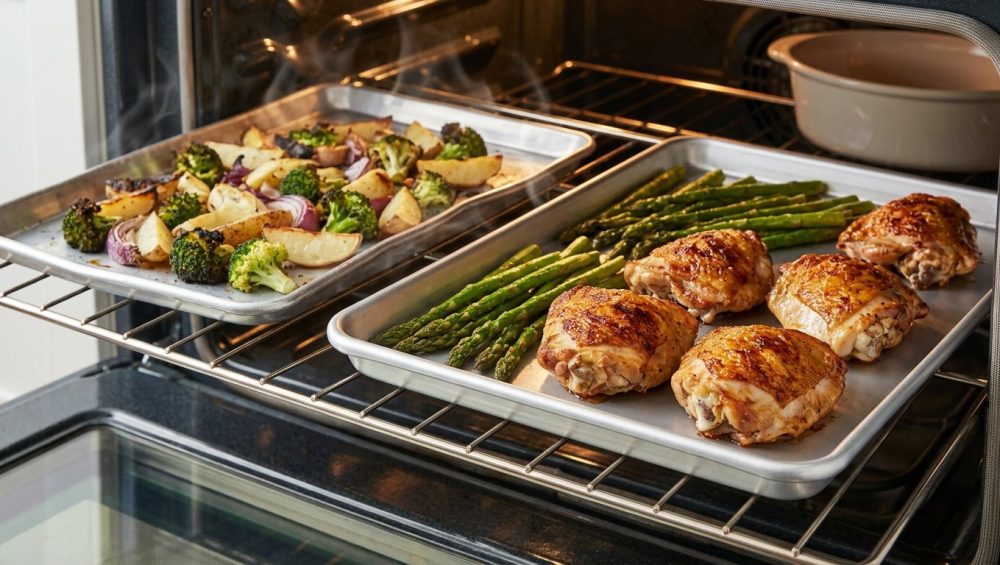
The same thing happens if you haphazardly arrange your food. If you pile all your chicken breasts in the center and leave the corners completely bare, those bare corners will heat up instantly while the center remains cool. This is why you must distribute your ingredients evenly. Not only does proper spacing ensure you are not eating mushy veggies that steamed instead of roasted, but it also protects the structural integrity of your pan.
The Sink Plunge
If you take away only one piece of advice from this entire masterclass, let it be this: never, under any circumstances, run a hot baking sheet under cold water.
I know the temptation. You just finished dinner, the pan is covered in baked-on grease, and you want to soak it immediately so you don’t have to scrub it later. But plunging a 400-degree metal pan into 60-degree tap water is a death sentence for the metal.
The rapid cooling forces the metal to contract so violently and unevenly that it will permanently warp. The stresses cannot relax at the lower temperature, meaning the pan will stay permanently buckled. Always, always let your pans cool completely to room temperature on a wire rack or the stovetop before you let them anywhere near the sink.
The Culinary Consequences of a Warped Pan
Why do we care so much about a little popping noise? If the pan eventually flattens back out, what is the big deal?
The problem is that warped pans actively sabotage your food. When a pan twists into a potato chip shape, all the fat, oil, and juices immediately run down into the lowest corners. If you are trying to achieve the crispiest roasted potatoes, you need them sitting in an even layer of hot oil. On a warped pan, half of your potatoes will be bone-dry and burning, while the other half are drowning and deep-frying in a pool of grease.
If you are baking cookies, a warped pan will cause the dough to slide downhill, resulting in misshapen, fused-together blobs. If you are baking a thin sheet cake or a jelly roll, the batter will pool on one side, giving you a cake that is paper-thin and burnt on the left, and thick and raw on the right.
Using defective gear is the root cause of so many beginner cooking mistakes. You blame yourself for burning the bottom of the cookies, but it wasn’t your fault—it was the pan’s inability to distribute heat evenly. You are letting cheap metal dictate the quality of your meals, and it is actively ruining your dinners.
Furthermore, repeated thermal shock causes metal fatigue. Every time the pan pops, the molecular structure weakens. Eventually, it won’t flatten back out when it cools. It will stay permanently warped, rendering it completely useless for anything other than carrying dirty dishes to the sink.
How to Stop the Pop: Actionable, Science-Backed Solutions
Alright, enough doom and gloom. You are a resourceful home cook, and we are going to fix this. Here is how you prevent your pans from screaming at you.
Master the Art of Preheating and Placement
The first step in preventing warping is managing the temperature gradient. You want the metal to heat as slowly and evenly as possible.
If your recipe allows for it, put the empty baking sheet into the oven while it preheats. This allows the pan to gradually come up to temperature along with the oven, minimizing thermal shock. Once the oven is hot, carefully pull the pan out, arrange your room-temperature (not frozen!) food evenly across the surface, and put it back in.
If you cannot preheat the pan, ensure your food is distributed flawlessly. Cover as much of the surface area as possible. If you only have a small amount of food to roast, do not use a massive half-sheet pan. Switch to a quarter-sheet pan so the food covers the entire surface, leaving no bare spots to overheat.
Avoid Extreme Hot Spots
Get to know your oven. Most home ovens have severe hot spots, usually right near the heating elements at the very bottom or top. If you place a thin baking sheet too close to the heating element, the direct radiant heat will blast the bottom of the pan, causing it to expand wildly before the top or sides can catch up.
Always bake on the center rack unless a recipe specifically demands otherwise. And if you know your oven runs hotter in the back, rotate the pan 180 degrees halfway through the cooking time to ensure even heat distribution.
The Ultimate Bakeware Upgrade: What to Buy Instead
If you are currently cooking on 18-gauge, dark-coated, warped mystery metal, no amount of careful preheating is going to save you. You need to upgrade. And the good news is, professional-grade baking sheets are surprisingly affordable. You do not need to spend $100 on a designer pan. You just need to buy what the professionals buy.
Heavy-Duty Bare Aluminum
Your best bet is a commercial-grade, bare aluminum half-sheet pan. Look specifically for 10-gauge or 13-gauge aluminum. (Remember, lower numbers mean thicker metal!)
Aluminum is an incredible conductor of heat. It heats up quickly and evenly, and it cools down just as fast when you take it out of the oven, which prevents carryover cooking from burning the bottoms of your cookies. Because a 10-gauge pan is so thick, it has the thermal mass to resist warping even under high heat.
Brands like Nordic Ware (specifically their Naturals line), Vollrath, and Fat Daddio’s make phenomenal, heavy-duty aluminum pans that will outlive you. They are shiny and untreated, meaning they reflect heat properly and will not peel toxic flakes into your food.
Aluminized Steel and Stainless Steel
If you frequently cook highly acidic foods (like tomatoes or citrus), bare aluminum can sometimes react, giving the food a metallic taste and pitting the pan. In these cases, you have two other excellent options.
Aluminized steel is a carbon steel core coated in an aluminum alloy. It offers the incredible strength and warp-resistance of steel, with the heat conductivity of aluminum. It is heavily used in commercial bakeries.
Stainless steel is another option, though it is a poor conductor of heat on its own. If you go the stainless route, you must look for “tri-ply” or clad pans, which feature an aluminum core sandwiched between layers of stainless steel. These are virtually indestructible and completely non-reactive, though they are significantly heavier and more expensive than bare aluminum.
Whatever you do, avoid anything labeled “lightweight,” “non-stick,” or “easy-clean ceramic.” You want raw, heavy, industrial metal.
Can You Fix a Permanently Warped Pan?
Let’s say you have a pan that is permanently stuck in a twisted shape. Can you save it?
The honest answer is: maybe, but probably not for long.
There is a popular DIY trick that involves heating the warped pan in a 200-degree oven for ten minutes until it is warm to the touch. You then place it upside down on a flat, hard surface (like a concrete floor or a heavy workbench), cover it with a thick towel to prevent scratching, and gently tap the warped corners with a rubber mallet until the pan sits flat again.
Will this work? Yes, temporarily. You are physically forcing the metal back into its original plane. But you cannot undo metal fatigue. The molecular structure of that pan has been compromised by repeated thermal shock. The “springs” have been stretched too far, too many times.
The next time you put that pan in a 400-degree oven, it is almost certainly going to find that exact same weak point and pop right back out of shape. Once a pan is permanently warped, its days as a high-heat roasting vessel are over.
Do not throw it away, though! Repurpose it. A warped sheet pan is perfect for organizing ingredients, carrying items out to the grill, or acting as a drip tray under a messy pie. Just don’t expect it to roast an even batch of vegetables ever again.
Weeknight Efficiency vs. Weekend Perfection
As home cooks, we are constantly balancing the need for speed during the week with our desire for culinary perfection on the weekend. But here is the secret: having the right equipment bridges that gap.
When you invest in a heavy-gauge, warp-resistant baking sheet, you are buying yourself time. You no longer have to constantly babysit the oven, desperately rotating a warped pan to keep the oil from pooling and burning your food. You can toss your ingredients on a reliable surface, walk away, and trust that the pan will do its job. This kind of reliability is exactly what you need to transform your daily meals from a stressful chore into an effortless routine.
Think about it. If you are trying to execute the perfect weeknight roast chicken, you are already battling the clock. You know that if your chicken turns out dry, the whole meal feels like a failure. You might even be relying on the magic of dry brining to ensure a crispy skin and juicy interior. But if you place that meticulously prepped chicken on a flimsy, popping sheet pan, the uneven heat distribution will ruin all your hard work. The bottom will scorch while the top steams.
Cooking should not be a battle against your tools. You should be focusing on flavor—like remembering that your dinner actually needs acid to balance the richness of that roasted chicken, rather than worrying if your pan is going to explode in the oven.
You do not need a culinary degree to cook like an expert. You just need to understand the basic rules of the kitchen, respect the physics of heat, and refuse to settle for cheap, toxic gear. Ditch the flimsy 18-gauge mystery metal. Invest in a heavy, 10-gauge commercial aluminum pan. Treat it right, keep it out of the cold water while it’s hot, and enjoy the beautiful, peaceful silence of an oven that doesn’t pop.
Your roasted vegetables, your perfectly baked cookies, and your sanity will thank you. Now pour yourself another glass of wine, and get back to cooking. You’ve got this.