Listen, I have set off enough smoke alarms and frantically microwaved enough lukewarm mashed potatoes to know that hosting a dinner party can quickly devolve into a sweaty, chaotic nightmare. You invite people over to enjoy their company, but instead, you spend the entire evening playing a frantic game of culinary whack-a-mole. The roast is perfectly rested, but the gravy is congealing. The asparagus is cold, and your guests are politely pretending they enjoy eating room-temperature food while you sweat over the stove. If you want to host a relaxed dinner party, you have to stop fighting thermodynamics and start using it to your advantage.
You do not need a Michelin star to serve a flawless, piping-hot meal to eight people at the exact same time. You just need to understand how your cookware behaves when it leaves the burner. The secret to eliminating the last-minute reheating bottleneck isn’t running faster or buying a second microwave; it is utilizing thermal mass. By choosing the right serving vessels, you can turn your cookware into a thermal battery that keeps your food at the optimal serving temperature for hours, buying you the time to actually sit down, pour a glass of wine, and enjoy the gathering you worked so hard to put together.
The Physics of Not Ruining Dinner: Decoding Thermal Mass
I have zero patience for pretentious recipe jargon, but understanding basic thermal physics is non-negotiable if you want to stop ruining your weekend meals. When we talk about keeping food hot, we are really talking about managing heat transfer. The materials you cook and serve in dictate exactly how fast your food will turn into a cold, unappetizing mess.
Specific Heat Capacity vs. Density
Let’s look at the actual numbers. Specific heat capacity is the amount of energy required to raise the temperature of one kilogram of a substance by one Kelvin. Aluminum has a specific heat capacity of roughly 910 J/kg·K, while iron sits at about 448 J/kg·K. At first glance, you might assume aluminum is the clear winner here because it takes more energy per kilogram to heat up. But here is the kicker: density.
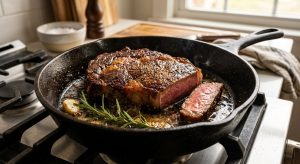
Cast iron is incredibly dense. When you hold a heavy cast iron skillet, you are holding significantly more mass than an identically sized aluminum pan. Because of this massive physical density, the volumetric heat capacity of cast iron is off the charts. It acts like a giant thermal reservoir, absorbing a massive amount of heat slowly and releasing it even slower. Furthermore, thermal diffusivity—which measures how fast heat spreads through a material—is much lower in cast iron than in aluminum. Aluminum heats up in seconds, but the moment you take it off the burner, it dumps its heat into the surrounding air just as fast. Cast iron is stubbornly slow to heat up, but once it reaches temperature, it refuses to let that thermal energy go.
The Magic of Emissivity
Then we have emissivity. Emissivity is a scientific measurement of how effectively a material radiates absorbed heat across an air gap to another object (like your food). Shiny, polished aluminum has a pathetic emissivity rating of around 0.05. It reflects heat; it doesn’t push it into your food. Rough cast iron sits at about 0.81, and enamel coating clocks in at a glorious 0.90. This means an enameled cast iron Dutch oven isn’t just passively holding heat; it is actively radiating that heat directly into your braised short ribs, keeping them bubbling hot long after you’ve turned off the stove.
The Toxic Elephant in the Room: Why Cheap Non-Stick is Banned
Before we talk about investing in high-mass serving ware, we need to address the peeling, toxic elephant in the room. If you are still serving your beautiful, lovingly prepared meals out of cheap, scratched non-stick pans, we need to have a serious intervention. I am ruthless about banishing toxic kitchen gear from my home, and you should be too.
The Legal Death of Forever Chemicals
For decades, the cookware industry has been pumping out flimsy aluminum pans coated in PTFE (Polytetrafluoroethylene) and other PFAS—widely known as “forever chemicals.” These synthetic chemicals do not break down in the environment, and they certainly do not belong anywhere near your food. The global regulatory landscape has finally caught up to this nightmare.
As of January 1, 2025, the state of Minnesota officially banned the sale of cookware containing intentionally added PFAS. They are not an outlier. Colorado, Maine, and Connecticut have implemented sweeping bans that took effect on January 1, 2026, prohibiting the distribution of PFAS-laden cookware and consumer goods. Even the European Union is currently barreling toward a universal restriction on over 10,000 PFAS compounds, aiming for a final commission decision by 2027.
When entire governments are legally prohibiting the sale of a material because it is a bioaccumulative hazard, you do not want it touching your dinner. Cheap non-stick cookware is a crutch for bad cooking technique, it is terrible at retaining heat, and it is a chemical liability. It is time to upgrade to safe, durable materials that respect your health and your time.
Enameled Cast Iron: The Heavyweight Champion of Heat Retention
If you want to keep a massive batch of chili or a delicate coq au vin hot for an extended gathering, enameled cast iron is the undisputed heavyweight champion of the kitchen. Consider this your ultimate kitchen survival guide for keeping communal meals piping hot without stressing yourself out.
The Anatomy of Enamel
Enameled cast iron takes the incredible volumetric heat capacity of raw iron and coats it in a layer of glass particulate that has been fused to the metal at violently high temperatures. This creates a surface that is completely non-reactive. Unlike bare cast iron, which can strip its seasoning and impart a metallic taste when exposed to highly acidic foods like tomatoes or wine, enameled cast iron handles acid beautifully.
Because the enamel coating has such a high emissivity rating (0.90), it behaves like a thermal mirror, constantly bouncing heat back into the center of the pot. When you pull a five-quart enameled Dutch oven out of a 350°F oven, that vessel has absorbed enough thermal energy to keep your food safely hot for well over an hour at room temperature.
Oven-to-Table Brilliance
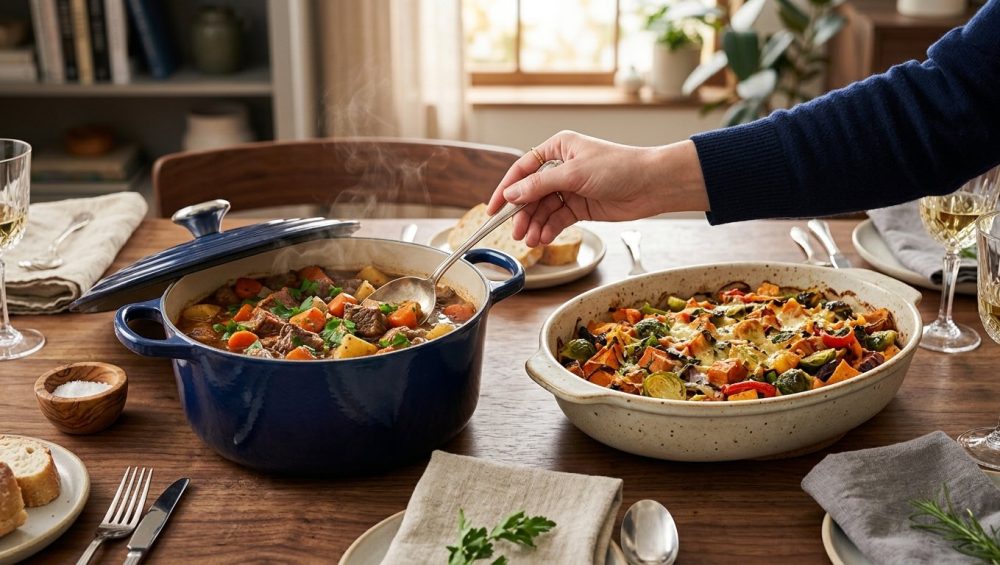
The true genius of enameled cast iron is its aesthetic versatility. You do not need to transfer your food from an ugly cooking pot into a cold, decorative serving bowl—a move that instantly saps the heat out of your food. Enameled braisers and Dutch ovens are designed to go straight from the oven to the dining table. You cook in it, you serve in it, and it acts as a gorgeous, colorful centerpiece that doubles as a functional radiator for your meal.
High-Mass Ceramics and Stoneware: The Aesthetic Heat Trap
While cast iron is perfect for stews and braises, it is not always the right tool for baked pastas, scalloped potatoes, or roasted root vegetables. This is where high-mass ceramics and stoneware enter the chat. The thermal retention in ceramic bakeware makes it the undisputed MVP of holiday side dishes and large communal feasts.
The Science of Clay and Porosity
Ceramics and stoneware are forged from natural clay that is fired in kilns at extreme temperatures, causing the material to vitrify and become incredibly dense. Unlike metals, ceramics have a very low thermal conductivity. This means they are terrible at quickly transferring heat from a stovetop burner, which is why you generally don’t use them for searing steaks. However, this exact same property makes them brilliant insulators.
Once a thick stoneware baking dish absorbs heat in the oven, its low thermal conductivity prevents that heat from easily escaping back into the ambient air. It acts as a thermal trap. This is why a bubbling dish of macaroni and cheese baked in a heavy ceramic dish will still burn the roof of your mouth thirty minutes after it comes out of the oven.
The Japanese Donabe
For the ultimate masterclass in ceramic heat retention, look to the traditional Japanese Donabe. Made from specialized porous clay, these pots are designed specifically for communal dining. The porosity of the clay allows the pot to absorb heat slowly and evenly, and once removed from the heat source, the Donabe keeps soups, rice, and hot pots simmering at the table for an astonishing amount of time. It is the perfect marriage of culinary tradition and thermodynamic efficiency.
The Strategic Pre-Warm: A Host’s Secret Weapon
Here is a rookie mistake that drives me absolutely crazy: spending three hours cooking a spectacular, temperature-perfect meal, only to dump it into an ice-cold serving bowl. A cold ceramic or glass bowl will instantly absorb the thermal energy from your food, rapidly cooling your meal until the bowl and the food reach an unappetizing equilibrium. A proper pre-warming routine is the easiest way to eliminate kitchen chaos right before your guests arrive.
The Hot Water Method
If you are using a heavy ceramic serving bowl for mashed potatoes or roasted vegetables, you must pre-warm it. The fastest and safest way to do this is the hot water method. About ten minutes before you are ready to plate, boil a kettle of water. Pour the boiling water directly into your room-temperature serving bowl and let it sit for five to ten minutes. The dense ceramic will absorb the heat from the water. Right before serving, dump the water, quickly dry the bowl with a clean towel, and add your food. You have just established a thermal baseline that will keep your food hot for an extra forty-five minutes.
The Low-Oven Method
For heavy stoneware platters or cast iron serving trays, the oven method is your best friend. Set your oven to its lowest setting (usually around 170°F to 200°F). Place your empty serving vessels in the oven for twenty minutes before dinner. They will safely absorb a massive amount of heat without risking thermal shock. When you pull them out, they will be hot to the touch (use oven mitts!) and ready to cradle your perfectly cooked proteins without aggressively sapping their heat.
The FDA Danger Zone and Thermodynamic Food Safety
Let’s get incredibly serious about food safety for a moment, because nobody wants their dinner party remembered as the event that gave the entire neighborhood food poisoning. The FDA explicitly defines the “Temperature Danger Zone” as the range between 40°F and 140°F.
Beating the Bacterial Clock
Why is this specific temperature range so terrifying? Because within this cozy, lukewarm window, harmful pathogens like Salmonella, E. coli, and Staphylococcus aureus thrive, multiplying at an alarming rate and doubling in population in as little as 20 minutes. The absolute golden rule of food safety is that perishable foods should never linger in this danger zone for more than two hours—or just one hour if you are hosting outdoors in ambient temperatures above 90°F.
When you serve a hot casserole in a thin, low-mass aluminum pan or a cheap glass dish, the temperature of the food plummets from a safe 165°F straight into the danger zone within twenty to thirty minutes. By implementing safe food holding strategies, such as serving in pre-warmed, high-mass enameled cast iron or dense stoneware, you drastically slow this temperature drop. The thermal mass of the vessel continuously feeds heat back into the food, keeping the internal temperature safely above 140°F for significantly longer, effectively pausing the bacterial clock and ensuring your guests remain safe.
Pacing Your Communal Meal Without the Microwave Panic
A dinner party should not feel like a competitive eating contest where everyone is rushing to finish their plate before the food gets cold. When you plan mindful gatherings, the goal is to actually spend time with your guests, not your microwave.
Mastering the art of effortless hosting means letting your cookware do the heavy lifting. By utilizing thermal mass, you gain the ultimate luxury of a host: time. You can stage your menu intentionally. You can serve the appetizers and actually sit down to eat them, knowing that your main course is resting safely in a heavy Dutch oven, retaining its heat perfectly. You eliminate the frantic, sweaty kitchen sprints. You pace the meal based on the flow of conversation, not the rapid cooling rate of your dinnerware.
Thermodynamic Food Holding Strategies for the Home Kitchen
If you want to push your heat retention to the absolute maximum, you need to understand the secondary factors that cause food to lose heat. It is not just about the vessel; it is about how you manage the environment around the vessel.
The Physics of Evaporation
The fastest way food loses heat is through evaporative cooling. When water turns from a liquid into a vapor, it requires a massive amount of energy (latent heat of vaporization). As steam escapes your food, it takes all that precious thermal energy with it, rapidly cooling your dish.
The solution is painfully simple: use a heavy lid. A heavy cast iron lid traps the steam, forcing it to condense and drip back into the food. This creates a closed thermodynamic loop, drastically reducing heat loss. If you are serving a dish that cannot be covered without ruining the texture (like a crispy gratin), you must rely entirely on the thermal mass of the bottom of the dish to combat the evaporative cooling happening at the surface.
Insulating Your Assets
Conductive heat loss is the other enemy of a hot meal. If you take a blazing hot cast iron pot and place it directly onto a cold granite or marble countertop, you are making a massive mistake. Stone and marble are incredibly dense and act as massive heat sinks. They will literally suck the heat right out of the bottom of your pot through direct conduction.
Always use a thick wooden trivet, a cork pad, or a heavy folded towel beneath your high-mass serving vessels. Wood and cork are fantastic insulators with very low thermal conductivity. They break the conductive chain, ensuring that the heat stays in the pot and goes into your food, rather than sinking uselessly into your kitchen island.
Care, Maintenance, and Avoiding Thermal Shock
High-mass cookware is an investment. These are heirloom pieces that, if treated correctly, will outlive you. Even if you have a minimalist kitchen setup, treating your few high-quality pieces with respect ensures they perform flawlessly every single time.
The Danger of Thermal Shock
The single fastest way to destroy an expensive enameled cast iron Dutch oven or a beautiful ceramic Donabe is thermal shock. Thermal shock occurs when a material experiences a rapid, extreme change in temperature (a massive ΔT). This causes different parts of the material to expand or contract at different rates, leading to catastrophic cracking, shattering, or the enamel violently popping off the iron.
Never, ever take a hot ceramic dish or a screaming hot cast iron pan and run it under cold water. Do not place a cold, refrigerated stoneware dish directly into a 400°F oven. You must let these materials heat up and cool down gradually. When dinner is over, let the pots sit on the stove and come down to room temperature naturally before you even think about washing them.
Safe Cleaning Practices
When it is finally time to clean your enameled cast iron or stoneware, put down the harsh metal scouring pads. You do not want to scratch the glass-like surface of the enamel or damage the glaze on your ceramics. For stubborn, stuck-on food, fill the cooled pot with warm water and a few tablespoons of baking soda, and let it simmer gently on the stove for ten minutes. The baked-on mess will lift right off with a soft sponge.
Conclusion: Reclaiming Your Weekend
You do not need to be a professional chef with a brigade of line cooks to pull off a flawless, multi-course dinner party. You just need to work smarter, not harder. By ditching the toxic, low-mass aluminum pans and investing in the thermodynamic power of enameled cast iron and dense ceramics, you fundamentally change the way you host.
You stop fighting the clock. You stop apologizing for cold food. You stop spending your own parties trapped in the kitchen. Use the physics of thermal mass to your advantage. Pre-warm your vessels, keep the lids tight, insulate your pots from cold countertops, and pour yourself a glass of wine. Sit down with your friends, engage in the conversation, and let your cookware do exactly what it was designed to do: hold the heat, hold the flavor, and hold the moment.