Weekdays in my kitchen are a battlefield of efficiency. I am all about survival, shortcuts, and getting a meal on the table before the hanger sets in. But the weekend? The weekend is when time slows down, the aprons get tied tight, and I transform into an absolute perfectionist. If you are anything like me, you know that mastering the ultimate beginner guide to mastering the art of the kitchen requires an understanding of your tools on a molecular level, and your teaware is absolutely no exception.
I have zero patience for pretentious chef-speak, and I have even less patience for mystical, gate-kept tea jargon. Let’s get one thing straight right out of the gate: a teapot is not going to align your chakras. However, an authentic Yixing clay teapot will fundamentally alter the chemical extraction of your tea leaves through applied thermodynamics, porosity, and material science.
If you want to elevate your weekend gatherings, ditch the bleached paper tea bags and step into the world of Gongfu Cha (the Chinese art of making tea with skill and precision). Executing a traditional Kungfu tea ceremony isn’t about putting on a theatrical performance; it’s about precise temperature management, intentional extraction, and using the right unglazed clay to manipulate the flavor profile of your brew. Today, we are going to geek out over the empirical science of Zisha (Yixing) clay, how its thermal properties facilitate mind-blowing tea, and exactly how to spot the toxic counterfeits that are flooding the market. Grab a cup of something hot, and let’s get to work.
The Geological Blueprint: Material Science of Authentic Zisha Clay
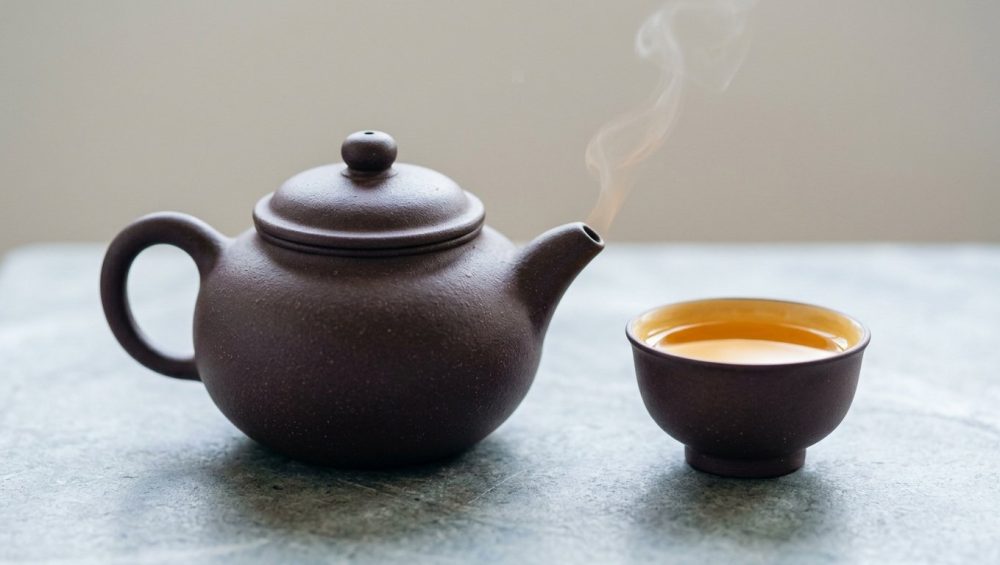
To understand why tea enthusiasts willingly drop hundreds of dollars on a tiny, unglazed teapot, we have to look at the dirt it’s made from. Authentic Yixing clay, known as Zisha (which translates to “purple sand”), is mined exclusively in the Yixing region of Jiangsu province, China—specifically around the Huanglongshan and Zhaozhuangshan mountains.
This isn’t your standard pottery wheel mud. Zisha is a unique mineral aggregate that exists in a fascinating middle ground between earthenware, stoneware, and porcelain. Its chemical composition is a highly specific blend of kaolinite, quartz, mica, and iron oxide.
Kaolinite provides the clay with its plasticity and its impressive fired strength, giving the finished teapot a dense, stone-like quality. The high quartz content acts as a rigid skeletal framework. This is crucial because it allows the clay to withstand incredibly high firing temperatures (typically between 1100°C and 1200°C) without melting, collapsing, or completely vitrifying into glass. The mica contributes to the clay’s signature rough, sandy texture and helps form its internal structure. Finally, the high iron oxide content is responsible not only for the beautiful natural colors of the clay—ranging from deep purples to vibrant reds—but also for its exceptional thermal retention properties.
The Double-Pore Structure: Nature’s Micro-Filter
When Zisha clay is fired at these extreme temperatures, a microscopic phenomenon occurs. Because the quartz prevents the clay from completely vitrifying (turning into a solid, glass-like state like porcelain), the resulting vessel retains a specific degree of porosity, usually ranging from 2% to 5%.
But it’s not just standard porosity; Zisha clay features a highly unique “double-pore” structure. During the firing process, two distinct types of microscopic pores are formed inside the clay body. There are “closed” pores located within the inner structure of the mineral aggregates, and “open” pores situated around the periphery of these particles.
This dual-porosity is the holy grail of teaware. It means the teapot is practically impermeable to liquid water—so it won’t leak on your table—but it remains highly permeable to air and volatile aromatic oils. The clay literally “breathes.” As you brew tea, the unglazed interior walls interact directly with the tea liquor, absorbing trace amounts of tea oils and aromatic compounds into these micro-pores. Over time, this builds a complex, organic seasoning inside the pot. This seasoning process is remarkably similar to the science of polymerization that gives a well-used carbon steel skillet its slick, non-stick properties. You are fundamentally changing the surface chemistry of your equipment through repeated, intentional use.
Thermodynamics in the Teacup: Heat Capacity and Retention
If you have ever looked into thermodynamic food holding strategies for keeping a holiday roast at the perfect serving temperature, you will immediately appreciate how Zisha clay acts as a highly efficient insulating jacket for your tea.
In Gongfu tea brewing, the ratio of tea leaves to water is exceptionally high, and the steeping times are incredibly short (often measured in seconds, not minutes). To extract the heavy, complex aromatic compounds from premium rolled Oolongs or aged Pu’erh teas, you need boiling or near-boiling water (90°C to 100°C). More importantly, you need that temperature to remain absolutely stable throughout the duration of the steep.
If you use a thin glass vessel or a cheap ceramic mug, the heat immediately dissipates into the surrounding air. The water temperature plummets the second it touches the leaves, resulting in a flat, under-extracted, and thoroughly disappointing cup of tea.
Temperature Stability Across Multiple Infusions
Anyone who has spent time understanding thermal retention in heavy cast iron Dutch ovens will recognize the importance of specific heat capacity in Yixing clay. Zisha has a remarkably high specific heat capacity and low thermal conductivity compared to glass or glazed porcelain.
When you pre-warm a Yixing teapot by pouring boiling water inside and over its exterior (a standard Gongfu practice known as “showering the pot”), the dense mineral walls absorb and store that thermal energy. When you subsequently add your tea leaves and brewing water, the clay walls radiate that stored heat back into the water. This creates a highly stable, insulated micro-climate inside the pot. The temperature remains consistently high, allowing for the aggressive extraction of deep flavor notes without the sudden temperature drops that lead to sour or muted flavors.
Furthermore, when you are optimizing thermal mass for a group tasting session, the thick walls of a Zisha pot ensure that even by the eighth or ninth consecutive infusion, the vessel is still holding enough baseline heat to fully extract the remaining life from the tightly rolled tea leaves.
The Chemical Advantages of Unglazed Clay
Beyond thermodynamics, the unglazed nature of Yixing clay offers distinct chemical advantages that actively improve the flavor of your tea. Most modern teaware is coated in a liquid glass glaze before firing. This glaze creates a perfectly smooth, inert barrier. An inert vessel (like glazed porcelain or glass) is fantastic for evaluating a tea exactly as it is, flaws and all.
However, an unglazed Yixing teapot is an active participant in your brewing process. Because the clay is slightly alkaline, it chemically interacts with the tea liquor. Teas that are heavily roasted, tightly compressed, or very young often contain high levels of astringent tannins and harsh polyphenols. When these compounds come into contact with the porous, alkaline walls of a Zisha pot, a subtle chemical buffering occurs.
The clay actively absorbs some of the sharpest, most bitter aromatic compounds, effectively rounding out the rough edges of the tea. It takes a tea that might be aggressively astringent in a glass vessel and transforms it into a smooth, thick, and deeply resonant brew. The clay softens the bite, elevates the body, and enhances the mouthfeel, making the tea taste richer and more cohesive.
The Dark Side of the Market: Spotting Toxic Counterfeits
Now, we need to have a very serious conversation. As someone who is fiercely passionate about banishing toxic kitchen gear from my home, the counterfeit Yixing market makes my absolute blood boil.
In 2005, due to the exploding global demand for Zisha teapots, the Chinese government rightly restricted the mining of authentic clay from Huanglongshan to prevent the total depletion of this geological treasure. Predictably, this caused the price of authentic, raw Zisha ore to skyrocket. And where there is money to be made, the counterfeiters arrive in droves.
The “No-Go” Rule in my kitchen is simple: we do not cook with mystery metals, peeling non-stick chemicals, or toxic glazes. The same applies to teaware. The market is currently flooded with cheap, mass-produced, slip-cast teapots masquerading as authentic Yixing clay, and they are genuinely dangerous to your health.
Authentic Yixing teapots are meticulously “slab-built.” The dense, heavy clay is pounded into flat sheets with heavy wooden mallets and expertly joined together by hand. It is a laborious, highly skilled process. Counterfeiters, aiming for mass production, want to pour liquid clay into plaster molds (a process called slip-casting). But true Zisha clay lacks the plasticity and moisture content to be poured as a liquid slurry.
To force ordinary, cheap mud to behave like a liquid, counterfeiters add massive amounts of sodium silicate and barium carbonate as deflocculants. Barium is a highly toxic chemical. To mimic the beautiful, natural firing colors of authentic Zisha, they spike this chemical mud with heavy metal oxides—manganese to fake the dark purple of Zini, chromium for green, and cobalt for blue. Because these pots are fired at much lower temperatures than authentic stoneware, these heavy metals are not fully stabilized and can easily leach into your boiling tea water.
To make matters worse, to fake the beautiful, natural patina that an authentic pot develops over years of use, some counterfeiters will literally rub the exterior of the finished pot with chemical floor wax or actual shoe polish. You do not want to be drinking hot water extracted from a shoe-polish-coated, barium-laced mud cup.
Empirical Criteria for Authenticity
Fortunately, even the most clumsy cooks can learn to spot the visual and tactile differences between a hand-pounded clay slab and a slip-cast counterfeit. Here is your empirical checklist for evaluating a Yixing teapot:
- The Price Tag: Authentic Zisha clay is a finite resource, and hand-building a pot takes days. If a teapot is listed for $30 on Amazon or Etsy, it is a chemical counterfeit. Expect to pay an absolute minimum of $100 to $150 for a legitimate, half-handmade entry-level pot from a reputable vendor.
- Manufacturing Marks: Look inside the pot. A slip-cast fake will be perfectly smooth and uniform on the inside. An authentic slab-built pot will show subtle signs of human hands: faint concentric lines from bamboo smoothing tools, a visible seam where the clay slab was joined to form the body, and slight texturing where the spout was attached.
- The Sound Test: Carefully tap the lid against the rim of the pot. A slip-cast fake fired at low temperatures will yield a dull, dead thud (like hitting a terracotta plant pot). A pot fired too high or made of porcelain will have a high-pitched, glass-like ring. Authentic Zisha has a distinct, resonant, stone-like clink.
- The Boiling Water Test: Pour boiling water over the exterior of the dry teapot. Because authentic Zisha has a 2% to 5% porosity, the water will spread out, absorb slightly into the surface, and evaporate rapidly and evenly. If the water beads up into perfect little spheres and rolls off like rain on a freshly waxed car, the pot has been coated in chemical wax or shoe polish. Throw it in the trash immediately.
Curating Your Gongfu Setup for Mindful Gatherings
When you decide to host a relaxed dinner party for your closest friends, ending the evening with a methodical, beautifully executed tea service is an incredible way to ground your guests, aid digestion, and foster genuine conversation. But to do it right, you need to match the specific thermal properties of your clay to the specific chemistry of your tea leaves.
In the world of Yixing, there is a golden rule: One pot, one tea. Because the unglazed clay absorbs flavors, you do not want to brew a dark, earthy, fermented Pu’erh in the same pot you use for a delicate, floral, high-mountain green tea. The flavors will muddle, and you will ruin the nuance of both. You need to curate your collection based on the three primary families of Zisha clay.
Matching Clay Types to Tea Profiles
1. Zhuni (Red Clay)
Zhuni, or cinnabar clay, is characterized by its bright, striking reddish-orange hue, which comes from its exceptionally high iron content. Zhuni is notoriously difficult for potters to work with because it has a massive shrinkage rate during firing (often shrinking up to 25% in the kiln). The resulting teapot is incredibly dense, with a very low porosity (often under 2%).
- Thermal Dynamics: Because it is so dense, Zhuni dissipates heat relatively quickly compared to thicker clays, but it boasts the highest “aroma lock” of any Yixing clay. It does not absorb much flavor, meaning it pushes all the volatile aromatic compounds straight up to your nose.
- Ideal Tea Pairings: This is your precision instrument for highly aromatic, lighter teas. It is the absolute undisputed king for brewing Phoenix Dancong Oolongs, Tieguanyin, and delicate black teas where preserving the sharp, high, floral notes is your top priority.
2. Zini (Purple Clay)
Zini is the classic, iconic Yixing clay. It fires to a beautiful, dark purplish-brown color. It is more forgiving to work with than Zhuni and is generally crafted with thicker walls. It sits right in the middle of the porosity spectrum.
- Thermal Dynamics: Zini is the ultimate thermal insulator. It absorbs heat slowly and releases it slowly, providing an incredibly stable, high-temperature environment. Its medium porosity allows it to absorb a good amount of tea oils, making it fantastic at mellowing out harsh flavors over time.
- Ideal Tea Pairings: This is your heavy-duty workhorse. Zini is perfect for teas that require sustained, high heat to extract their thickest flavors. Dedicate a Zini pot to Ripe (Shou) Pu’erh, heavily roasted Wuyi Rock Oolongs (like Da Hong Pao), or aged white teas.
3. Duanni (Fortified / Yellow Clay)
Duanni is a natural composite clay that fires to stunning shades of golden yellow, beige, or pale green. It has a much sandier texture and a visibly granular surface.
- Thermal Dynamics: Duanni has the highest porosity of the big three (often exceeding 5%). Because of its highly open structure, it dissipates heat faster than Zini and is a massive flavor sponge. It will aggressively absorb the oils and tannins of whatever tea you put in it.
- Ideal Tea Pairings: Duanni is the ultimate “fixer” clay. If you have a tea that is a bit too sharp, overly astringent, or aggressively bitter, Duanni will soften it beautifully. It is highly recommended for young Raw (Sheng) Pu’erh or certain green teas where you want to round out the bite and emphasize a thicker, smoother body.
Practical Maintenance: Seasoning Without the Nonsense
You have done your research, avoided the toxic fakes, and purchased a beautiful, authentic Yixing teapot. Now, you need to know how to take care of it. Establishing a simple, rigorous cleaning routine will eliminate kitchen chaos and ensure your unglazed clay remains pristine for decades.
First, when your new teapot arrives, it will be covered in residual quartz dust from the kiln. You must prep it. Gently rinse the pot under warm water, then place it in a clean pot of boiling water (ensure the pot is fully submerged and resting on a clean cloth so it doesn’t rattle and chip). Boil it gently for 30 minutes to open the pores and sanitize the clay. Let it air dry completely. It is now ready to use.
From this point forward, there is only one rule you must never, ever break: Absolutely no soap. Ever.
Remember the double-pore structure? If you wash your Yixing teapot with dish soap, those microscopic pores will aggressively absorb the synthetic detergents and artificial lemon fragrances. Your next hundred batches of expensive, artisanal Oolong tea will taste exactly like a mouthful of Palmolive.
To clean your pot after a session, simply remove the spent tea leaves and rinse the interior and exterior thoroughly with boiling water. That is it. Use a soft, clean tea towel to gently pat the exterior dry, which helps build that beautiful, natural patina over time. Finally—and this is crucial—always leave the lid off until the interior is 100% bone dry. Sealing a damp, porous clay pot in a dark cabinet is a one-way ticket to mold growth.
Mastering Gongfu tea with authentic Yixing teaware is one of the most rewarding weekend rituals you can cultivate. It forces you to slow down, pay attention to the subtle physics of heat transfer, and appreciate the profound impact that high-quality, non-toxic materials have on the food and drink we consume. You don’t need a culinary degree or a spiritual guru to make a mind-blowing cup of tea. You just need good clay, boiling water, and a little bit of scientific curiosity. Now, go put the kettle on.