The End of the “Mystery Metal” Era: Why You Need to Care About Copper
Welcome to my kitchen, my lovely weekend culinary warriors and weekday survivalists. If you have been following my rants for any amount of time, you already know my absolute, non-negotiable, zero-tolerance policy for garbage equipment. I am talking about those flimsy, peeling, mystery-metal non-stick pans that warp the second they even look at a hot burner. You know the ones—the pans that flake toxic black specks into your scrambled eggs and leave your onions burnt on one side and tragically raw on the other. We are officially done with them. I am extremely passionate about banishing toxic kitchen gear from your home, because you simply cannot create mind-blowing food if you are fighting your equipment every step of the way.
As a busy professional, I survive my chaotic weekdays using clever shortcuts, but when the weekend arrives, I transform into an absolute, unapologetic perfectionist. And if you want to cook like an expert without dropping thousands of dollars on a pretentious culinary degree, you need to understand the materials you are cooking with. Today, we are diving deep into the undisputed king of the kitchen: authentic, hand-hammered, tin-lined copper cookware.
I know what you are thinking. “But Sassy Sous-Chef, copper is so intimidating! It’s so expensive! Doesn’t it require a butler to polish it?” Stop it. Take a deep breath and pour yourself a glass of wine. I have zero patience for pretentious chef-speak, but I have infinite patience for empowering home cooks. Copper is not just a pretty face to hang on your pot rack; it is a highly functional, scientifically superior cooking surface that will drastically change the way you approach heat. By the time we are done here, you will understand exactly why professional chefs obsess over it, how to find the good stuff, and how to maintain it for the rest of your life.
The Physics of Perfect Heat: Thermal Conductivity Demystified
Let’s talk numbers, because physics does not care about your feelings, and it certainly does not care about the marketing copy on that twenty-dollar pan you bought at a big-box store. The single biggest pain point for home cooks is uneven heat distribution. When you place a cheap pan on a standard residential stovetop, the area directly above the flame gets blistering hot, while the edges remain cool. This creates hot spots. Hot spots are the enemy of culinary greatness.
The Numbers Don’t Lie: Copper vs. The Imposters
To understand why copper reigns supreme, we have to look at a metric called thermal conductivity, which is measured in Watts per meter-Kelvin (W/m·K). This measurement dictates how efficiently a material transfers heat.
Let’s look at the cold, hard data:
Standard stainless steel has a shockingly low thermal conductivity of roughly 14 to 16 W/m·K. This means it is a terrible conductor of heat, which is why stainless steel pans must be bonded with a core of aluminum or copper just to be usable in a modern kitchen. Cast iron, the darling of rustic cooking, clocks in at a surprisingly low 52 W/m·K. Yes, cast iron holds heat beautifully once it finally gets hot, but it takes forever to heat up and distributes that heat very poorly. Aluminum, the industry standard for mid-range cookware, is highly respectable at about 205 W/m·K.
But copper? Copper boasts an astonishingly high thermal conductivity of approximately 385 to 401 W/m·K. It is nearly double the efficiency of aluminum and more than twenty-five times more conductive than stainless steel.
Eradicating Hot Spots and Searing Like a Pro
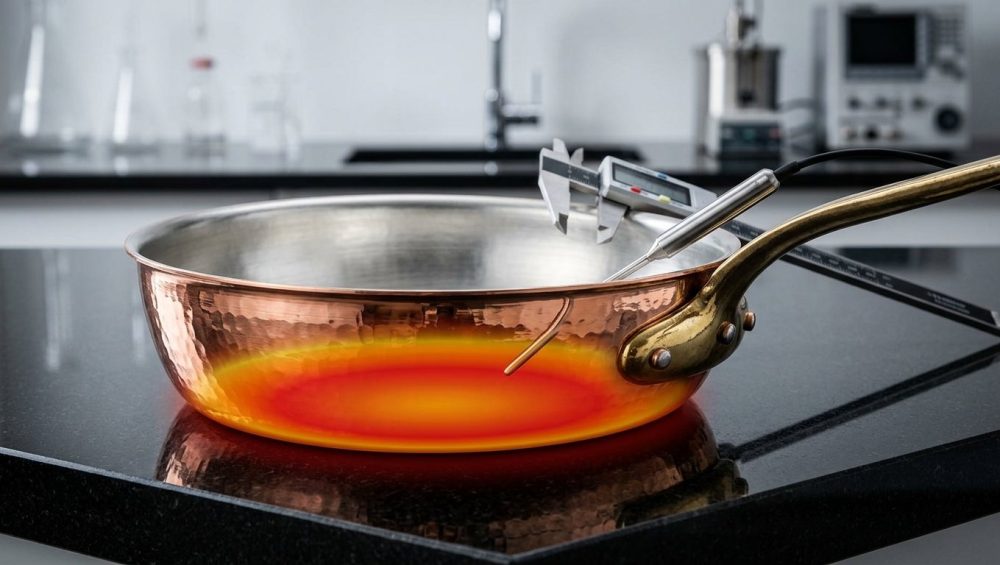
What does this mean for your Tuesday night dinner? It means that when you place a solid copper skillet on a burner, the heat instantly shoots across the entire base and up the sidewalls of the pan. There are no hot spots. The temperature is identical in the dead center and at the far edges.
Furthermore, copper has an incredible rate of thermal diffusivity. This means it responds to temperature changes almost instantaneously. If your hollandaise sauce is about to break and you turn the dial down, a copper pan drops its temperature immediately. A heavy cast iron pan, on the other hand, will hold onto that heat and stubbornly scramble your sauce even after you remove it from the stove. Just as we have previously discussed the thermodynamics of carbon steel for high-heat searing, you must understand that copper’s superpower is its absolute, pinpoint thermal control.
The Culinary Heritage of Villedieu-les-Poêles
You cannot fully appreciate copper cookware without understanding where it comes from. We are not talking about mass-produced, factory-stamped metal from a nameless assembly line. We are talking about a rich, centuries-old European heritage.
Eight Centuries of Coppersmithing
If you want to trace the lineage of the finest copper pots in the world, you must travel to Normandy, France, to a small, picturesque town called Villedieu-les-Poêles. The name literally translates to “God’s City of the Pans”. This town has an 800-year heritage of coppersmithing and metalwork, dating back to the 12th century.
Historically known for its bell foundries (the Fonderie de Cloches) and artisan copper workshops (the Atelier du Cuivre), this town became the epicenter of French culinary craftsmanship. In 1830, a visionary named Mr. Ernest Mauviel established the Mauviel manufacturing company right in the heart of Villedieu-les-Poêles. For generations, these coppersmiths have utilized techniques handed down from master to apprentice, hammering sheets of raw copper into braisiers, sauté pans, and roasting dishes that would eventually grace the kitchens of the finest Michelin-starred restaurants in Paris.
The Visual Impact on Your Kitchen Space
Beyond the sheer performance, there is an undeniable romance to owning a piece of this history. Hanging a genuine, gleaming French copper pot from a ceiling rack is arguably one of the most effective aesthetic kitchen upgrades you can possibly make. It instantly communicates that your kitchen is a place of serious culinary intent. But as I always say, we do not buy gear just to look pretty. It has to earn its keep on the stove.
Hand-Hammered vs. Spun Copper: The Structural Truth
If you start shopping for copper cookware, you will quickly notice a massive price difference between smooth, machine-spun copper and traditional hand-hammered copper. Let me be brutally honest: not all copper is created equal, and the manufacturing process dictates how the pan will behave under fire.
The Work-Hardening Process
Mass-produced copper pans are often “spun.” This involves taking a single piece of soft copper and spinning it over a mold on a high-speed lathe. While this is a cost-effective way to produce a beautiful pan, the spinning process physically stretches the metal. This stretching frequently results in a pan with a thicker base but significantly thinner walls, which compromises the uniform thermal mass we so desperately want.
Hand-raised, hammered copper is an entirely different beast. Traditional artisans take a thick sheet of copper and manually hammer it into shape over an anvil. This is not just for a rustic, dimpled aesthetic. The physical act of striking the copper with a hammer compresses the crystalline structure of the metal, a metallurgical process known as “work-hardening”. This makes the naturally soft copper incredibly rigid, durable, and structurally sound. A true hand-hammered pan maintains a completely uniform thickness from the base all the way up to the rim, ensuring flawless heat distribution.
Why Thickness Dictates Performance
When you are curating the essential tools every beginner needs, you must pay strict attention to the gauge (thickness) of the metal. A copper pan that is 1.2mm thick is essentially a decorative serving dish. It will heat up too fast, warp, and scorch your food. For serious cooking, you want a minimum thickness of 2mm, and ideally 2.5mm to 3mm for heavy-duty sauté pans and braisiers. This thick, work-hardened gauge provides the “heft” required to hold and carry heat evenly, completely eliminating the hot spots that plague thinner metals.
The Safety and Science of Pure Tin Linings
Here is where many home cooks get confused. If copper is such a brilliant conductor of heat, why is the inside of the pan always silver? Why don’t we just cook directly on the bare copper?
Why Not Bare Copper? The Reactivity Problem
Copper is a highly reactive metal. If you attempt to cook acidic foods—like tomato sauce, wine reductions, or anything involving lemon juice—directly on bare copper, the acid will trigger a chemical reaction. The copper will literally dissolve and leach into your food. Not only will this turn your beautiful marinara sauce a horrifying shade of metallic green, but ingesting large amounts of dissolved copper can lead to severe gastrointestinal distress and toxicity. (Note: Unlined copper is traditionally used by pastry chefs specifically for whipping egg whites or boiling pure sugar for confections, as sugar is non-acidic and the copper ions actually stabilize the egg foam. But for savory, everyday cooking, bare copper is a strict no-go).
The Magic of Pure Tin: Nature’s Non-Stick
To mitigate this reactivity, coppersmiths have historically lined the interior of the pans with a protective barrier. While modern manufacturers sometimes use a thin layer of stainless steel, traditionalists and serious chefs demand a lining of pure tin.
Why tin? Because tin is a culinary miracle. It bonds chemically and flawlessly with copper, it does not impede the thermal conductivity of the pan, and it is completely inert, meaning it will never react with your acidic ingredients. Furthermore, tin is remarkably smooth and naturally non-stick. Unlike the toxic, synthetic chemical coatings that inevitably peel into your food, tin allows you to easily prevent protein sticking when searing fish or scrambling eggs.
And if you are worried about safety, don’t be. The US Center for Disease Control (CDC) has affirmed that inorganic tin is non-toxic. If you accidentally ingest a microscopic fleck of tin from heavy scraping, it passes right through your digestive system without being absorbed into your bloodstream.
The 450-Degree Rule: Understanding Tin’s Melting Point
There is, however, one crucial rule you must obey when cooking with tin-lined copper. Pure tin has a relatively low melting point of 449.4°F (231.9°C). In fact, the tin begins to shift its crystal structure from shiny “beta” tetragonal tin to a duller rhombic tin at around 321.8°F (161°C).
If you place an empty tin-lined copper pan on a roaring high flame and walk away to check your email, the tin will bubble, soften, and melt. This is the only way you can truly ruin the lining. To prevent this, never preheat a tin-lined pan empty. Always add your butter or cooking oil first. A brilliant trick is the “butter test”: if your butter begins to smoke, your pan is getting too hot, and you need to lower the heat immediately. Because copper conducts heat so aggressively, you rarely need to push your stove dial past medium anyway.
Navigating the Vintage Market: Curating Your Heirloom Collection
Buying brand new, heavy-gauge copper from heritage brands like Mauviel can be a massive financial investment. But here is a secret: the vintage market is flooded with incredible, professional-grade copper pots that have outlived their original owners.
Identifying True Artisanal Quality
When hunting for vintage copper at antique stores or online auctions, you need to know what to look for. First, pick the pan up. It should feel shockingly heavy. If it feels as light as an aluminum baking sheet, put it down and walk away.
Next, inspect the handles. High-end, professional-grade French copper almost always features heavy cast iron handles securely fastened with thick, hand-pounded copper rivets. Cast iron is a poor conductor of heat, meaning the handle stays relatively cool while the pot boils. Lighter, consumer-grade pans often feature brass handles, which get blistering hot very quickly and generally indicate a thinner gauge of copper.
Finally, look at the interior lining. A genuine, hand-tinned pan will have faint, sweeping “wipe marks”. This is the physical signature of the artisan who melted pure tin inside the hot pan and rapidly wiped it smooth with a flux-coated cotton cloth. It is a mark of authenticity and pride.
The Art of Retinning and Lifetime Maintenance
One of the greatest tragedies of modern kitchenware is the disposable mindset. When your cheap Teflon pan scratches, it goes into a landfill. But a copper pan is an heirloom. When the tin lining eventually wears down from years of stirring and whisking, the pan is not dead; it just needs a spa day.
The industry rule of thumb is that you should have your pan retinned when you can see an area of bare copper shining through the tin that is roughly the size of a US quarter (about 24mm).
The retinning process is a beautiful, old-world craft. A skilled tinsmith will strip the pan, heat it to over 500°F (260°C), melt fresh ingots of pure tin into the bowl, and swiftly wipe it to create a thick, brand-new non-stick cooking surface. Yes, sending a pan off to a coppersmith costs money, but having a reliable, lifetime piece of equipment helps eliminate kitchen chaos by ensuring you never have to guess how your pan will perform. A quality copper pan will easily outlive you.
Integrating Copper into Your Modern Kitchen Workflow
Owning a beautiful piece of hand-hammered copper is only half the battle; you actually have to use it. And using it correctly requires a slight adjustment to your daily workflow.
Weekday Efficiency Meets Weekend Perfection
Remember my philosophy: time is money during the week. Because copper heats up with lightning speed, it is your best friend when you are rushing to get dinner on the table. Boiling water for pasta takes a fraction of the time. Searing chicken thighs happens rapidly and evenly. When you are trying to master simple weeknight dinners, the sheer efficiency of copper shaves precious minutes off your prep time.
But on the weekend, when you have the luxury of time, copper transforms into a precision instrument. Making a delicate beurre blanc, tempering chocolate, or gently simmering a fragile dairy-based sauce becomes entirely stress-free because you have absolute control over the thermal environment. Understanding how to leverage this instant heat response is one of those foolproof cooking secrets that instantly separates the amateurs from the seasoned home chefs.
Utensil Etiquette and Cleaning Protocols
If you want your tin lining to last a decade before needing a re-tin, you must treat it with respect. Treat tin exactly as you would treat a delicate non-stick surface. Never, under any circumstances, use metal spatulas, steel whisks, or sharp forks inside a tin-lined pan. Wood, bamboo, or high-quality heat-resistant silicone utensils are mandatory. Avoiding aggressive metal scraping is crucial, and dodging these beginner cooking mistakes will save you a massive amount of money in maintenance costs.
When it comes to cleaning, put down the abrasive steel wool. Because tin is naturally slick, most food debris will lift away effortlessly with warm water, a squirt of mild dish soap, and a soft sponge.
As for the gleaming copper exterior, it will naturally oxidize and develop a dark, mottled patina as it is exposed to high heat and oxygen. Many chefs love this rustic, lived-in look. However, if you are a perfectionist who demands a shiny kitchen, a quick polish with a specialized copper cream (like Copperbrill) or a homemade paste of lemon juice and fine salt will instantly strip away the tarnish and restore its mirror-like brilliance.
The Final Verdict on Culinary Artistry
At the end of the day, cooking should be an act of joy, not a stressful battle against inferior tools. You do not need a Michelin star to cook like a master, but you do need equipment that honors your time, your ingredients, and your effort.
Investing in authentic, hand-hammered, tin-lined copper cookware is not an act of snobbery; it is an investment in thermodynamics, culinary heritage, and material safety. It forces you to pay attention to your heat, it rewards you with unparalleled thermal control, and it completely eradicates the uneven cooking that ruins so many well-intentioned meals.
Throw out the peeling mystery metals. Stop settling for hot spots and burnt sauces. Embrace the weight, the history, and the brilliant science of Villedieu-les-Poêles. Mastering the heat of a heavy copper pan is one of the most rewarding simple secrets for kitchen artistry, and once you experience the sheer responsiveness of pure copper, I promise you, you will never want to cook on anything else. Now, go pour that wine, get your mise en place ready, and let’s make something spectacular tonight.