Listen up. I know exactly what your weeknight looks like. You log off from work, stare blankly into the refrigerator for five full minutes, and silently pray that a fully cooked, Michelin-starred meal will magically materialize between a jar of expired mayonnaise and some sad, wilting spinach. When it inevitably doesn’t, you sigh, close the door, and grab your phone to order overpriced Pad Thai for the third time this week. You tell yourself that you simply do not have the time, the energy, or the culinary skills to cook a real meal. I am here to tell you, with all the love and snark in my heart, that you are lying to yourself. It is entirely possible to cure cooking anxiety without enrolling in a prestigious culinary academy or spending three hours slaving over a hot stove. You just need a heavy dose of reality, a few bulletproof techniques, and the willingness to stop treating your kitchen like a hostile environment.
The Reality Check: Why You Currently Suck at Cooking (And Why It’s Not Your Fault)
Before we start chopping onions, we need to address the elephant in the room: your takeout habit is bleeding your wallet dry and actively making you worse at feeding yourself. We live in an era of unprecedented convenience, but that convenience comes with a massive, hidden cost.
The Takeout Trap and the Cost of Convenience
Let’s look at the actual numbers, because the financial and environmental reality of our collective takeout dependency is grim. In 2024, the average American blew over $760 just on food that they brought home and let rot, contributing to a staggering $141 billion spent nationally on completely uneaten food. We buy beautiful, vibrant groceries on Sunday with the best of intentions, only to watch them slowly liquefy in the crisper drawer by Thursday when the siren song of delivery apps takes over.
The Environmental Protection Agency estimates that this chronic cycle of overbuying and under-utilizing costs a household of four almost $3,000 annually. Meanwhile, households are responsible for 60% of all global food waste, tossing out the equivalent of one billion meals every single day. Think about that. You could fund a luxury vacation with the money you are currently tossing into the compost bin.
And those delivery apps? They are literally conditioning you to avoid your stove. Studies show that the arrival of turnkey delivery services like Grubhub is associated with a 9% decrease in the time people spend preparing meals. We have traded our basic life skills for a $7 delivery fee, a lukewarm burrito, and a mountain of single-use plastic containers. But here is the good news: you do not need to spend two hours in the kitchen to break this cycle. You just need a system to transform your chaotic cooking routine into a highly efficient, streamlined habit.
The Illusion of the “Perfect” Social Media Chef
Part of the reason you hate cooking is that you are comparing your chaotic Tuesday night to a highly edited, meticulously lit Instagram reel. You watch a 22-year-old influencer in a $100,000 kitchen effortlessly whip up a thirty-ingredient, authentic beef bourguignon while wearing a pristine white linen shirt. You look at your own cramped kitchen, your dull knife, and your sheer exhaustion, and you give up before you even start.
Stop doing this. Professional chefs in restaurant kitchens have a team of prep cooks who spent six hours chopping vegetables before the service even started. They have dishwashers. You have you. Weeknight cooking is not about romance or cinematic perfection; it is about ruthless efficiency and getting a nutritious, delicious meal on the table before you pass out on the couch.
The “Time is Money” Kitchen Philosophy
If you are spending an hour chopping vegetables on a Wednesday evening, you are doing it wrong. Time is money, and my patience for unnecessary kitchen labor is entirely nonexistent. To survive the week, you must embrace the art of the shortcut. Before you can cook like a pro, you have to realize that one of the biggest rookie kitchen mistakes is assuming that cooking “from scratch” means you have to grow the wheat and churn the butter yourself.
The Art of the Cheat Code: Pre-Chopped, Frozen, and Canned
I am a culinary purist on the weekends, but from Monday to Friday, I am a shameless opportunist. There is absolutely no shame in utilizing high-quality grocery store shortcuts.
Buy the pre-washed baby spinach. Buy the canned chickpeas. Buy the jar of minced garlic if you absolutely despise peeling cloves (though fresh is always better, I will allow the jar if it keeps you away from UberEats). Most importantly, embrace the freezer aisle. Flash-frozen vegetables are harvested and frozen at peak ripeness, meaning they often retain more vitamins and nutrients than the sad, limp broccoli that has been sitting on a refrigerated truck for a week before languishing on a grocery store shelf. Keeping a stash of frozen peas, corn, and edamame means you are never more than three minutes away from adding a vibrant, healthy green to your meal.
Master the 15-Minute Prep Sprint
“Mise en place” is a fancy French culinary term that translates to “putting everything in its place.” For the home cook, it translates to: “do not turn on the stove until your crap is organized.”
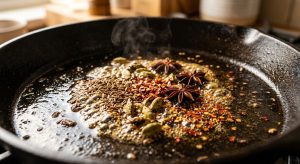
Read your chosen recipe entirely before you do anything else. Then, execute a 15-minute prep sprint. Chop your onions, mince your garlic, measure your spices, and put them in little bowls right next to the stove. If you are frantically trying to dice a bell pepper while your garlic is actively burning in a hot skillet, you have already lost the game. Cooking is infinitely less stressful when all the required components are sitting exactly where you need them, exactly when you need them.
The Non-Negotiable Gear: Banishing Toxic Junk from Your Kitchen
This is where I drop the snark and get incredibly serious. I have zero tolerance for cheap, toxic kitchenware. If you are cooking your morning eggs on a scratched, peeling non-stick pan that you bought for $12 at a discount store five years ago, you are actively poisoning yourself. That is not an exaggeration; it is a scientific fact.
The “No-Go” Rule on Toxic Cookware
The Ecology Center recently tested a wide range of popular non-stick pans and found that a horrifying 79% of them were coated with PTFE (polytetrafluoroethylene), which is commonly known by the brand name Teflon. Here is the kicker: many of these pans were sneakily labeled as “PFOA-free” to trick consumers into thinking they were entirely safe, while still relying on hazardous PFAS “forever chemicals”.
When you heat these cheap, thin pans above 500°F (260°C)—which is incredibly easy to do if you leave an empty pan on a hot burner for just a few minutes—the PTFE coating begins to physically decompose and release toxic, invisible fumes. Inhaling these fumes can cause a condition literally known as “polymer fume fever,” characterized by flu-like symptoms and respiratory distress. But the long-term effects are much darker. Current peer-reviewed science from the EPA links PFAS exposure to severe health outcomes, including decreased fertility, developmental delays in children, elevated cholesterol, and a heightened risk of prostate, kidney, and testicular cancers.
I am completely uncompromising when it comes to banishing toxic kitchen gear from your home. If your non-stick pan has scratches, chips, or peeling flakes, throw it in the garbage immediately. Your health is worth more than the convenience of a slide-out omelet.
The Only Three Tools You Actually Need
You do not need a gadget for every vegetable. You do not need a strawberry huller, an avocado slicer, or a plastic garlic press that is impossible to clean. Stocking up on true beginner cooking essentials means investing in three high-quality, durable items that will last you a lifetime.
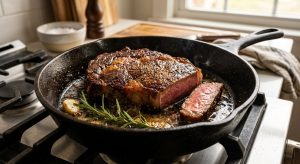
- A Heavy-Bottomed Stainless Steel or Cast-Iron Skillet: These pans do not have toxic coatings. They can go from the stovetop directly into a 400-degree oven without melting. They develop a beautiful, caramelized sear on meats and vegetables that a non-stick pan could never dream of achieving. Yes, they require a tiny bit of technique to prevent sticking, but we will cover that later.
- An 8-Inch Chef’s Knife: Throw away those flimsy, brightly colored knives that came in a $20 block. Buy one high-quality, forged steel 8-inch chef’s knife. Keep it sharp. A dull knife requires you to use excessive force, which makes it far more likely to slip and send you to the emergency room.
- A Massive Wooden Cutting Board: Stop chopping your food on tiny, slippery plastic mats that slide all over the counter. You need a large, heavy wooden cutting board that gives you ample real estate to work safely.
The Pantry Arsenal: Your Secret Weapons
When we discuss the essential tools every beginner needs, we aren’t just talking about hardware; your pantry is your most valuable toolkit. You cannot build a flavorful meal if your pantry only contains stale cereal and a bottle of ketchup.
You need extra virgin olive oil for finishing, and a neutral oil (like avocado or canola) for high-heat searing. You need kosher salt (throw away the iodized table salt; it tastes metallic and is impossible to measure by hand). You need a pepper grinder, because pre-ground black pepper tastes like dust. Finally, you need acid: keep lemons, apple cider vinegar, and balsamic vinegar on hand to wake up flat flavors.
The Foolproof Strategy: Building Blocks of a Weeknight Dinner
You do not need to decode pretentious recipe jargon to get a spectacular dinner on the table. You just need to understand the fundamental architecture of a satisfying meal.
The Formula: Protein + Carb + Veg + Sauce
Every successful weeknight dinner follows this exact formula. If you memorize this, you will never need a recipe again.
- Protein: Chicken thighs, salmon, tofu, black beans, or eggs.
- Carb: Rice, quinoa, pasta, sweet potatoes, or a crusty piece of sourdough bread.
- Veg: Broccoli, spinach, bell peppers, zucchini, or Brussels sprouts.
- Sauce: This is what ties the dry ingredients together. It can be a store-bought pesto, a quick lemon-tahini drizzle, a splash of soy sauce and sesame oil, or just high-quality olive oil and melted butter.
Mix and match these four categories based on whatever is languishing in your fridge.
Sheet Pan Magic: The Lazy Cook’s Best Friend
The sheet pan is the ultimate weapon against a sink full of dirty dishes. The concept is brilliantly simple: toss your protein and your vegetables in olive oil, salt, and spices, spread them out in a single layer on a heavy-duty baking sheet, and blast them in a hot oven (usually around 400°F or 200°C) until everything is caramelized and cooked through.
The secret to a perfect sheet pan meal is timing. Potatoes take 35 minutes to roast; shrimp takes 8 minutes. Do not put them on the pan at the same time, or you will end up with raw potatoes and shrimp that have the texture of pencil erasers. Start the hard vegetables first, and add the quick-cooking proteins toward the end.
One-Pot Wonders: Minimizing the Dishwashing Nightmare
If you aren’t roasting, you should be simmering everything in a single Dutch oven or deep skillet. Soups, stews, curries, and even pastas can be cooked in one pot. Cooking pasta directly in its own sauce (adding just enough broth or water to cook the noodles) releases starches directly into the dish, creating a naturally thick, glossy, luxurious glaze without needing heavy cream.
Essential Techniques Disguised as “Chef Secrets”
These aren’t exclusive culinary school tricks; they are foolproof cooking secrets that apply to literally everything you make. Master these, and your food will instantly taste like it came from a restaurant.
Salt, Fat, Acid, Heat (The Non-Pretentious Version)
Salt is not just a topping you shake onto your plate when the food tastes boring. Salt is a chemical flavor amplifier. When you salt a piece of meat 45 minutes before cooking, the salt draws out moisture, dissolves into that moisture, and is then reabsorbed deep into the muscle fibers, seasoning the meat from the inside out while breaking down tough proteins. If you are only salting your food right before you eat it, you are doing it wrong.
Fat carries flavor compounds across your palate. Acid (lemon juice, vinegar, wine) cuts through richness and makes heavy dishes taste vibrant and light. Heat transforms raw, fibrous textures into tender, digestible meals. Balance these four elements, and you can fix almost any culinary disaster.
The Maillard Reaction: Why Brown Equals Good
The Maillard reaction is a chemical reaction between amino acids and reducing sugars that gives browned food its distinctive, complex flavor. It is the reason a seared steak tastes infinitely better than a boiled steak, and why golden-brown bread crust is delicious.
To achieve this, your food must be dry, and your pan must be hot. Moisture is the enemy of browning. If you take a soaking wet chicken breast out of the package and throw it into a lukewarm pan, it will steam in its own juices and turn a depressing shade of gray. Pat your proteins completely dry with a paper towel before they hit the hot oil. Furthermore, do not crowd the pan. If you pack too many vegetables or pieces of meat into a skillet, the temperature drops, the moisture gets trapped, and again, you are steaming instead of searing. Cook in batches if you have to.
Resting Your Meat (Seriously, Leave It Alone)
I cannot tell you how many times I have watched someone spend good money on a beautiful steak, cook it to a perfect medium-rare, and then immediately slice into it on the cutting board, watching all the flavorful juices bleed out into a tragic, unappetizing puddle.
When meat cooks, the intense heat causes the muscle fibers to contract, pushing the juices toward the cooler center. If you cut it while it is piping hot, those pressurized juices escape immediately. If you take it off the heat and let it rest on a board for ten minutes, the fibers relax, the temperature equalizes, and the juices redistribute evenly throughout the cut. Leave the meat alone.
Knife Skills for the Clumsy: The Claw Grip
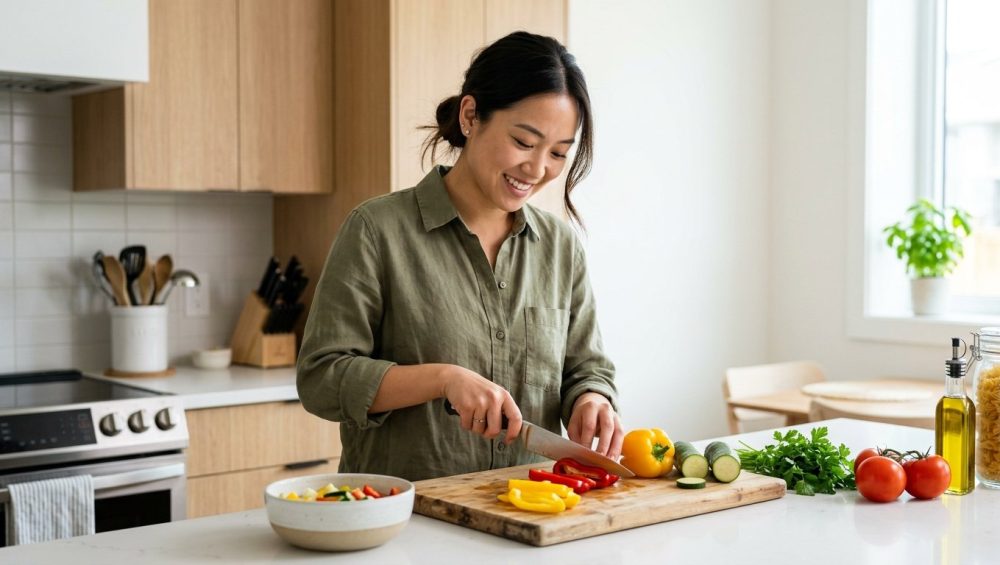
Most beginners chop vegetables by holding the item with their fingertips extended outward, practically begging the knife to slice off a digit. You must learn “The Claw.” Tuck your fingertips inward, gripping the vegetable with your knuckles acting as a physical shield against the flat side of the knife blade. The blade rests against your knuckles, and as you chop, you slowly walk your claw hand backward. It feels awkward for the first ten minutes, and then it becomes second nature. It is the only way to chop quickly without risking a trip to the hospital.
Five Lifesaving, Zero-Skill Weeknight Templates
You don’t need recipes; you need templates. Here are five foolproof frameworks that you can adapt based on whatever ingredients you currently have.
Template 1: The “Throw It In a Bowl” Grain Bowl
Cook a big batch of grains (quinoa, farro, brown rice) on Sunday. On Wednesday night, scoop a portion into a bowl. Top it with whatever protein you have (a fried egg, leftover rotisserie chicken, canned black beans). Add a raw crunchy vegetable (sliced cucumbers, shredded carrots) and a cooked vegetable (leftover roasted broccoli). Drizzle the entire thing heavily with a store-bought dressing or a quick mix of olive oil, lemon juice, and Dijon mustard. It takes four minutes to assemble, it is incredibly healthy, and it cleans out your fridge.
Template 2: The “I Forgot to Thaw Meat” Pasta
We have all been there. It is 6:30 PM, you are starving, and the chicken breasts you meant to cook are still frozen solid like arctic bricks in your freezer. This is when you turn to your pantry. Boil heavily salted water—it should taste like the ocean. Drop in your dried pasta. While it boils, heat a generous glug of good olive oil in a skillet. Sauté three cloves of minced garlic and a pinch of red pepper flakes for exactly thirty seconds. Do not let the garlic brown, or it will taste bitter. Toss in a drained can of chickpeas for protein. Add a handful of whatever sad, wilting greens you have in the crisper drawer. When the pasta is al dente, drag it directly from the water into the skillet. Add a splash of the starchy pasta water and a mountain of grated Parmesan. Stir vigorously until a glossy sauce forms. Dinner is served in 12 minutes.
Template 3: The 20-Minute Curry Fake-Out
You do not need to simmer a curry for three hours to develop deep flavor. Heat some oil in a pot, sauté diced onions until soft, and then stir in two tablespoons of store-bought Thai curry paste (red, green, or yellow). Let the paste fry for a minute until it smells incredibly fragrant. Pour in one can of full-fat coconut milk and a splash of soy sauce or fish sauce. Toss in chopped chicken thighs, tofu, and frozen vegetables. Simmer for 15 minutes until the protein is cooked through. Serve it over microwaveable jasmine rice. It tastes better than the $18 takeout version you ordered last week.
Template 4: The Fancy-Looking (But Stupidly Easy) Salmon
Salmon is the ultimate cheat code for looking like you know what you are doing. It cooks in minutes and requires almost zero prep. Preheat your oven to 400°F (200°C). Place your salmon fillets on a sheet pan lined with parchment paper. Rub them with a tiny bit of olive oil, salt, pepper, and a smear of Dijon mustard. Roast for 10 to 12 minutes, depending on the thickness. While it roasts, toss some asparagus in olive oil and throw it on the same pan for the last 8 minutes. Squeeze fresh lemon juice over everything the second it comes out of the oven. Even if you just slide it carelessly onto a plate, you can still master the art of food plating by adding a simple garnish of fresh dill and a lemon wedge. It looks like a $30 restaurant entrée.
Template 5: The “Clean Out the Fridge” Frittata
Remember that $2,913 a year you are throwing away in food waste? The frittata is your financial savior. It is the ultimate vehicle for using up the random halves of bell peppers, the handful of wilting spinach, and the leftover roasted potatoes from Tuesday. Sauté your leftover vegetables in an oven-safe skillet until they are warm. Whisk eight eggs in a bowl with salt, pepper, and a splash of milk, then pour the eggs over the vegetables in the skillet. Let the bottom set on the stove for three minutes, sprinkle whatever cheese you have on top, and then transfer the whole skillet to a 375°F (190°C) oven for 10 to 15 minutes until the eggs are puffed and golden.
Surviving the Inevitable Kitchen Disasters
You are going to mess up. You are going to burn things, over-salt things, and undercook things. The true mark of a home cook isn’t perfection; it is surviving kitchen disasters with your sanity intact and dinner still edible.
Too Salty, Too Spicy, Too Bland: The Quick Fixes
- If you over-salt a soup or a sauce: Do not panic. Add a splash of acid, like lemon juice or a mild vinegar. Acid cuts through the perception of saltiness on your palate. You can also add a splash of unsalted broth, water, or a dollop of dairy like heavy cream or yogurt to dilute the concentration.
- If you make something too spicy: Dairy is your best friend. The casein protein in dairy binds to the capsaicin (the chemical compound that makes chilis hot) and washes it away. Stir in some sour cream, coconut milk, or serve the dish with a cooling side of yogurt.
- If your food tastes flat or bland: If you have already added salt and it still tastes boring, you do not need more salt. You need acid. A squeeze of fresh citrus or a dash of vinegar wakes up the flavors and makes everything taste brighter and more complex.
The Science of the Sauté: When Good Food Sticks to Bad Pans
If you took my advice and threw away your toxic Teflon pans, you are probably cooking on stainless steel. And if you are a beginner, your food is probably sticking to it like superglue. This is because you are not preheating the pan correctly.
You must utilize the Leidenfrost effect. Heat your dry stainless steel pan over medium heat for about two to three minutes. Drop a tiny splash of water into the pan. If the water fizzles and evaporates immediately, the pan is too cold. If it splatters violently into a million tiny droplets, it is too hot. But if the water forms a single, perfect bead that glides and dances around the surface of the pan like a mercury marble, your pan is perfectly preheated. Wipe the water out with a towel, add your oil, let the oil heat up for ten seconds, and then add your food. It will sear beautifully, and it will release from the metal without tearing.
Conclusion: Your New Weeknight Reality
Cooking is not a mystical talent that you are either born with or you aren’t. It is a mechanical skill, a series of basic chemical reactions, and a daily habit. You do not need to be a chef to feed yourself well. You just need to stop relying on expensive apps, stop buying garbage equipment that poisons your food, and start utilizing smart, efficient techniques that respect your time.
The next time you open your refrigerator on a Tuesday night, do not look at the ingredients as a chore. Look at them as a 15-minute puzzle that you already know how to solve. Grab your sharp knife, heat up your heavy pan, and reclaim your kitchen. You’ve got this.