The Great Breakfast Lie: Why You’ve Been Sabotaging Your Skillet
Listen up. We need to have a serious conversation about what you are doing to your breakfast. Every single morning, millions of well-intentioned home cooks stand over their stoves, aggressively pushing a rubber spatula around a frying pan, desperately hoping that today will be the day their scrambled eggs don’t turn out like a chopped-up yoga mat. And almost every single morning, they fail. You sit down to a plate of tough, squeaky curds sitting in a depressing puddle of opaque liquid, and you convince yourself that this is just what homemade eggs taste like. It isn’t.
For decades, we have been lied to by screaming television chefs and outdated culinary dogma. You have probably seen the famous videos of Michelin-starred chefs frantically whisking eggs in a saucepan, aggressively warning you that adding salt to raw eggs will “break them down” and turn them into a watery, ruined mess. It is a fantastic, highly entertaining television performance, but scientifically speaking, it is absolute garbage. We love a good restaurant aesthetic, but restaurant habits do not always translate to the reality of the home kitchen. As a busy professional who relies on efficiency to survive the week, I don’t have the time or the patience to stand over a stove for twenty minutes micro-managing a saucepan just to compensate for fundamentally backward seasoning habits. If you are looking for foolproof cooking secrets, the absolute first thing you need to do is stop treating culinary myths as gospel and start trusting actual, verifiable food science.
The Origins of the “Salt Last” Myth: Blame the Old Guard
Where did this ridiculous “salt at the end” rule even come from? Like many pretentious kitchen rules, it stems from a fundamental misunderstanding of chemistry passed down through generations of the old-school French brigade system. Early chefs observed that if you dropped a heavy pinch of salt into a bowl of raw eggs and let it sit for a few hours, the eggs would darken and turn slightly watery on the surface. Without the benefit of molecular biology, they assumed the salt was “cooking” or “destroying” the egg. Therefore, the rigid rule was born: never season an egg until it is actively coagulating in the pan, or better yet, wait until it is safely resting on the plate.
This myth was popularized in the modern era by celebrity chefs who prioritize high-octane kitchen drama over the quiet, undeniable truth of chemistry. But as legendary food scientist Harold McGee and modern culinary heavyweights like J. Kenji López-Alt have exhaustively proven, salting at the end is actually the precise reason your eggs are tough. You are missing the crucial chemical window to alter the structure of the food.
The Egg Matrix: A Microscopic Look at Your Breakfast
Let’s get nerdy, but I promise to keep it quick, because you have a life to live and a breakfast to eat. An egg is essentially a tiny, highly complex, edible science experiment. The egg white (the albumen) is roughly 90% water and 10% protein. The yolk is a richer emulsion, sitting at about 50% water, 32% fat, and 16% protein. Those proteins—specifically ovalbumin, conalbumin (also known as ovotransferrin), ovomucoid, and ovomucin—are the absolute divas of this culinary show.
In their raw, uncooked state, these proteins exist as tightly wound, microscopic balls of yarn floating peacefully in a watery suspension. Furthermore, they carry a mutually repelling negative electrical charge. Think of them like a room full of highly introverted people at a party, actively pushing each other away to maintain their strict personal space bubbles. This electrostatic repulsion is exactly what keeps a raw egg liquid, fluid, and viscous. Mastering the art of the kitchen doesn’t require a pretentious degree from a European culinary institute; it merely requires a basic, working understanding of what happens to these introverted, negatively charged proteins when you introduce them to a hot skillet.
The Heat Wave: Understanding Denaturation and Coagulation
When you drop those whisked, raw eggs into a hot frying pan, you are introducing a massive wave of thermal kinetic energy. The heat causes those tightly wound balls of protein yarn to shake violently. As the temperature rises, the weak internal bonds holding those balls together begin to snap. The proteins unspool, stretch out, and unfold in a process scientifically known as denaturation.
Once they are stretched out and flailing around in the heat, they inevitably crash into one another. Because their structures are now open and exposed, they begin to form new, much stronger bonds with their neighboring proteins. This linking process is called coagulation. As they link up, they form a massive, three-dimensional mesh network that traps the surrounding water and fat inside, miraculously transforming your liquid egg into a solid, fluffy curd.
Egg white proteins typically begin to coagulate between 145°F and 150°F (62°C to 65°C), while the fat-rich yolks require a slightly higher temperature range of 150°F to 158°F (65°C to 70°C). But here is the dangerous catch: if you expose them to too much heat, or if they bond together too quickly and aggressively, that three-dimensional network contracts violently. When this delicate network forms too tightly, your eggs turn out rubbery because the proteins have effectively panicked, strangled each other, and ruined the soft texture you were aiming for.
Syneresis: The Scientific Term for Your Sad, Weeping Eggs
This brings us to the most depressing phenomenon in the entire culinary world: syneresis. It sounds like a rare, unfortunate medical diagnosis, but it’s actually the scientific term for the expulsion of liquid from a gel matrix. When your egg proteins are exposed to high heat without any sort of chemical buffer to protect them, they form aggressive, incredibly tight covalent and disulfide bonds.
Imagine that newly formed 3D protein network as a thoroughly soaked kitchen sponge. When the proteins bond too tightly, it is exactly like a giant, invisible hand aggressively squeezing that sponge. The trapped water has absolutely nowhere to go but out. This mechanical squeezing action is exactly why your scrambled eggs leak water all over your plate, turning a perfectly crisp, buttered piece of artisanal sourdough toast into a soggy, unappetizing tragedy. You are left chewing on dense, tough, squeaky curds sitting in a puddle of cloudy, flavorless egg-water. It is a textural nightmare, a culinary failure, and worst of all, it is entirely preventable.
The Sodium Chloride Savior: How Salt Acts as a Molecular Buffer
Enter your pantry’s most basic, unsung hero: Sodium Chloride. Whether you prefer kosher salt, fine sea salt, or standard table salt, the chemical compound NaCl is about to save your breakfast. When you add salt to raw, whisked eggs, the natural moisture in the albumen causes the salt crystals to dissolve and completely dissociate into positively charged sodium ions (Na+) and negatively charged chloride ions (Cl-).
Remember how those raw egg proteins carry a negative electrical charge that keeps them apart? The positive sodium ions immediately swarm and cluster around the negatively charged portions of the proteins, effectively neutralizing their repulsion. This phenomenon is known as electrostatic shielding. Because the proteins are no longer aggressively repelling each other, they actually begin to approach one another and coagulate at a slightly lower temperature.
But—and this is the absolute magic of the science hack—the salt ions physically wedge themselves between the protein strands. They act as a microscopic, molecular buffer, physically preventing the proteins from getting too close and forming those ultra-tight, water-squeezing bonds. The resulting protein network forms looser, softer, and infinitely more tender, easily retaining all of its internal moisture. This undeniable chemical reality is the exact reason you must stop salting them last. Waiting until the eggs are already cooked and sitting on your plate means you have entirely missed the window to alter their structural chemistry. You are just seasoning rubber.
Choosing Your Sodium: Not All Salts Are Created Equal
While we are on the subject of salt, we need to address the type of salt you are using. In the culinary world, salt is not just salt. If you are using iodized table salt that comes in a dark blue cardboard cylinder, you need to be extremely careful with your measurements. Table salt has incredibly fine, dense crystals, meaning a teaspoon of table salt contains significantly more actual sodium chloride than a teaspoon of flaky kosher salt.
For the absolute best results, I rigorously recommend Diamond Crystal Kosher Salt. Its hollow, pyramid-shaped flakes dissolve rapidly into the raw egg mixture, ensuring an even distribution of those crucial ions without accidentally over-salting your breakfast. If you only have table salt, cut the volume measurement in half. The goal is to introduce enough electrolytes to buffer the proteins, not to cure the egg like a piece of charcuterie.
The 15-Minute Rule: Why Timing is Literally Everything
Now, before you go enthusiastically dumping kosher salt into your bowl and immediately tossing the eggs into a hot skillet, listen up. Chemistry takes time. If you salt your eggs and instantly throw them into the pan, the salt crystals simply do not have enough time to fully dissolve into the highly viscous albumen and yolk mixture. You will end up with localized pockets of salty rubber and a pan full of weeping curds, which defeats the entire purpose of this exercise.
The universally agreed-upon sweet spot, heavily tested and verified by culinary scientists, is exactly 15 minutes. You must whisk the salt into the raw eggs and let the bowl sit undisturbed on the counter for a quarter of an hour. During this time, you will actually witness a visual transformation. The ropy, snotty, uneven texture of the egg whites will break down, and the mixture will turn a deeper, more uniform, slightly translucent yellow. This color shift is your visual confirmation that the salt has successfully penetrated the proteins, neutralized the charges, and begun the uncoiling process. The secret to salting them early is simply having the patience to let the sodium chloride do the heavy lifting while you prep your pour-over coffee, toast your bread, or cook your bacon. It is the ultimate passive, time-saving cooking hack for the busy home cook.
The Sassy Sous-Chef’s Rant on Toxic Kitchen Gear
I cannot, in good conscience, teach you the molecular science of perfect eggs without aggressively addressing the absolute state of your cookware. You cannot achieve a flawless, tender, professional-level scramble if you are cooking in a scratched, peeling, ten-dollar Teflon pan you bought at a discount supermarket during the Obama administration. I have absolutely zero patience for toxic kitchenware.
Cheap non-stick coatings degrade quickly under high heat, leach forever chemicals (PFAS and PFOA) into your family’s food, and lose their non-stick slip faster than you can say “breakfast.” Furthermore, if you are using those convenient aerosol cooking sprays, you are actively destroying what little non-stick capability you have left. The chemical propellants and synthetic emulsifiers in those sprays carbonize at incredibly low temperatures, baking a sticky, invisible, polymerized residue onto the surface and effectively ruining your nonstick pans forever. Stop doing this immediately. Throw the spray in the trash.
The Thermodynamics of the Skillet: Heat Transfer Explained
To cook perfect eggs, you need a pan that understands thermodynamics. Flimsy, thin aluminum pans suffer from aggressive hot spots. When you pour delicate egg proteins into a pan with hot spots, the eggs in those specific areas will flash-cook, instantly tightening their bonds and triggering syneresis before the rest of the pan has even begun to coagulate. You need thermal mass. You need a pan that absorbs heat evenly and distributes it gently across the entire cooking surface. Conduction is the name of the game here, and cheap pans are terrible conductors.
Upgrading Your Arsenal for the Perfect Scramble
If you want professional results at home, you need to respect your ingredients by using the right tools. I am a relentless, unapologetic advocate for banishing toxic kitchen gear and replacing it with durable, safe, high-performance equipment that will actually outlive you. For eggs, you have three acceptable options: a high-quality, non-toxic ceramic skillet, a meticulously seasoned flat-bottom carbon steel pan, or a smooth enameled cast-iron skillet. These materials offer superior thermal mass, meaning you get the gentle, radiant heat necessary to execute the chemistry we just discussed.
Alongside a proper pan, you need the right utensils. Ditch the metal forks that scrape your pans to death and introduce micro-abrasions where food will stick. Use a seamless, heat-resistant silicone spatula for gentle, sweeping folds. Or, if you are cooking in a nearly indestructible, well-seasoned carbon steel pan and want the ultimate, precise control over your curds, a flexible stainless steel slotted fish turner is an unexpectedly brilliant tool for cleanly sweeping the bottom of the skillet without bruising the eggs.
The “No Fluff” Step-by-Step Masterclass
Let’s put the science into practice. Here is your definitive, no-nonsense, scientifically validated roadmap to the perfect scramble.
Step 1: The Aggressive Whisk
Crack your fresh eggs into a mixing bowl—never directly into the hot pan. Add your salt right now (aim for about a heavy pinch, or 1/8th of a teaspoon of kosher salt per two large eggs). Take a real balloon whisk and beat them aggressively. You are not just lazily swirling the yolks and whites together; you are mechanically shearing the chalazae (those white, stringy anchors) and fully homogenizing the mixture until it is a uniform color.
Step 2: The 15-Minute Rest
Walk away. Leave the bowl sitting at room temperature for exactly 15 minutes. Let the electrostatic shielding commence. Let the salt ions wedge themselves into the protein structures. Do not skip this step.
Step 3: The Pan Setup
Place your high-quality, heavy-bottomed skillet over medium-low heat. Do not blast it on high; patience is a virtue you must cultivate. Add a generous knob of high-quality unsalted butter (since you already perfectly salted the eggs, salted butter will push you over the edge). Let the butter melt until it is bubbling and foamy, but do not let the milk solids brown. You want a gentle, even, luxurious heat.
Step 4: The Pour and Sweep
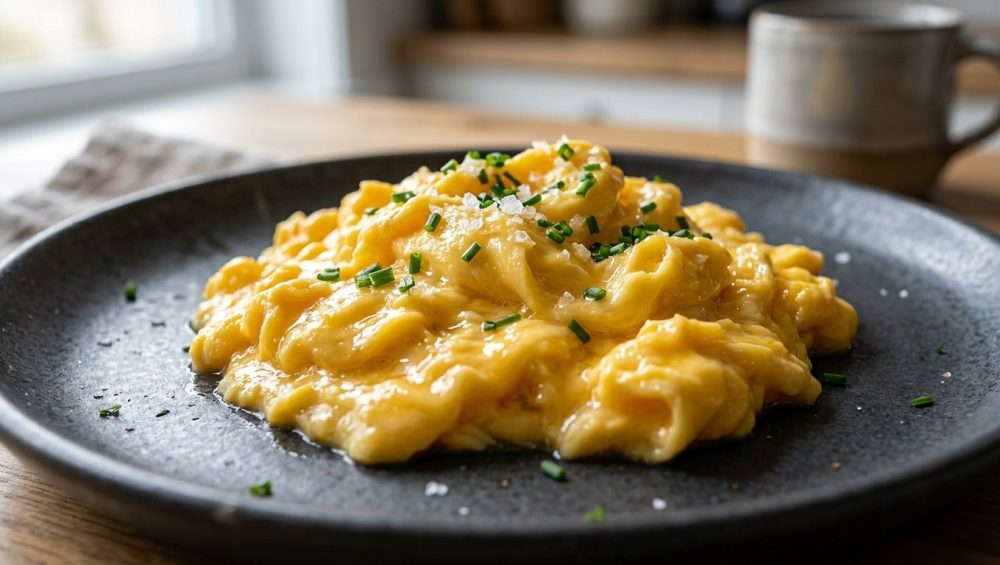
Pour the homogenous, deeply yellow, salted egg mixture into the center of the pan. Now, stop touching it. Let it sit undisturbed for about 15 to 20 seconds so the very bottom layer can just barely begin to set. Then, take your silicone spatula and make long, deliberate, sweeping motions from the outside edge of the pan toward the center. You are not aggressively stirring a witch’s cauldron; you are gently folding the coagulated proteins over themselves to create large, luxurious, pillowy curds.
Step 5: The Early Pull
This is where 90% of home cooks fail. You must remove the eggs from the heat when they look about 85% done. They should still look slightly wet, glossy, and arguably a tiny bit undercooked. The residual thermal energy trapped in the heavy pan, and within the eggs themselves, will continue to cook them as you transfer them to the serving plate. If they look perfectly dry and done in the pan, they will be overcooked, rubbery, and dry by the time they hit your mouth.
Troubleshooting Your Breakfast Disasters: Where You’re Still Messing Up
Even armed with the 15-minute salt hack, there are a few ways you might still be actively sabotaging your morning. Let’s address the dairy myth first. Stop adding milk, heavy cream, or—heaven forbid—tap water to your raw eggs. People add extraneous liquid because they falsely believe it makes the eggs fluffier or prevents them from drying out. In reality, adding liquid dilutes the rich flavor of the yolk and creates a structural nightmare. As the eggs cook, that extra water separates from the protein matrix and steams out, or worse, pools on your plate. If you salt your eggs 15 minutes early, the proteins will retain their own natural moisture perfectly. You do not need the watery crutch of added dairy.
Another incredibly common error is over-agitation. If you stir the eggs constantly and rapidly over high heat, you physically break the curds into tiny, dense, grainy granules. This is perfectly fine if you are making a very specific style of French soft scramble over a double boiler, but in a standard hot skillet, it just leads to a tough, unpalatable texture. Even the most well-intentioned clumsy cooks can execute a flawless, restaurant-quality breakfast if they just stop trying to micromanage the pan on high heat and let the chemistry do the work.
The Pre-Shredded Cheese Trap and Other Add-In Disasters
If you are the type of person who loves a cheesy scramble, you need to be highly strategic about your add-ins. Never, under any circumstances, dump a handful of pre-shredded bagged cheese into your pristine eggs. Bagged cheese is coated in cellulose (wood pulp) or potato starch to prevent it from clumping in the bag. When you add this to your eggs, that anti-caking agent prevents the cheese from melting smoothly, resulting in a gritty, grainy texture that ruins the delicate, buffered protein network you just spent 15 minutes perfecting. Always grate your own cheese from a block, and fold it in at the very last second, right as you are pulling the pan off the heat.
Elevating Global Styles with the Salt Hack
The absolute beauty of the 15-minute salting rule is that it applies universally, regardless of your preferred geographical style of scramble.
The American Diner Scramble:
Characterized by large, distinct, fluffy, well-defined curds. Salting early ensures that even these large, thick curds remain incredibly tender on the inside rather than turning into dense, rubbery chunks. The molecular buffer effect allows the large curds to hold their shape proudly without squeezing out their internal moisture.
The French Soft Scramble (Brouillade):
This highly refined technique involves cooking the eggs incredibly slowly, often over a bain-marie (a gentle water bath), while stirring constantly with a whisk or spatula to create microscopic curds that resemble a rich, pourable custard. Salting 15 minutes prior is absolutely critical here because it lowers the coagulation temperature, allowing the custard to set evenly and smoothly without ever risking those dreaded grainy, overcooked bits.
The English Scramble:
A beautiful middle ground between the American and French styles, featuring medium-sized curds and often generous amounts of cold butter folded in at the very end. Salting early ensures the protein matrix is relaxed and open enough to seamlessly integrate the emulsified fat of the butter, resulting in a glossy, rich finish that holds together perfectly on a piece of toasted sourdough.
Conclusion: Reclaiming Your Morning
Cooking is not magic; it is simply applied physics and chemistry. But you don’t need to wear a white lab coat or hold a Michelin star to make a mind-blowing breakfast in your own kitchen. By simply understanding how thermal kinetic energy and sodium chloride interact with ovalbumin and conalbumin at a molecular level, you have effectively eliminated all the frustrating guesswork from your morning routine. You survive the weekdays with clever efficiency, and this 15-minute passive resting technique is the ultimate intersection of time-saving prep and weekend-level culinary perfection.
Ditch the toxic pans, throw out the aerosol sprays, ignore the screaming television chefs who tell you to season at the end, and trust the undeniable science. Whisk vigorously, salt generously, wait exactly 15 minutes, and cook gently over moderate heat. You are now fully equipped to produce the most tender, moist, and luxurious scrambled eggs of your entire life. Now go make breakfast, and for the love of all things culinary, pull them off the heat before they look done.