We have all been there. You spend your hard-earned money on a beautiful, lush bouquet of fresh sweet basil. You splurge on the good Parmigiano-Reggiano and the authentic, painfully expensive pine nuts. You carefully blend it all together with a glug of high-quality extra virgin olive oil, imagining the vibrant, herbaceous pasta dish you are about to devour. The pesto looks electric green, smelling like a sun-drenched garden in Liguria. You use half of it, carefully pack the rest into a jar, and place it in the fridge, dreaming of the sandwiches and scrambled eggs you will elevate throughout the week.
Then, the next day, you open the fridge and are greeted by a culinary tragedy.
Your electric green masterpiece has transformed into a murky, oxidized, olive-drab sludge that looks less like a premium Italian sauce and more like literal swamp mud. It is heartbreaking. It is frustrating. And if you are anything like I was during my early days of navigating the kitchen, you probably assumed you did something wrong. You might have even thrown the whole jar away, thinking it had spoiled.
Let’s get one thing straight right now: it is not your fault. You are fighting a microscopic biological war against the very nature of the basil plant itself. But here is the good news: you do not need a culinary degree or a commercial kitchen to win this war. You just need to understand a little bit of basic food science and apply a ridiculously simple, ten-second technique that will completely revolutionize how you make green sauces from scratch.
Welcome to the ultimate, no-nonsense masterclass on why your pesto turns brown, and the foolproof quick-boiling trick that will keep it vibrantly, aggressively green for days.
The Heartbreak of Swamp-Mud Pesto
Before we dive into the chemical warfare happening inside your food processor, we need to acknowledge why this matters. We eat with our eyes first. You can make a sauce that tastes like it was blessed by an Italian grandmother, but if it looks like oxidized sludge, your brain is going to inherently reject it.
When your beautiful homemade sauce turns brown, it actively mutes the visual appeal of your entire meal. It is incredibly discouraging for weekend culinary hobbyists who just spent thirty dollars on premium ingredients. Letting your fresh herbs oxidize into oblivion is one of the most common rookie kitchen mistakes out there, simply because recipe writers rarely bother to explain the “why” behind the instructions.
Most standard recipes just tell you to “blend the basil with oil and cheese” and send you on your merry way. They set you up for failure. They do not warn you that within exactly ninety seconds of bruising those delicate basil leaves, a chain reaction of oxidation begins. They do not tell you that the heat from your blender blades is actively accelerating the destruction of your sauce. I have zero patience for recipes that withhold the crucial techniques that separate restaurant-quality food from sad, homemade disappointments.
You deserve better. Your basil deserves better. So, let’s peel back the curtain and look at the actual science of why good basil goes bad.
The Science of the Sludge: Why Good Basil Goes Bad
To defeat the enemy, you must first understand the enemy. And in the case of brown pesto, the enemy has a name: Enzymatic Browning.
You have seen enzymatic browning before. It is the exact same biological process that causes a sliced apple to turn brown on your counter, or a bruised avocado to turn gray in your guacamole. But why does it happen so aggressively with basil?
Meet the Enemy: Polyphenol Oxidase (PPO)
Basil leaves are absolutely packed with a copper-containing enzyme called polyphenol oxidase, or PPO for short. In the wild, this enzyme acts as a natural defense mechanism for the plant. When an insect takes a bite out of a basil leaf, it ruptures the plant’s cell walls. This allows the PPO enzyme to mix with phenolic compounds (the natural chemicals that give basil its flavor and antioxidant properties) and oxygen from the air.
When PPO, phenols, and oxygen meet, a rapid chemical reaction occurs. The enzyme catalyzes the oxidation of those phenols, converting them into o-quinones. These quinones then quickly polymerize into dark, melanin-like pigments. Yes, melanin—the same type of pigment that darkens human skin. The plant does this to create a toxic, unappetizing brown barrier to deter the bug from eating the rest of the leaf.
When you make pesto, you are the bug.
By chopping, smashing, or blending the basil, you are inflicting massive cellular damage, unleashing a flood of PPO, and mixing it with oxygen. You do not need a science degree to decode pretentious recipe jargon; you just need to know that breaking the leaves equals releasing the browning enzyme.
The Chopping Block: How We Sabotage Our Herbs
The way you break down your basil dictates how fast it will turn brown. This is why the method of preparation matters immensely.
If you use a dull knife or a cheap, weak blender, you are not cleanly slicing the basil cells; you are violently crushing and tearing them. This excessive bruising maximizes the release of PPO. Furthermore, research shows that basil PPO thrives and reaches its peak enzymatic activity at temperatures between 20°C and 50°C (68°F to 122°F). Do you know what temperature a food processor bowl reaches when the motor has been running for a minute? Exactly that range. The friction from the spinning metal blades actively heats up the bruised basil, creating a cozy, warm incubator that sends the PPO enzymes into overdrive.
You are literally engineering the perfect environment for your pesto to turn brown. But we can stop it dead in its tracks.
The 10-Second Miracle: Blanching Your Basil
If PPO is the villain of our story, heat is the superhero. But it must be applied with surgical precision.
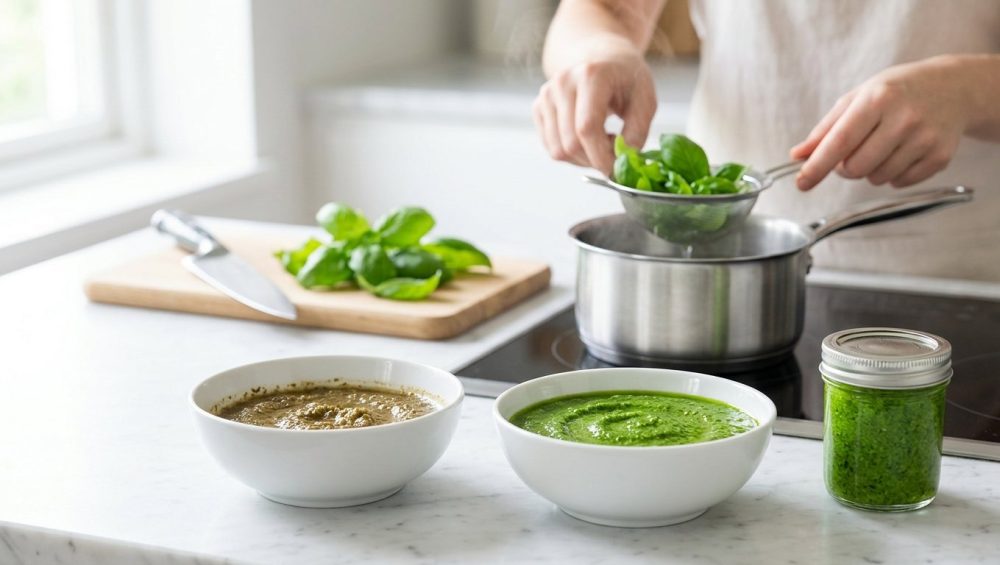
The absolute most foolproof, definitive way to lock in that vibrant, electric green color for days is a technique called blanching. Blanching involves briefly plunging your fresh basil leaves into boiling water, and then immediately shocking them in an ice-water bath. It sounds like an annoying extra step for a sauce that is supposed to be “raw,” but I promise you, this ten-second trick is the secret weapon used in high-end restaurant kitchens around the world.
Thermodynamics in the Kitchen: Denaturing the Enzyme
Why does boiling water work? It comes down to the physical structure of proteins. PPO is a protein, and proteins are essentially long chains of amino acids folded into highly specific, complex 3D shapes. For the enzyme to do its job (turning your pesto brown), it must maintain that exact shape.
When you expose the basil to boiling water (100°C / 212°F), the intense thermal energy violently shakes the PPO protein molecules. This heat breaks the weak molecular bonds holding the protein together, causing it to unfold and lose its shape. This process is called denaturation.
Studies on lotus root and sweet basil have shown that PPO is rapidly and permanently inactivated at temperatures above 90°C. By dropping your basil into boiling water for just 10 to 15 seconds, you are completely destroying the browning enzymes before they ever have a chance to react with oxygen. You are effectively disarming the bomb.
The Crucial Ice Bath Shock
However, there is a catch. If you leave the basil in the boiling water for too long, or if you pull it out and just let it sit on a cutting board, the residual heat will continue to cook the leaves.
If basil overcooks, the structural integrity of the plant breaks down, turning it into a mushy, flavorless mess. Worse, prolonged heat causes the bright green chlorophyll molecules to degrade, which is a massive problem if you want to rescue a ruined dinner from looking like a swamp.
This is why the ice bath is non-negotiable. Plunging the boiling-hot basil directly into a bowl of heavily iced water drops the temperature instantly, halting the cooking process in its tracks. The enzymes are dead, but the fresh flavor and the bright green chlorophyll remain perfectly intact.
Step-by-Step: The Foolproof Bright Green Pesto Method
Knowing the science is great, but execution is everything. If you want to make a masterclass-level pesto that stays neon green in your fridge for a week, follow this exact workflow. Time is money, so we are going to do this efficiently.
Prep Your Station Like a Pro
Do not even think about boiling water until your landing zone is ready.
- Fill a large bowl with cold water and at least two cups of solid ice cubes. Set it right next to your stove.
- Lay out a clean, dry kitchen towel or paper towels on your counter.
- Pick your fresh basil leaves off the tough stems. You only want the tender leaves.
The Rapid Boil and Plunge
- Bring a large pot of water to a rolling, aggressive boil. Do not salt the water for this step; we are not cooking pasta yet, we are just executing a chemical hit-job on some enzymes.
- Grab your basil leaves with a pair of tongs or a spider skimmer.
- Dunk the leaves completely into the boiling water.
- Count to ten. Do not walk away. Do not check your phone. Ten to fifteen seconds is all it takes to denature the PPO.
- Immediately yank the basil out of the boiling water and plunge it directly into the ice bath. Push the leaves down so they are completely submerged in the freezing water.
- Let them sit in the ice bath for about one minute until they are completely cold to the touch.
The Squeeze-Dry Squeeze
This is the step where most amateurs mess up the blanching method. If you take wet, soggy basil and throw it into your food processor, you are going to introduce water into an oil-based sauce. Water and oil do not mix, and excess water will dilute the rich, luxurious texture of your cheese and nuts, leaving you with a watery, split pesto.
Remove the cold basil from the ice bath and gently squeeze out the excess water with your hands. Then, place the clump of basil inside your clean kitchen towel (or use one of the essential tools every beginner needs—a high-quality salad spinner) and wring it out completely. You want the leaves to be as dry as humanly possible before they hit the oil.
From here, you simply proceed with your normal pesto recipe: blend the blanched basil with your toasted pine nuts, raw garlic, Parmigiano-Reggiano, Pecorino, and extra virgin olive oil. Because the enzymes are dead, the resulting sauce will be a stunning, brilliant green that refuses to oxidize.
Gear Check: Don’t Let Toxic Junk Ruin Your Sauce
We need to take a brief detour to talk about your equipment, because I absolutely despise cheap, toxic kitchenware. You can execute the perfect blanching technique, but if you throw your beautiful ingredients into a garbage-tier food processor, you are still going to ruin your sauce.
I am a relentless advocate for banishing toxic kitchen gear from your home. If you are using a twenty-dollar plastic blender from a discount bin, you are actively harming your food. Cheap blenders often feature dull, mystery-metal blades. When a blade is dull, it doesn’t cut the basil; it bludgeons it. This extreme friction generates massive amounts of heat, which not only cooks the basil but also accelerates lipid oxidation—the process where the unsaturated fats in your expensive olive oil and pine nuts turn rancid due to heat and trace metal exposure.
Furthermore, cheap plastic blender pitchers scratch easily. Those microscopic scratches harbor bacteria and degrade the plastic over time, leaching microplastics into your acidic foods. It is exactly the same infuriating principle as how cheap non-stick pans keep losing their chemical coatings directly into your morning eggs. Stop buying disposable junk.
Invest in a high-quality food processor with a razor-sharp, surgical stainless steel blade. A sharp blade cleanly shears the ingredients, emulsifying the oil and water phases of the pesto smoothly without generating excessive friction heat. Quality gear is not a luxury; it is a baseline requirement for good cooking.
Weekday Hacks vs. Weekend Perfection
I am a realist. I know that as much as I preach the gospel of the ten-second blanch, there are going to be random Tuesday nights where you are exhausted, starving, and absolutely refuse to boil a pot of water. Time is money. So, how do we handle pesto depending on the day of the week?
The Quick Blender Pesto (Weekday)
When you are desperately trying to get simple weeknight dinners on the table and you refuse to blanch, you can use the “Ice Cube Trick.”
Since we know that the food processor blade generates heat, and that heat accelerates the PPO browning enzyme, we can fight back by artificially lowering the temperature of the blender bowl. When you add your raw basil, garlic, nuts, and cheese to the processor, drop in a single, solid ice cube before you pulse.
As the blades spin, the ice cube crushes, rapidly cooling the entire mixture and neutralizing the friction heat. The small amount of water from one ice cube actually helps to tighten the emulsion of the sauce, making it incredibly creamy without diluting the flavor. It won’t keep the pesto green for a week like blanching will, but it will absolutely keep it vibrant for dinner that night.
The Traditional Mortar and Pestle (Weekend)
When the weekend rolls around and you have the time to be an absolute perfectionist, you should ditch the food processor entirely and make pesto the authentic, traditional way: with a heavy marble mortar and a wooden pestle.
The word “pesto” literally comes from the Italian word pestare, which means to pound or crush. A food processor chops; a mortar and pestle crushes. Crushing the basil leaves against the abrasive salt and garlic extracts the essential oils in a way that a spinning blade simply cannot replicate, resulting in a vastly superior, deeply aromatic flavor profile.
To prevent browning when using a mortar and pestle, you must control the temperature. Place your marble mortar in the freezer for 15 minutes before you start. The freezing cold stone will keep the ingredients chilled while you work, drastically slowing down the PPO enzyme activity. Pound the garlic and coarse salt into a paste first, then add the pine nuts, and finally, add the raw basil leaves a few at a time, using a gentle, rhythmic grinding motion rather than aggressive smashing.
Beyond the Boil: Other Pesto Preservation Myths Busted
The internet is full of terrible cooking advice, and pesto preservation is no exception. Let’s debunk the most pervasive myths floating around the culinary blogosphere so you don’t ruin your next batch.
The Acid Trap: Why Lemon Juice Turns Basil Olive-Drab
If you Google “how to keep pesto green,” half the articles will tell you to squeeze a lemon into the blender. This is fundamentally flawed food science.
The theory is that the ascorbic and citric acids in lemon juice will lower the pH of the sauce, which inhibits the PPO enzyme from causing enzymatic browning. And yes, while it is absolutely true that your dinner actually needs acid to balance the flavor profile and cut through the richness of the cheese and oil, adding it during the blending and storage phase is a fatal error for the color of your sauce.
Here is the chemical reality: basil gets its bright green color from chlorophyll. Chlorophyll molecules have a magnesium ion sitting right in the center of their porphyrin ring. When you introduce a highly acidic environment (like lemon juice, which has a pH of around 2.3), the acid strips that magnesium ion right out of the center of the chlorophyll molecule and replaces it with hydrogen ions.
This chemical conversion changes the chlorophyll into a new compound called pheophytin. Do you know what color pheophytin is? It is a dull, unappetizing olive-drab brown.
So, by adding lemon juice to prevent enzymatic browning, you are actually triggering an entirely different chemical reaction that turns your basil brown anyway! If you love the bright, zippy flavor of lemon in your pesto (and I highly recommend it), you must stir the lemon juice into the pesto immediately before serving it, right on the plate. Never blend it into the batch you plan to store in the fridge.
The Olive Oil Seal
Another common trick is the “olive oil seal.” Because enzymatic browning requires oxygen to occur, blocking oxygen from touching the surface of the pesto will slow the decay.
Once you transfer your homemade pesto into a storage jar, use a spoon to smooth out the top surface so it is perfectly flat. Then, gently pour a quarter-inch layer of high-quality extra virgin olive oil directly over the top. This creates an airtight lipid barrier. It works wonderfully, but only for the pesto underneath the seal. The moment you break that seal to scoop some out, you must re-smooth and re-pour a new oil layer, or the exposed edges will turn brown within hours.
Storing and Freezing Your Vibrant Masterpiece
Even with the blanching trick and the olive oil seal, fresh pesto is highly perishable. Let’s talk about food safety, because botulism is not a joke.
Fresh basil and raw garlic mixed with oil create a low-acid, anaerobic (oxygen-free) environment. This is the exact environment where Clostridium botulinum spores thrive and produce deadly toxins. You can never, ever leave homemade pesto sitting out at room temperature for more than a couple of hours. It must be strictly refrigerated, and even then, it should be consumed within 4 to 5 days.
If you make a massive batch of blanched, bright green pesto and want to preserve it for the winter, the freezer is your best friend. The most efficient way to freeze pesto is to spoon it into ice cube trays, freeze them solid, and then pop the frozen pesto cubes into a heavy-duty vacuum-sealed bag.
However, be incredibly careful about the materials you use. Do not use cheap, degraded silicone ice cube trays that you have been running through the dishwasher with heavily scented detergents. Silicone is highly porous and absorbs odors, which is exactly why so many people complain because nobody wants to find out their silicone spatulas taste like soap, and the same goes for your ice cube trays. If you freeze your premium, expensive pesto in a soap-tainted tray, the fats in the olive oil will absorb that synthetic lavender detergent flavor, completely ruining your hard work. Use high-quality, food-grade stainless steel trays, or thoroughly neutralize your high-grade silicone by baking it at a low temperature before use.
Conclusion: Reclaiming Your Green Glory
Cooking is not magic; it is applied science mixed with a little bit of soul. You don’t need to be a Michelin-starred chef to make food that looks and tastes extraordinary. You just need to respect the ingredients, understand how they react to their environment, and refuse to settle for mediocre results.
By understanding the destructive power of polyphenol oxidase and utilizing the rapid ten-second blanching trick, you have officially conquered one of the most frustrating hurdles in the home kitchen. You are no longer at the mercy of oxidizing herbs. You control the chemistry.
So go buy that massive bunch of basil. Splurge on the good olive oil. Fire up a pot of boiling water and get your ice bath ready. Because the next time you decide to host a meaningful dinner party, you can serve a vibrant, electric-green pesto that will make your guests wonder if you secretly went to culinary school. Just smile, accept the compliments, and never let them know it only took you ten extra seconds.